

SUBSCRIBE TO OUR FREE NEWSLETTER
Daily news & progressive opinion—funded by the people, not the corporations—delivered straight to your inbox.
5
#000000
#FFFFFF
To donate by check, phone, or other method, see our More Ways to Give page.
Daily news & progressive opinion—funded by the people, not the corporations—delivered straight to your inbox.
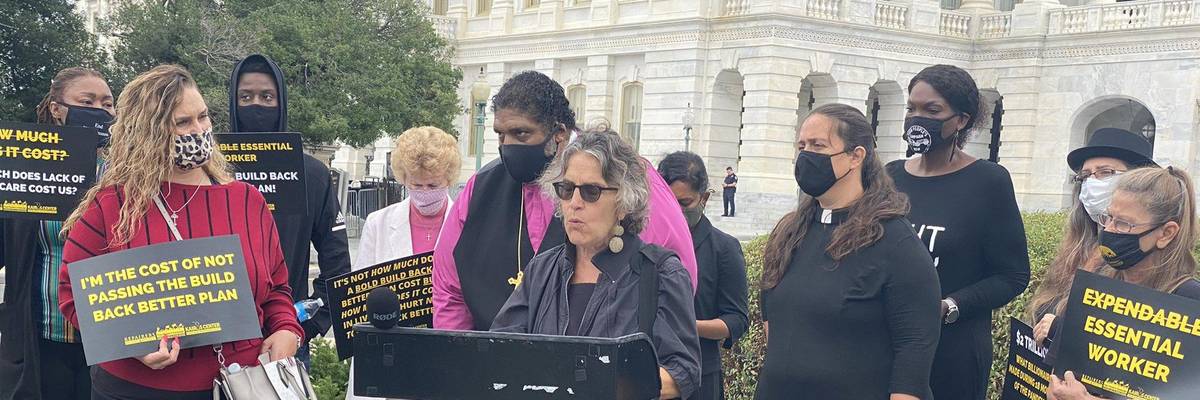
Low-wage workers, economists, faith leaders, and a progressive lawmaker spoke about Democrats' budget reconciliation package outside the U.S. Capitol in Washington, D.C. on October 12, 2021. (Photo: Poor People's Campaign/Twitter)
Low-wage essential workers--joined by economists, faith leaders, and a progressive lawmaker--gathered outside the U.S. Capitol on Tuesday to share their stories and encourage Congress to "look at the people behind the numbers" in debates about the Build Back Better budget reconciliation bill.
"We are literally starving. It's time for Congress to act."
Federal lawmakers and the White House have been fighting for months about what to include in the climate and social programs package. While progressives argue that the proposed $3.5 trillion in spending over a decade is already a compromise, right-wing Democrats continue to push for major cuts.
Some participants in the Tuesday event, organized by the Poor People's Campaign: A National Call for Moral Revival, took aim at two key advocates of scaling back Democrats' package: Sens. Joe Manchin (D-W.Va.) and Kyrsten Sinema (D-Ariz.).
"We are not lazy and we are not asking for a handout," declared Pam Garrison, a low-wage worker and tri-chair of the West Virginia Poor People's Campaign.
"Sen. Manchin, do your job," she continued. "Take care of the people! Quit taking care of the corporations!"
Fellow West Virginian Kaylen Marie Barker also spoke, warning that "time has run out for the people in my state. We are literally starving. It's time for Congress to act."
"We're no longer asking for help--we are demanding that you act now," Barker said. "The Build Back Better plan can finally stop the generational poverty that's been forced on Appalachia and people all across the country."
Joan Steede of Phoenix said that "I hear all these women's stories and they all sound the same."
"We work much harder than what we get paid for," said Steede, who has worked extra time without pay to care for aging veterans. "We will all some day get old and need care. And I will be there for you, and I will work for less than I'm worth because I care about other people. And I demand Congress back a bill that took so much work and time. Just do your job--build back America."
Other speakers included a produce packer from Philadelphia, an unhoused DoorDash driver in Maryland, an advocate for victims of human trafficking in Mississippi, a low-wage worker on disability in New York, and a game-day employee at the University of Kentucky.
"Please help us," said the Kentucky speaker, Adriel Downing, to lawmakers. "We get tired of asking for help. We don't want to beg you. We shouldn't have to beg you."
Katrina Corbell, the New Yorker, emphasized that "this legislation is about me--the legislation is about us. It is about real people, low-wage essential workers."
Corbell added that "it is shameful that Congress is debating that we cannot afford $350 billion a year for 10 years" while pouring so much into war-spending that the public doesn't support.
"We shouldn't be talking about trillions of dollars and just in terms of cost," argued Rev. Dr. William J. Barber II, who co-chairs the Poor People's Campaign with Rev. Dr. Liz Theoharis.
"The problem is we have gotten stuck in a numbers argument rather than a people argument."
Rather than focusing on the package's price tag, lawmakers should be thinking about how much it will "cost lives and hurt people not to build back better," he said. "The problem is we have gotten stuck in a numbers argument rather than a people argument."
Theoharis pointed out that "what we know and what this pandemic has laid bare is that women, people of color, poor communities, have been disproportionately impacted."
Lawmakers who have the power to serve those most in need and are instead pushing for cuts are "compromising the lives of essential workers and the poor," she added. "They're sending a message that people's lives and their work don't matter, when we know that this is a lie."
The low-wage workers who shared their stories weren't alone in calling out lawmakers by name.
"We've heard the voices of the poor. We've heard the voices crying out, demanding justice," said Rev. Angela Martin of the Maryland Poor People's Campaign. "All I want to know right now, Joe Manchin, is which side are you on?"
"Are you on the side of poor and low-wealth persons who are crying out, who are suffering in the midst of this pandemic? Or are you here to represent your pockets?" she asked. "It's really just as simple as that."
Dear Common Dreams reader, It’s been nearly 30 years since I co-founded Common Dreams with my late wife, Lina Newhouser. We had the radical notion that journalism should serve the public good, not corporate profits. It was clear to us from the outset what it would take to build such a project. No paid advertisements. No corporate sponsors. No millionaire publisher telling us what to think or do. Many people said we wouldn't last a year, but we proved those doubters wrong. Together with a tremendous team of journalists and dedicated staff, we built an independent media outlet free from the constraints of profits and corporate control. Our mission has always been simple: To inform. To inspire. To ignite change for the common good. Building Common Dreams was not easy. Our survival was never guaranteed. When you take on the most powerful forces—Wall Street greed, fossil fuel industry destruction, Big Tech lobbyists, and uber-rich oligarchs who have spent billions upon billions rigging the economy and democracy in their favor—the only bulwark you have is supporters who believe in your work. But here’s the urgent message from me today. It's never been this bad out there. And it's never been this hard to keep us going. At the very moment Common Dreams is most needed, the threats we face are intensifying. We need your support now more than ever. We don't accept corporate advertising and never will. We don't have a paywall because we don't think people should be blocked from critical news based on their ability to pay. Everything we do is funded by the donations of readers like you. When everyone does the little they can afford, we are strong. But if that support retreats or dries up, so do we. Will you donate now to make sure Common Dreams not only survives but thrives? —Craig Brown, Co-founder |
Low-wage essential workers--joined by economists, faith leaders, and a progressive lawmaker--gathered outside the U.S. Capitol on Tuesday to share their stories and encourage Congress to "look at the people behind the numbers" in debates about the Build Back Better budget reconciliation bill.
"We are literally starving. It's time for Congress to act."
Federal lawmakers and the White House have been fighting for months about what to include in the climate and social programs package. While progressives argue that the proposed $3.5 trillion in spending over a decade is already a compromise, right-wing Democrats continue to push for major cuts.
Some participants in the Tuesday event, organized by the Poor People's Campaign: A National Call for Moral Revival, took aim at two key advocates of scaling back Democrats' package: Sens. Joe Manchin (D-W.Va.) and Kyrsten Sinema (D-Ariz.).
"We are not lazy and we are not asking for a handout," declared Pam Garrison, a low-wage worker and tri-chair of the West Virginia Poor People's Campaign.
"Sen. Manchin, do your job," she continued. "Take care of the people! Quit taking care of the corporations!"
Fellow West Virginian Kaylen Marie Barker also spoke, warning that "time has run out for the people in my state. We are literally starving. It's time for Congress to act."
"We're no longer asking for help--we are demanding that you act now," Barker said. "The Build Back Better plan can finally stop the generational poverty that's been forced on Appalachia and people all across the country."
Joan Steede of Phoenix said that "I hear all these women's stories and they all sound the same."
"We work much harder than what we get paid for," said Steede, who has worked extra time without pay to care for aging veterans. "We will all some day get old and need care. And I will be there for you, and I will work for less than I'm worth because I care about other people. And I demand Congress back a bill that took so much work and time. Just do your job--build back America."
Other speakers included a produce packer from Philadelphia, an unhoused DoorDash driver in Maryland, an advocate for victims of human trafficking in Mississippi, a low-wage worker on disability in New York, and a game-day employee at the University of Kentucky.
"Please help us," said the Kentucky speaker, Adriel Downing, to lawmakers. "We get tired of asking for help. We don't want to beg you. We shouldn't have to beg you."
Katrina Corbell, the New Yorker, emphasized that "this legislation is about me--the legislation is about us. It is about real people, low-wage essential workers."
Corbell added that "it is shameful that Congress is debating that we cannot afford $350 billion a year for 10 years" while pouring so much into war-spending that the public doesn't support.
"We shouldn't be talking about trillions of dollars and just in terms of cost," argued Rev. Dr. William J. Barber II, who co-chairs the Poor People's Campaign with Rev. Dr. Liz Theoharis.
"The problem is we have gotten stuck in a numbers argument rather than a people argument."
Rather than focusing on the package's price tag, lawmakers should be thinking about how much it will "cost lives and hurt people not to build back better," he said. "The problem is we have gotten stuck in a numbers argument rather than a people argument."
Theoharis pointed out that "what we know and what this pandemic has laid bare is that women, people of color, poor communities, have been disproportionately impacted."
Lawmakers who have the power to serve those most in need and are instead pushing for cuts are "compromising the lives of essential workers and the poor," she added. "They're sending a message that people's lives and their work don't matter, when we know that this is a lie."
The low-wage workers who shared their stories weren't alone in calling out lawmakers by name.
"We've heard the voices of the poor. We've heard the voices crying out, demanding justice," said Rev. Angela Martin of the Maryland Poor People's Campaign. "All I want to know right now, Joe Manchin, is which side are you on?"
"Are you on the side of poor and low-wealth persons who are crying out, who are suffering in the midst of this pandemic? Or are you here to represent your pockets?" she asked. "It's really just as simple as that."
Low-wage essential workers--joined by economists, faith leaders, and a progressive lawmaker--gathered outside the U.S. Capitol on Tuesday to share their stories and encourage Congress to "look at the people behind the numbers" in debates about the Build Back Better budget reconciliation bill.
"We are literally starving. It's time for Congress to act."
Federal lawmakers and the White House have been fighting for months about what to include in the climate and social programs package. While progressives argue that the proposed $3.5 trillion in spending over a decade is already a compromise, right-wing Democrats continue to push for major cuts.
Some participants in the Tuesday event, organized by the Poor People's Campaign: A National Call for Moral Revival, took aim at two key advocates of scaling back Democrats' package: Sens. Joe Manchin (D-W.Va.) and Kyrsten Sinema (D-Ariz.).
"We are not lazy and we are not asking for a handout," declared Pam Garrison, a low-wage worker and tri-chair of the West Virginia Poor People's Campaign.
"Sen. Manchin, do your job," she continued. "Take care of the people! Quit taking care of the corporations!"
Fellow West Virginian Kaylen Marie Barker also spoke, warning that "time has run out for the people in my state. We are literally starving. It's time for Congress to act."
"We're no longer asking for help--we are demanding that you act now," Barker said. "The Build Back Better plan can finally stop the generational poverty that's been forced on Appalachia and people all across the country."
Joan Steede of Phoenix said that "I hear all these women's stories and they all sound the same."
"We work much harder than what we get paid for," said Steede, who has worked extra time without pay to care for aging veterans. "We will all some day get old and need care. And I will be there for you, and I will work for less than I'm worth because I care about other people. And I demand Congress back a bill that took so much work and time. Just do your job--build back America."
Other speakers included a produce packer from Philadelphia, an unhoused DoorDash driver in Maryland, an advocate for victims of human trafficking in Mississippi, a low-wage worker on disability in New York, and a game-day employee at the University of Kentucky.
"Please help us," said the Kentucky speaker, Adriel Downing, to lawmakers. "We get tired of asking for help. We don't want to beg you. We shouldn't have to beg you."
Katrina Corbell, the New Yorker, emphasized that "this legislation is about me--the legislation is about us. It is about real people, low-wage essential workers."
Corbell added that "it is shameful that Congress is debating that we cannot afford $350 billion a year for 10 years" while pouring so much into war-spending that the public doesn't support.
"We shouldn't be talking about trillions of dollars and just in terms of cost," argued Rev. Dr. William J. Barber II, who co-chairs the Poor People's Campaign with Rev. Dr. Liz Theoharis.
"The problem is we have gotten stuck in a numbers argument rather than a people argument."
Rather than focusing on the package's price tag, lawmakers should be thinking about how much it will "cost lives and hurt people not to build back better," he said. "The problem is we have gotten stuck in a numbers argument rather than a people argument."
Theoharis pointed out that "what we know and what this pandemic has laid bare is that women, people of color, poor communities, have been disproportionately impacted."
Lawmakers who have the power to serve those most in need and are instead pushing for cuts are "compromising the lives of essential workers and the poor," she added. "They're sending a message that people's lives and their work don't matter, when we know that this is a lie."
The low-wage workers who shared their stories weren't alone in calling out lawmakers by name.
"We've heard the voices of the poor. We've heard the voices crying out, demanding justice," said Rev. Angela Martin of the Maryland Poor People's Campaign. "All I want to know right now, Joe Manchin, is which side are you on?"
"Are you on the side of poor and low-wealth persons who are crying out, who are suffering in the midst of this pandemic? Or are you here to represent your pockets?" she asked. "It's really just as simple as that."

