SUBSCRIBE TO OUR FREE NEWSLETTER
Daily news & progressive opinion—funded by the people, not the corporations—delivered straight to your inbox.
5
#000000
#FFFFFF
To donate by check, phone, or other method, see our More Ways to Give page.
Daily news & progressive opinion—funded by the people, not the corporations—delivered straight to your inbox.
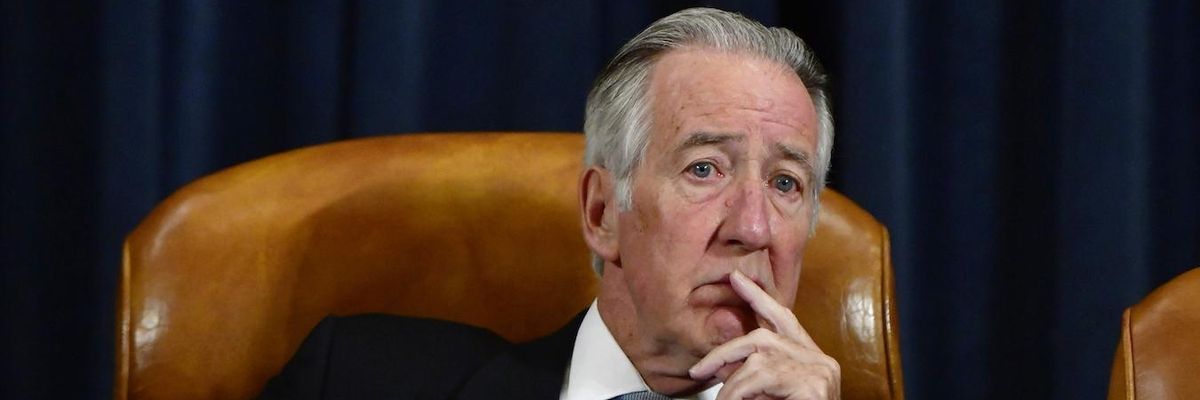
House Ways and Means Committee Chair Rep. Richard Neal (D-Mass.) listens during a committee hearing on March 3, 2020 in Washington, DC. (Photo: Mark Makela/Getty Images)
House Democrats' 2,465-page reconciliation package includes a plan to add dental benefits to Medicare, a proposal that is overwhelmingly popular with U.S. voters and--according to advocates--urgently needed to assist the tens of millions seniors who have been forced to go without crucial care.
"Did no one learn anything from the long delay in implementing the ACA?"
The caveat is that, as currently written, Democrats' legislation wouldn't roll out the new dental coverage until 2028, a lag that progressives say is morally unacceptable and politically problematic for the majority party and the White House.
"This is political malpractice," Joe Calvello of New Deal Strategies, a progressive consulting firm, said in response to the legislative text (pdf) released Friday by the House Budget Committee. "Absolutely no excuse for it."
As the Washington Post reported earlier this month, federal health officials have warned that "it could take in the range of three to five years to implement new dental benefits" due to numerous factors, including the time-consuming processes of vetting new dentists for the Medicare program and establishing a "new pricing system for reimbursing dentists for the new Medicare procedures and products."
"The lengthy timeline threatens to diminish the political upside of the new benefits, which Democrats have seen as an immediate and tangible improvement in voters' lives they could present to the public in the 2022 and 2024 elections," the Post noted. "One person characterized the prediction of five years as CMS's 'worst case scenario' timeline."
Helaine Olen, who serves on the advisory board of the Economic Hardship Reporting Project, stressed in a tweet on Friday that "seniors desperately want dental benefits." Roughly two-thirds of Americans over the age of 65 don't have dental coverage and half haven't been to the dentist within the past year, according to the Kaiser Family Foundation.
The Centers for Disease Control and Prevention notes on its website that nearly one in five U.S. seniors have lost all of their natural teeth.
"Seniors vote. The White House realizes this," Olen wrote. "Why, oh, why do so many people consider the Democratic moderates the realists in this equation? Did no one learn anything from the long delay in implementing the [Affordable Care Act]?"
Congressional Democrats and the Biden administration are reportedly exploring possible ways to speed up the provision of new dental benefits, including some kind of voucher program that would provide financial assistance to seniors as the federal government stands up the full dental program.
"The benefit must start soon--we can't wait until 2028!"
Under Democrats' current Medicare expansion plan--which the House Ways and Means Committee approved earlier this month--new vision benefits would be created in 2022 followed by hearing benefits in 2023. If enacted, the plan would represent one of the largest expansions of Medicare in the program's 56-year history.
In a statement touting his committee's vote, Ways and Means Chair Rep. Richard Neal (D-Mass.) emphasized that Democrats' reconciliation package would expand "Medicare coverage to include dental, vision, and hearing benefits, quickly getting new vision and hearing services to beneficiaries in 2022 and 2023, respectively, to eliminate cost and coverage barriers to this care."
The statement notably didn't mention the plan's 2028 start date for dental benefits.
Democrats' proposal is subject to change as the reconciliation package moves through congressional committees. Sen. Bernie Sanders (I-Vt.), the chair of the Senate Budget Committee and one of the leading proponents of Medicare expansion in Congress, has taken issue with the House's proposed timeline for the implementation of new dental coverage.
During a press call earlier this month, the Vermont senator acknowledged that the dental benefits could be "complicated" to set up but said he doesn't believe the process should take roughly six years.
"Do I think we should take such a long time to implement the dental provisions? No I don't," Sanders said on a press call when asked about the House proposal. "I don't want to see it drawn out to as far as the House has proposed."
In recent days, Social Security Works, Justice in Aging, and other advocacy groups have attempted to put pressure on senators to shorten the dental benefits timeline.
"Dental care is healthcare," Social Security Works tweeted last Friday. "That's why Congress must add a dental benefit to Medicare as part of #BuildBackBetter. And the benefit must start soon--we can't wait until 2028! Call your Senators at 202-509-9128 and urge them to act."
Dear Common Dreams reader, It’s been nearly 30 years since I co-founded Common Dreams with my late wife, Lina Newhouser. We had the radical notion that journalism should serve the public good, not corporate profits. It was clear to us from the outset what it would take to build such a project. No paid advertisements. No corporate sponsors. No millionaire publisher telling us what to think or do. Many people said we wouldn't last a year, but we proved those doubters wrong. Together with a tremendous team of journalists and dedicated staff, we built an independent media outlet free from the constraints of profits and corporate control. Our mission has always been simple: To inform. To inspire. To ignite change for the common good. Building Common Dreams was not easy. Our survival was never guaranteed. When you take on the most powerful forces—Wall Street greed, fossil fuel industry destruction, Big Tech lobbyists, and uber-rich oligarchs who have spent billions upon billions rigging the economy and democracy in their favor—the only bulwark you have is supporters who believe in your work. But here’s the urgent message from me today. It's never been this bad out there. And it's never been this hard to keep us going. At the very moment Common Dreams is most needed, the threats we face are intensifying. We need your support now more than ever. We don't accept corporate advertising and never will. We don't have a paywall because we don't think people should be blocked from critical news based on their ability to pay. Everything we do is funded by the donations of readers like you. When everyone does the little they can afford, we are strong. But if that support retreats or dries up, so do we. Will you donate now to make sure Common Dreams not only survives but thrives? —Craig Brown, Co-founder |
House Democrats' 2,465-page reconciliation package includes a plan to add dental benefits to Medicare, a proposal that is overwhelmingly popular with U.S. voters and--according to advocates--urgently needed to assist the tens of millions seniors who have been forced to go without crucial care.
"Did no one learn anything from the long delay in implementing the ACA?"
The caveat is that, as currently written, Democrats' legislation wouldn't roll out the new dental coverage until 2028, a lag that progressives say is morally unacceptable and politically problematic for the majority party and the White House.
"This is political malpractice," Joe Calvello of New Deal Strategies, a progressive consulting firm, said in response to the legislative text (pdf) released Friday by the House Budget Committee. "Absolutely no excuse for it."
As the Washington Post reported earlier this month, federal health officials have warned that "it could take in the range of three to five years to implement new dental benefits" due to numerous factors, including the time-consuming processes of vetting new dentists for the Medicare program and establishing a "new pricing system for reimbursing dentists for the new Medicare procedures and products."
"The lengthy timeline threatens to diminish the political upside of the new benefits, which Democrats have seen as an immediate and tangible improvement in voters' lives they could present to the public in the 2022 and 2024 elections," the Post noted. "One person characterized the prediction of five years as CMS's 'worst case scenario' timeline."
Helaine Olen, who serves on the advisory board of the Economic Hardship Reporting Project, stressed in a tweet on Friday that "seniors desperately want dental benefits." Roughly two-thirds of Americans over the age of 65 don't have dental coverage and half haven't been to the dentist within the past year, according to the Kaiser Family Foundation.
The Centers for Disease Control and Prevention notes on its website that nearly one in five U.S. seniors have lost all of their natural teeth.
"Seniors vote. The White House realizes this," Olen wrote. "Why, oh, why do so many people consider the Democratic moderates the realists in this equation? Did no one learn anything from the long delay in implementing the [Affordable Care Act]?"
Congressional Democrats and the Biden administration are reportedly exploring possible ways to speed up the provision of new dental benefits, including some kind of voucher program that would provide financial assistance to seniors as the federal government stands up the full dental program.
"The benefit must start soon--we can't wait until 2028!"
Under Democrats' current Medicare expansion plan--which the House Ways and Means Committee approved earlier this month--new vision benefits would be created in 2022 followed by hearing benefits in 2023. If enacted, the plan would represent one of the largest expansions of Medicare in the program's 56-year history.
In a statement touting his committee's vote, Ways and Means Chair Rep. Richard Neal (D-Mass.) emphasized that Democrats' reconciliation package would expand "Medicare coverage to include dental, vision, and hearing benefits, quickly getting new vision and hearing services to beneficiaries in 2022 and 2023, respectively, to eliminate cost and coverage barriers to this care."
The statement notably didn't mention the plan's 2028 start date for dental benefits.
Democrats' proposal is subject to change as the reconciliation package moves through congressional committees. Sen. Bernie Sanders (I-Vt.), the chair of the Senate Budget Committee and one of the leading proponents of Medicare expansion in Congress, has taken issue with the House's proposed timeline for the implementation of new dental coverage.
During a press call earlier this month, the Vermont senator acknowledged that the dental benefits could be "complicated" to set up but said he doesn't believe the process should take roughly six years.
"Do I think we should take such a long time to implement the dental provisions? No I don't," Sanders said on a press call when asked about the House proposal. "I don't want to see it drawn out to as far as the House has proposed."
In recent days, Social Security Works, Justice in Aging, and other advocacy groups have attempted to put pressure on senators to shorten the dental benefits timeline.
"Dental care is healthcare," Social Security Works tweeted last Friday. "That's why Congress must add a dental benefit to Medicare as part of #BuildBackBetter. And the benefit must start soon--we can't wait until 2028! Call your Senators at 202-509-9128 and urge them to act."
House Democrats' 2,465-page reconciliation package includes a plan to add dental benefits to Medicare, a proposal that is overwhelmingly popular with U.S. voters and--according to advocates--urgently needed to assist the tens of millions seniors who have been forced to go without crucial care.
"Did no one learn anything from the long delay in implementing the ACA?"
The caveat is that, as currently written, Democrats' legislation wouldn't roll out the new dental coverage until 2028, a lag that progressives say is morally unacceptable and politically problematic for the majority party and the White House.
"This is political malpractice," Joe Calvello of New Deal Strategies, a progressive consulting firm, said in response to the legislative text (pdf) released Friday by the House Budget Committee. "Absolutely no excuse for it."
As the Washington Post reported earlier this month, federal health officials have warned that "it could take in the range of three to five years to implement new dental benefits" due to numerous factors, including the time-consuming processes of vetting new dentists for the Medicare program and establishing a "new pricing system for reimbursing dentists for the new Medicare procedures and products."
"The lengthy timeline threatens to diminish the political upside of the new benefits, which Democrats have seen as an immediate and tangible improvement in voters' lives they could present to the public in the 2022 and 2024 elections," the Post noted. "One person characterized the prediction of five years as CMS's 'worst case scenario' timeline."
Helaine Olen, who serves on the advisory board of the Economic Hardship Reporting Project, stressed in a tweet on Friday that "seniors desperately want dental benefits." Roughly two-thirds of Americans over the age of 65 don't have dental coverage and half haven't been to the dentist within the past year, according to the Kaiser Family Foundation.
The Centers for Disease Control and Prevention notes on its website that nearly one in five U.S. seniors have lost all of their natural teeth.
"Seniors vote. The White House realizes this," Olen wrote. "Why, oh, why do so many people consider the Democratic moderates the realists in this equation? Did no one learn anything from the long delay in implementing the [Affordable Care Act]?"
Congressional Democrats and the Biden administration are reportedly exploring possible ways to speed up the provision of new dental benefits, including some kind of voucher program that would provide financial assistance to seniors as the federal government stands up the full dental program.
"The benefit must start soon--we can't wait until 2028!"
Under Democrats' current Medicare expansion plan--which the House Ways and Means Committee approved earlier this month--new vision benefits would be created in 2022 followed by hearing benefits in 2023. If enacted, the plan would represent one of the largest expansions of Medicare in the program's 56-year history.
In a statement touting his committee's vote, Ways and Means Chair Rep. Richard Neal (D-Mass.) emphasized that Democrats' reconciliation package would expand "Medicare coverage to include dental, vision, and hearing benefits, quickly getting new vision and hearing services to beneficiaries in 2022 and 2023, respectively, to eliminate cost and coverage barriers to this care."
The statement notably didn't mention the plan's 2028 start date for dental benefits.
Democrats' proposal is subject to change as the reconciliation package moves through congressional committees. Sen. Bernie Sanders (I-Vt.), the chair of the Senate Budget Committee and one of the leading proponents of Medicare expansion in Congress, has taken issue with the House's proposed timeline for the implementation of new dental coverage.
During a press call earlier this month, the Vermont senator acknowledged that the dental benefits could be "complicated" to set up but said he doesn't believe the process should take roughly six years.
"Do I think we should take such a long time to implement the dental provisions? No I don't," Sanders said on a press call when asked about the House proposal. "I don't want to see it drawn out to as far as the House has proposed."
In recent days, Social Security Works, Justice in Aging, and other advocacy groups have attempted to put pressure on senators to shorten the dental benefits timeline.
"Dental care is healthcare," Social Security Works tweeted last Friday. "That's why Congress must add a dental benefit to Medicare as part of #BuildBackBetter. And the benefit must start soon--we can't wait until 2028! Call your Senators at 202-509-9128 and urge them to act."