SUBSCRIBE TO OUR FREE NEWSLETTER
Daily news & progressive opinion—funded by the people, not the corporations—delivered straight to your inbox.
5
#000000
#FFFFFF
To donate by check, phone, or other method, see our More Ways to Give page.
Daily news & progressive opinion—funded by the people, not the corporations—delivered straight to your inbox.
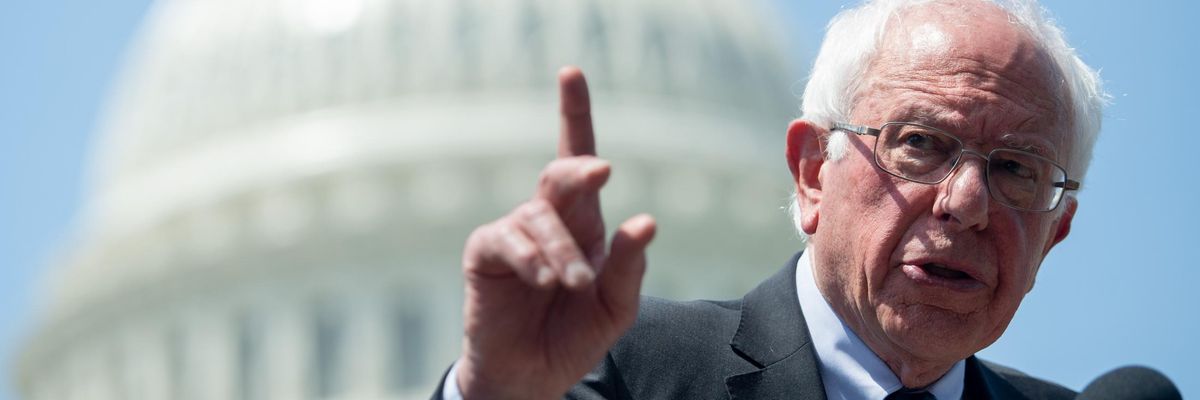
Sen. Bernie Sanders (I-Vt.) speaks during a press conference outside the U.S. Capitol in Washington, D.C. on June 24, 2019. (Photo: Saul Loeb/AFP/Getty Images)
Sen. Bernie Sanders said Monday that a new congressional watchdog report showing the Pentagon failing in efforts to combat department-wide fraud and waste revealed an "absolutely unacceptable" situation that merits true accountability.
Budget Committee chair Sanders (I-Vt.), along with House Oversight Committee chair Rep. Carolyn Maloney (D-N.Y.), had requested the Government Accountability Office (GAO) report, which was made public Monday.
The report covered fiscal year 2020, when the Defense Department (DOD) "obligated approximately $422 billion on contracts."
"The scope and scale of this activity," the report found, "makes DOD procurement inherently susceptible to fraud."
GAO also noted that it "has long reported that DOD's procurement processes are vulnerable to waste, fraud, and abuse," and referenced 2018, when the Defense Department "reported to Congress that from fiscal years 2013- 2017, over $6.6 billion had been recovered from defense-contracting fraud cases." The report also noted that in 2020, about one out of five of the Pentagon's inspector general's ongoing investigations were related to procurement fraud.
Auditors found a number of shortcomings the Pentagon has in tackling fraud risks, which can include contractors billing for work not completed or disguising conflicts of interests.
A year after the formation of the Pentagon's Fraud Reduction Task Force, for example, 11 of the department's 59 organizations, including the Army, hadn't designated a representative to that body. Also problematic is that the department "policy governing the risk management program does not specifically require fraud risk assessments," and as such, "DOD may not be identifying all fraud risks, and its control activities may not be appropriately designed or implemented."
The department's overall fraud risk profile may also be inaccurate as a result of not all component organizations reporting their individual procurement fraud risks.
"Given the billions of dollars DOD spends annually on procurement," the report stated, "failing to manage and mitigate fraud effectively may ultimately adversely affect DOD's ability to support the warfighter."
A statement from Sanders and Maloney pointed to the assessment of the Pentagon's lackluster efforts as particularly egregious in light of defense contracts regularly "worth hundreds of billions of dollars."
"The Pentagon doesn't seem to want to get serious about combating the fraud, waste, and financial mismanagement that has been its legacy for decades," said Sanders. "They don't seem to want to get serious about spending taxpayer dollars wisely and effectively. Well, I think we can all agree, that is absolutely unacceptable."
"Currently," added Sanders, "the U.S. spends more on our nation's military than the next 13 countries combined. Meanwhile, half of our people are living paycheck to paycheck, just under 40 million Americans are living in poverty, and over 600,000 Americans are homeless including roughly 40,000 veterans. The time is long overdue for the Defense Department to be held to the same level of accountability as the rest of the government."
Maloney, in her statement Monday, similarly pointed to "this failure to safeguard taxpayer dollars" as "completely unacceptable."
She urged the Biden administration to act on the report's recommendations to ensure the Pentagon stops putting money into "fraudulent contracts."
Dear Common Dreams reader, It’s been nearly 30 years since I co-founded Common Dreams with my late wife, Lina Newhouser. We had the radical notion that journalism should serve the public good, not corporate profits. It was clear to us from the outset what it would take to build such a project. No paid advertisements. No corporate sponsors. No millionaire publisher telling us what to think or do. Many people said we wouldn't last a year, but we proved those doubters wrong. Together with a tremendous team of journalists and dedicated staff, we built an independent media outlet free from the constraints of profits and corporate control. Our mission has always been simple: To inform. To inspire. To ignite change for the common good. Building Common Dreams was not easy. Our survival was never guaranteed. When you take on the most powerful forces—Wall Street greed, fossil fuel industry destruction, Big Tech lobbyists, and uber-rich oligarchs who have spent billions upon billions rigging the economy and democracy in their favor—the only bulwark you have is supporters who believe in your work. But here’s the urgent message from me today. It's never been this bad out there. And it's never been this hard to keep us going. At the very moment Common Dreams is most needed, the threats we face are intensifying. We need your support now more than ever. We don't accept corporate advertising and never will. We don't have a paywall because we don't think people should be blocked from critical news based on their ability to pay. Everything we do is funded by the donations of readers like you. When everyone does the little they can afford, we are strong. But if that support retreats or dries up, so do we. Will you donate now to make sure Common Dreams not only survives but thrives? —Craig Brown, Co-founder |
Sen. Bernie Sanders said Monday that a new congressional watchdog report showing the Pentagon failing in efforts to combat department-wide fraud and waste revealed an "absolutely unacceptable" situation that merits true accountability.
Budget Committee chair Sanders (I-Vt.), along with House Oversight Committee chair Rep. Carolyn Maloney (D-N.Y.), had requested the Government Accountability Office (GAO) report, which was made public Monday.
The report covered fiscal year 2020, when the Defense Department (DOD) "obligated approximately $422 billion on contracts."
"The scope and scale of this activity," the report found, "makes DOD procurement inherently susceptible to fraud."
GAO also noted that it "has long reported that DOD's procurement processes are vulnerable to waste, fraud, and abuse," and referenced 2018, when the Defense Department "reported to Congress that from fiscal years 2013- 2017, over $6.6 billion had been recovered from defense-contracting fraud cases." The report also noted that in 2020, about one out of five of the Pentagon's inspector general's ongoing investigations were related to procurement fraud.
Auditors found a number of shortcomings the Pentagon has in tackling fraud risks, which can include contractors billing for work not completed or disguising conflicts of interests.
A year after the formation of the Pentagon's Fraud Reduction Task Force, for example, 11 of the department's 59 organizations, including the Army, hadn't designated a representative to that body. Also problematic is that the department "policy governing the risk management program does not specifically require fraud risk assessments," and as such, "DOD may not be identifying all fraud risks, and its control activities may not be appropriately designed or implemented."
The department's overall fraud risk profile may also be inaccurate as a result of not all component organizations reporting their individual procurement fraud risks.
"Given the billions of dollars DOD spends annually on procurement," the report stated, "failing to manage and mitigate fraud effectively may ultimately adversely affect DOD's ability to support the warfighter."
A statement from Sanders and Maloney pointed to the assessment of the Pentagon's lackluster efforts as particularly egregious in light of defense contracts regularly "worth hundreds of billions of dollars."
"The Pentagon doesn't seem to want to get serious about combating the fraud, waste, and financial mismanagement that has been its legacy for decades," said Sanders. "They don't seem to want to get serious about spending taxpayer dollars wisely and effectively. Well, I think we can all agree, that is absolutely unacceptable."
"Currently," added Sanders, "the U.S. spends more on our nation's military than the next 13 countries combined. Meanwhile, half of our people are living paycheck to paycheck, just under 40 million Americans are living in poverty, and over 600,000 Americans are homeless including roughly 40,000 veterans. The time is long overdue for the Defense Department to be held to the same level of accountability as the rest of the government."
Maloney, in her statement Monday, similarly pointed to "this failure to safeguard taxpayer dollars" as "completely unacceptable."
She urged the Biden administration to act on the report's recommendations to ensure the Pentagon stops putting money into "fraudulent contracts."
Sen. Bernie Sanders said Monday that a new congressional watchdog report showing the Pentagon failing in efforts to combat department-wide fraud and waste revealed an "absolutely unacceptable" situation that merits true accountability.
Budget Committee chair Sanders (I-Vt.), along with House Oversight Committee chair Rep. Carolyn Maloney (D-N.Y.), had requested the Government Accountability Office (GAO) report, which was made public Monday.
The report covered fiscal year 2020, when the Defense Department (DOD) "obligated approximately $422 billion on contracts."
"The scope and scale of this activity," the report found, "makes DOD procurement inherently susceptible to fraud."
GAO also noted that it "has long reported that DOD's procurement processes are vulnerable to waste, fraud, and abuse," and referenced 2018, when the Defense Department "reported to Congress that from fiscal years 2013- 2017, over $6.6 billion had been recovered from defense-contracting fraud cases." The report also noted that in 2020, about one out of five of the Pentagon's inspector general's ongoing investigations were related to procurement fraud.
Auditors found a number of shortcomings the Pentagon has in tackling fraud risks, which can include contractors billing for work not completed or disguising conflicts of interests.
A year after the formation of the Pentagon's Fraud Reduction Task Force, for example, 11 of the department's 59 organizations, including the Army, hadn't designated a representative to that body. Also problematic is that the department "policy governing the risk management program does not specifically require fraud risk assessments," and as such, "DOD may not be identifying all fraud risks, and its control activities may not be appropriately designed or implemented."
The department's overall fraud risk profile may also be inaccurate as a result of not all component organizations reporting their individual procurement fraud risks.
"Given the billions of dollars DOD spends annually on procurement," the report stated, "failing to manage and mitigate fraud effectively may ultimately adversely affect DOD's ability to support the warfighter."
A statement from Sanders and Maloney pointed to the assessment of the Pentagon's lackluster efforts as particularly egregious in light of defense contracts regularly "worth hundreds of billions of dollars."
"The Pentagon doesn't seem to want to get serious about combating the fraud, waste, and financial mismanagement that has been its legacy for decades," said Sanders. "They don't seem to want to get serious about spending taxpayer dollars wisely and effectively. Well, I think we can all agree, that is absolutely unacceptable."
"Currently," added Sanders, "the U.S. spends more on our nation's military than the next 13 countries combined. Meanwhile, half of our people are living paycheck to paycheck, just under 40 million Americans are living in poverty, and over 600,000 Americans are homeless including roughly 40,000 veterans. The time is long overdue for the Defense Department to be held to the same level of accountability as the rest of the government."
Maloney, in her statement Monday, similarly pointed to "this failure to safeguard taxpayer dollars" as "completely unacceptable."
She urged the Biden administration to act on the report's recommendations to ensure the Pentagon stops putting money into "fraudulent contracts."