SUBSCRIBE TO OUR FREE NEWSLETTER
Daily news & progressive opinion—funded by the people, not the corporations—delivered straight to your inbox.
5
#000000
#FFFFFF
To donate by check, phone, or other method, see our More Ways to Give page.
Daily news & progressive opinion—funded by the people, not the corporations—delivered straight to your inbox.
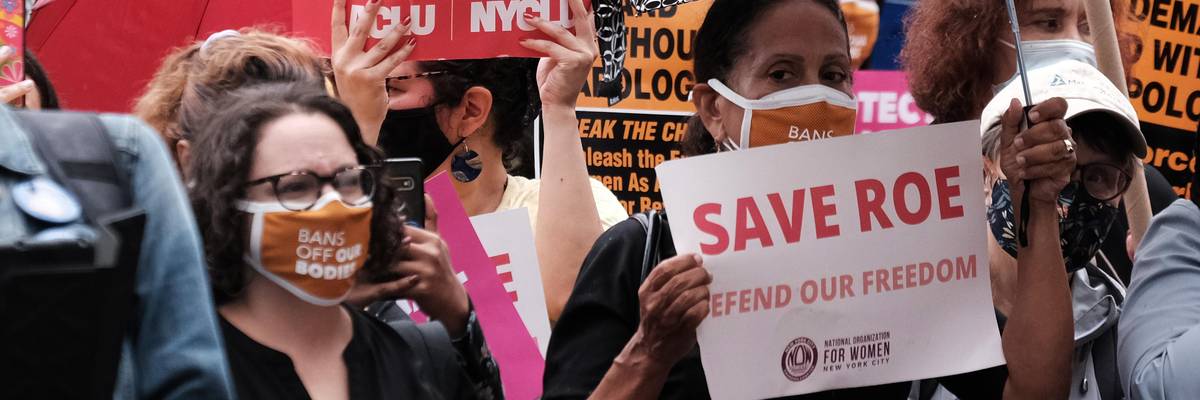
Supporters of abortion rights participate in a rally to denounce Texas' abortion ban on September 9, 2021 in New York City. (Photo: Spencer Platt/Getty Images)
While applauding the Biden Justice Department for quickly suing Texas over its draconian abortion ban, the Congressional Progressive Caucus is stressing that legal action must be accompanied by a legislative push to codify Roe v. Wade into federal law if there's to be any hope of stopping the GOP's nationwide assault on reproductive rights.
"We're calling on the Senate to abolish the filibuster so we can send this urgent bill to the president's desk."
--Rep. Pramila Jayapal
Rep. Pramila Jayapal (D-Wash.), the chair of the nearly 100-member CPC, said in a statement Thursday that the Justice Department's lawsuit is the "right move" against a near-total abortion ban that "clearly violates" the U.S. Constitution.
But Jayapal emphasized that "Texas is not alone in their attempts to push abortion out of reach; this law is just one of nearly 600 restrictive abortion laws introduced in state legislatures in 2021." The Guttmacher Institute estimates that at least 11 states currently have in place post-Roe trigger laws that would ban all or nearly all abortions if the landmark 1973 Supreme Court decision is officially overturned.
"This is a nationwide crisis that requires a nationwide solution, and Congress must also do its part," Jayapal said Thursday. "That's why we are looking forward to passing the Women's Health Protection Act out of the House of Representatives this month, and why we're calling on the Senate to abolish the filibuster so we can send this urgent bill to the president's desk. That is how we finally codify the right to abortion in federal law, outlaw attacks on access, and protect healthcare for millions."
"This is a fight we cannot and must not lose," she added.
First introduced by Rep. Judy Chu (D-Calif.) and several other congressional Democrats in June, the Women's Health Protection Act (WHPA) would establish a federal statutory right to abortion care "free from medically unnecessary restrictions that single out abortion and impede access." Last week, House Speaker Nancy Pelosi (D-Calif.) vowed to bring the legislation up for a vote when her chamber returns from recess later this month.
At present, the bill has 206 co-sponsors, including Chu, in the House and 48 in the Senate. Sens. Joe Manchin (D-W.Va.) and Bob Casey (D-Pa.) are the only Democratic holdouts in the upper chamber.
Even if every member of the Senate Democratic caucus gets behind the WHPA, the bill would still need at least 10 Republican votes to pass the upper chamber if Democrats refuse to eliminate the legislative filibuster. Manchin and other conservative Democrats have adamantly opposed reforming or scrapping the 60-vote filibuster rule, a position that has imperiled voting rights legislation and other major elements of the party's agenda.
"The Women's Health Protection Act can protect abortion rights. But only if we end the filibuster," Jayapal tweeted Thursday. "The rights of pregnant people are on the line."
The Justice Department's lawsuit against Texas came just over a week after five right-wing justices on the U.S. Supreme Court refused to block the state's abortion ban, which empowers private individuals to sue abortion providers or anyone who "aids or abets" the procedure after around six weeks of a pregnancy.
The law, known as S.B. 8, has already had a devastating impact, forcing Texas clinics to turn away patients and dramatically increasing the likelihood that many of the state's few abortion facilities will be forced to shut their doors for good.
"Before the new law went into effect, the number of abortion clinics in Texas had already dwindled, falling from 41 in 2008 to 15 in 2020," the Texas Tribune reported earlier this week.
Nancy Northup, president and CEO of the Center for Reproductive Rights, warned in a statement Thursday that "every day this law is in effect, patients are being denied access to essential healthcare, and the hardest-hit are people of color, those struggling to make ends meet, undocumented immigrants, and others with pre-existing obstacles to access healthcare."
This post has been updated with the latest number of House co-sponsors of the WHPA and the correct month of the bill's introduction.
Dear Common Dreams reader, It’s been nearly 30 years since I co-founded Common Dreams with my late wife, Lina Newhouser. We had the radical notion that journalism should serve the public good, not corporate profits. It was clear to us from the outset what it would take to build such a project. No paid advertisements. No corporate sponsors. No millionaire publisher telling us what to think or do. Many people said we wouldn't last a year, but we proved those doubters wrong. Together with a tremendous team of journalists and dedicated staff, we built an independent media outlet free from the constraints of profits and corporate control. Our mission has always been simple: To inform. To inspire. To ignite change for the common good. Building Common Dreams was not easy. Our survival was never guaranteed. When you take on the most powerful forces—Wall Street greed, fossil fuel industry destruction, Big Tech lobbyists, and uber-rich oligarchs who have spent billions upon billions rigging the economy and democracy in their favor—the only bulwark you have is supporters who believe in your work. But here’s the urgent message from me today. It's never been this bad out there. And it's never been this hard to keep us going. At the very moment Common Dreams is most needed, the threats we face are intensifying. We need your support now more than ever. We don't accept corporate advertising and never will. We don't have a paywall because we don't think people should be blocked from critical news based on their ability to pay. Everything we do is funded by the donations of readers like you. When everyone does the little they can afford, we are strong. But if that support retreats or dries up, so do we. Will you donate now to make sure Common Dreams not only survives but thrives? —Craig Brown, Co-founder |
While applauding the Biden Justice Department for quickly suing Texas over its draconian abortion ban, the Congressional Progressive Caucus is stressing that legal action must be accompanied by a legislative push to codify Roe v. Wade into federal law if there's to be any hope of stopping the GOP's nationwide assault on reproductive rights.
"We're calling on the Senate to abolish the filibuster so we can send this urgent bill to the president's desk."
--Rep. Pramila Jayapal
Rep. Pramila Jayapal (D-Wash.), the chair of the nearly 100-member CPC, said in a statement Thursday that the Justice Department's lawsuit is the "right move" against a near-total abortion ban that "clearly violates" the U.S. Constitution.
But Jayapal emphasized that "Texas is not alone in their attempts to push abortion out of reach; this law is just one of nearly 600 restrictive abortion laws introduced in state legislatures in 2021." The Guttmacher Institute estimates that at least 11 states currently have in place post-Roe trigger laws that would ban all or nearly all abortions if the landmark 1973 Supreme Court decision is officially overturned.
"This is a nationwide crisis that requires a nationwide solution, and Congress must also do its part," Jayapal said Thursday. "That's why we are looking forward to passing the Women's Health Protection Act out of the House of Representatives this month, and why we're calling on the Senate to abolish the filibuster so we can send this urgent bill to the president's desk. That is how we finally codify the right to abortion in federal law, outlaw attacks on access, and protect healthcare for millions."
"This is a fight we cannot and must not lose," she added.
First introduced by Rep. Judy Chu (D-Calif.) and several other congressional Democrats in June, the Women's Health Protection Act (WHPA) would establish a federal statutory right to abortion care "free from medically unnecessary restrictions that single out abortion and impede access." Last week, House Speaker Nancy Pelosi (D-Calif.) vowed to bring the legislation up for a vote when her chamber returns from recess later this month.
At present, the bill has 206 co-sponsors, including Chu, in the House and 48 in the Senate. Sens. Joe Manchin (D-W.Va.) and Bob Casey (D-Pa.) are the only Democratic holdouts in the upper chamber.
Even if every member of the Senate Democratic caucus gets behind the WHPA, the bill would still need at least 10 Republican votes to pass the upper chamber if Democrats refuse to eliminate the legislative filibuster. Manchin and other conservative Democrats have adamantly opposed reforming or scrapping the 60-vote filibuster rule, a position that has imperiled voting rights legislation and other major elements of the party's agenda.
"The Women's Health Protection Act can protect abortion rights. But only if we end the filibuster," Jayapal tweeted Thursday. "The rights of pregnant people are on the line."
The Justice Department's lawsuit against Texas came just over a week after five right-wing justices on the U.S. Supreme Court refused to block the state's abortion ban, which empowers private individuals to sue abortion providers or anyone who "aids or abets" the procedure after around six weeks of a pregnancy.
The law, known as S.B. 8, has already had a devastating impact, forcing Texas clinics to turn away patients and dramatically increasing the likelihood that many of the state's few abortion facilities will be forced to shut their doors for good.
"Before the new law went into effect, the number of abortion clinics in Texas had already dwindled, falling from 41 in 2008 to 15 in 2020," the Texas Tribune reported earlier this week.
Nancy Northup, president and CEO of the Center for Reproductive Rights, warned in a statement Thursday that "every day this law is in effect, patients are being denied access to essential healthcare, and the hardest-hit are people of color, those struggling to make ends meet, undocumented immigrants, and others with pre-existing obstacles to access healthcare."
This post has been updated with the latest number of House co-sponsors of the WHPA and the correct month of the bill's introduction.
While applauding the Biden Justice Department for quickly suing Texas over its draconian abortion ban, the Congressional Progressive Caucus is stressing that legal action must be accompanied by a legislative push to codify Roe v. Wade into federal law if there's to be any hope of stopping the GOP's nationwide assault on reproductive rights.
"We're calling on the Senate to abolish the filibuster so we can send this urgent bill to the president's desk."
--Rep. Pramila Jayapal
Rep. Pramila Jayapal (D-Wash.), the chair of the nearly 100-member CPC, said in a statement Thursday that the Justice Department's lawsuit is the "right move" against a near-total abortion ban that "clearly violates" the U.S. Constitution.
But Jayapal emphasized that "Texas is not alone in their attempts to push abortion out of reach; this law is just one of nearly 600 restrictive abortion laws introduced in state legislatures in 2021." The Guttmacher Institute estimates that at least 11 states currently have in place post-Roe trigger laws that would ban all or nearly all abortions if the landmark 1973 Supreme Court decision is officially overturned.
"This is a nationwide crisis that requires a nationwide solution, and Congress must also do its part," Jayapal said Thursday. "That's why we are looking forward to passing the Women's Health Protection Act out of the House of Representatives this month, and why we're calling on the Senate to abolish the filibuster so we can send this urgent bill to the president's desk. That is how we finally codify the right to abortion in federal law, outlaw attacks on access, and protect healthcare for millions."
"This is a fight we cannot and must not lose," she added.
First introduced by Rep. Judy Chu (D-Calif.) and several other congressional Democrats in June, the Women's Health Protection Act (WHPA) would establish a federal statutory right to abortion care "free from medically unnecessary restrictions that single out abortion and impede access." Last week, House Speaker Nancy Pelosi (D-Calif.) vowed to bring the legislation up for a vote when her chamber returns from recess later this month.
At present, the bill has 206 co-sponsors, including Chu, in the House and 48 in the Senate. Sens. Joe Manchin (D-W.Va.) and Bob Casey (D-Pa.) are the only Democratic holdouts in the upper chamber.
Even if every member of the Senate Democratic caucus gets behind the WHPA, the bill would still need at least 10 Republican votes to pass the upper chamber if Democrats refuse to eliminate the legislative filibuster. Manchin and other conservative Democrats have adamantly opposed reforming or scrapping the 60-vote filibuster rule, a position that has imperiled voting rights legislation and other major elements of the party's agenda.
"The Women's Health Protection Act can protect abortion rights. But only if we end the filibuster," Jayapal tweeted Thursday. "The rights of pregnant people are on the line."
The Justice Department's lawsuit against Texas came just over a week after five right-wing justices on the U.S. Supreme Court refused to block the state's abortion ban, which empowers private individuals to sue abortion providers or anyone who "aids or abets" the procedure after around six weeks of a pregnancy.
The law, known as S.B. 8, has already had a devastating impact, forcing Texas clinics to turn away patients and dramatically increasing the likelihood that many of the state's few abortion facilities will be forced to shut their doors for good.
"Before the new law went into effect, the number of abortion clinics in Texas had already dwindled, falling from 41 in 2008 to 15 in 2020," the Texas Tribune reported earlier this week.
Nancy Northup, president and CEO of the Center for Reproductive Rights, warned in a statement Thursday that "every day this law is in effect, patients are being denied access to essential healthcare, and the hardest-hit are people of color, those struggling to make ends meet, undocumented immigrants, and others with pre-existing obstacles to access healthcare."
This post has been updated with the latest number of House co-sponsors of the WHPA and the correct month of the bill's introduction.