

SUBSCRIBE TO OUR FREE NEWSLETTER
Daily news & progressive opinion—funded by the people, not the corporations—delivered straight to your inbox.
5
#000000
#FFFFFF
To donate by check, phone, or other method, see our More Ways to Give page.
Daily news & progressive opinion—funded by the people, not the corporations—delivered straight to your inbox.
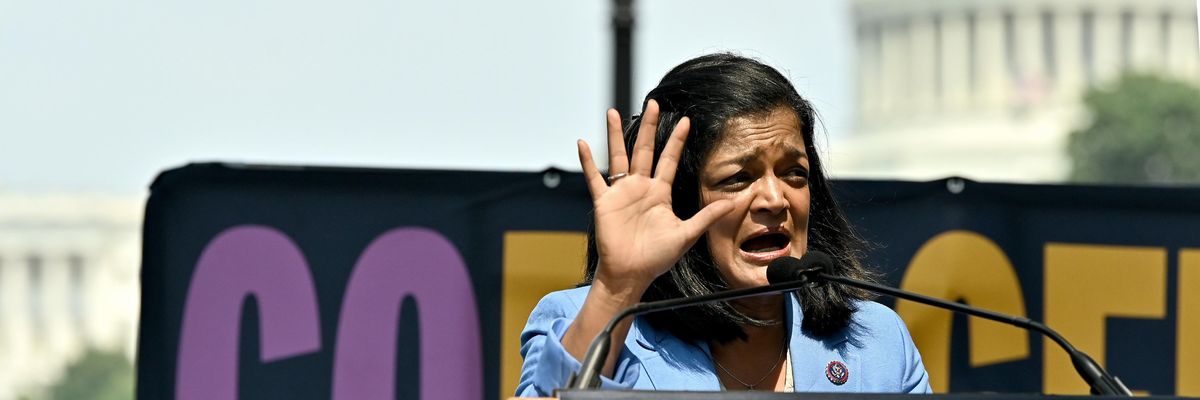
Rep. Pramila Jayapal (D-Wash.) speaks at a "Go Bigger on Climate, Care, and Justice" rally on July 20, 2021 in Washington, D.C. (Photo: Shannon Finney/Getty Images for Green New Deal Network)
The leader of the nearly 100-member Congressional Progressive Caucus made clear Tuesday that she's not willing to accept cuts to Democrats' $3.5 trillion budget reconciliation proposal, a sweeping climate and social spending package that conservative members of the party are currently attempting to scale back.
"There is no flexibility on the price tag, and it's not because I care about what the top line is," Rep. Pramila Jayapal (D-Wash.), the chair of the CPC, told the Washington Post. "It's because I care about delivering on these benefits."
Jayapal went on to warn that approving a watered-down version of the popular proposal--which includes Medicare expansion, paid family and medical leave, immigration reform, and major investments in green energy--could have disastrous electoral consequences for Democrats, who are clinging to vanishingly narrow majorities in the House and Senate ahead of the 2022 midterms.
According to a recent USA Today/Suffolk University survey, 52% of U.S. voters overall and 90% of Democrats support the $3.5 trillion package, which lawmakers are racing to complete by next month as deadly extreme weather across the U.S. lays bare the need for ambitious climate action.
"If we don't deliver," Jayapal said, "then I think all of the people who came out and voted for Democrats to take control of the House, the Senate, and the White House are going to come out and say, 'that's it.'"
Progressives in Congress believe they have the leverage to ensure that their major priorities are not stripped from the final reconciliation package to appease conservative Democrats, who are griping about the bill's $3.5 trillion price tag without offering an alternative or specifically detailing which provisions they would like to cut.
For weeks, members of the CPC have promised to vote against a $550 billion bipartisan infrastructure bill backed by conservative Democrats unless a reconciliation package containing progressive priorities is approved at the same time--a position that Rep. Ilhan Omar (D-Minn.) reiterated Tuesday.
"The commitment on this strategy to move both of these pieces simultaneously still remains," Omar, the CPC whip, told Roll Call.
Democratic committee leaders currently are rushing to finalize the details of the far-reaching reconciliation package before September 27, the date on which House Speaker Nancy Pelosi (D-Calif.) agreed to bring the bipartisan infrastructure bill up for a floor vote.
Asked about Sen. Joe Manchin's (D-W.Va.) call last week for a "strategic pause" on the reconciliation package, Pelosi said Tuesday, "Obviously, I don't agree."
"The number is the number: $3.5 [trillion]," Pelosi added. "We're going to pay for as much of it as possible. It'll have far less impact on the national debt than Republicans' 2017 tax scam."
A large majority of that tax giveaway went to the richest 1%, noted Pelosi, and "it added $2 trillion to the national debt."
Intraparty haggling over the final price tag of the reconciliation package comes as powerful corporations from a variety of industries--such as pharmaceuticals to fossil fuels--are mobilizing their vast resources in an effort to defeat the proposal, which is expected to include tax hikes on big businesses and wealthy individuals.
"These guys don't lose," Sanders (I-Vt.), the chair of the Senate Budget Committee and leading architect of the $3.5 trillion measure, told the Post earlier this summer when asked about the corporate lobbying blitz. "They're going to lose this round."
During five Labor Day town halls in his home state of Vermont on Monday, Sanders touted the reconciliation package as a necessity for "working families all over this country and to those of us who believe we have to act boldly on climate change."
"We've got California on fire," said the Vermont senator. "In Vermont, 3,000 miles away from Oregon, we're breathing the air, the smoke from those fires. Unbelievable."
Speaking to 350.org co-founder Bill McKibben at an event in Middlebury, Sanders stressed that the reconciliation package is "immensely popular, especially among working people," and said it's no surprise that corporations are aiming to tank the bill.
"The big-money interests are going to be hit on this bill," Sanders continued. "They're going to be asked to pay more in taxes. We're going to move away from fossil fuel. We're going to take on the pharmaceutical industry, the healthcare industry. Of course they are going to do everything they can to defeat it."
Dear Common Dreams reader, It’s been nearly 30 years since I co-founded Common Dreams with my late wife, Lina Newhouser. We had the radical notion that journalism should serve the public good, not corporate profits. It was clear to us from the outset what it would take to build such a project. No paid advertisements. No corporate sponsors. No millionaire publisher telling us what to think or do. Many people said we wouldn't last a year, but we proved those doubters wrong. Together with a tremendous team of journalists and dedicated staff, we built an independent media outlet free from the constraints of profits and corporate control. Our mission has always been simple: To inform. To inspire. To ignite change for the common good. Building Common Dreams was not easy. Our survival was never guaranteed. When you take on the most powerful forces—Wall Street greed, fossil fuel industry destruction, Big Tech lobbyists, and uber-rich oligarchs who have spent billions upon billions rigging the economy and democracy in their favor—the only bulwark you have is supporters who believe in your work. But here’s the urgent message from me today. It's never been this bad out there. And it's never been this hard to keep us going. At the very moment Common Dreams is most needed, the threats we face are intensifying. We need your support now more than ever. We don't accept corporate advertising and never will. We don't have a paywall because we don't think people should be blocked from critical news based on their ability to pay. Everything we do is funded by the donations of readers like you. When everyone does the little they can afford, we are strong. But if that support retreats or dries up, so do we. Will you donate now to make sure Common Dreams not only survives but thrives? —Craig Brown, Co-founder |
The leader of the nearly 100-member Congressional Progressive Caucus made clear Tuesday that she's not willing to accept cuts to Democrats' $3.5 trillion budget reconciliation proposal, a sweeping climate and social spending package that conservative members of the party are currently attempting to scale back.
"There is no flexibility on the price tag, and it's not because I care about what the top line is," Rep. Pramila Jayapal (D-Wash.), the chair of the CPC, told the Washington Post. "It's because I care about delivering on these benefits."
Jayapal went on to warn that approving a watered-down version of the popular proposal--which includes Medicare expansion, paid family and medical leave, immigration reform, and major investments in green energy--could have disastrous electoral consequences for Democrats, who are clinging to vanishingly narrow majorities in the House and Senate ahead of the 2022 midterms.
According to a recent USA Today/Suffolk University survey, 52% of U.S. voters overall and 90% of Democrats support the $3.5 trillion package, which lawmakers are racing to complete by next month as deadly extreme weather across the U.S. lays bare the need for ambitious climate action.
"If we don't deliver," Jayapal said, "then I think all of the people who came out and voted for Democrats to take control of the House, the Senate, and the White House are going to come out and say, 'that's it.'"
Progressives in Congress believe they have the leverage to ensure that their major priorities are not stripped from the final reconciliation package to appease conservative Democrats, who are griping about the bill's $3.5 trillion price tag without offering an alternative or specifically detailing which provisions they would like to cut.
For weeks, members of the CPC have promised to vote against a $550 billion bipartisan infrastructure bill backed by conservative Democrats unless a reconciliation package containing progressive priorities is approved at the same time--a position that Rep. Ilhan Omar (D-Minn.) reiterated Tuesday.
"The commitment on this strategy to move both of these pieces simultaneously still remains," Omar, the CPC whip, told Roll Call.
Democratic committee leaders currently are rushing to finalize the details of the far-reaching reconciliation package before September 27, the date on which House Speaker Nancy Pelosi (D-Calif.) agreed to bring the bipartisan infrastructure bill up for a floor vote.
Asked about Sen. Joe Manchin's (D-W.Va.) call last week for a "strategic pause" on the reconciliation package, Pelosi said Tuesday, "Obviously, I don't agree."
"The number is the number: $3.5 [trillion]," Pelosi added. "We're going to pay for as much of it as possible. It'll have far less impact on the national debt than Republicans' 2017 tax scam."
A large majority of that tax giveaway went to the richest 1%, noted Pelosi, and "it added $2 trillion to the national debt."
Intraparty haggling over the final price tag of the reconciliation package comes as powerful corporations from a variety of industries--such as pharmaceuticals to fossil fuels--are mobilizing their vast resources in an effort to defeat the proposal, which is expected to include tax hikes on big businesses and wealthy individuals.
"These guys don't lose," Sanders (I-Vt.), the chair of the Senate Budget Committee and leading architect of the $3.5 trillion measure, told the Post earlier this summer when asked about the corporate lobbying blitz. "They're going to lose this round."
During five Labor Day town halls in his home state of Vermont on Monday, Sanders touted the reconciliation package as a necessity for "working families all over this country and to those of us who believe we have to act boldly on climate change."
"We've got California on fire," said the Vermont senator. "In Vermont, 3,000 miles away from Oregon, we're breathing the air, the smoke from those fires. Unbelievable."
Speaking to 350.org co-founder Bill McKibben at an event in Middlebury, Sanders stressed that the reconciliation package is "immensely popular, especially among working people," and said it's no surprise that corporations are aiming to tank the bill.
"The big-money interests are going to be hit on this bill," Sanders continued. "They're going to be asked to pay more in taxes. We're going to move away from fossil fuel. We're going to take on the pharmaceutical industry, the healthcare industry. Of course they are going to do everything they can to defeat it."
The leader of the nearly 100-member Congressional Progressive Caucus made clear Tuesday that she's not willing to accept cuts to Democrats' $3.5 trillion budget reconciliation proposal, a sweeping climate and social spending package that conservative members of the party are currently attempting to scale back.
"There is no flexibility on the price tag, and it's not because I care about what the top line is," Rep. Pramila Jayapal (D-Wash.), the chair of the CPC, told the Washington Post. "It's because I care about delivering on these benefits."
Jayapal went on to warn that approving a watered-down version of the popular proposal--which includes Medicare expansion, paid family and medical leave, immigration reform, and major investments in green energy--could have disastrous electoral consequences for Democrats, who are clinging to vanishingly narrow majorities in the House and Senate ahead of the 2022 midterms.
According to a recent USA Today/Suffolk University survey, 52% of U.S. voters overall and 90% of Democrats support the $3.5 trillion package, which lawmakers are racing to complete by next month as deadly extreme weather across the U.S. lays bare the need for ambitious climate action.
"If we don't deliver," Jayapal said, "then I think all of the people who came out and voted for Democrats to take control of the House, the Senate, and the White House are going to come out and say, 'that's it.'"
Progressives in Congress believe they have the leverage to ensure that their major priorities are not stripped from the final reconciliation package to appease conservative Democrats, who are griping about the bill's $3.5 trillion price tag without offering an alternative or specifically detailing which provisions they would like to cut.
For weeks, members of the CPC have promised to vote against a $550 billion bipartisan infrastructure bill backed by conservative Democrats unless a reconciliation package containing progressive priorities is approved at the same time--a position that Rep. Ilhan Omar (D-Minn.) reiterated Tuesday.
"The commitment on this strategy to move both of these pieces simultaneously still remains," Omar, the CPC whip, told Roll Call.
Democratic committee leaders currently are rushing to finalize the details of the far-reaching reconciliation package before September 27, the date on which House Speaker Nancy Pelosi (D-Calif.) agreed to bring the bipartisan infrastructure bill up for a floor vote.
Asked about Sen. Joe Manchin's (D-W.Va.) call last week for a "strategic pause" on the reconciliation package, Pelosi said Tuesday, "Obviously, I don't agree."
"The number is the number: $3.5 [trillion]," Pelosi added. "We're going to pay for as much of it as possible. It'll have far less impact on the national debt than Republicans' 2017 tax scam."
A large majority of that tax giveaway went to the richest 1%, noted Pelosi, and "it added $2 trillion to the national debt."
Intraparty haggling over the final price tag of the reconciliation package comes as powerful corporations from a variety of industries--such as pharmaceuticals to fossil fuels--are mobilizing their vast resources in an effort to defeat the proposal, which is expected to include tax hikes on big businesses and wealthy individuals.
"These guys don't lose," Sanders (I-Vt.), the chair of the Senate Budget Committee and leading architect of the $3.5 trillion measure, told the Post earlier this summer when asked about the corporate lobbying blitz. "They're going to lose this round."
During five Labor Day town halls in his home state of Vermont on Monday, Sanders touted the reconciliation package as a necessity for "working families all over this country and to those of us who believe we have to act boldly on climate change."
"We've got California on fire," said the Vermont senator. "In Vermont, 3,000 miles away from Oregon, we're breathing the air, the smoke from those fires. Unbelievable."
Speaking to 350.org co-founder Bill McKibben at an event in Middlebury, Sanders stressed that the reconciliation package is "immensely popular, especially among working people," and said it's no surprise that corporations are aiming to tank the bill.
"The big-money interests are going to be hit on this bill," Sanders continued. "They're going to be asked to pay more in taxes. We're going to move away from fossil fuel. We're going to take on the pharmaceutical industry, the healthcare industry. Of course they are going to do everything they can to defeat it."

