
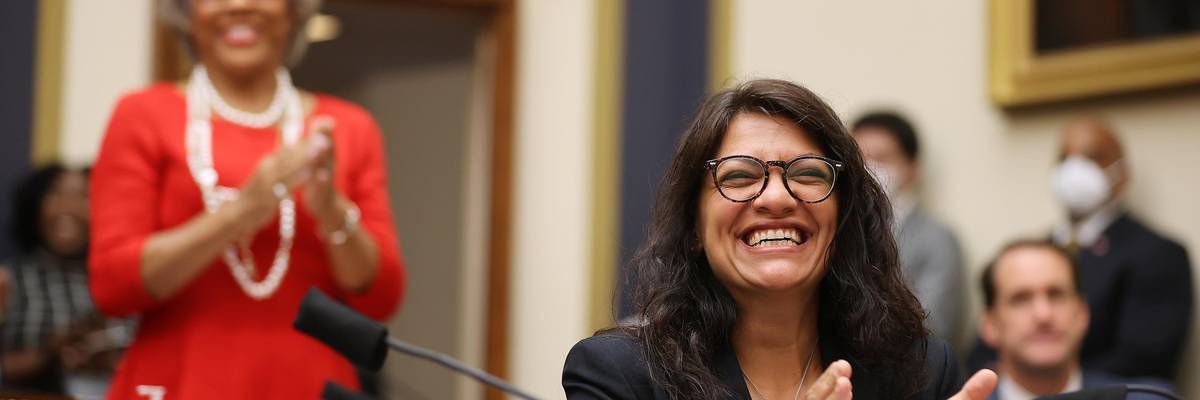
Rep. Rashida Tlaib (D-Mich.) attends a House Financial Services Committee hearing on July 20, 2021 in Washington, D.C. (Photo: Chip Somodevilla via Getty Images)
To Stop 'Life-Threatening Injustice' of Shutoffs, Tlaib Unveils Bill to Cancel $40 Billion in Utility Debt
"Utility shutoffs—from water to electricity to broadband internet—leave our most vulnerable communities without essential life-sustaining services and are especially unacceptable during a deadly pandemic," said the Michigan Democrat.
To protect low-income households from utility shutoffs as the ultra-contagious Delta variant drives another surge in Covid-19 infections, Rep. Rashida Tlaib introduced a bill Thursday that would erase nearly $40 billion in water, power, and broadband debt that has accumulated throughout the U.S.
"It's outrageous that private fossil fuel utilities control access to these public goods."
--Jean Su, Center for Biological Diversity
"Utility shutoffs--from water to electricity to broadband internet--leave our most vulnerable communities without essential life-sustaining services and are especially unacceptable during a deadly pandemic," the Michigan Democrat said in a statement.
The Maintaining Access to Essential Services Act, as Tlaib's utility debt cancellation legislation is called, would "create a new loan-to-grant program to provide nearly $40 billion in emergency low-interest loans for water, electric, and broadband providers," The Detroit News reported Wednesday. "The loans would be forgiven in whole or in part after the utility [company] cancels outstanding debts for residential accounts for the period covered by the public health emergency."
Tlaib's bill, which mirrors legislation introduced in May by Sen. Jeff Merkley (D-Ore.), would also mandate that utility providers report disconnections. Forgiveness of the federal government's low-interest loans would be conditioned on discharging customers' debts. If, even after receiving financial assistance to cover the cost of uncollected bills, companies were to disconnect households or charge late fees for missed payments during the pandemic, they would be required to pay back the loans.
"Families across the country have accrued billions of dollars in water debt during this pandemic, and now, as we are in the midst of another Covid surge, they are suffering water shutoffs, a life-threatening injustice that must be stopped," said Mary Grant, director of the Public Water for All campaign at Food & Water Watch.
Alissa Weinman, associate campaign director at Corporate Accountability, noted that the current spike in Covid-19 cases, hospitalizations, and deaths makes it "more essential than ever that people have access to water, electricity, and broadband service."
"This bill is a critical first step to support low-wealth families and communities of color that have borne the brunt of compounding threats of utility shutoffs and poverty," said Weinman, who added that "sustained, long-term federal investments in our infrastructure are necessary to ensure that everyone has access to clean and affordable water."
Since the beginning of the pandemic, more than 275,000 people have petitioned for a federal ban on utility shutoffs. According to an analysis conducted by Cornell University researchers in collaboration with Food & Water Watch, a nationwide water shutoff moratorium would have prevented roughly 500,000 Covid-19 infections and more than 9,000 deaths.
In the absence of federal action to prohibit service cuts, some states enacted shutoff moratoria, but most of those policies have expired. In addition, temporary local protections did little to address the crisis of mounting utility debt. As a result, millions have already lost access to life-saving services amid a public health emergency, and more remain at risk.
Calling Tlaib's bill "a great example of legislation that centers economic and racial justice to support local recovery and prosperity," Juan Jhong-Chung of the Michigan Environmental Justice Coalition asked: "How can investor-owned utilities make record profits while our families struggle to pay monthly bills? We cannot build back better if we leave the most vulnerable behind."
Given the lack of shutoff protections in the proposed $550 billion bipartisan infrastructure bill, Jean Su, Energy Justice director at the Center for Biological Diversity, argued that Congress should include Tlaib's legislation in the $3.5 trillion reconciliation package "to ensure that no family is cut off from access to the basic human rights of power, water, and broadband."
"It's outrageous that private fossil fuel utilities control access to these public goods," said Su. "With the rapid spread of the new Covid variant, we have to prevent another utility shutoffs tsunami."
The importance of a reliable internet connection was underscored during the pandemic, including for families with school-aged children who needed to log in to their remote learning environments. And yet, even though "we were encouraged to move our personal and professional lives online for the sake of public health, millions of us struggled to access our schools, jobs, and government and nonprofit programs because of the lack of affordable broadband access," said Amy Sample War, the CEO of NTEN.
"To turn off someone's access is to say their participation in society isn't needed or wanted. It's unconscionable."
--Amy Sample War, NTEN
"Broadband is vital to our lives in 21st century America. To turn off someone's access is to say their participation in society isn't needed or wanted," she added. "It's unconscionable."
Tlaib argued that utility debt cancellation would complement the new federal eviction moratorium--implemented earlier this week by the Centers for Disease Control and Prevention following a direct action campaign led by Rep. Cori Bush (D-Mo.)--because both measures are designed to keep people adequately housed and curb the spread of the coronavirus.
"So many of us have eviction protection on our minds right now," said the progressive lawmaker. "A study showing that low-income Michigan families pay more than 30% of their household income on utility bills alone, creating a direct path to debt and eviction, makes the issue that much more pertinent. We have to break the cycle and ensure folks can keep their lights on, their water running, and the roofs over their head."
Beth Pauley, director of the Climate + Energy Project, stressed that beyond Tlaib's utility debt cancellation bill, lawmakers must "address the energy poverty crisis by implementing equitable energy efficiency and community solar programs, with impacted communities leading the policies and program implementation."
Emphasizing that affordable utilities are an "essential part" of the human right to housing, Eric Tars, legal director of the National Homelessness Law Center, said that "energy infrastructure doesn't just mean the power lines above us and pipes below us, but the ability for every American to get those utilities into their homes reliably and sustainably."
"Without this bill," he said, "any larger infrastructure action that Congress takes will be incomplete."
An Urgent Message From Our Co-Founder
Dear Common Dreams reader, It’s been nearly 30 years since I co-founded Common Dreams with my late wife, Lina Newhouser. We had the radical notion that journalism should serve the public good, not corporate profits. It was clear to us from the outset what it would take to build such a project. No paid advertisements. No corporate sponsors. No millionaire publisher telling us what to think or do. Many people said we wouldn't last a year, but we proved those doubters wrong. Together with a tremendous team of journalists and dedicated staff, we built an independent media outlet free from the constraints of profits and corporate control. Our mission has always been simple: To inform. To inspire. To ignite change for the common good. Building Common Dreams was not easy. Our survival was never guaranteed. When you take on the most powerful forces—Wall Street greed, fossil fuel industry destruction, Big Tech lobbyists, and uber-rich oligarchs who have spent billions upon billions rigging the economy and democracy in their favor—the only bulwark you have is supporters who believe in your work. But here’s the urgent message from me today. It's never been this bad out there. And it's never been this hard to keep us going. At the very moment Common Dreams is most needed, the threats we face are intensifying. We need your support now more than ever. We don't accept corporate advertising and never will. We don't have a paywall because we don't think people should be blocked from critical news based on their ability to pay. Everything we do is funded by the donations of readers like you. When everyone does the little they can afford, we are strong. But if that support retreats or dries up, so do we. Will you donate now to make sure Common Dreams not only survives but thrives? —Craig Brown, Co-founder |
To protect low-income households from utility shutoffs as the ultra-contagious Delta variant drives another surge in Covid-19 infections, Rep. Rashida Tlaib introduced a bill Thursday that would erase nearly $40 billion in water, power, and broadband debt that has accumulated throughout the U.S.
"It's outrageous that private fossil fuel utilities control access to these public goods."
--Jean Su, Center for Biological Diversity
"Utility shutoffs--from water to electricity to broadband internet--leave our most vulnerable communities without essential life-sustaining services and are especially unacceptable during a deadly pandemic," the Michigan Democrat said in a statement.
The Maintaining Access to Essential Services Act, as Tlaib's utility debt cancellation legislation is called, would "create a new loan-to-grant program to provide nearly $40 billion in emergency low-interest loans for water, electric, and broadband providers," The Detroit News reported Wednesday. "The loans would be forgiven in whole or in part after the utility [company] cancels outstanding debts for residential accounts for the period covered by the public health emergency."
Tlaib's bill, which mirrors legislation introduced in May by Sen. Jeff Merkley (D-Ore.), would also mandate that utility providers report disconnections. Forgiveness of the federal government's low-interest loans would be conditioned on discharging customers' debts. If, even after receiving financial assistance to cover the cost of uncollected bills, companies were to disconnect households or charge late fees for missed payments during the pandemic, they would be required to pay back the loans.
"Families across the country have accrued billions of dollars in water debt during this pandemic, and now, as we are in the midst of another Covid surge, they are suffering water shutoffs, a life-threatening injustice that must be stopped," said Mary Grant, director of the Public Water for All campaign at Food & Water Watch.
Alissa Weinman, associate campaign director at Corporate Accountability, noted that the current spike in Covid-19 cases, hospitalizations, and deaths makes it "more essential than ever that people have access to water, electricity, and broadband service."
"This bill is a critical first step to support low-wealth families and communities of color that have borne the brunt of compounding threats of utility shutoffs and poverty," said Weinman, who added that "sustained, long-term federal investments in our infrastructure are necessary to ensure that everyone has access to clean and affordable water."
Since the beginning of the pandemic, more than 275,000 people have petitioned for a federal ban on utility shutoffs. According to an analysis conducted by Cornell University researchers in collaboration with Food & Water Watch, a nationwide water shutoff moratorium would have prevented roughly 500,000 Covid-19 infections and more than 9,000 deaths.
In the absence of federal action to prohibit service cuts, some states enacted shutoff moratoria, but most of those policies have expired. In addition, temporary local protections did little to address the crisis of mounting utility debt. As a result, millions have already lost access to life-saving services amid a public health emergency, and more remain at risk.
Calling Tlaib's bill "a great example of legislation that centers economic and racial justice to support local recovery and prosperity," Juan Jhong-Chung of the Michigan Environmental Justice Coalition asked: "How can investor-owned utilities make record profits while our families struggle to pay monthly bills? We cannot build back better if we leave the most vulnerable behind."
Given the lack of shutoff protections in the proposed $550 billion bipartisan infrastructure bill, Jean Su, Energy Justice director at the Center for Biological Diversity, argued that Congress should include Tlaib's legislation in the $3.5 trillion reconciliation package "to ensure that no family is cut off from access to the basic human rights of power, water, and broadband."
"It's outrageous that private fossil fuel utilities control access to these public goods," said Su. "With the rapid spread of the new Covid variant, we have to prevent another utility shutoffs tsunami."
The importance of a reliable internet connection was underscored during the pandemic, including for families with school-aged children who needed to log in to their remote learning environments. And yet, even though "we were encouraged to move our personal and professional lives online for the sake of public health, millions of us struggled to access our schools, jobs, and government and nonprofit programs because of the lack of affordable broadband access," said Amy Sample War, the CEO of NTEN.
"To turn off someone's access is to say their participation in society isn't needed or wanted. It's unconscionable."
--Amy Sample War, NTEN
"Broadband is vital to our lives in 21st century America. To turn off someone's access is to say their participation in society isn't needed or wanted," she added. "It's unconscionable."
Tlaib argued that utility debt cancellation would complement the new federal eviction moratorium--implemented earlier this week by the Centers for Disease Control and Prevention following a direct action campaign led by Rep. Cori Bush (D-Mo.)--because both measures are designed to keep people adequately housed and curb the spread of the coronavirus.
"So many of us have eviction protection on our minds right now," said the progressive lawmaker. "A study showing that low-income Michigan families pay more than 30% of their household income on utility bills alone, creating a direct path to debt and eviction, makes the issue that much more pertinent. We have to break the cycle and ensure folks can keep their lights on, their water running, and the roofs over their head."
Beth Pauley, director of the Climate + Energy Project, stressed that beyond Tlaib's utility debt cancellation bill, lawmakers must "address the energy poverty crisis by implementing equitable energy efficiency and community solar programs, with impacted communities leading the policies and program implementation."
Emphasizing that affordable utilities are an "essential part" of the human right to housing, Eric Tars, legal director of the National Homelessness Law Center, said that "energy infrastructure doesn't just mean the power lines above us and pipes below us, but the ability for every American to get those utilities into their homes reliably and sustainably."
"Without this bill," he said, "any larger infrastructure action that Congress takes will be incomplete."
To protect low-income households from utility shutoffs as the ultra-contagious Delta variant drives another surge in Covid-19 infections, Rep. Rashida Tlaib introduced a bill Thursday that would erase nearly $40 billion in water, power, and broadband debt that has accumulated throughout the U.S.
"It's outrageous that private fossil fuel utilities control access to these public goods."
--Jean Su, Center for Biological Diversity
"Utility shutoffs--from water to electricity to broadband internet--leave our most vulnerable communities without essential life-sustaining services and are especially unacceptable during a deadly pandemic," the Michigan Democrat said in a statement.
The Maintaining Access to Essential Services Act, as Tlaib's utility debt cancellation legislation is called, would "create a new loan-to-grant program to provide nearly $40 billion in emergency low-interest loans for water, electric, and broadband providers," The Detroit News reported Wednesday. "The loans would be forgiven in whole or in part after the utility [company] cancels outstanding debts for residential accounts for the period covered by the public health emergency."
Tlaib's bill, which mirrors legislation introduced in May by Sen. Jeff Merkley (D-Ore.), would also mandate that utility providers report disconnections. Forgiveness of the federal government's low-interest loans would be conditioned on discharging customers' debts. If, even after receiving financial assistance to cover the cost of uncollected bills, companies were to disconnect households or charge late fees for missed payments during the pandemic, they would be required to pay back the loans.
"Families across the country have accrued billions of dollars in water debt during this pandemic, and now, as we are in the midst of another Covid surge, they are suffering water shutoffs, a life-threatening injustice that must be stopped," said Mary Grant, director of the Public Water for All campaign at Food & Water Watch.
Alissa Weinman, associate campaign director at Corporate Accountability, noted that the current spike in Covid-19 cases, hospitalizations, and deaths makes it "more essential than ever that people have access to water, electricity, and broadband service."
"This bill is a critical first step to support low-wealth families and communities of color that have borne the brunt of compounding threats of utility shutoffs and poverty," said Weinman, who added that "sustained, long-term federal investments in our infrastructure are necessary to ensure that everyone has access to clean and affordable water."
Since the beginning of the pandemic, more than 275,000 people have petitioned for a federal ban on utility shutoffs. According to an analysis conducted by Cornell University researchers in collaboration with Food & Water Watch, a nationwide water shutoff moratorium would have prevented roughly 500,000 Covid-19 infections and more than 9,000 deaths.
In the absence of federal action to prohibit service cuts, some states enacted shutoff moratoria, but most of those policies have expired. In addition, temporary local protections did little to address the crisis of mounting utility debt. As a result, millions have already lost access to life-saving services amid a public health emergency, and more remain at risk.
Calling Tlaib's bill "a great example of legislation that centers economic and racial justice to support local recovery and prosperity," Juan Jhong-Chung of the Michigan Environmental Justice Coalition asked: "How can investor-owned utilities make record profits while our families struggle to pay monthly bills? We cannot build back better if we leave the most vulnerable behind."
Given the lack of shutoff protections in the proposed $550 billion bipartisan infrastructure bill, Jean Su, Energy Justice director at the Center for Biological Diversity, argued that Congress should include Tlaib's legislation in the $3.5 trillion reconciliation package "to ensure that no family is cut off from access to the basic human rights of power, water, and broadband."
"It's outrageous that private fossil fuel utilities control access to these public goods," said Su. "With the rapid spread of the new Covid variant, we have to prevent another utility shutoffs tsunami."
The importance of a reliable internet connection was underscored during the pandemic, including for families with school-aged children who needed to log in to their remote learning environments. And yet, even though "we were encouraged to move our personal and professional lives online for the sake of public health, millions of us struggled to access our schools, jobs, and government and nonprofit programs because of the lack of affordable broadband access," said Amy Sample War, the CEO of NTEN.
"To turn off someone's access is to say their participation in society isn't needed or wanted. It's unconscionable."
--Amy Sample War, NTEN
"Broadband is vital to our lives in 21st century America. To turn off someone's access is to say their participation in society isn't needed or wanted," she added. "It's unconscionable."
Tlaib argued that utility debt cancellation would complement the new federal eviction moratorium--implemented earlier this week by the Centers for Disease Control and Prevention following a direct action campaign led by Rep. Cori Bush (D-Mo.)--because both measures are designed to keep people adequately housed and curb the spread of the coronavirus.
"So many of us have eviction protection on our minds right now," said the progressive lawmaker. "A study showing that low-income Michigan families pay more than 30% of their household income on utility bills alone, creating a direct path to debt and eviction, makes the issue that much more pertinent. We have to break the cycle and ensure folks can keep their lights on, their water running, and the roofs over their head."
Beth Pauley, director of the Climate + Energy Project, stressed that beyond Tlaib's utility debt cancellation bill, lawmakers must "address the energy poverty crisis by implementing equitable energy efficiency and community solar programs, with impacted communities leading the policies and program implementation."
Emphasizing that affordable utilities are an "essential part" of the human right to housing, Eric Tars, legal director of the National Homelessness Law Center, said that "energy infrastructure doesn't just mean the power lines above us and pipes below us, but the ability for every American to get those utilities into their homes reliably and sustainably."
"Without this bill," he said, "any larger infrastructure action that Congress takes will be incomplete."