SUBSCRIBE TO OUR FREE NEWSLETTER
Daily news & progressive opinion—funded by the people, not the corporations—delivered straight to your inbox.
5
#000000
#FFFFFF
To donate by check, phone, or other method, see our More Ways to Give page.
Daily news & progressive opinion—funded by the people, not the corporations—delivered straight to your inbox.
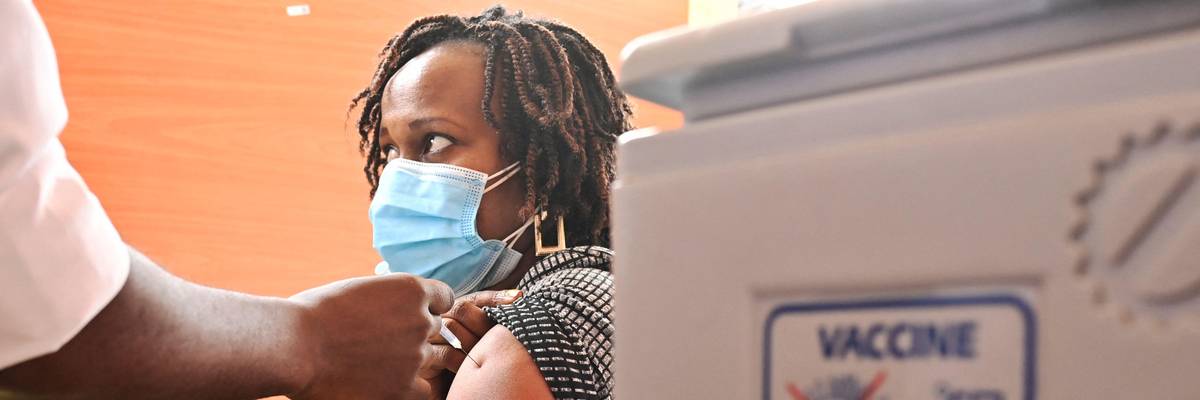
A Kenyan woman receives an injection with a dose of the Oxford/AstraZeneca Covid-19 vaccine at the Kenyatta national hospital in Nairobi on August 3, 2021. (Photo: Simon MAINA / AFP via Getty Images)
Exposing stark global vaccine inequity amid a fast-spreading delta variant, White House officials said Monday that at least 70% of U.S. adults are now at least partly vaccinated against the coronavirus--compared to just barely over 1% when it comes to the world's poorest nations.
White House Covid-19 data director Cyrus Shahpar marked the milestone--reached nearly a month after President Joe Biden's July 4 70% goal date--on Twitter:
There remains plenty of cause for concern, said Centers for Disease Control and Prevention Director Rochelle Walensky, who remarked Monday that despite an uptick in vaccination rates, "Covid-19 is clearly not done with us."
She pointed to CDC data as of Saturday showing the seven-day moving average of daily new Covid-19 cases up 44% to roughly 72,000 cases per day. The seven-day average daily deaths also increased 25% from the previous period, reaching 300 per day.
There's a glaring backdrop to the U.S. vaccination milestone, namely the canyon of difference in the percentage of the population in lower-income countries that have received doses. According to tracking by Our World in Data, just 1.1% of people in low-income countries have received at least one dose.
Referencing vaccines--"key to saving lives and blunting the pandemic"--World Health Organization (WHO) regional director for Africa Matshidiso Moeti said July 22 that the continent "continues to lag behind sadly."
"Just 20 million Africans or 1.5% of the continent's population are fully vaccinated so far," she said. "Just 1.7% of the 3.7 billion doses given globally have been administered in Africa."
Those figures underscore a crisis human rights campaigners have dubbed "vaccine apartheid."
As the Washington Post reported Friday, "wealthy nations cut deals directly with vaccine-makers, securing a disproportionately large share of early supply and undermining a fledgling Covax, the WHO-backed push to distribute shots equitably" on which Africa has been dependent. From the Post:
The WHO set a target of vaccinating at least 10% of the population of every country worldwide by the end of September, at least 40% by the end of the year and 70% by the middle of next year. Meeting that goal globally will require 11 billion doses, [WHO chief] Tedros said.
Africa is a long way off. Tedros said he is "concerned" that almost 70% of African countries won't meet the WHO target for September. To do so, the continent needs to administer roughly five times more doses per week than it is administering now.
To address the vaccine inequity, groups like the People's Vaccine Alliance have been demanding richer nations stop hoarding vaccine doses and considering "booster" shots for their citizens before lower income nations have yet to secure adequate first doses. The handful of wealthy nations including Germany that still oppose a proposed intellectual property waiver at the World Trade Organization must also drop their obstruction so that vaccine recipes and technology can be more widely distributed, the alliance says.
Humanitarian group Doctors Without Borders (MSF) has also laid out a number of demands directed at the Biden administration:
"Wealthy governments shouldn't be prioritizing giving third doses when much of the developing world hasn't even yet had the chance to get their first Covid-19 shots," Kate Elder, senior vaccines policy advisor at MSF's Access Campaign, said in a statement.
The world is at a "devastating place of vaccine inequity," she said, "precisely because pharmaceutical corporations prioritized profits over lives, and the countries where these companies are primarily based decided to pursue a 'me first' approach."
"The longer billions of people remain unvaccinated, the more variants will develop that threaten all of us," Elder added. "This profit-driven and self-centered approach is not only morally questionable, but shortsighted."
This country and this world are at a monumental crossroads. US voters have an opportunity to beat back the forces of fascism and confront the billionaires who are rigging the economy, our media system, and our democracy, making it increasingly impossible for ordinary people to get by. We’re not just talking about the election. We’re talking about what must be done once these fascist elements are vanquished from power. We need a bolder set of solutions than what either major party has so far been willing to offer and a working-class movement ready to fight like hell for it. Trump didn't emerge from nowhere. The conditions that fueled MAGA authoritarianism were created by decades of radical neoliberal economic policies and a corrupt political system dominated by corporate interests. They slashed taxes on the super-rich, promising that the benefits would trickle down. They said giveaways to the corporate titans would make life more affordable for the rest of us. It was all bullshit. And when a bitter, betrayed populace searches for someone to blame, right-wing demagogues have little trouble finding scapegoats. People know when they're being lied to, but you won't hear any of this from the corporate media. Only independent journalism—powered and funded by people who believe in building a better world—can deliver truly trustworthy daily news. If you share our vision, please contribute whatever you can to sustain our work. |
Exposing stark global vaccine inequity amid a fast-spreading delta variant, White House officials said Monday that at least 70% of U.S. adults are now at least partly vaccinated against the coronavirus--compared to just barely over 1% when it comes to the world's poorest nations.
White House Covid-19 data director Cyrus Shahpar marked the milestone--reached nearly a month after President Joe Biden's July 4 70% goal date--on Twitter:
There remains plenty of cause for concern, said Centers for Disease Control and Prevention Director Rochelle Walensky, who remarked Monday that despite an uptick in vaccination rates, "Covid-19 is clearly not done with us."
She pointed to CDC data as of Saturday showing the seven-day moving average of daily new Covid-19 cases up 44% to roughly 72,000 cases per day. The seven-day average daily deaths also increased 25% from the previous period, reaching 300 per day.
There's a glaring backdrop to the U.S. vaccination milestone, namely the canyon of difference in the percentage of the population in lower-income countries that have received doses. According to tracking by Our World in Data, just 1.1% of people in low-income countries have received at least one dose.
Referencing vaccines--"key to saving lives and blunting the pandemic"--World Health Organization (WHO) regional director for Africa Matshidiso Moeti said July 22 that the continent "continues to lag behind sadly."
"Just 20 million Africans or 1.5% of the continent's population are fully vaccinated so far," she said. "Just 1.7% of the 3.7 billion doses given globally have been administered in Africa."
Those figures underscore a crisis human rights campaigners have dubbed "vaccine apartheid."
As the Washington Post reported Friday, "wealthy nations cut deals directly with vaccine-makers, securing a disproportionately large share of early supply and undermining a fledgling Covax, the WHO-backed push to distribute shots equitably" on which Africa has been dependent. From the Post:
The WHO set a target of vaccinating at least 10% of the population of every country worldwide by the end of September, at least 40% by the end of the year and 70% by the middle of next year. Meeting that goal globally will require 11 billion doses, [WHO chief] Tedros said.
Africa is a long way off. Tedros said he is "concerned" that almost 70% of African countries won't meet the WHO target for September. To do so, the continent needs to administer roughly five times more doses per week than it is administering now.
To address the vaccine inequity, groups like the People's Vaccine Alliance have been demanding richer nations stop hoarding vaccine doses and considering "booster" shots for their citizens before lower income nations have yet to secure adequate first doses. The handful of wealthy nations including Germany that still oppose a proposed intellectual property waiver at the World Trade Organization must also drop their obstruction so that vaccine recipes and technology can be more widely distributed, the alliance says.
Humanitarian group Doctors Without Borders (MSF) has also laid out a number of demands directed at the Biden administration:
"Wealthy governments shouldn't be prioritizing giving third doses when much of the developing world hasn't even yet had the chance to get their first Covid-19 shots," Kate Elder, senior vaccines policy advisor at MSF's Access Campaign, said in a statement.
The world is at a "devastating place of vaccine inequity," she said, "precisely because pharmaceutical corporations prioritized profits over lives, and the countries where these companies are primarily based decided to pursue a 'me first' approach."
"The longer billions of people remain unvaccinated, the more variants will develop that threaten all of us," Elder added. "This profit-driven and self-centered approach is not only morally questionable, but shortsighted."