

SUBSCRIBE TO OUR FREE NEWSLETTER
Daily news & progressive opinion—funded by the people, not the corporations—delivered straight to your inbox.
5
#000000
#FFFFFF
To donate by check, phone, or other method, see our More Ways to Give page.
Daily news & progressive opinion—funded by the people, not the corporations—delivered straight to your inbox.
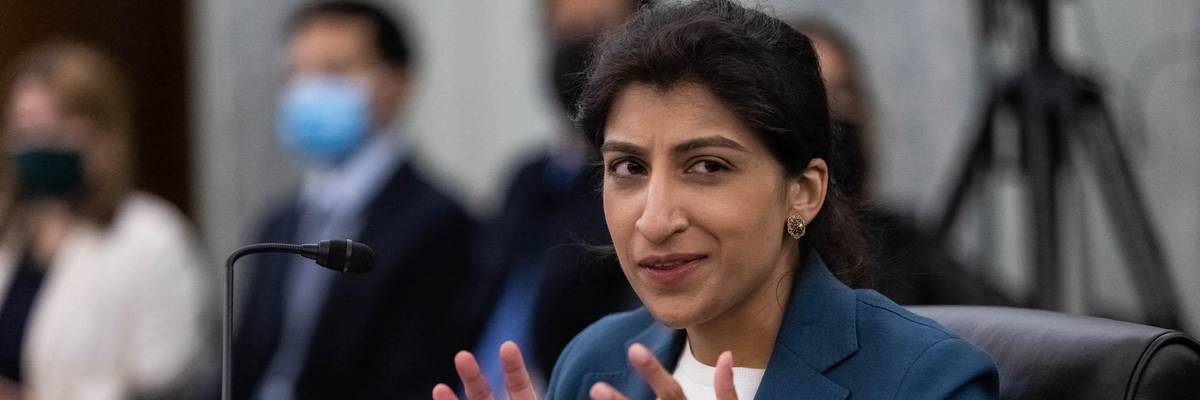
FTC Chair Lina Khan testifies during a Senate Committee on Commerce, Science, and Transportation hearing on Capitol Hill in Washington, D.C. on April 21, 2021.
Amazon filed a petition Wednesday seeking the recusal of newly confirmed Federal Trade Commission Chair Lina Khan from any antitrust probes involving the tech behemoth, arguing that Khan's past work criticizing the company means she cannot oversee such investigations in an impartial manner.
"Amazon is going to pursue every single angle they can invent to try to dodge scrutiny."
--Stacy Mitchell, Institute for Local Self-Reliance
Experts and commentators were quick to reject Amazon's case for Khan's recusal as absurd. Lindsey Barrett, a Fritz Family Fellow at the Institute for Technology Law and Policy at Georgetown Law, called Amazon's filing "an embarrassingly transparent ploy with zero substantive basis."
"I'm sure no one involved with filing this is ashamed of it, but they absolutely should be," added Barrett, who said Amazon's petition follows a "playbook" that powerful companies have used in the past to slime government regulators as overly biased and thus unqualified to perform their duties.
Stacy Mitchell, co-director of the Institute for Local Self-Reliance, described Amazon's 25-page petition (pdf) to the FTC as "predictable" and "ridiculous, obviously."
"Amazon is going to pursue every single angle they can invent to try to dodge scrutiny," Mitchell wrote on Twitter.
Amazon's filing comes two weeks after the U.S. Senate confirmed Khan, an expert in antitrust law, by an overwhelming bipartisan vote of 69-28. President Joe Biden promptly named Khan chair of the FTC.
Khan rose to prominence as an incisive critic of corporate concentration after the 2017 publication of her scholarly paper titled "Amazon's Antitrust Paradox," which examined how current antitrust law has failed to restrain the tech giant's monopolistic practices. The paper, published while Khan was still a student at Yale University, argues that "Amazon's business strategies and current market dominance pose anti-competitive concerns."
Amazon, which is currently the subject of an FTC investigation, points to the 2017 paper as well as Khan's work at the Open Markets Institute--an advocacy group that has called for the break-up of Amazon--as evidence of her supposed inability to run an unbiased probe.
"Khan has built her academic and professional career in large measure by pronouncing Amazon liable for violating the antitrust laws," Amazon's petition states. "Although Amazon profoundly disagrees with Chair Khan's conclusions about the company, it does not dispute her right to have spoken provocatively and at great length about it in her prior roles. But given her long track record of detailed pronouncements about Amazon, and her repeated proclamations that Amazon has violated the antitrust laws, a reasonable observer would conclude that she no longer can consider the company's antitrust defenses with an open mind."
Khan has yet to comment on Amazon's filing, which was submitted as the FTC is scrutinizing Amazon's proposed $8.5 billion purchase of MGM.
Matt Stoller, director of research at the American Economic Liberties Project, argued in response to the recusal petition that "having views on antitrust law is not a conflict of interest."
"And contrary to Amazon's claims, Khan's work has not been oriented towards criticizing Amazon or alleging guilt, it has been oriented towards understanding why the current interpretation of antitrust laws facilitates the growth of firms like Amazon. It's about the law," Stoller added. "Every FTC commissioner should absolutely have views about how we enforce and structure antitrust law. That's a job qualification, not an argument for recusals."
Dear Common Dreams reader, It’s been nearly 30 years since I co-founded Common Dreams with my late wife, Lina Newhouser. We had the radical notion that journalism should serve the public good, not corporate profits. It was clear to us from the outset what it would take to build such a project. No paid advertisements. No corporate sponsors. No millionaire publisher telling us what to think or do. Many people said we wouldn't last a year, but we proved those doubters wrong. Together with a tremendous team of journalists and dedicated staff, we built an independent media outlet free from the constraints of profits and corporate control. Our mission has always been simple: To inform. To inspire. To ignite change for the common good. Building Common Dreams was not easy. Our survival was never guaranteed. When you take on the most powerful forces—Wall Street greed, fossil fuel industry destruction, Big Tech lobbyists, and uber-rich oligarchs who have spent billions upon billions rigging the economy and democracy in their favor—the only bulwark you have is supporters who believe in your work. But here’s the urgent message from me today. It's never been this bad out there. And it's never been this hard to keep us going. At the very moment Common Dreams is most needed, the threats we face are intensifying. We need your support now more than ever. We don't accept corporate advertising and never will. We don't have a paywall because we don't think people should be blocked from critical news based on their ability to pay. Everything we do is funded by the donations of readers like you. When everyone does the little they can afford, we are strong. But if that support retreats or dries up, so do we. Will you donate now to make sure Common Dreams not only survives but thrives? —Craig Brown, Co-founder |
Amazon filed a petition Wednesday seeking the recusal of newly confirmed Federal Trade Commission Chair Lina Khan from any antitrust probes involving the tech behemoth, arguing that Khan's past work criticizing the company means she cannot oversee such investigations in an impartial manner.
"Amazon is going to pursue every single angle they can invent to try to dodge scrutiny."
--Stacy Mitchell, Institute for Local Self-Reliance
Experts and commentators were quick to reject Amazon's case for Khan's recusal as absurd. Lindsey Barrett, a Fritz Family Fellow at the Institute for Technology Law and Policy at Georgetown Law, called Amazon's filing "an embarrassingly transparent ploy with zero substantive basis."
"I'm sure no one involved with filing this is ashamed of it, but they absolutely should be," added Barrett, who said Amazon's petition follows a "playbook" that powerful companies have used in the past to slime government regulators as overly biased and thus unqualified to perform their duties.
Stacy Mitchell, co-director of the Institute for Local Self-Reliance, described Amazon's 25-page petition (pdf) to the FTC as "predictable" and "ridiculous, obviously."
"Amazon is going to pursue every single angle they can invent to try to dodge scrutiny," Mitchell wrote on Twitter.
Amazon's filing comes two weeks after the U.S. Senate confirmed Khan, an expert in antitrust law, by an overwhelming bipartisan vote of 69-28. President Joe Biden promptly named Khan chair of the FTC.
Khan rose to prominence as an incisive critic of corporate concentration after the 2017 publication of her scholarly paper titled "Amazon's Antitrust Paradox," which examined how current antitrust law has failed to restrain the tech giant's monopolistic practices. The paper, published while Khan was still a student at Yale University, argues that "Amazon's business strategies and current market dominance pose anti-competitive concerns."
Amazon, which is currently the subject of an FTC investigation, points to the 2017 paper as well as Khan's work at the Open Markets Institute--an advocacy group that has called for the break-up of Amazon--as evidence of her supposed inability to run an unbiased probe.
"Khan has built her academic and professional career in large measure by pronouncing Amazon liable for violating the antitrust laws," Amazon's petition states. "Although Amazon profoundly disagrees with Chair Khan's conclusions about the company, it does not dispute her right to have spoken provocatively and at great length about it in her prior roles. But given her long track record of detailed pronouncements about Amazon, and her repeated proclamations that Amazon has violated the antitrust laws, a reasonable observer would conclude that she no longer can consider the company's antitrust defenses with an open mind."
Khan has yet to comment on Amazon's filing, which was submitted as the FTC is scrutinizing Amazon's proposed $8.5 billion purchase of MGM.
Matt Stoller, director of research at the American Economic Liberties Project, argued in response to the recusal petition that "having views on antitrust law is not a conflict of interest."
"And contrary to Amazon's claims, Khan's work has not been oriented towards criticizing Amazon or alleging guilt, it has been oriented towards understanding why the current interpretation of antitrust laws facilitates the growth of firms like Amazon. It's about the law," Stoller added. "Every FTC commissioner should absolutely have views about how we enforce and structure antitrust law. That's a job qualification, not an argument for recusals."
Amazon filed a petition Wednesday seeking the recusal of newly confirmed Federal Trade Commission Chair Lina Khan from any antitrust probes involving the tech behemoth, arguing that Khan's past work criticizing the company means she cannot oversee such investigations in an impartial manner.
"Amazon is going to pursue every single angle they can invent to try to dodge scrutiny."
--Stacy Mitchell, Institute for Local Self-Reliance
Experts and commentators were quick to reject Amazon's case for Khan's recusal as absurd. Lindsey Barrett, a Fritz Family Fellow at the Institute for Technology Law and Policy at Georgetown Law, called Amazon's filing "an embarrassingly transparent ploy with zero substantive basis."
"I'm sure no one involved with filing this is ashamed of it, but they absolutely should be," added Barrett, who said Amazon's petition follows a "playbook" that powerful companies have used in the past to slime government regulators as overly biased and thus unqualified to perform their duties.
Stacy Mitchell, co-director of the Institute for Local Self-Reliance, described Amazon's 25-page petition (pdf) to the FTC as "predictable" and "ridiculous, obviously."
"Amazon is going to pursue every single angle they can invent to try to dodge scrutiny," Mitchell wrote on Twitter.
Amazon's filing comes two weeks after the U.S. Senate confirmed Khan, an expert in antitrust law, by an overwhelming bipartisan vote of 69-28. President Joe Biden promptly named Khan chair of the FTC.
Khan rose to prominence as an incisive critic of corporate concentration after the 2017 publication of her scholarly paper titled "Amazon's Antitrust Paradox," which examined how current antitrust law has failed to restrain the tech giant's monopolistic practices. The paper, published while Khan was still a student at Yale University, argues that "Amazon's business strategies and current market dominance pose anti-competitive concerns."
Amazon, which is currently the subject of an FTC investigation, points to the 2017 paper as well as Khan's work at the Open Markets Institute--an advocacy group that has called for the break-up of Amazon--as evidence of her supposed inability to run an unbiased probe.
"Khan has built her academic and professional career in large measure by pronouncing Amazon liable for violating the antitrust laws," Amazon's petition states. "Although Amazon profoundly disagrees with Chair Khan's conclusions about the company, it does not dispute her right to have spoken provocatively and at great length about it in her prior roles. But given her long track record of detailed pronouncements about Amazon, and her repeated proclamations that Amazon has violated the antitrust laws, a reasonable observer would conclude that she no longer can consider the company's antitrust defenses with an open mind."
Khan has yet to comment on Amazon's filing, which was submitted as the FTC is scrutinizing Amazon's proposed $8.5 billion purchase of MGM.
Matt Stoller, director of research at the American Economic Liberties Project, argued in response to the recusal petition that "having views on antitrust law is not a conflict of interest."
"And contrary to Amazon's claims, Khan's work has not been oriented towards criticizing Amazon or alleging guilt, it has been oriented towards understanding why the current interpretation of antitrust laws facilitates the growth of firms like Amazon. It's about the law," Stoller added. "Every FTC commissioner should absolutely have views about how we enforce and structure antitrust law. That's a job qualification, not an argument for recusals."

