SUBSCRIBE TO OUR FREE NEWSLETTER
Daily news & progressive opinion—funded by the people, not the corporations—delivered straight to your inbox.
5
#000000
#FFFFFF
To donate by check, phone, or other method, see our More Ways to Give page.
Daily news & progressive opinion—funded by the people, not the corporations—delivered straight to your inbox.
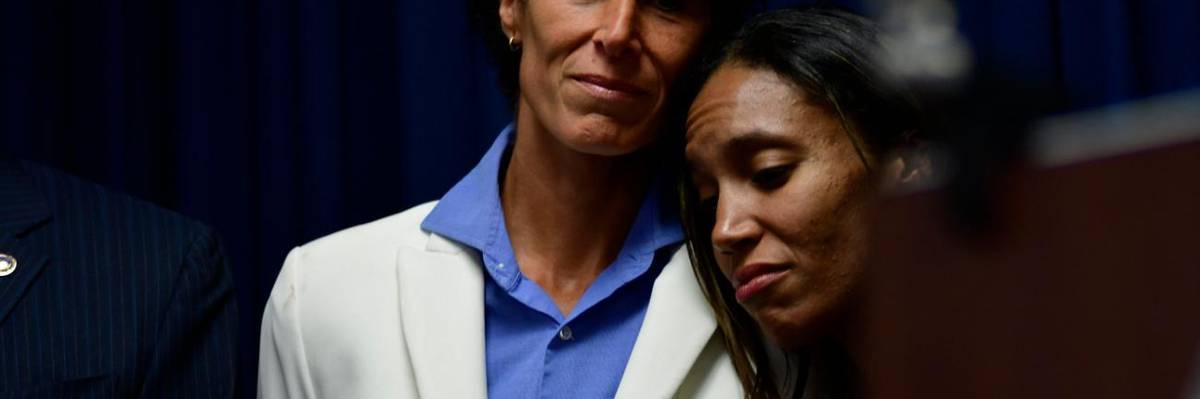
Andrea Constand and her attorney react to the Bill Cosby's sexual assault conviction at the Montgomery County District Attorney's office in Norristown, Pennsylvania on April 26, 2018. (Photo: Bastiaan Slabbers/NurPhoto via Getty Images)
Women's rights advocates expressed solidarity on Wednesday with the 60 women who came forward to tell their stories of sexual abuse at the hands of Bill Cosby after the actor's conviction was overturned by the Pennsylvania Supreme Court.
The seven-judge panel ruled that Cosby should not have been convicted in 2018 on three counts of aggravated indecent assault of his former mentee, Andrea Constand, due to a "non-prosecution agreement" he had reached earlier with a former prosecutor.
Cosby struck an agreement--of which there is no written record, according to the Associated Press--in 2005 with former Montgomery County District Attorney Bruce Castor Jr. As he was being investigated for drugging and sexually assaulting Constand, Castor gave Cosby an assurance that he would not be prosecuted if he testified in a civil case brought by Constand.
"His release means that Cosby, a sexual predator, was incarcerated within a criminal legal system that has as little regard for its own rules and procedures as Cosby does for his victims."
--Marc Lamont Hill, Temple University
The assurance led Cosby to testify that he had given quaaludes to women in order to rape them--a testimony that was used by Castor's successor to charge Cosby in 2015, days before the statute of limitations expired in Constand's case.
"In light of these circumstances, the subsequent decision by successor D.A.s to prosecute Cosby violated Cosby's due process rights," the state's high court said in its ruling.
The ruling will allow Cosby to leave the maximum-security facility where he's been imprisoned after serving nearly three years of his three-to-10 year sentence. The justices barred prosecutors from attempting to retry the case in Pennsylvania.
The anti-sexual assault campaign No More was among those expressing support for dozens of survivors who came forward to accuse Cosby of a pattern of abuse and violence that was exemplified by Constand's case.
Temple University professor and author Marc Lamont Hill emphasized that the court's decision did not exonerate Cosby, but rather revealed the inner workings of an unjust legal system.
Josie Duffy Rice, former president of criminal justice publication The Appeal, blamed "prosecutorial misconduct" for the outcome of Cosby's case, in which the former TV star vowed to serve all 10 years of his sentence rather than express remorse or admit wrongdoing despite his earlier admission that he had drugged and raped women.
A number of observers linked the ruling to the fact that more than two-thirds of sexual assaults are never reported to the police, with survivors reticent to try to convince law enforcement, the court system, and in cases like Cosby's, the broader public, that their experience really happened.
"We stand with all 60 survivors of Cosby's actions, who bravely came forward with their experiences, which include being drugged, raped, assaulted, threatened, and gaslighted, only to find their abuser let off the hook," said Shaunna Thomas, executive director of women's advocacy group UltraViolet. "Today is a blow to survivors everywhere, who deserve so much better than this."
Dear Common Dreams reader, It’s been nearly 30 years since I co-founded Common Dreams with my late wife, Lina Newhouser. We had the radical notion that journalism should serve the public good, not corporate profits. It was clear to us from the outset what it would take to build such a project. No paid advertisements. No corporate sponsors. No millionaire publisher telling us what to think or do. Many people said we wouldn't last a year, but we proved those doubters wrong. Together with a tremendous team of journalists and dedicated staff, we built an independent media outlet free from the constraints of profits and corporate control. Our mission has always been simple: To inform. To inspire. To ignite change for the common good. Building Common Dreams was not easy. Our survival was never guaranteed. When you take on the most powerful forces—Wall Street greed, fossil fuel industry destruction, Big Tech lobbyists, and uber-rich oligarchs who have spent billions upon billions rigging the economy and democracy in their favor—the only bulwark you have is supporters who believe in your work. But here’s the urgent message from me today. It's never been this bad out there. And it's never been this hard to keep us going. At the very moment Common Dreams is most needed, the threats we face are intensifying. We need your support now more than ever. We don't accept corporate advertising and never will. We don't have a paywall because we don't think people should be blocked from critical news based on their ability to pay. Everything we do is funded by the donations of readers like you. When everyone does the little they can afford, we are strong. But if that support retreats or dries up, so do we. Will you donate now to make sure Common Dreams not only survives but thrives? —Craig Brown, Co-founder |
Women's rights advocates expressed solidarity on Wednesday with the 60 women who came forward to tell their stories of sexual abuse at the hands of Bill Cosby after the actor's conviction was overturned by the Pennsylvania Supreme Court.
The seven-judge panel ruled that Cosby should not have been convicted in 2018 on three counts of aggravated indecent assault of his former mentee, Andrea Constand, due to a "non-prosecution agreement" he had reached earlier with a former prosecutor.
Cosby struck an agreement--of which there is no written record, according to the Associated Press--in 2005 with former Montgomery County District Attorney Bruce Castor Jr. As he was being investigated for drugging and sexually assaulting Constand, Castor gave Cosby an assurance that he would not be prosecuted if he testified in a civil case brought by Constand.
"His release means that Cosby, a sexual predator, was incarcerated within a criminal legal system that has as little regard for its own rules and procedures as Cosby does for his victims."
--Marc Lamont Hill, Temple University
The assurance led Cosby to testify that he had given quaaludes to women in order to rape them--a testimony that was used by Castor's successor to charge Cosby in 2015, days before the statute of limitations expired in Constand's case.
"In light of these circumstances, the subsequent decision by successor D.A.s to prosecute Cosby violated Cosby's due process rights," the state's high court said in its ruling.
The ruling will allow Cosby to leave the maximum-security facility where he's been imprisoned after serving nearly three years of his three-to-10 year sentence. The justices barred prosecutors from attempting to retry the case in Pennsylvania.
The anti-sexual assault campaign No More was among those expressing support for dozens of survivors who came forward to accuse Cosby of a pattern of abuse and violence that was exemplified by Constand's case.
Temple University professor and author Marc Lamont Hill emphasized that the court's decision did not exonerate Cosby, but rather revealed the inner workings of an unjust legal system.
Josie Duffy Rice, former president of criminal justice publication The Appeal, blamed "prosecutorial misconduct" for the outcome of Cosby's case, in which the former TV star vowed to serve all 10 years of his sentence rather than express remorse or admit wrongdoing despite his earlier admission that he had drugged and raped women.
A number of observers linked the ruling to the fact that more than two-thirds of sexual assaults are never reported to the police, with survivors reticent to try to convince law enforcement, the court system, and in cases like Cosby's, the broader public, that their experience really happened.
"We stand with all 60 survivors of Cosby's actions, who bravely came forward with their experiences, which include being drugged, raped, assaulted, threatened, and gaslighted, only to find their abuser let off the hook," said Shaunna Thomas, executive director of women's advocacy group UltraViolet. "Today is a blow to survivors everywhere, who deserve so much better than this."
Women's rights advocates expressed solidarity on Wednesday with the 60 women who came forward to tell their stories of sexual abuse at the hands of Bill Cosby after the actor's conviction was overturned by the Pennsylvania Supreme Court.
The seven-judge panel ruled that Cosby should not have been convicted in 2018 on three counts of aggravated indecent assault of his former mentee, Andrea Constand, due to a "non-prosecution agreement" he had reached earlier with a former prosecutor.
Cosby struck an agreement--of which there is no written record, according to the Associated Press--in 2005 with former Montgomery County District Attorney Bruce Castor Jr. As he was being investigated for drugging and sexually assaulting Constand, Castor gave Cosby an assurance that he would not be prosecuted if he testified in a civil case brought by Constand.
"His release means that Cosby, a sexual predator, was incarcerated within a criminal legal system that has as little regard for its own rules and procedures as Cosby does for his victims."
--Marc Lamont Hill, Temple University
The assurance led Cosby to testify that he had given quaaludes to women in order to rape them--a testimony that was used by Castor's successor to charge Cosby in 2015, days before the statute of limitations expired in Constand's case.
"In light of these circumstances, the subsequent decision by successor D.A.s to prosecute Cosby violated Cosby's due process rights," the state's high court said in its ruling.
The ruling will allow Cosby to leave the maximum-security facility where he's been imprisoned after serving nearly three years of his three-to-10 year sentence. The justices barred prosecutors from attempting to retry the case in Pennsylvania.
The anti-sexual assault campaign No More was among those expressing support for dozens of survivors who came forward to accuse Cosby of a pattern of abuse and violence that was exemplified by Constand's case.
Temple University professor and author Marc Lamont Hill emphasized that the court's decision did not exonerate Cosby, but rather revealed the inner workings of an unjust legal system.
Josie Duffy Rice, former president of criminal justice publication The Appeal, blamed "prosecutorial misconduct" for the outcome of Cosby's case, in which the former TV star vowed to serve all 10 years of his sentence rather than express remorse or admit wrongdoing despite his earlier admission that he had drugged and raped women.
A number of observers linked the ruling to the fact that more than two-thirds of sexual assaults are never reported to the police, with survivors reticent to try to convince law enforcement, the court system, and in cases like Cosby's, the broader public, that their experience really happened.
"We stand with all 60 survivors of Cosby's actions, who bravely came forward with their experiences, which include being drugged, raped, assaulted, threatened, and gaslighted, only to find their abuser let off the hook," said Shaunna Thomas, executive director of women's advocacy group UltraViolet. "Today is a blow to survivors everywhere, who deserve so much better than this."