SUBSCRIBE TO OUR FREE NEWSLETTER
Daily news & progressive opinion—funded by the people, not the corporations—delivered straight to your inbox.
5
#000000
#FFFFFF
To donate by check, phone, or other method, see our More Ways to Give page.
Daily news & progressive opinion—funded by the people, not the corporations—delivered straight to your inbox.
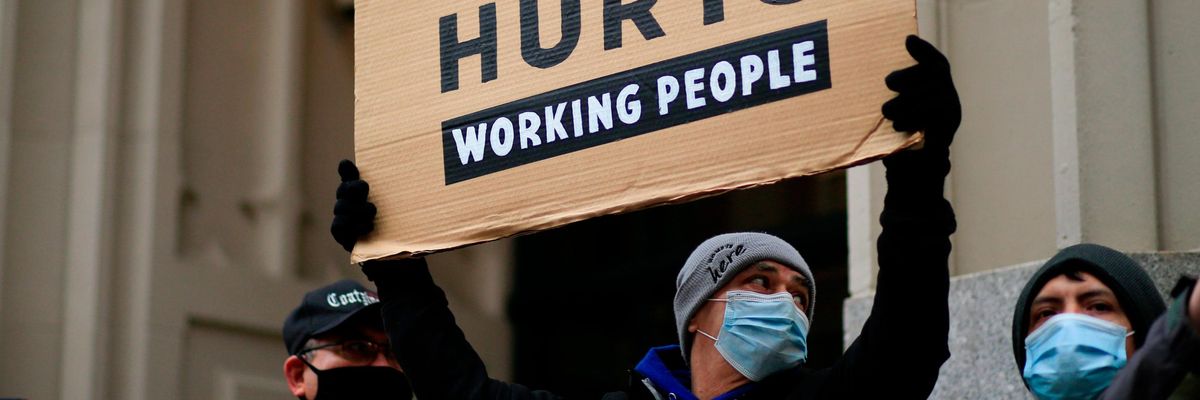
Amazon workers and community allies demonstrate during a protest organized by New York Communities for Change and Make the Road New York in front of the Jeff Bezos' Manhattan residence on December 2, 2020. (Photo: Kena Betancur/AFP via Getty Images)
Progressive opponents of corporate consolidation are pushing the Biden administration to intervene after Amazon announced Wednesday that it has agreed to acquire the Hollywood film and television studio MGM for nearly $8.5 billion, a deal that critics denounced as harmful to workers, consumers, and U.S. democracy.
"In announcing plans to buy MGM, Jeff Bezos placed a big softball on a tee for the Biden administration to knock over the fence," Barry Lynn, executive director of Open Markets Institute, said in a statement. "It should be immediately blocked."
"Amazon should be broken apart from the warehouses. This MGM nonsense is exactly the wrong direction. Stop the monopoly madness."
-- Zephyr Teachout, Fordham University
As the Wall Street Journal reported, Amazon's purchase of MGM will net the e-commerce behemoth "a library of over 4,000 films, including iconic franchises such as 'James Bond' and 'Rocky,' and classics such as 'The Silence of the Lambs,' 'Raging Bull,' and '12 Angry Men.'"
"The TV catalog includes critically acclaimed shows such as 'The Handmaid's Tale,' 'Fargo,' and 'Vikings,'" the newspaper noted.
Made public just days after AT&T announced a $43 billion agreement to combine its content arm WarnerMedia with Discovery, Amazon's purchase of MGM, according to the Financial Times, "propel[s] media dealmaking so far this year to its highest level since the turn of the century with more than $240 billion worth of transactions announced."
The new acquisition prompted fresh calls for congressional action to break up Amazon, which in recent years has become what one observer described as "a sprawling array of loosely related businesses under one roof."
"Amazon should be broken apart from the warehouses," Zephyr Teachout, associate professor of law at Fordham University, tweeted Wednesday. "This MGM nonsense is exactly the wrong direction. Stop the monopoly madness."
Rep. David Cicilline (D-R.I.), chair of the House Antitrust Subcommittee, argued that Amazon's planned takeover of MGM "reinforces what we already know--they are laser-focused on expanding and entrenching their monopoly power."
News of Amazon's move to buy up MGM came hours after Washington, D.C. Attorney General Karl Racine filed suit against the corporate giant on Tuesday for "illegally abusing and maintaining its monopoly power by controlling prices across the online retail market."
"This deal is bad for anyone who watches movies in theaters or streams movies and other shows online. It is bad for the people who write, film, edit, produce, and act in movies. It is bad for workers. And it is bad for American democracy."
--Barry Lynn, Open Markets Institute
"Amazon has used its dominant position in the online retail market to win at all costs," Racine said in a statement. "It maximizes its profits at the expense of third-party sellers and consumers, while harming competition, stifling innovation, and illegally tilting the playing field in its favor."
It's unclear how regulators in the Biden administration will respond to Amazon's acquisition of MGM, the tech giant's largest-ever media purchase. Critically, President Joe Biden has yet to nominate an official to lead the Justice Department's Antitrust Division--and progressives have raised alarm at some of the candidates floated for the key post thus far.
In his statement on Wednesday, Lynn of the Open Markets Institute said that the Amazon-MGM deal "underscores the need for the Biden administration to use its appointment of a head of the Antitrust Division within the Department of Justice and a new chair for the Federal Trade Commission to demonstrate that it takes America's severe and worsening monopoly crisis seriously."
"This deal is bad for anyone who watches movies in theaters or streams movies and other shows online," said Lynn. "It is bad for the people who write, film, edit, produce, and act in movies. It is bad for workers. And it is bad for American democracy."
Dear Common Dreams reader, It’s been nearly 30 years since I co-founded Common Dreams with my late wife, Lina Newhouser. We had the radical notion that journalism should serve the public good, not corporate profits. It was clear to us from the outset what it would take to build such a project. No paid advertisements. No corporate sponsors. No millionaire publisher telling us what to think or do. Many people said we wouldn't last a year, but we proved those doubters wrong. Together with a tremendous team of journalists and dedicated staff, we built an independent media outlet free from the constraints of profits and corporate control. Our mission has always been simple: To inform. To inspire. To ignite change for the common good. Building Common Dreams was not easy. Our survival was never guaranteed. When you take on the most powerful forces—Wall Street greed, fossil fuel industry destruction, Big Tech lobbyists, and uber-rich oligarchs who have spent billions upon billions rigging the economy and democracy in their favor—the only bulwark you have is supporters who believe in your work. But here’s the urgent message from me today. It's never been this bad out there. And it's never been this hard to keep us going. At the very moment Common Dreams is most needed, the threats we face are intensifying. We need your support now more than ever. We don't accept corporate advertising and never will. We don't have a paywall because we don't think people should be blocked from critical news based on their ability to pay. Everything we do is funded by the donations of readers like you. When everyone does the little they can afford, we are strong. But if that support retreats or dries up, so do we. Will you donate now to make sure Common Dreams not only survives but thrives? —Craig Brown, Co-founder |
Progressive opponents of corporate consolidation are pushing the Biden administration to intervene after Amazon announced Wednesday that it has agreed to acquire the Hollywood film and television studio MGM for nearly $8.5 billion, a deal that critics denounced as harmful to workers, consumers, and U.S. democracy.
"In announcing plans to buy MGM, Jeff Bezos placed a big softball on a tee for the Biden administration to knock over the fence," Barry Lynn, executive director of Open Markets Institute, said in a statement. "It should be immediately blocked."
"Amazon should be broken apart from the warehouses. This MGM nonsense is exactly the wrong direction. Stop the monopoly madness."
-- Zephyr Teachout, Fordham University
As the Wall Street Journal reported, Amazon's purchase of MGM will net the e-commerce behemoth "a library of over 4,000 films, including iconic franchises such as 'James Bond' and 'Rocky,' and classics such as 'The Silence of the Lambs,' 'Raging Bull,' and '12 Angry Men.'"
"The TV catalog includes critically acclaimed shows such as 'The Handmaid's Tale,' 'Fargo,' and 'Vikings,'" the newspaper noted.
Made public just days after AT&T announced a $43 billion agreement to combine its content arm WarnerMedia with Discovery, Amazon's purchase of MGM, according to the Financial Times, "propel[s] media dealmaking so far this year to its highest level since the turn of the century with more than $240 billion worth of transactions announced."
The new acquisition prompted fresh calls for congressional action to break up Amazon, which in recent years has become what one observer described as "a sprawling array of loosely related businesses under one roof."
"Amazon should be broken apart from the warehouses," Zephyr Teachout, associate professor of law at Fordham University, tweeted Wednesday. "This MGM nonsense is exactly the wrong direction. Stop the monopoly madness."
Rep. David Cicilline (D-R.I.), chair of the House Antitrust Subcommittee, argued that Amazon's planned takeover of MGM "reinforces what we already know--they are laser-focused on expanding and entrenching their monopoly power."
News of Amazon's move to buy up MGM came hours after Washington, D.C. Attorney General Karl Racine filed suit against the corporate giant on Tuesday for "illegally abusing and maintaining its monopoly power by controlling prices across the online retail market."
"This deal is bad for anyone who watches movies in theaters or streams movies and other shows online. It is bad for the people who write, film, edit, produce, and act in movies. It is bad for workers. And it is bad for American democracy."
--Barry Lynn, Open Markets Institute
"Amazon has used its dominant position in the online retail market to win at all costs," Racine said in a statement. "It maximizes its profits at the expense of third-party sellers and consumers, while harming competition, stifling innovation, and illegally tilting the playing field in its favor."
It's unclear how regulators in the Biden administration will respond to Amazon's acquisition of MGM, the tech giant's largest-ever media purchase. Critically, President Joe Biden has yet to nominate an official to lead the Justice Department's Antitrust Division--and progressives have raised alarm at some of the candidates floated for the key post thus far.
In his statement on Wednesday, Lynn of the Open Markets Institute said that the Amazon-MGM deal "underscores the need for the Biden administration to use its appointment of a head of the Antitrust Division within the Department of Justice and a new chair for the Federal Trade Commission to demonstrate that it takes America's severe and worsening monopoly crisis seriously."
"This deal is bad for anyone who watches movies in theaters or streams movies and other shows online," said Lynn. "It is bad for the people who write, film, edit, produce, and act in movies. It is bad for workers. And it is bad for American democracy."
Progressive opponents of corporate consolidation are pushing the Biden administration to intervene after Amazon announced Wednesday that it has agreed to acquire the Hollywood film and television studio MGM for nearly $8.5 billion, a deal that critics denounced as harmful to workers, consumers, and U.S. democracy.
"In announcing plans to buy MGM, Jeff Bezos placed a big softball on a tee for the Biden administration to knock over the fence," Barry Lynn, executive director of Open Markets Institute, said in a statement. "It should be immediately blocked."
"Amazon should be broken apart from the warehouses. This MGM nonsense is exactly the wrong direction. Stop the monopoly madness."
-- Zephyr Teachout, Fordham University
As the Wall Street Journal reported, Amazon's purchase of MGM will net the e-commerce behemoth "a library of over 4,000 films, including iconic franchises such as 'James Bond' and 'Rocky,' and classics such as 'The Silence of the Lambs,' 'Raging Bull,' and '12 Angry Men.'"
"The TV catalog includes critically acclaimed shows such as 'The Handmaid's Tale,' 'Fargo,' and 'Vikings,'" the newspaper noted.
Made public just days after AT&T announced a $43 billion agreement to combine its content arm WarnerMedia with Discovery, Amazon's purchase of MGM, according to the Financial Times, "propel[s] media dealmaking so far this year to its highest level since the turn of the century with more than $240 billion worth of transactions announced."
The new acquisition prompted fresh calls for congressional action to break up Amazon, which in recent years has become what one observer described as "a sprawling array of loosely related businesses under one roof."
"Amazon should be broken apart from the warehouses," Zephyr Teachout, associate professor of law at Fordham University, tweeted Wednesday. "This MGM nonsense is exactly the wrong direction. Stop the monopoly madness."
Rep. David Cicilline (D-R.I.), chair of the House Antitrust Subcommittee, argued that Amazon's planned takeover of MGM "reinforces what we already know--they are laser-focused on expanding and entrenching their monopoly power."
News of Amazon's move to buy up MGM came hours after Washington, D.C. Attorney General Karl Racine filed suit against the corporate giant on Tuesday for "illegally abusing and maintaining its monopoly power by controlling prices across the online retail market."
"This deal is bad for anyone who watches movies in theaters or streams movies and other shows online. It is bad for the people who write, film, edit, produce, and act in movies. It is bad for workers. And it is bad for American democracy."
--Barry Lynn, Open Markets Institute
"Amazon has used its dominant position in the online retail market to win at all costs," Racine said in a statement. "It maximizes its profits at the expense of third-party sellers and consumers, while harming competition, stifling innovation, and illegally tilting the playing field in its favor."
It's unclear how regulators in the Biden administration will respond to Amazon's acquisition of MGM, the tech giant's largest-ever media purchase. Critically, President Joe Biden has yet to nominate an official to lead the Justice Department's Antitrust Division--and progressives have raised alarm at some of the candidates floated for the key post thus far.
In his statement on Wednesday, Lynn of the Open Markets Institute said that the Amazon-MGM deal "underscores the need for the Biden administration to use its appointment of a head of the Antitrust Division within the Department of Justice and a new chair for the Federal Trade Commission to demonstrate that it takes America's severe and worsening monopoly crisis seriously."
"This deal is bad for anyone who watches movies in theaters or streams movies and other shows online," said Lynn. "It is bad for the people who write, film, edit, produce, and act in movies. It is bad for workers. And it is bad for American democracy."