

SUBSCRIBE TO OUR FREE NEWSLETTER
Daily news & progressive opinion—funded by the people, not the corporations—delivered straight to your inbox.
5
#000000
#FFFFFF
To donate by check, phone, or other method, see our More Ways to Give page.
Daily news & progressive opinion—funded by the people, not the corporations—delivered straight to your inbox.
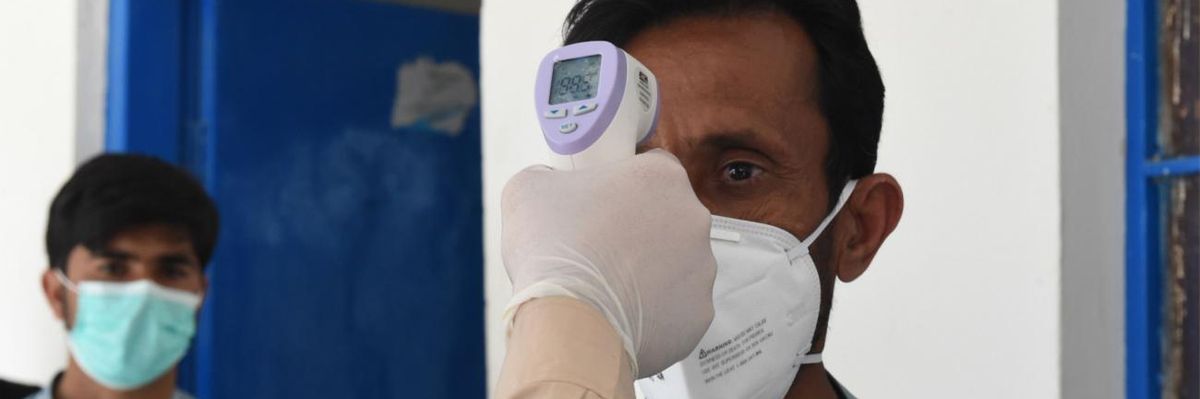
A doctor checks the body temperature of a man returning from Iran at a quarantine zone to test for the coronavirus in the Pakistan-Iran border town of Taftan on February 25, 2020. An international panel called February 2020 a "lost month" during which the global community failed to work cooperatively to get the pandemic under control. (Photo by Banaras Khan / AFP via Getty Images)
A lack of global leadership, raging inequality, and lack of a functionary alert system were pinpointed as among the key failures as the Covid-19 outbreak took hold last year, an international panel announced in a new report released Wednesday.
The report--titled Covid-19: Make it the Last Pandemic (pdf)--warns fundamental changes must be made to defeat future pandemics.
Compiled by the Independent Panel for Pandemic Preparedness and Response (IPPPR), the study was the work of a 13-member committee formed last year as the coronavirus spread across the world.
"Preparation was inconsistent and underfunded," the official report summary (pdf) reads. "The alert system was too slow--and too meek. The World Health Organization was under-powered. The response has exacerbated inequalities. Global political leadership was absent."
"Preparation was inconsistent and underfunded. The alert system was too slow--and too meek. The World Health Organization was under-powered. The response has exacerbated inequalities. Global political leadership was absent."
--IPPPR
"The combination of poor strategic choices, unwillingness to tackle inequalities, and an uncoordinated system created a toxic cocktail which allowed the pandemic to turn into a catastrophic human crisis," the report adds.
As the world continues to battle the virus--including devastating situations in India, Nepal, and many other nations and regions without access to vaccines and other medical supplies--the IPPPR said the world must not miss a crucial opportunity for a course correction.
The global community "must learn from this crisis, and plan for the next one," the experts said. "Otherwise, precious time and momentum will be lost...Covid-19 has been a terrible wake-up call. So now the world needs to wake up, and commit to clear targets, additional resources, new measures, and strong leadership to prepare for the future."
The report points to the slow response by the World Health Organization (WHO)--which was hampered by formal procedures under the International Health Regulations (IHR)--for allowing the pandemic to spread from Wuhan, China to the rest of the world in a matter of weeks in early 2020, calling February 2020 "a lost month."
A Public Health Emergency of International Concern (PHEIC) should have been declared by WHO's Emergency Committee on January 22, 2020, instead of a week later, the panel said. When the PHEIC was finally declared, it "was not followed by forceful and immediate emergency responses in most countries, despite the mounting evidence that a highly contagious new pathogen was spreading around the world," and was also not accompanied by warnings of human-to-human transmission, as the WHO was still assessing how the pathogen was spread.
"The Panel's view is that [WHO] could also have told countries that they should take the precaution of assuming that human-to-human transmission was occurring," the IPPPR said.
The panel also noted that the pandemic, which laid bare inequalities around the globe and within individual countries as middle- and upper-class people were far more able to protect themselves from the virus as the working poor were often left to their own devices on the front lines of the crisis, was able to spread as far as it has because world leaders have been unwilling to tackle inequalities.
"Building resilient and equitable societies requires a serious shift in mindsets. The extent to which the Covid-19 pandemic has exacerbated inequalities is an emphatic demonstration of the interconnectedness of social, economic, environmental, and political factors in society," the report states.
The panel urged governments to "increase the threshold of national health and social investments to build resilient health and social protection systems, grounded in high-quality primary and community health services, universal health coverage, and a strong and well-supported health workforce."
To help the Global South to prepare for another pandemic, the panel said wealthy countries should invest $5 billion to $10 billion annually in an International Pandemic Financing Facility, which would allow poor countries to stock up on personal protective equipment, testing supplies, and other infrastructure.
Such investments are "not out of proportion to many things we do already," Mark Dybul, a physician at Georgetown University and member of the panel, told Science magazine.
Other recommendations include:
In the immediate term, recommendations include a waiver of intellectual property rights for vaccines that exist for Covid-19 "should come into force immediately" to ensure all countries can get current outbreaks under control.
Miliband noted that previous global committees have made recommendations for pandemic preparedness--which have not been implemented.
"We have been warned. Let's not ignore again," he tweeted.
Implementation of the panel's recommendations "will put the world on course to ensure that this is the last pandemic causing devastation on the scale we are experiencing now," Sirleaf said Wednesday.
Dear Common Dreams reader, It’s been nearly 30 years since I co-founded Common Dreams with my late wife, Lina Newhouser. We had the radical notion that journalism should serve the public good, not corporate profits. It was clear to us from the outset what it would take to build such a project. No paid advertisements. No corporate sponsors. No millionaire publisher telling us what to think or do. Many people said we wouldn't last a year, but we proved those doubters wrong. Together with a tremendous team of journalists and dedicated staff, we built an independent media outlet free from the constraints of profits and corporate control. Our mission has always been simple: To inform. To inspire. To ignite change for the common good. Building Common Dreams was not easy. Our survival was never guaranteed. When you take on the most powerful forces—Wall Street greed, fossil fuel industry destruction, Big Tech lobbyists, and uber-rich oligarchs who have spent billions upon billions rigging the economy and democracy in their favor—the only bulwark you have is supporters who believe in your work. But here’s the urgent message from me today. It's never been this bad out there. And it's never been this hard to keep us going. At the very moment Common Dreams is most needed, the threats we face are intensifying. We need your support now more than ever. We don't accept corporate advertising and never will. We don't have a paywall because we don't think people should be blocked from critical news based on their ability to pay. Everything we do is funded by the donations of readers like you. When everyone does the little they can afford, we are strong. But if that support retreats or dries up, so do we. Will you donate now to make sure Common Dreams not only survives but thrives? —Craig Brown, Co-founder |
A lack of global leadership, raging inequality, and lack of a functionary alert system were pinpointed as among the key failures as the Covid-19 outbreak took hold last year, an international panel announced in a new report released Wednesday.
The report--titled Covid-19: Make it the Last Pandemic (pdf)--warns fundamental changes must be made to defeat future pandemics.
Compiled by the Independent Panel for Pandemic Preparedness and Response (IPPPR), the study was the work of a 13-member committee formed last year as the coronavirus spread across the world.
"Preparation was inconsistent and underfunded," the official report summary (pdf) reads. "The alert system was too slow--and too meek. The World Health Organization was under-powered. The response has exacerbated inequalities. Global political leadership was absent."
"Preparation was inconsistent and underfunded. The alert system was too slow--and too meek. The World Health Organization was under-powered. The response has exacerbated inequalities. Global political leadership was absent."
--IPPPR
"The combination of poor strategic choices, unwillingness to tackle inequalities, and an uncoordinated system created a toxic cocktail which allowed the pandemic to turn into a catastrophic human crisis," the report adds.
As the world continues to battle the virus--including devastating situations in India, Nepal, and many other nations and regions without access to vaccines and other medical supplies--the IPPPR said the world must not miss a crucial opportunity for a course correction.
The global community "must learn from this crisis, and plan for the next one," the experts said. "Otherwise, precious time and momentum will be lost...Covid-19 has been a terrible wake-up call. So now the world needs to wake up, and commit to clear targets, additional resources, new measures, and strong leadership to prepare for the future."
The report points to the slow response by the World Health Organization (WHO)--which was hampered by formal procedures under the International Health Regulations (IHR)--for allowing the pandemic to spread from Wuhan, China to the rest of the world in a matter of weeks in early 2020, calling February 2020 "a lost month."
A Public Health Emergency of International Concern (PHEIC) should have been declared by WHO's Emergency Committee on January 22, 2020, instead of a week later, the panel said. When the PHEIC was finally declared, it "was not followed by forceful and immediate emergency responses in most countries, despite the mounting evidence that a highly contagious new pathogen was spreading around the world," and was also not accompanied by warnings of human-to-human transmission, as the WHO was still assessing how the pathogen was spread.
"The Panel's view is that [WHO] could also have told countries that they should take the precaution of assuming that human-to-human transmission was occurring," the IPPPR said.
The panel also noted that the pandemic, which laid bare inequalities around the globe and within individual countries as middle- and upper-class people were far more able to protect themselves from the virus as the working poor were often left to their own devices on the front lines of the crisis, was able to spread as far as it has because world leaders have been unwilling to tackle inequalities.
"Building resilient and equitable societies requires a serious shift in mindsets. The extent to which the Covid-19 pandemic has exacerbated inequalities is an emphatic demonstration of the interconnectedness of social, economic, environmental, and political factors in society," the report states.
The panel urged governments to "increase the threshold of national health and social investments to build resilient health and social protection systems, grounded in high-quality primary and community health services, universal health coverage, and a strong and well-supported health workforce."
To help the Global South to prepare for another pandemic, the panel said wealthy countries should invest $5 billion to $10 billion annually in an International Pandemic Financing Facility, which would allow poor countries to stock up on personal protective equipment, testing supplies, and other infrastructure.
Such investments are "not out of proportion to many things we do already," Mark Dybul, a physician at Georgetown University and member of the panel, told Science magazine.
Other recommendations include:
In the immediate term, recommendations include a waiver of intellectual property rights for vaccines that exist for Covid-19 "should come into force immediately" to ensure all countries can get current outbreaks under control.
Miliband noted that previous global committees have made recommendations for pandemic preparedness--which have not been implemented.
"We have been warned. Let's not ignore again," he tweeted.
Implementation of the panel's recommendations "will put the world on course to ensure that this is the last pandemic causing devastation on the scale we are experiencing now," Sirleaf said Wednesday.
A lack of global leadership, raging inequality, and lack of a functionary alert system were pinpointed as among the key failures as the Covid-19 outbreak took hold last year, an international panel announced in a new report released Wednesday.
The report--titled Covid-19: Make it the Last Pandemic (pdf)--warns fundamental changes must be made to defeat future pandemics.
Compiled by the Independent Panel for Pandemic Preparedness and Response (IPPPR), the study was the work of a 13-member committee formed last year as the coronavirus spread across the world.
"Preparation was inconsistent and underfunded," the official report summary (pdf) reads. "The alert system was too slow--and too meek. The World Health Organization was under-powered. The response has exacerbated inequalities. Global political leadership was absent."
"Preparation was inconsistent and underfunded. The alert system was too slow--and too meek. The World Health Organization was under-powered. The response has exacerbated inequalities. Global political leadership was absent."
--IPPPR
"The combination of poor strategic choices, unwillingness to tackle inequalities, and an uncoordinated system created a toxic cocktail which allowed the pandemic to turn into a catastrophic human crisis," the report adds.
As the world continues to battle the virus--including devastating situations in India, Nepal, and many other nations and regions without access to vaccines and other medical supplies--the IPPPR said the world must not miss a crucial opportunity for a course correction.
The global community "must learn from this crisis, and plan for the next one," the experts said. "Otherwise, precious time and momentum will be lost...Covid-19 has been a terrible wake-up call. So now the world needs to wake up, and commit to clear targets, additional resources, new measures, and strong leadership to prepare for the future."
The report points to the slow response by the World Health Organization (WHO)--which was hampered by formal procedures under the International Health Regulations (IHR)--for allowing the pandemic to spread from Wuhan, China to the rest of the world in a matter of weeks in early 2020, calling February 2020 "a lost month."
A Public Health Emergency of International Concern (PHEIC) should have been declared by WHO's Emergency Committee on January 22, 2020, instead of a week later, the panel said. When the PHEIC was finally declared, it "was not followed by forceful and immediate emergency responses in most countries, despite the mounting evidence that a highly contagious new pathogen was spreading around the world," and was also not accompanied by warnings of human-to-human transmission, as the WHO was still assessing how the pathogen was spread.
"The Panel's view is that [WHO] could also have told countries that they should take the precaution of assuming that human-to-human transmission was occurring," the IPPPR said.
The panel also noted that the pandemic, which laid bare inequalities around the globe and within individual countries as middle- and upper-class people were far more able to protect themselves from the virus as the working poor were often left to their own devices on the front lines of the crisis, was able to spread as far as it has because world leaders have been unwilling to tackle inequalities.
"Building resilient and equitable societies requires a serious shift in mindsets. The extent to which the Covid-19 pandemic has exacerbated inequalities is an emphatic demonstration of the interconnectedness of social, economic, environmental, and political factors in society," the report states.
The panel urged governments to "increase the threshold of national health and social investments to build resilient health and social protection systems, grounded in high-quality primary and community health services, universal health coverage, and a strong and well-supported health workforce."
To help the Global South to prepare for another pandemic, the panel said wealthy countries should invest $5 billion to $10 billion annually in an International Pandemic Financing Facility, which would allow poor countries to stock up on personal protective equipment, testing supplies, and other infrastructure.
Such investments are "not out of proportion to many things we do already," Mark Dybul, a physician at Georgetown University and member of the panel, told Science magazine.
Other recommendations include:
In the immediate term, recommendations include a waiver of intellectual property rights for vaccines that exist for Covid-19 "should come into force immediately" to ensure all countries can get current outbreaks under control.
Miliband noted that previous global committees have made recommendations for pandemic preparedness--which have not been implemented.
"We have been warned. Let's not ignore again," he tweeted.
Implementation of the panel's recommendations "will put the world on course to ensure that this is the last pandemic causing devastation on the scale we are experiencing now," Sirleaf said Wednesday.

