SUBSCRIBE TO OUR FREE NEWSLETTER
Daily news & progressive opinion—funded by the people, not the corporations—delivered straight to your inbox.
5
#000000
#FFFFFF
To donate by check, phone, or other method, see our More Ways to Give page.
Daily news & progressive opinion—funded by the people, not the corporations—delivered straight to your inbox.
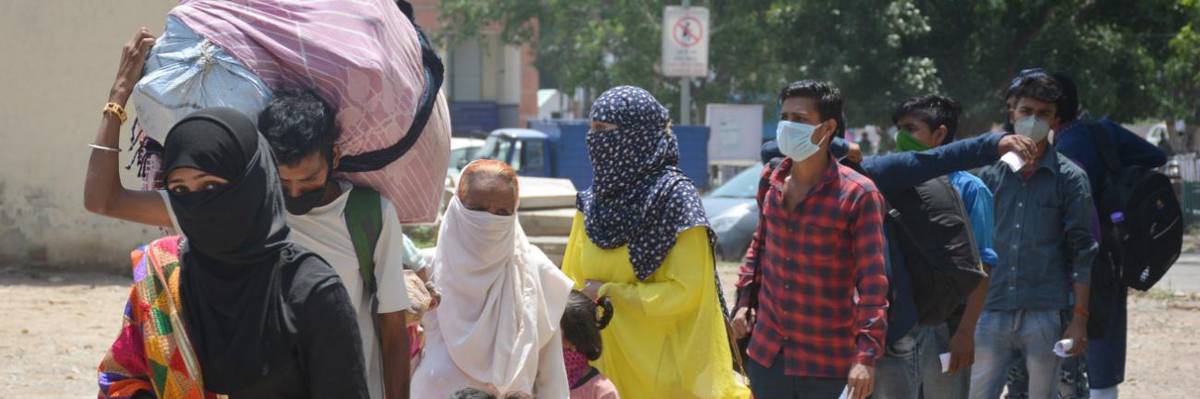
Migrants arrive to board a train for Uttar Pradesh, at Chandigarh railway station, on May 24, 2020 in Panchkula, India. (Photo: Sant Arora/Hindustan Times via Getty Images)
Research from the World Health Organization points to tens of millions of displaced people across the globe who won't currently be able to access coronavirus vaccines--leading to concerns about the ability of the international community to end the pandemic, The Guardian reported Friday.
Public health experts say that many countries are not accounting for refugees, migrants, and internally displaced people in their plans to vaccinate their populations.
The WHO reviewed 104 vaccination plans around the world, finding that more than 70% of them excluded migrants. The exclusion means more than 30 million people, including nearly five million in India, where the world's worst coronavirus outbreak is now taking place, may not have access to the vaccines.
In Indonesia, refugees are among those being "systematically excluded" from the country's vaccination program, which uses a digital ID system for recipients, journalist Jacob Kushner tweeted.
The plans also excluded about five million refugees and asylum-seekers, including 1.8 million in Colombia, and 11.8 million internally displaced people, including 2.7 million Nigerians--bringing the total number of people with no path to vaccination to more than 46 million.
The failure of governments to plan to vaccinate people who are displaced or migrating "is not an oversight," tweeted writer John Smith.
"Most of those who live in prosperous nations don't care if [displaced people] live or die and that doesn't bode well for us in the long or short term," Smith said.
The COVAX facility, which is co-led by the WHO, the Coalition for Epidemic Preparedness, and Gavi: the Vaccine Alliance, approved in March a channel of vaccine doses that will be reserved for the most vulnerable people in the world, who have no access to the life-saving vaccines.
The channel will redirect 5% of the doses allocated to COVAX to the most vulnerable people, including displaced people. The doses will be administered by NGOs including Doctors Without Borders.
COVAX estimates that 33 million people could obtain doses from the channel, but it's unclear whether or how the other 13 million displaced people counted by the WHO will be able to access the vaccines.
The United Nations' refugee agency this week called for Covid-19 vaccines to be made available to people who have been displaced, warning that fully protecting public health for the global community "means protecting refugees."
"To build back stronger from the pandemic, fair and equal access to Covid-19 vaccines is needed for everyone everywhere, including displaced people," the UNHCR said.
"As we learned from the outset of Covid-19 and all the restrictions put in place, availability of testing, and access to healthcare for coronavirus, no one is safe until everyone is safe, and that is absolutely the same for vaccination programs," Nadia Hardman, a researcher at Human Rights Watch, told The Guardian.
Dear Common Dreams reader, It’s been nearly 30 years since I co-founded Common Dreams with my late wife, Lina Newhouser. We had the radical notion that journalism should serve the public good, not corporate profits. It was clear to us from the outset what it would take to build such a project. No paid advertisements. No corporate sponsors. No millionaire publisher telling us what to think or do. Many people said we wouldn't last a year, but we proved those doubters wrong. Together with a tremendous team of journalists and dedicated staff, we built an independent media outlet free from the constraints of profits and corporate control. Our mission has always been simple: To inform. To inspire. To ignite change for the common good. Building Common Dreams was not easy. Our survival was never guaranteed. When you take on the most powerful forces—Wall Street greed, fossil fuel industry destruction, Big Tech lobbyists, and uber-rich oligarchs who have spent billions upon billions rigging the economy and democracy in their favor—the only bulwark you have is supporters who believe in your work. But here’s the urgent message from me today. It's never been this bad out there. And it's never been this hard to keep us going. At the very moment Common Dreams is most needed, the threats we face are intensifying. We need your support now more than ever. We don't accept corporate advertising and never will. We don't have a paywall because we don't think people should be blocked from critical news based on their ability to pay. Everything we do is funded by the donations of readers like you. When everyone does the little they can afford, we are strong. But if that support retreats or dries up, so do we. Will you donate now to make sure Common Dreams not only survives but thrives? —Craig Brown, Co-founder |
Research from the World Health Organization points to tens of millions of displaced people across the globe who won't currently be able to access coronavirus vaccines--leading to concerns about the ability of the international community to end the pandemic, The Guardian reported Friday.
Public health experts say that many countries are not accounting for refugees, migrants, and internally displaced people in their plans to vaccinate their populations.
The WHO reviewed 104 vaccination plans around the world, finding that more than 70% of them excluded migrants. The exclusion means more than 30 million people, including nearly five million in India, where the world's worst coronavirus outbreak is now taking place, may not have access to the vaccines.
In Indonesia, refugees are among those being "systematically excluded" from the country's vaccination program, which uses a digital ID system for recipients, journalist Jacob Kushner tweeted.
The plans also excluded about five million refugees and asylum-seekers, including 1.8 million in Colombia, and 11.8 million internally displaced people, including 2.7 million Nigerians--bringing the total number of people with no path to vaccination to more than 46 million.
The failure of governments to plan to vaccinate people who are displaced or migrating "is not an oversight," tweeted writer John Smith.
"Most of those who live in prosperous nations don't care if [displaced people] live or die and that doesn't bode well for us in the long or short term," Smith said.
The COVAX facility, which is co-led by the WHO, the Coalition for Epidemic Preparedness, and Gavi: the Vaccine Alliance, approved in March a channel of vaccine doses that will be reserved for the most vulnerable people in the world, who have no access to the life-saving vaccines.
The channel will redirect 5% of the doses allocated to COVAX to the most vulnerable people, including displaced people. The doses will be administered by NGOs including Doctors Without Borders.
COVAX estimates that 33 million people could obtain doses from the channel, but it's unclear whether or how the other 13 million displaced people counted by the WHO will be able to access the vaccines.
The United Nations' refugee agency this week called for Covid-19 vaccines to be made available to people who have been displaced, warning that fully protecting public health for the global community "means protecting refugees."
"To build back stronger from the pandemic, fair and equal access to Covid-19 vaccines is needed for everyone everywhere, including displaced people," the UNHCR said.
"As we learned from the outset of Covid-19 and all the restrictions put in place, availability of testing, and access to healthcare for coronavirus, no one is safe until everyone is safe, and that is absolutely the same for vaccination programs," Nadia Hardman, a researcher at Human Rights Watch, told The Guardian.
Research from the World Health Organization points to tens of millions of displaced people across the globe who won't currently be able to access coronavirus vaccines--leading to concerns about the ability of the international community to end the pandemic, The Guardian reported Friday.
Public health experts say that many countries are not accounting for refugees, migrants, and internally displaced people in their plans to vaccinate their populations.
The WHO reviewed 104 vaccination plans around the world, finding that more than 70% of them excluded migrants. The exclusion means more than 30 million people, including nearly five million in India, where the world's worst coronavirus outbreak is now taking place, may not have access to the vaccines.
In Indonesia, refugees are among those being "systematically excluded" from the country's vaccination program, which uses a digital ID system for recipients, journalist Jacob Kushner tweeted.
The plans also excluded about five million refugees and asylum-seekers, including 1.8 million in Colombia, and 11.8 million internally displaced people, including 2.7 million Nigerians--bringing the total number of people with no path to vaccination to more than 46 million.
The failure of governments to plan to vaccinate people who are displaced or migrating "is not an oversight," tweeted writer John Smith.
"Most of those who live in prosperous nations don't care if [displaced people] live or die and that doesn't bode well for us in the long or short term," Smith said.
The COVAX facility, which is co-led by the WHO, the Coalition for Epidemic Preparedness, and Gavi: the Vaccine Alliance, approved in March a channel of vaccine doses that will be reserved for the most vulnerable people in the world, who have no access to the life-saving vaccines.
The channel will redirect 5% of the doses allocated to COVAX to the most vulnerable people, including displaced people. The doses will be administered by NGOs including Doctors Without Borders.
COVAX estimates that 33 million people could obtain doses from the channel, but it's unclear whether or how the other 13 million displaced people counted by the WHO will be able to access the vaccines.
The United Nations' refugee agency this week called for Covid-19 vaccines to be made available to people who have been displaced, warning that fully protecting public health for the global community "means protecting refugees."
"To build back stronger from the pandemic, fair and equal access to Covid-19 vaccines is needed for everyone everywhere, including displaced people," the UNHCR said.
"As we learned from the outset of Covid-19 and all the restrictions put in place, availability of testing, and access to healthcare for coronavirus, no one is safe until everyone is safe, and that is absolutely the same for vaccination programs," Nadia Hardman, a researcher at Human Rights Watch, told The Guardian.