SUBSCRIBE TO OUR FREE NEWSLETTER
Daily news & progressive opinion—funded by the people, not the corporations—delivered straight to your inbox.
5
#000000
#FFFFFF
To donate by check, phone, or other method, see our More Ways to Give page.
Daily news & progressive opinion—funded by the people, not the corporations—delivered straight to your inbox.
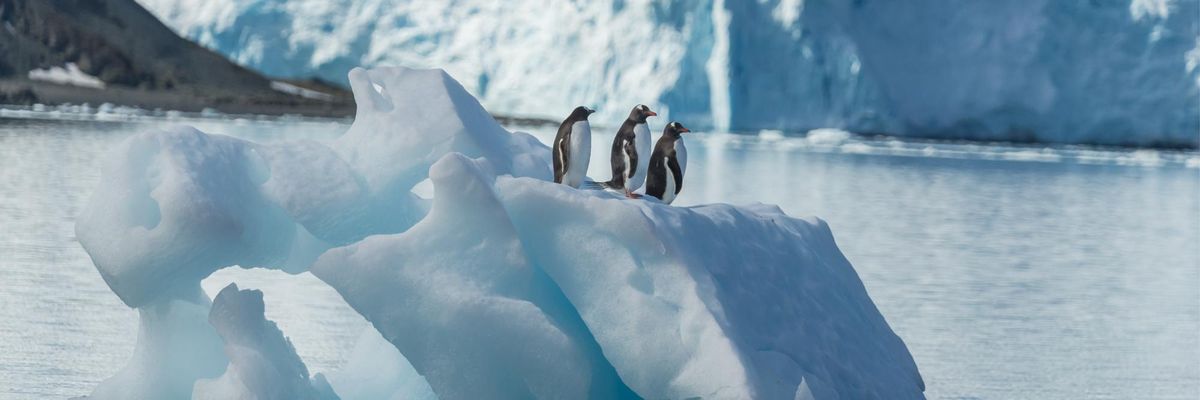
Three Gentoo penguins on top of an iceberg at Yellow Point Beach on January 1, 2020 in King George Island, Antarctica. (Photo: Alessandro Dahan/Getty Images)
A new study published Wednesday in the journal Nature warns that if the world's governments fail to meet warming targets set by the Paris climate accord, sea level rise from the melting of the Antarctic ice sheet will accelerate at a "rapid and unstoppable" rate in the coming decades.
Authored by researchers at the University of Massachusetts Amherst, the new paper finds that if planetary warming continues at its current rate--which is headed toward 3deg Celsius above pre-industrial levels--Antarctic melting will reach a tipping point by 2060, beyond which the consequences would be "irreversible on multi-century timescales."
"If we did nothing at all to reduce emissions we could get five meters of sea level rise just from Antarctica by 2200, at which point you'd have to remap the world from space. It would be unimaginable."
--Robert DeConto, University of Massachusetts Amherst"If the world warms up at a rate dictated by current policies we will see the Antarctic system start to get away from us around 2060," Robert DeConto, the lead author of the study, told The Guardian. "Once you put enough heat into the climate system, you are going to lose those ice shelves, and once that is set in motion you can't reverse it."
"It's really the next few decades that will determine the sea level rise from Antarctica," DeConto added. "These ice shelves won't be able to just grow back."
The researchers find that if the most optimistic Paris goal of no more than 1.5deg Celsius of warming by the end of the century is met, the Antarctic ice sheet would contribute around six centimeters of sea level rise by 2100.
"But if the current course toward 3 degrees is maintained, the model points to a major jump in melting," the study warns. "Unless ambitious action to rein in warming begins by 2060, no human intervention, including geoengineering, would be able to stop 17 to 21 centimeters of sea-level rise from Antarctic ice melt alone by 2100."
Under a scenario in which no further action is taken to limit planet-warming greenhouse gas emissions, the research paper finds, Antarctic melting would contribute a "globally catastrophic" 10 meters or more to sea level rise by 2300.
"If we did nothing at all to reduce emissions we could get five meters of sea level rise just from Antarctica by 2200, at which point you'd have to remap the world from space," said DeConto. "It would be unimaginable."
The study comes days after U.S. President Joe Biden hosted a climate summit with 40 world leaders to discuss ways to bring the world into line with Paris warming targets. Biden, for his part, pledged to cut U.S. emissions at least 50% below 2005 levels by the end of the decade--a goal climate activists slammed as nowhere near sufficient.
" Science and justice demand that we reduce emissions by 70% from 2005 levels by 2030 on the road to zero emissions by mid-century," Janet Redman of Greenpeace USA said last month. "The White House can get this done by removing government subsidies to fossil fuel companies, investing in an equitable and sustainable economic recovery, and stopping fishy carbon offset deals."
Dear Common Dreams reader, It’s been nearly 30 years since I co-founded Common Dreams with my late wife, Lina Newhouser. We had the radical notion that journalism should serve the public good, not corporate profits. It was clear to us from the outset what it would take to build such a project. No paid advertisements. No corporate sponsors. No millionaire publisher telling us what to think or do. Many people said we wouldn't last a year, but we proved those doubters wrong. Together with a tremendous team of journalists and dedicated staff, we built an independent media outlet free from the constraints of profits and corporate control. Our mission has always been simple: To inform. To inspire. To ignite change for the common good. Building Common Dreams was not easy. Our survival was never guaranteed. When you take on the most powerful forces—Wall Street greed, fossil fuel industry destruction, Big Tech lobbyists, and uber-rich oligarchs who have spent billions upon billions rigging the economy and democracy in their favor—the only bulwark you have is supporters who believe in your work. But here’s the urgent message from me today. It's never been this bad out there. And it's never been this hard to keep us going. At the very moment Common Dreams is most needed, the threats we face are intensifying. We need your support now more than ever. We don't accept corporate advertising and never will. We don't have a paywall because we don't think people should be blocked from critical news based on their ability to pay. Everything we do is funded by the donations of readers like you. When everyone does the little they can afford, we are strong. But if that support retreats or dries up, so do we. Will you donate now to make sure Common Dreams not only survives but thrives? —Craig Brown, Co-founder |
A new study published Wednesday in the journal Nature warns that if the world's governments fail to meet warming targets set by the Paris climate accord, sea level rise from the melting of the Antarctic ice sheet will accelerate at a "rapid and unstoppable" rate in the coming decades.
Authored by researchers at the University of Massachusetts Amherst, the new paper finds that if planetary warming continues at its current rate--which is headed toward 3deg Celsius above pre-industrial levels--Antarctic melting will reach a tipping point by 2060, beyond which the consequences would be "irreversible on multi-century timescales."
"If we did nothing at all to reduce emissions we could get five meters of sea level rise just from Antarctica by 2200, at which point you'd have to remap the world from space. It would be unimaginable."
--Robert DeConto, University of Massachusetts Amherst"If the world warms up at a rate dictated by current policies we will see the Antarctic system start to get away from us around 2060," Robert DeConto, the lead author of the study, told The Guardian. "Once you put enough heat into the climate system, you are going to lose those ice shelves, and once that is set in motion you can't reverse it."
"It's really the next few decades that will determine the sea level rise from Antarctica," DeConto added. "These ice shelves won't be able to just grow back."
The researchers find that if the most optimistic Paris goal of no more than 1.5deg Celsius of warming by the end of the century is met, the Antarctic ice sheet would contribute around six centimeters of sea level rise by 2100.
"But if the current course toward 3 degrees is maintained, the model points to a major jump in melting," the study warns. "Unless ambitious action to rein in warming begins by 2060, no human intervention, including geoengineering, would be able to stop 17 to 21 centimeters of sea-level rise from Antarctic ice melt alone by 2100."
Under a scenario in which no further action is taken to limit planet-warming greenhouse gas emissions, the research paper finds, Antarctic melting would contribute a "globally catastrophic" 10 meters or more to sea level rise by 2300.
"If we did nothing at all to reduce emissions we could get five meters of sea level rise just from Antarctica by 2200, at which point you'd have to remap the world from space," said DeConto. "It would be unimaginable."
The study comes days after U.S. President Joe Biden hosted a climate summit with 40 world leaders to discuss ways to bring the world into line with Paris warming targets. Biden, for his part, pledged to cut U.S. emissions at least 50% below 2005 levels by the end of the decade--a goal climate activists slammed as nowhere near sufficient.
" Science and justice demand that we reduce emissions by 70% from 2005 levels by 2030 on the road to zero emissions by mid-century," Janet Redman of Greenpeace USA said last month. "The White House can get this done by removing government subsidies to fossil fuel companies, investing in an equitable and sustainable economic recovery, and stopping fishy carbon offset deals."
A new study published Wednesday in the journal Nature warns that if the world's governments fail to meet warming targets set by the Paris climate accord, sea level rise from the melting of the Antarctic ice sheet will accelerate at a "rapid and unstoppable" rate in the coming decades.
Authored by researchers at the University of Massachusetts Amherst, the new paper finds that if planetary warming continues at its current rate--which is headed toward 3deg Celsius above pre-industrial levels--Antarctic melting will reach a tipping point by 2060, beyond which the consequences would be "irreversible on multi-century timescales."
"If we did nothing at all to reduce emissions we could get five meters of sea level rise just from Antarctica by 2200, at which point you'd have to remap the world from space. It would be unimaginable."
--Robert DeConto, University of Massachusetts Amherst"If the world warms up at a rate dictated by current policies we will see the Antarctic system start to get away from us around 2060," Robert DeConto, the lead author of the study, told The Guardian. "Once you put enough heat into the climate system, you are going to lose those ice shelves, and once that is set in motion you can't reverse it."
"It's really the next few decades that will determine the sea level rise from Antarctica," DeConto added. "These ice shelves won't be able to just grow back."
The researchers find that if the most optimistic Paris goal of no more than 1.5deg Celsius of warming by the end of the century is met, the Antarctic ice sheet would contribute around six centimeters of sea level rise by 2100.
"But if the current course toward 3 degrees is maintained, the model points to a major jump in melting," the study warns. "Unless ambitious action to rein in warming begins by 2060, no human intervention, including geoengineering, would be able to stop 17 to 21 centimeters of sea-level rise from Antarctic ice melt alone by 2100."
Under a scenario in which no further action is taken to limit planet-warming greenhouse gas emissions, the research paper finds, Antarctic melting would contribute a "globally catastrophic" 10 meters or more to sea level rise by 2300.
"If we did nothing at all to reduce emissions we could get five meters of sea level rise just from Antarctica by 2200, at which point you'd have to remap the world from space," said DeConto. "It would be unimaginable."
The study comes days after U.S. President Joe Biden hosted a climate summit with 40 world leaders to discuss ways to bring the world into line with Paris warming targets. Biden, for his part, pledged to cut U.S. emissions at least 50% below 2005 levels by the end of the decade--a goal climate activists slammed as nowhere near sufficient.
" Science and justice demand that we reduce emissions by 70% from 2005 levels by 2030 on the road to zero emissions by mid-century," Janet Redman of Greenpeace USA said last month. "The White House can get this done by removing government subsidies to fossil fuel companies, investing in an equitable and sustainable economic recovery, and stopping fishy carbon offset deals."