

SUBSCRIBE TO OUR FREE NEWSLETTER
Daily news & progressive opinion—funded by the people, not the corporations—delivered straight to your inbox.
5
#000000
#FFFFFF
To donate by check, phone, or other method, see our More Ways to Give page.
Daily news & progressive opinion—funded by the people, not the corporations—delivered straight to your inbox.
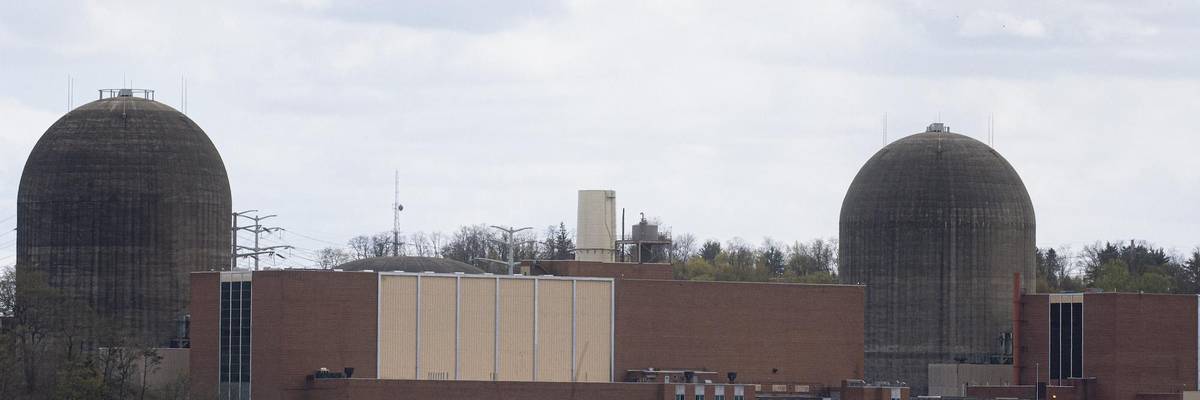
The Indian Point nuclear power plant is seen from Tomkins Cove, New York on April 22, 2021. Indian Point ceased operations on April 30. (Photo: Kena Betancur/VIEWpress)
The Biden administration is being urged Wednesday not to court "disaster" after new reporting revealed the White House is pushing for taxpayer subsidies to keep nuclear power plants afloat in its sweeping infrastructure plan.
According to Bloomberg and Reuters, the taxpayer prop-up would come in the form of "production tax credits," which already apply to renewables like wind and solar.
The PTC effort "would likely be swept into" Biden's American Jobs Plan, Reuters reported, stating that the White House "has signaled privately to lawmakers and stakeholders in recent weeks" its support for the action.
The American Jobs Plan already points broadly to support for nuclear power, stating the plan will invest in "advanced nuclear."
Writing last month at The American Prospect, Gabrielle Gurley outlined the administration's efforts at a clean energy standard (CES):
The White House has realized that finding a niche for nuclear energy is another way to bring Republicans along. (Its American Jobs Plan notes that the CES will "continue to leverage the carbon pollution-free energy provided by existing sources like nuclear and hydropower.") That said, nuclear energy is anathema in some quarters. The 2011 Fukushima nuclear disaster took the luster off the sector in Japan and Germany, but in the U.S., a new nuclear plant is planned for Georgia, and new, smaller nuclear plants are in the research and development stages even though they pose many of the same risks as conventional plants and cannot be brought online fast enough to make a difference. Proponents of nuclear argue that such plants can serve as a bridge fuel in the transition to renewables, at least until the solar and wind energy sectors can surmount the storage challenges posed by current levels of technology.
Among nuclear's proponents in Congress is Sen. Joe Manchin (D-W.Va), chair of the Senate Energy Committee.
Manchin--who continues to declare his support for continued burning of fossil fuels-- asserted at a March committee hearing that "if we are serious about meeting our climate goals without sacrificing reliability, we must protect our existing [nuclear] fleet."
Such thinking, according to progressive advocacy groups, is deeply flawed because it ignores problems with nuclear such as environmentally destructive uranium mining and disasters caused by flooding or other threats. Experts also warn that any commitment to nuclear stands in the way of the advancement of truly climate-friendly energy policies and infrastructure.
In a Facebook post corresponding to Reuters' reporting, Paul Gunter, director of Beyond Nuclear's Reactor Oversight Project, called the PTC proposal "an example of nuclear power as a 'diversion' of resources from the climate crisis."
"President Biden needs to open his eyes to see the bottomless bucket he's considering pouring production tax credits into [are] economically failing and deteriorating nuclear power plants. Incentivizing and ramping up renewables, efficiency, and conservation is far more carbon reduction [and] cost effective per dollar, brings more sustainable job creation, and builds local economies," rather than "hazardous centralized atomic financial sink holes," wrote Gunter.
Lukas Ross, program manager at Friends of the Earth, concurred.
"A nuclear bailout is wrong for taxpayers, wrong for ratepayers, and wrong for the climate," Ross said in a statement.
"Paying to keep aging reactors online is courting disaster and guaranteed to slow the deployment of truly clean renewables. Congress and President Biden should not throw good money after bad," he said.
Dear Common Dreams reader, It’s been nearly 30 years since I co-founded Common Dreams with my late wife, Lina Newhouser. We had the radical notion that journalism should serve the public good, not corporate profits. It was clear to us from the outset what it would take to build such a project. No paid advertisements. No corporate sponsors. No millionaire publisher telling us what to think or do. Many people said we wouldn't last a year, but we proved those doubters wrong. Together with a tremendous team of journalists and dedicated staff, we built an independent media outlet free from the constraints of profits and corporate control. Our mission has always been simple: To inform. To inspire. To ignite change for the common good. Building Common Dreams was not easy. Our survival was never guaranteed. When you take on the most powerful forces—Wall Street greed, fossil fuel industry destruction, Big Tech lobbyists, and uber-rich oligarchs who have spent billions upon billions rigging the economy and democracy in their favor—the only bulwark you have is supporters who believe in your work. But here’s the urgent message from me today. It's never been this bad out there. And it's never been this hard to keep us going. At the very moment Common Dreams is most needed, the threats we face are intensifying. We need your support now more than ever. We don't accept corporate advertising and never will. We don't have a paywall because we don't think people should be blocked from critical news based on their ability to pay. Everything we do is funded by the donations of readers like you. When everyone does the little they can afford, we are strong. But if that support retreats or dries up, so do we. Will you donate now to make sure Common Dreams not only survives but thrives? —Craig Brown, Co-founder |
The Biden administration is being urged Wednesday not to court "disaster" after new reporting revealed the White House is pushing for taxpayer subsidies to keep nuclear power plants afloat in its sweeping infrastructure plan.
According to Bloomberg and Reuters, the taxpayer prop-up would come in the form of "production tax credits," which already apply to renewables like wind and solar.
The PTC effort "would likely be swept into" Biden's American Jobs Plan, Reuters reported, stating that the White House "has signaled privately to lawmakers and stakeholders in recent weeks" its support for the action.
The American Jobs Plan already points broadly to support for nuclear power, stating the plan will invest in "advanced nuclear."
Writing last month at The American Prospect, Gabrielle Gurley outlined the administration's efforts at a clean energy standard (CES):
The White House has realized that finding a niche for nuclear energy is another way to bring Republicans along. (Its American Jobs Plan notes that the CES will "continue to leverage the carbon pollution-free energy provided by existing sources like nuclear and hydropower.") That said, nuclear energy is anathema in some quarters. The 2011 Fukushima nuclear disaster took the luster off the sector in Japan and Germany, but in the U.S., a new nuclear plant is planned for Georgia, and new, smaller nuclear plants are in the research and development stages even though they pose many of the same risks as conventional plants and cannot be brought online fast enough to make a difference. Proponents of nuclear argue that such plants can serve as a bridge fuel in the transition to renewables, at least until the solar and wind energy sectors can surmount the storage challenges posed by current levels of technology.
Among nuclear's proponents in Congress is Sen. Joe Manchin (D-W.Va), chair of the Senate Energy Committee.
Manchin--who continues to declare his support for continued burning of fossil fuels-- asserted at a March committee hearing that "if we are serious about meeting our climate goals without sacrificing reliability, we must protect our existing [nuclear] fleet."
Such thinking, according to progressive advocacy groups, is deeply flawed because it ignores problems with nuclear such as environmentally destructive uranium mining and disasters caused by flooding or other threats. Experts also warn that any commitment to nuclear stands in the way of the advancement of truly climate-friendly energy policies and infrastructure.
In a Facebook post corresponding to Reuters' reporting, Paul Gunter, director of Beyond Nuclear's Reactor Oversight Project, called the PTC proposal "an example of nuclear power as a 'diversion' of resources from the climate crisis."
"President Biden needs to open his eyes to see the bottomless bucket he's considering pouring production tax credits into [are] economically failing and deteriorating nuclear power plants. Incentivizing and ramping up renewables, efficiency, and conservation is far more carbon reduction [and] cost effective per dollar, brings more sustainable job creation, and builds local economies," rather than "hazardous centralized atomic financial sink holes," wrote Gunter.
Lukas Ross, program manager at Friends of the Earth, concurred.
"A nuclear bailout is wrong for taxpayers, wrong for ratepayers, and wrong for the climate," Ross said in a statement.
"Paying to keep aging reactors online is courting disaster and guaranteed to slow the deployment of truly clean renewables. Congress and President Biden should not throw good money after bad," he said.
The Biden administration is being urged Wednesday not to court "disaster" after new reporting revealed the White House is pushing for taxpayer subsidies to keep nuclear power plants afloat in its sweeping infrastructure plan.
According to Bloomberg and Reuters, the taxpayer prop-up would come in the form of "production tax credits," which already apply to renewables like wind and solar.
The PTC effort "would likely be swept into" Biden's American Jobs Plan, Reuters reported, stating that the White House "has signaled privately to lawmakers and stakeholders in recent weeks" its support for the action.
The American Jobs Plan already points broadly to support for nuclear power, stating the plan will invest in "advanced nuclear."
Writing last month at The American Prospect, Gabrielle Gurley outlined the administration's efforts at a clean energy standard (CES):
The White House has realized that finding a niche for nuclear energy is another way to bring Republicans along. (Its American Jobs Plan notes that the CES will "continue to leverage the carbon pollution-free energy provided by existing sources like nuclear and hydropower.") That said, nuclear energy is anathema in some quarters. The 2011 Fukushima nuclear disaster took the luster off the sector in Japan and Germany, but in the U.S., a new nuclear plant is planned for Georgia, and new, smaller nuclear plants are in the research and development stages even though they pose many of the same risks as conventional plants and cannot be brought online fast enough to make a difference. Proponents of nuclear argue that such plants can serve as a bridge fuel in the transition to renewables, at least until the solar and wind energy sectors can surmount the storage challenges posed by current levels of technology.
Among nuclear's proponents in Congress is Sen. Joe Manchin (D-W.Va), chair of the Senate Energy Committee.
Manchin--who continues to declare his support for continued burning of fossil fuels-- asserted at a March committee hearing that "if we are serious about meeting our climate goals without sacrificing reliability, we must protect our existing [nuclear] fleet."
Such thinking, according to progressive advocacy groups, is deeply flawed because it ignores problems with nuclear such as environmentally destructive uranium mining and disasters caused by flooding or other threats. Experts also warn that any commitment to nuclear stands in the way of the advancement of truly climate-friendly energy policies and infrastructure.
In a Facebook post corresponding to Reuters' reporting, Paul Gunter, director of Beyond Nuclear's Reactor Oversight Project, called the PTC proposal "an example of nuclear power as a 'diversion' of resources from the climate crisis."
"President Biden needs to open his eyes to see the bottomless bucket he's considering pouring production tax credits into [are] economically failing and deteriorating nuclear power plants. Incentivizing and ramping up renewables, efficiency, and conservation is far more carbon reduction [and] cost effective per dollar, brings more sustainable job creation, and builds local economies," rather than "hazardous centralized atomic financial sink holes," wrote Gunter.
Lukas Ross, program manager at Friends of the Earth, concurred.
"A nuclear bailout is wrong for taxpayers, wrong for ratepayers, and wrong for the climate," Ross said in a statement.
"Paying to keep aging reactors online is courting disaster and guaranteed to slow the deployment of truly clean renewables. Congress and President Biden should not throw good money after bad," he said.

