SUBSCRIBE TO OUR FREE NEWSLETTER
Daily news & progressive opinion—funded by the people, not the corporations—delivered straight to your inbox.
5
#000000
#FFFFFF
To donate by check, phone, or other method, see our More Ways to Give page.
Daily news & progressive opinion—funded by the people, not the corporations—delivered straight to your inbox.
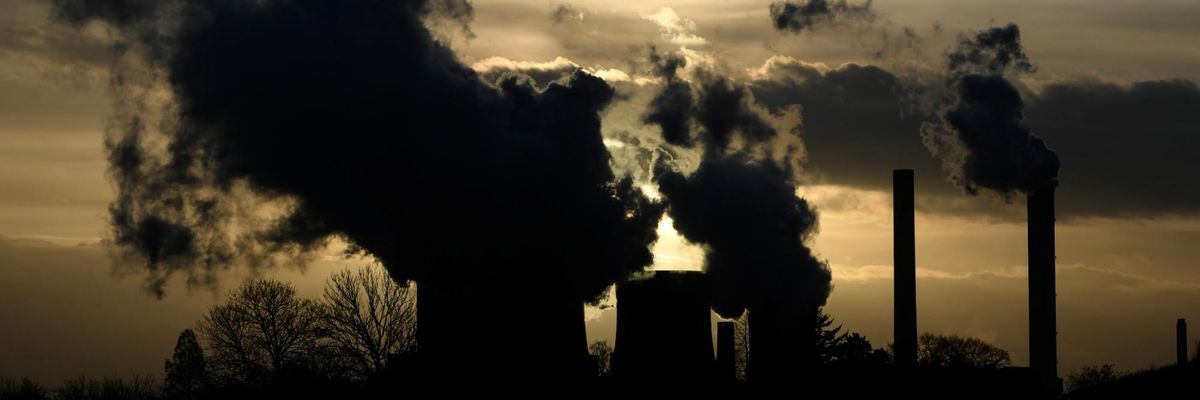
This coal power plant of German energy giant RWE is located in Weisweiler. (Photo: Ina Fassbender/AFP via Getty Images)
While marking Earth Day with his long-awaited Leaders Summit on Climate to discuss how countries plan to meet the goals of the Paris agreement, U.S. President Joe Biden on Thursday released an International Climate Finance Plan that disappointed some progressive campaigners.
"Today's announcement by President Biden on international finance for fossil fuels is a welcome step, but the lack of firm commitments falls short of what's needed," said Collin Rees, senior campaigner at Oil Change International, in a statement.
"This is a missed opportunity to end a harmful U.S. climate legacy abroad and add to the growing momentum of other institutions ruling out all public finance for fossil fuels," he said. "We urge the Biden administration to add a clear commitment to an immediate phaseout, with no loopholes for gas or any other continued fossil support."
Biden initiated the development of this first-of-its-kind U.S. finance plan on January 27 with his Executive Order on Tackling the Climate Crisis at Home and Abroad (E.O. 14008). As a new summary from the White House details, it has five key components:
"The United States intends to double, by 2024, our annual public climate finance to developing countries relative to the average level during the second half of the Obama-Biden administration (FY 2013-2016)," the summary says. "As part of this goal, the United States intends to triple our adaptation finance by 2024."
The White House highlights specific plans for some U.S. agencies. This month, the Millennium Challenge Corporation (MCC) will adopt a new climate strategy, and at COP26, a United Nations summit in Glasgow scheduled for November, the U.S. Agency for International Development (USAID) will release its new climate strategy.
"Treasury will direct U.S. executive directors in multilateral development banks (MDBs) to help ensure MDBs set and apply ambitious climate finance targets and policies, in partnership with other shareholders," according to the document.
The summary says that the U.S. International Development Finance Corporation (DFC), the nation's development bank, "will update its development strategy to not only include climate for the first time, but also to make investments in climate mitigation and adaptation a top priority."
Biden's January order said that the secretaries of state, the treasury, and energy would work with the Export-Import Bank of the United States (EXIM), the head of DFC, and leaders at other agencies to identify steps the country can take to "promote ending international financing of carbon-intensive fossil fuel-based energy while simultaneously advancing sustainable development and a green recovery, in consultation with the assistant to the president for national security affairs."
DFC, in support of Biden's summit on Thursday, announced key commitments, from a pledge to get its portfolio to net-zero emissions by 2040 to boosting climate-focused investment--including in mitigation, adaptation, and resilience--to 33% of new investments beginning in FY 2023. The bank added that "to advance these efforts and further enable the private sector to tackle climate-related challenges, DFC will launch a new $50 million technical assistance facility as well as a risk-sharing platform."
The institution's chief operating officer, David Marchick, said that "Biden has appropriately stated that the climate crisis represents the existential threat of our time and called for coordinated global action."
"DFC is proud to contribute to U.S. leadership on climate action through our net-zero pledge, new climate investment target, and inclusion of climate as a core element in our development strategy for the first time--steps that aim to help developing countries mitigate and respond to climate change while increasing resilience," he added.
Kate DeAngelis, international finance program manager at Friends of the Earth U.S., was critical of the bank's announcement.
"DFC's broad-based restrictions on fossil fuel financing are a first for any U.S. institution, but still insufficient to address the true nature of the climate crisis," she said. "DFC should have taken the opportunity of the climate summit to once and for all end support for all fossil fuels immediately. In putting forward a net-zero target, DFC is ignoring the lifetime and lifecycle emissions of its portfolio while putting off real climate action with dangerous and ineffective offsets."
"Even more alarming is Biden's silence on the Export-Import Bank, which provides billions of dollars every year to disastrous projects like Mozambique LNG and the Vaca Muerta fracking projects in Argentina," DeAngelis added. "While the United Kingdom has shown true climate leadership by ending support for overseas fossil fuel projects, Biden has failed to take a whole-of-government approach to stop enabling overseas carbon emissions."
Earlier Thursday, The Guardian reported that Lidy Nacpil, coordinator at the Asian Peoples' Movement on Debt and Development, said, "We are at a point where we know what needs to be done to reverse the climate chaos and it boils down to this simple principle: wealthier countries, who emit more now and historically, can and should do more with their emissions reductions and delivery of climate finance."
As the newspaper detailed:
Poor countries were promised $100 billion a year in climate finance from 2020, more than a decade ago at the troubled Copenhagen climate summit in 2009. But that longstanding commitment, repeated in the landmark 2015 Paris agreement, was not met last year.
The Covid-19 pandemic has meant rich countries are facing rising financial pressures, as countries struggle to recover from the health impacts and lockdowns. But for poor countries, the situation is yet more dire: their economies have been battered by the global Covid recession, at the same time as they have lost large amounts of the remittances sent home by their citizens working abroad that many rely on, and they face mounting debt as the cost of finance has increased.
In a statement, Oil Change International strategic communications director David Turnbull emphasized that "true climate leadership requires a full reckoning with the realities of what's driving our climate crisis: fossil fuels. Without a robust plan from rich countries in particular to ramp down fossil fuel production and ramp up support for communities for a just transition to a renewable energy economy, any conversation about 'climate leadership' is incomplete at best, or misleading at worst."
"Continued fossil fuel production impacts those on the frontlines of extraction and related infrastructure every day, adding to the historic injustices our extractive economy has perpetuated," Turnbull added. "Today's session on ramping up ambition came up short, and we call on all world leaders to quickly catch up to the reality that we must stop spending public money on fossil fuels and start the fossil fuel production phaseout and just transition for communities immediately."
Dear Common Dreams reader, It’s been nearly 30 years since I co-founded Common Dreams with my late wife, Lina Newhouser. We had the radical notion that journalism should serve the public good, not corporate profits. It was clear to us from the outset what it would take to build such a project. No paid advertisements. No corporate sponsors. No millionaire publisher telling us what to think or do. Many people said we wouldn't last a year, but we proved those doubters wrong. Together with a tremendous team of journalists and dedicated staff, we built an independent media outlet free from the constraints of profits and corporate control. Our mission has always been simple: To inform. To inspire. To ignite change for the common good. Building Common Dreams was not easy. Our survival was never guaranteed. When you take on the most powerful forces—Wall Street greed, fossil fuel industry destruction, Big Tech lobbyists, and uber-rich oligarchs who have spent billions upon billions rigging the economy and democracy in their favor—the only bulwark you have is supporters who believe in your work. But here’s the urgent message from me today. It's never been this bad out there. And it's never been this hard to keep us going. At the very moment Common Dreams is most needed, the threats we face are intensifying. We need your support now more than ever. We don't accept corporate advertising and never will. We don't have a paywall because we don't think people should be blocked from critical news based on their ability to pay. Everything we do is funded by the donations of readers like you. When everyone does the little they can afford, we are strong. But if that support retreats or dries up, so do we. Will you donate now to make sure Common Dreams not only survives but thrives? —Craig Brown, Co-founder |
While marking Earth Day with his long-awaited Leaders Summit on Climate to discuss how countries plan to meet the goals of the Paris agreement, U.S. President Joe Biden on Thursday released an International Climate Finance Plan that disappointed some progressive campaigners.
"Today's announcement by President Biden on international finance for fossil fuels is a welcome step, but the lack of firm commitments falls short of what's needed," said Collin Rees, senior campaigner at Oil Change International, in a statement.
"This is a missed opportunity to end a harmful U.S. climate legacy abroad and add to the growing momentum of other institutions ruling out all public finance for fossil fuels," he said. "We urge the Biden administration to add a clear commitment to an immediate phaseout, with no loopholes for gas or any other continued fossil support."
Biden initiated the development of this first-of-its-kind U.S. finance plan on January 27 with his Executive Order on Tackling the Climate Crisis at Home and Abroad (E.O. 14008). As a new summary from the White House details, it has five key components:
"The United States intends to double, by 2024, our annual public climate finance to developing countries relative to the average level during the second half of the Obama-Biden administration (FY 2013-2016)," the summary says. "As part of this goal, the United States intends to triple our adaptation finance by 2024."
The White House highlights specific plans for some U.S. agencies. This month, the Millennium Challenge Corporation (MCC) will adopt a new climate strategy, and at COP26, a United Nations summit in Glasgow scheduled for November, the U.S. Agency for International Development (USAID) will release its new climate strategy.
"Treasury will direct U.S. executive directors in multilateral development banks (MDBs) to help ensure MDBs set and apply ambitious climate finance targets and policies, in partnership with other shareholders," according to the document.
The summary says that the U.S. International Development Finance Corporation (DFC), the nation's development bank, "will update its development strategy to not only include climate for the first time, but also to make investments in climate mitigation and adaptation a top priority."
Biden's January order said that the secretaries of state, the treasury, and energy would work with the Export-Import Bank of the United States (EXIM), the head of DFC, and leaders at other agencies to identify steps the country can take to "promote ending international financing of carbon-intensive fossil fuel-based energy while simultaneously advancing sustainable development and a green recovery, in consultation with the assistant to the president for national security affairs."
DFC, in support of Biden's summit on Thursday, announced key commitments, from a pledge to get its portfolio to net-zero emissions by 2040 to boosting climate-focused investment--including in mitigation, adaptation, and resilience--to 33% of new investments beginning in FY 2023. The bank added that "to advance these efforts and further enable the private sector to tackle climate-related challenges, DFC will launch a new $50 million technical assistance facility as well as a risk-sharing platform."
The institution's chief operating officer, David Marchick, said that "Biden has appropriately stated that the climate crisis represents the existential threat of our time and called for coordinated global action."
"DFC is proud to contribute to U.S. leadership on climate action through our net-zero pledge, new climate investment target, and inclusion of climate as a core element in our development strategy for the first time--steps that aim to help developing countries mitigate and respond to climate change while increasing resilience," he added.
Kate DeAngelis, international finance program manager at Friends of the Earth U.S., was critical of the bank's announcement.
"DFC's broad-based restrictions on fossil fuel financing are a first for any U.S. institution, but still insufficient to address the true nature of the climate crisis," she said. "DFC should have taken the opportunity of the climate summit to once and for all end support for all fossil fuels immediately. In putting forward a net-zero target, DFC is ignoring the lifetime and lifecycle emissions of its portfolio while putting off real climate action with dangerous and ineffective offsets."
"Even more alarming is Biden's silence on the Export-Import Bank, which provides billions of dollars every year to disastrous projects like Mozambique LNG and the Vaca Muerta fracking projects in Argentina," DeAngelis added. "While the United Kingdom has shown true climate leadership by ending support for overseas fossil fuel projects, Biden has failed to take a whole-of-government approach to stop enabling overseas carbon emissions."
Earlier Thursday, The Guardian reported that Lidy Nacpil, coordinator at the Asian Peoples' Movement on Debt and Development, said, "We are at a point where we know what needs to be done to reverse the climate chaos and it boils down to this simple principle: wealthier countries, who emit more now and historically, can and should do more with their emissions reductions and delivery of climate finance."
As the newspaper detailed:
Poor countries were promised $100 billion a year in climate finance from 2020, more than a decade ago at the troubled Copenhagen climate summit in 2009. But that longstanding commitment, repeated in the landmark 2015 Paris agreement, was not met last year.
The Covid-19 pandemic has meant rich countries are facing rising financial pressures, as countries struggle to recover from the health impacts and lockdowns. But for poor countries, the situation is yet more dire: their economies have been battered by the global Covid recession, at the same time as they have lost large amounts of the remittances sent home by their citizens working abroad that many rely on, and they face mounting debt as the cost of finance has increased.
In a statement, Oil Change International strategic communications director David Turnbull emphasized that "true climate leadership requires a full reckoning with the realities of what's driving our climate crisis: fossil fuels. Without a robust plan from rich countries in particular to ramp down fossil fuel production and ramp up support for communities for a just transition to a renewable energy economy, any conversation about 'climate leadership' is incomplete at best, or misleading at worst."
"Continued fossil fuel production impacts those on the frontlines of extraction and related infrastructure every day, adding to the historic injustices our extractive economy has perpetuated," Turnbull added. "Today's session on ramping up ambition came up short, and we call on all world leaders to quickly catch up to the reality that we must stop spending public money on fossil fuels and start the fossil fuel production phaseout and just transition for communities immediately."
While marking Earth Day with his long-awaited Leaders Summit on Climate to discuss how countries plan to meet the goals of the Paris agreement, U.S. President Joe Biden on Thursday released an International Climate Finance Plan that disappointed some progressive campaigners.
"Today's announcement by President Biden on international finance for fossil fuels is a welcome step, but the lack of firm commitments falls short of what's needed," said Collin Rees, senior campaigner at Oil Change International, in a statement.
"This is a missed opportunity to end a harmful U.S. climate legacy abroad and add to the growing momentum of other institutions ruling out all public finance for fossil fuels," he said. "We urge the Biden administration to add a clear commitment to an immediate phaseout, with no loopholes for gas or any other continued fossil support."
Biden initiated the development of this first-of-its-kind U.S. finance plan on January 27 with his Executive Order on Tackling the Climate Crisis at Home and Abroad (E.O. 14008). As a new summary from the White House details, it has five key components:
"The United States intends to double, by 2024, our annual public climate finance to developing countries relative to the average level during the second half of the Obama-Biden administration (FY 2013-2016)," the summary says. "As part of this goal, the United States intends to triple our adaptation finance by 2024."
The White House highlights specific plans for some U.S. agencies. This month, the Millennium Challenge Corporation (MCC) will adopt a new climate strategy, and at COP26, a United Nations summit in Glasgow scheduled for November, the U.S. Agency for International Development (USAID) will release its new climate strategy.
"Treasury will direct U.S. executive directors in multilateral development banks (MDBs) to help ensure MDBs set and apply ambitious climate finance targets and policies, in partnership with other shareholders," according to the document.
The summary says that the U.S. International Development Finance Corporation (DFC), the nation's development bank, "will update its development strategy to not only include climate for the first time, but also to make investments in climate mitigation and adaptation a top priority."
Biden's January order said that the secretaries of state, the treasury, and energy would work with the Export-Import Bank of the United States (EXIM), the head of DFC, and leaders at other agencies to identify steps the country can take to "promote ending international financing of carbon-intensive fossil fuel-based energy while simultaneously advancing sustainable development and a green recovery, in consultation with the assistant to the president for national security affairs."
DFC, in support of Biden's summit on Thursday, announced key commitments, from a pledge to get its portfolio to net-zero emissions by 2040 to boosting climate-focused investment--including in mitigation, adaptation, and resilience--to 33% of new investments beginning in FY 2023. The bank added that "to advance these efforts and further enable the private sector to tackle climate-related challenges, DFC will launch a new $50 million technical assistance facility as well as a risk-sharing platform."
The institution's chief operating officer, David Marchick, said that "Biden has appropriately stated that the climate crisis represents the existential threat of our time and called for coordinated global action."
"DFC is proud to contribute to U.S. leadership on climate action through our net-zero pledge, new climate investment target, and inclusion of climate as a core element in our development strategy for the first time--steps that aim to help developing countries mitigate and respond to climate change while increasing resilience," he added.
Kate DeAngelis, international finance program manager at Friends of the Earth U.S., was critical of the bank's announcement.
"DFC's broad-based restrictions on fossil fuel financing are a first for any U.S. institution, but still insufficient to address the true nature of the climate crisis," she said. "DFC should have taken the opportunity of the climate summit to once and for all end support for all fossil fuels immediately. In putting forward a net-zero target, DFC is ignoring the lifetime and lifecycle emissions of its portfolio while putting off real climate action with dangerous and ineffective offsets."
"Even more alarming is Biden's silence on the Export-Import Bank, which provides billions of dollars every year to disastrous projects like Mozambique LNG and the Vaca Muerta fracking projects in Argentina," DeAngelis added. "While the United Kingdom has shown true climate leadership by ending support for overseas fossil fuel projects, Biden has failed to take a whole-of-government approach to stop enabling overseas carbon emissions."
Earlier Thursday, The Guardian reported that Lidy Nacpil, coordinator at the Asian Peoples' Movement on Debt and Development, said, "We are at a point where we know what needs to be done to reverse the climate chaos and it boils down to this simple principle: wealthier countries, who emit more now and historically, can and should do more with their emissions reductions and delivery of climate finance."
As the newspaper detailed:
Poor countries were promised $100 billion a year in climate finance from 2020, more than a decade ago at the troubled Copenhagen climate summit in 2009. But that longstanding commitment, repeated in the landmark 2015 Paris agreement, was not met last year.
The Covid-19 pandemic has meant rich countries are facing rising financial pressures, as countries struggle to recover from the health impacts and lockdowns. But for poor countries, the situation is yet more dire: their economies have been battered by the global Covid recession, at the same time as they have lost large amounts of the remittances sent home by their citizens working abroad that many rely on, and they face mounting debt as the cost of finance has increased.
In a statement, Oil Change International strategic communications director David Turnbull emphasized that "true climate leadership requires a full reckoning with the realities of what's driving our climate crisis: fossil fuels. Without a robust plan from rich countries in particular to ramp down fossil fuel production and ramp up support for communities for a just transition to a renewable energy economy, any conversation about 'climate leadership' is incomplete at best, or misleading at worst."
"Continued fossil fuel production impacts those on the frontlines of extraction and related infrastructure every day, adding to the historic injustices our extractive economy has perpetuated," Turnbull added. "Today's session on ramping up ambition came up short, and we call on all world leaders to quickly catch up to the reality that we must stop spending public money on fossil fuels and start the fossil fuel production phaseout and just transition for communities immediately."