SUBSCRIBE TO OUR FREE NEWSLETTER
Daily news & progressive opinion—funded by the people, not the corporations—delivered straight to your inbox.
5
#000000
#FFFFFF
To donate by check, phone, or other method, see our More Ways to Give page.
Daily news & progressive opinion—funded by the people, not the corporations—delivered straight to your inbox.
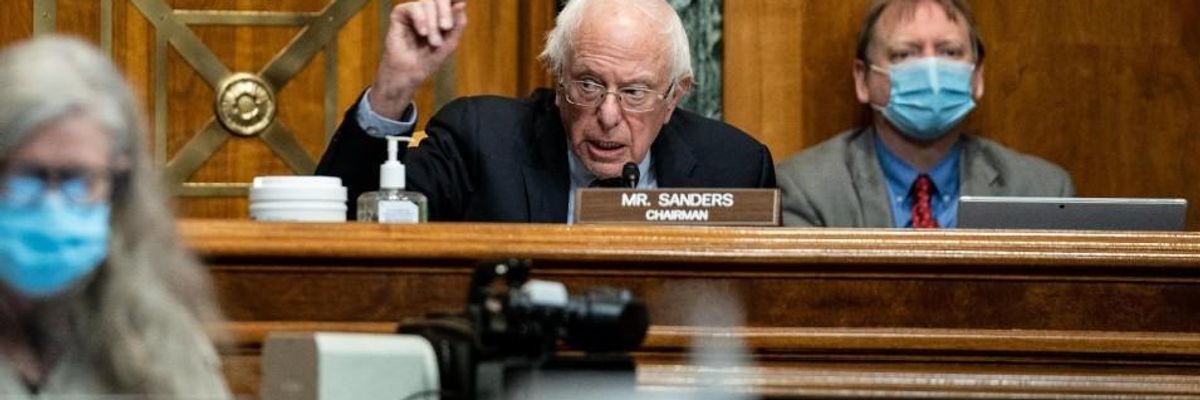
Sen. Bernie Sanders (I-Vt.) speaks during a Senate Budget Committee hearing on February 10, 2021 at the U.S. Capitol in Washington, D.C. (Photo: Anna Moneymaker--Pool/Getty Images)
Congressional Democrats are reportedly aiming to use a forthcoming coronavirus recovery package to lower the Medicare eligibility age from 65 to 60, a development that comes days after Sen. Bernie Sanders publicly advocated for the proposal as a way to expand healthcare coverage for seniors amid the deadly pandemic.
The Wall Street Journal reported Tuesday that "proposals to expand Medicare eligibility from age 65 to 60 and to enable the federal government to negotiate drug prices in the health program for seniors--both of which President Biden supported on the campaign trail--are... likely to be included" in the new package, the second part of a two-pronged "Build Back Better" program focused on infrastructure, jobs, healthcare, and other priorities.
"We should lower the eligibility age for Medicare from 65 down to 60," Sanders told the Journal, which noted that the popular proposal is already drawing opposition from Republicans and the hospital industry.
According to an analysis last April by the healthcare consulting firm Avalere, lowering the Medicare eligibility age to 60 could extend the program's coverage to as many as 23 million people.
"There are many millions of seniors who would be very, very grateful if we did that right now," said Sanders.
The Vermont senator--a leading supporter of the far more ambitious effort to extend Medicare to every person in the U.S.--is also pushing congressional Democrats to use the new legislation to make Medicare more generous by expanding its coverage to include dental work, glasses and eye surgeries, and hearing aids, Politico reported last Friday.
Given that Republican lawmakers are already speaking out against the nascent legislative package, Democrats will likely have to use the arcane and restrictive budget reconciliation process to pass the measure with a simple majority. That means the Medicare expansion proposal will likely face the scrutiny of the unelected Senate parliamentarian, who drew widespread ire last month for deeming a $15 minimum wage proposal in violation of reconciliation rules.
The new recovery package is also expected to include an extension of the boosted child tax credit, paid family and medical leave, and other measures, according to reporting Tuesday by the Washington Post.
"We have to look at the structural long-term problems facing our people," Sanders said last week. "We're talking about physical infrastructure, affordable housing. We're talking about transforming our energy system to deal with climate change. We're talking about human infrastructure. In the rescue plan, we were able to take a major step forward in lowering child poverty--very important. Now I want to deal with issues facing seniors as well."
Dear Common Dreams reader, It’s been nearly 30 years since I co-founded Common Dreams with my late wife, Lina Newhouser. We had the radical notion that journalism should serve the public good, not corporate profits. It was clear to us from the outset what it would take to build such a project. No paid advertisements. No corporate sponsors. No millionaire publisher telling us what to think or do. Many people said we wouldn't last a year, but we proved those doubters wrong. Together with a tremendous team of journalists and dedicated staff, we built an independent media outlet free from the constraints of profits and corporate control. Our mission has always been simple: To inform. To inspire. To ignite change for the common good. Building Common Dreams was not easy. Our survival was never guaranteed. When you take on the most powerful forces—Wall Street greed, fossil fuel industry destruction, Big Tech lobbyists, and uber-rich oligarchs who have spent billions upon billions rigging the economy and democracy in their favor—the only bulwark you have is supporters who believe in your work. But here’s the urgent message from me today. It's never been this bad out there. And it's never been this hard to keep us going. At the very moment Common Dreams is most needed, the threats we face are intensifying. We need your support now more than ever. We don't accept corporate advertising and never will. We don't have a paywall because we don't think people should be blocked from critical news based on their ability to pay. Everything we do is funded by the donations of readers like you. When everyone does the little they can afford, we are strong. But if that support retreats or dries up, so do we. Will you donate now to make sure Common Dreams not only survives but thrives? —Craig Brown, Co-founder |
Congressional Democrats are reportedly aiming to use a forthcoming coronavirus recovery package to lower the Medicare eligibility age from 65 to 60, a development that comes days after Sen. Bernie Sanders publicly advocated for the proposal as a way to expand healthcare coverage for seniors amid the deadly pandemic.
The Wall Street Journal reported Tuesday that "proposals to expand Medicare eligibility from age 65 to 60 and to enable the federal government to negotiate drug prices in the health program for seniors--both of which President Biden supported on the campaign trail--are... likely to be included" in the new package, the second part of a two-pronged "Build Back Better" program focused on infrastructure, jobs, healthcare, and other priorities.
"We should lower the eligibility age for Medicare from 65 down to 60," Sanders told the Journal, which noted that the popular proposal is already drawing opposition from Republicans and the hospital industry.
According to an analysis last April by the healthcare consulting firm Avalere, lowering the Medicare eligibility age to 60 could extend the program's coverage to as many as 23 million people.
"There are many millions of seniors who would be very, very grateful if we did that right now," said Sanders.
The Vermont senator--a leading supporter of the far more ambitious effort to extend Medicare to every person in the U.S.--is also pushing congressional Democrats to use the new legislation to make Medicare more generous by expanding its coverage to include dental work, glasses and eye surgeries, and hearing aids, Politico reported last Friday.
Given that Republican lawmakers are already speaking out against the nascent legislative package, Democrats will likely have to use the arcane and restrictive budget reconciliation process to pass the measure with a simple majority. That means the Medicare expansion proposal will likely face the scrutiny of the unelected Senate parliamentarian, who drew widespread ire last month for deeming a $15 minimum wage proposal in violation of reconciliation rules.
The new recovery package is also expected to include an extension of the boosted child tax credit, paid family and medical leave, and other measures, according to reporting Tuesday by the Washington Post.
"We have to look at the structural long-term problems facing our people," Sanders said last week. "We're talking about physical infrastructure, affordable housing. We're talking about transforming our energy system to deal with climate change. We're talking about human infrastructure. In the rescue plan, we were able to take a major step forward in lowering child poverty--very important. Now I want to deal with issues facing seniors as well."
Congressional Democrats are reportedly aiming to use a forthcoming coronavirus recovery package to lower the Medicare eligibility age from 65 to 60, a development that comes days after Sen. Bernie Sanders publicly advocated for the proposal as a way to expand healthcare coverage for seniors amid the deadly pandemic.
The Wall Street Journal reported Tuesday that "proposals to expand Medicare eligibility from age 65 to 60 and to enable the federal government to negotiate drug prices in the health program for seniors--both of which President Biden supported on the campaign trail--are... likely to be included" in the new package, the second part of a two-pronged "Build Back Better" program focused on infrastructure, jobs, healthcare, and other priorities.
"We should lower the eligibility age for Medicare from 65 down to 60," Sanders told the Journal, which noted that the popular proposal is already drawing opposition from Republicans and the hospital industry.
According to an analysis last April by the healthcare consulting firm Avalere, lowering the Medicare eligibility age to 60 could extend the program's coverage to as many as 23 million people.
"There are many millions of seniors who would be very, very grateful if we did that right now," said Sanders.
The Vermont senator--a leading supporter of the far more ambitious effort to extend Medicare to every person in the U.S.--is also pushing congressional Democrats to use the new legislation to make Medicare more generous by expanding its coverage to include dental work, glasses and eye surgeries, and hearing aids, Politico reported last Friday.
Given that Republican lawmakers are already speaking out against the nascent legislative package, Democrats will likely have to use the arcane and restrictive budget reconciliation process to pass the measure with a simple majority. That means the Medicare expansion proposal will likely face the scrutiny of the unelected Senate parliamentarian, who drew widespread ire last month for deeming a $15 minimum wage proposal in violation of reconciliation rules.
The new recovery package is also expected to include an extension of the boosted child tax credit, paid family and medical leave, and other measures, according to reporting Tuesday by the Washington Post.
"We have to look at the structural long-term problems facing our people," Sanders said last week. "We're talking about physical infrastructure, affordable housing. We're talking about transforming our energy system to deal with climate change. We're talking about human infrastructure. In the rescue plan, we were able to take a major step forward in lowering child poverty--very important. Now I want to deal with issues facing seniors as well."