SUBSCRIBE TO OUR FREE NEWSLETTER
Daily news & progressive opinion—funded by the people, not the corporations—delivered straight to your inbox.
5
#000000
#FFFFFF
To donate by check, phone, or other method, see our More Ways to Give page.
Daily news & progressive opinion—funded by the people, not the corporations—delivered straight to your inbox.
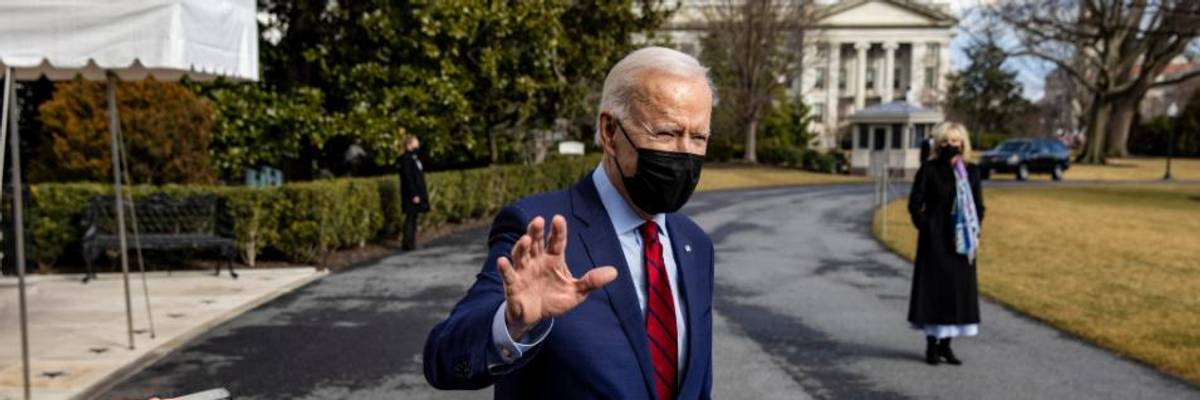
U.S. President Joe Biden speaks to the media outside the White House on February 27, 2021 in Washington, D.C. (Photo: Tasos Katopodis/Getty Images)
While President Joe Biden has been less secretive than his immediate predecessor, watchdog groups--unimpressed by the president's ability to clear the low ethical bar set by former President Donald Trump and frustrated by the White House's refusal to release virtual visitor logs despite the ongoing need for online meetings--are criticizing the current administration for its lack of openness and urging Biden to prioritize government transparency.
Emphasizing that "Biden has fallen short" of his previous boss, former President Barack Obama, when it comes to "bringing transparency back to the White House," Politico reported Monday that "the White House has committed to releasing visitor logs. But it doesn't plan to divulge the names of attendees of virtual meetings, which are the primary mode of interaction until the coronavirus pandemic eases."
"We're in a pandemic," said Walter Shaub, former director of the U.S. Office of Government Ethics and now a senior ethics fellow at the Project on Government Oversight, an anti-corruption nonprofit. "People meet by video conference instead of in person. Why offer to release visitor logs and then keep virtual meetings secret?"
Politico noted that critics, who want Biden to "do more to restore confidence in the federal government following Trump's chaotic term," also cited his administration's failure to share the president and vice president's schedules online, to reinstate the White House comment line, and to allow for citizen petitions on the White House website.
"And while Biden has received kudos for keeping the American public informed, primarily by resuming the daily White House press briefings, he has yet to hold a news conference of his own," Politico added.
Alex Howard, director of the Digital Democracy Project at the left-leaning Demand Progress Educational Fund, told Politico that the steps taken by the Biden administration are "insufficient to the moment and the need." Howard advocated "opening Cabinet meetings, disclosing information, and using political capital to emphasize that being 'open by default' isn't just an option but an obligation across the government."
As Citizens forResponsibility and Ethics in Washington (CREW) tweeted, "Being more transparent than Trump (the president who refused to release his tax returns) is a very low bar. Biden should go even farther to ensure that Trump's standard is not the new normal."
In the interest of promoting good government, dozens of civil society organizations--having recently sent letters to the White House that questioned existing practices and pushed for policy changes--are now insisting that Biden address the weaknesses in transparency laws that his predecessor exposed during his time in office.
As the news outlet noted, "That includes answering public records requests more quickly; publishing Office of Legal Counsel opinions; revising classification policies; and releasing logs of virtual meetings and physical meetings at other locations where the president and his aides travel."
According to Shaub: "We have now learned the system was too weak. And we've been through four years of having to battle tooth and nail to get any documents and we need [Biden] to set up new systems so the next administration will follow them."
White House Press Secretary Jen Psaki announced before Inauguration Day that the White House "would bring back the release of its visitor logs--a practice started by Obama eight months into his presidency, when the administration would regularly release and archive visitor logs for its core offices, with exceptions," Politico reported. "Trump discontinued the practice, though after a lawsuit he agreed to allow monthly publication of visitor logs for some White House offices, including the Office of Management and Budget."
"When Biden pledged to bring the logs back, it was seen as a reversion to the Obama norm," the news outlet noted. "But Covid changed the basic concept of White House visitation and has altered expectations around what should be revealed."
An unnamed White House official confirmed the Biden administration would not release virtual logs, telling Politico: "Virtual meetings will not be subject to release--in the same way that previous administrations didn't release phone logs--but we're planning on regularly releasing the attendee lists for in-person meetings at the White House."
Not everyone is buying the White House's comparison of virtual meetings to phone calls, given how virtual meetings have, for public health reasons, become a stand-in for in-person meetings.
One of the skeptics who thinks Biden should publicize the virtual logs is Norm Eisen, who served as Obama's "ethics czar" from 2009 to 2011.
"For the Covid era when so much is being done remotely, there should be an accommodation for that," said Eisen, now a senior fellow at the Brookings Institution and editor of a recent report (pdf) urging Biden take steps to rebuild faith in U.S. democracy in the wake of Trump's norm-shattering presidency.
In addition, Biden has come under fire for his failure to restore the We the People page on the White House website, which was a popular citizen petition tool launched by Obama and discontinued under Trump. He has also been criticized for not restarting the White House comment line, an alternative to the website frequently used by senior citizens.
Despite taking "promising first steps toward transparency," said Anna Diakun, staff attorney at the Knight First Amendment Institute at Columbia University, "the Biden administration hasn't yet unveiled any broader plan to make good on its commitment to open government."
Dear Common Dreams reader, It’s been nearly 30 years since I co-founded Common Dreams with my late wife, Lina Newhouser. We had the radical notion that journalism should serve the public good, not corporate profits. It was clear to us from the outset what it would take to build such a project. No paid advertisements. No corporate sponsors. No millionaire publisher telling us what to think or do. Many people said we wouldn't last a year, but we proved those doubters wrong. Together with a tremendous team of journalists and dedicated staff, we built an independent media outlet free from the constraints of profits and corporate control. Our mission has always been simple: To inform. To inspire. To ignite change for the common good. Building Common Dreams was not easy. Our survival was never guaranteed. When you take on the most powerful forces—Wall Street greed, fossil fuel industry destruction, Big Tech lobbyists, and uber-rich oligarchs who have spent billions upon billions rigging the economy and democracy in their favor—the only bulwark you have is supporters who believe in your work. But here’s the urgent message from me today. It's never been this bad out there. And it's never been this hard to keep us going. At the very moment Common Dreams is most needed, the threats we face are intensifying. We need your support now more than ever. We don't accept corporate advertising and never will. We don't have a paywall because we don't think people should be blocked from critical news based on their ability to pay. Everything we do is funded by the donations of readers like you. When everyone does the little they can afford, we are strong. But if that support retreats or dries up, so do we. Will you donate now to make sure Common Dreams not only survives but thrives? —Craig Brown, Co-founder |
While President Joe Biden has been less secretive than his immediate predecessor, watchdog groups--unimpressed by the president's ability to clear the low ethical bar set by former President Donald Trump and frustrated by the White House's refusal to release virtual visitor logs despite the ongoing need for online meetings--are criticizing the current administration for its lack of openness and urging Biden to prioritize government transparency.
Emphasizing that "Biden has fallen short" of his previous boss, former President Barack Obama, when it comes to "bringing transparency back to the White House," Politico reported Monday that "the White House has committed to releasing visitor logs. But it doesn't plan to divulge the names of attendees of virtual meetings, which are the primary mode of interaction until the coronavirus pandemic eases."
"We're in a pandemic," said Walter Shaub, former director of the U.S. Office of Government Ethics and now a senior ethics fellow at the Project on Government Oversight, an anti-corruption nonprofit. "People meet by video conference instead of in person. Why offer to release visitor logs and then keep virtual meetings secret?"
Politico noted that critics, who want Biden to "do more to restore confidence in the federal government following Trump's chaotic term," also cited his administration's failure to share the president and vice president's schedules online, to reinstate the White House comment line, and to allow for citizen petitions on the White House website.
"And while Biden has received kudos for keeping the American public informed, primarily by resuming the daily White House press briefings, he has yet to hold a news conference of his own," Politico added.
Alex Howard, director of the Digital Democracy Project at the left-leaning Demand Progress Educational Fund, told Politico that the steps taken by the Biden administration are "insufficient to the moment and the need." Howard advocated "opening Cabinet meetings, disclosing information, and using political capital to emphasize that being 'open by default' isn't just an option but an obligation across the government."
As Citizens forResponsibility and Ethics in Washington (CREW) tweeted, "Being more transparent than Trump (the president who refused to release his tax returns) is a very low bar. Biden should go even farther to ensure that Trump's standard is not the new normal."
In the interest of promoting good government, dozens of civil society organizations--having recently sent letters to the White House that questioned existing practices and pushed for policy changes--are now insisting that Biden address the weaknesses in transparency laws that his predecessor exposed during his time in office.
As the news outlet noted, "That includes answering public records requests more quickly; publishing Office of Legal Counsel opinions; revising classification policies; and releasing logs of virtual meetings and physical meetings at other locations where the president and his aides travel."
According to Shaub: "We have now learned the system was too weak. And we've been through four years of having to battle tooth and nail to get any documents and we need [Biden] to set up new systems so the next administration will follow them."
White House Press Secretary Jen Psaki announced before Inauguration Day that the White House "would bring back the release of its visitor logs--a practice started by Obama eight months into his presidency, when the administration would regularly release and archive visitor logs for its core offices, with exceptions," Politico reported. "Trump discontinued the practice, though after a lawsuit he agreed to allow monthly publication of visitor logs for some White House offices, including the Office of Management and Budget."
"When Biden pledged to bring the logs back, it was seen as a reversion to the Obama norm," the news outlet noted. "But Covid changed the basic concept of White House visitation and has altered expectations around what should be revealed."
An unnamed White House official confirmed the Biden administration would not release virtual logs, telling Politico: "Virtual meetings will not be subject to release--in the same way that previous administrations didn't release phone logs--but we're planning on regularly releasing the attendee lists for in-person meetings at the White House."
Not everyone is buying the White House's comparison of virtual meetings to phone calls, given how virtual meetings have, for public health reasons, become a stand-in for in-person meetings.
One of the skeptics who thinks Biden should publicize the virtual logs is Norm Eisen, who served as Obama's "ethics czar" from 2009 to 2011.
"For the Covid era when so much is being done remotely, there should be an accommodation for that," said Eisen, now a senior fellow at the Brookings Institution and editor of a recent report (pdf) urging Biden take steps to rebuild faith in U.S. democracy in the wake of Trump's norm-shattering presidency.
In addition, Biden has come under fire for his failure to restore the We the People page on the White House website, which was a popular citizen petition tool launched by Obama and discontinued under Trump. He has also been criticized for not restarting the White House comment line, an alternative to the website frequently used by senior citizens.
Despite taking "promising first steps toward transparency," said Anna Diakun, staff attorney at the Knight First Amendment Institute at Columbia University, "the Biden administration hasn't yet unveiled any broader plan to make good on its commitment to open government."
While President Joe Biden has been less secretive than his immediate predecessor, watchdog groups--unimpressed by the president's ability to clear the low ethical bar set by former President Donald Trump and frustrated by the White House's refusal to release virtual visitor logs despite the ongoing need for online meetings--are criticizing the current administration for its lack of openness and urging Biden to prioritize government transparency.
Emphasizing that "Biden has fallen short" of his previous boss, former President Barack Obama, when it comes to "bringing transparency back to the White House," Politico reported Monday that "the White House has committed to releasing visitor logs. But it doesn't plan to divulge the names of attendees of virtual meetings, which are the primary mode of interaction until the coronavirus pandemic eases."
"We're in a pandemic," said Walter Shaub, former director of the U.S. Office of Government Ethics and now a senior ethics fellow at the Project on Government Oversight, an anti-corruption nonprofit. "People meet by video conference instead of in person. Why offer to release visitor logs and then keep virtual meetings secret?"
Politico noted that critics, who want Biden to "do more to restore confidence in the federal government following Trump's chaotic term," also cited his administration's failure to share the president and vice president's schedules online, to reinstate the White House comment line, and to allow for citizen petitions on the White House website.
"And while Biden has received kudos for keeping the American public informed, primarily by resuming the daily White House press briefings, he has yet to hold a news conference of his own," Politico added.
Alex Howard, director of the Digital Democracy Project at the left-leaning Demand Progress Educational Fund, told Politico that the steps taken by the Biden administration are "insufficient to the moment and the need." Howard advocated "opening Cabinet meetings, disclosing information, and using political capital to emphasize that being 'open by default' isn't just an option but an obligation across the government."
As Citizens forResponsibility and Ethics in Washington (CREW) tweeted, "Being more transparent than Trump (the president who refused to release his tax returns) is a very low bar. Biden should go even farther to ensure that Trump's standard is not the new normal."
In the interest of promoting good government, dozens of civil society organizations--having recently sent letters to the White House that questioned existing practices and pushed for policy changes--are now insisting that Biden address the weaknesses in transparency laws that his predecessor exposed during his time in office.
As the news outlet noted, "That includes answering public records requests more quickly; publishing Office of Legal Counsel opinions; revising classification policies; and releasing logs of virtual meetings and physical meetings at other locations where the president and his aides travel."
According to Shaub: "We have now learned the system was too weak. And we've been through four years of having to battle tooth and nail to get any documents and we need [Biden] to set up new systems so the next administration will follow them."
White House Press Secretary Jen Psaki announced before Inauguration Day that the White House "would bring back the release of its visitor logs--a practice started by Obama eight months into his presidency, when the administration would regularly release and archive visitor logs for its core offices, with exceptions," Politico reported. "Trump discontinued the practice, though after a lawsuit he agreed to allow monthly publication of visitor logs for some White House offices, including the Office of Management and Budget."
"When Biden pledged to bring the logs back, it was seen as a reversion to the Obama norm," the news outlet noted. "But Covid changed the basic concept of White House visitation and has altered expectations around what should be revealed."
An unnamed White House official confirmed the Biden administration would not release virtual logs, telling Politico: "Virtual meetings will not be subject to release--in the same way that previous administrations didn't release phone logs--but we're planning on regularly releasing the attendee lists for in-person meetings at the White House."
Not everyone is buying the White House's comparison of virtual meetings to phone calls, given how virtual meetings have, for public health reasons, become a stand-in for in-person meetings.
One of the skeptics who thinks Biden should publicize the virtual logs is Norm Eisen, who served as Obama's "ethics czar" from 2009 to 2011.
"For the Covid era when so much is being done remotely, there should be an accommodation for that," said Eisen, now a senior fellow at the Brookings Institution and editor of a recent report (pdf) urging Biden take steps to rebuild faith in U.S. democracy in the wake of Trump's norm-shattering presidency.
In addition, Biden has come under fire for his failure to restore the We the People page on the White House website, which was a popular citizen petition tool launched by Obama and discontinued under Trump. He has also been criticized for not restarting the White House comment line, an alternative to the website frequently used by senior citizens.
Despite taking "promising first steps toward transparency," said Anna Diakun, staff attorney at the Knight First Amendment Institute at Columbia University, "the Biden administration hasn't yet unveiled any broader plan to make good on its commitment to open government."