SUBSCRIBE TO OUR FREE NEWSLETTER
Daily news & progressive opinion—funded by the people, not the corporations—delivered straight to your inbox.
5
#000000
#FFFFFF
To donate by check, phone, or other method, see our More Ways to Give page.
Daily news & progressive opinion—funded by the people, not the corporations—delivered straight to your inbox.
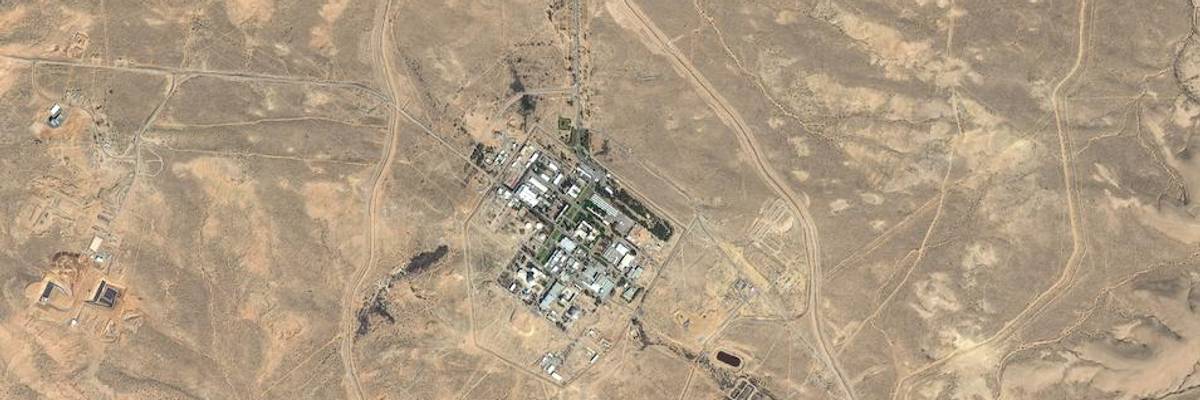
Maxar satellite imagery of the Shimon Peres Negev Nuclear Research Center in the Negev Desert outside Dimona, Isreal on Feb. 19, 2017. (Photo: Satellite image (c) 2020 Maxar Technologies)
New satellite analysis by the Associated Press of Israel's nuclear facility in the Negev desert provides fresh evidence of recent, major activity at at the site.
Israel, which has not signed the nuclear Nonproliferation Treaty (NPT), has never officially declared its nuclear weapons program but is believed to have an arsenal of an estimated 90 nuclear warheads.
The secretive facility in question is the Negev Nuclear Research Center near Dimona.
Last week, the International Panel on Fissile Materials (IPFM) said that commercial satellite imagery it obtained and that was taken in January showed "significant new construction" at the site.
"The construction site is located in the immediate vicinity of the buildings that house the nuclear reactor and the reprocessing plant (to the southwest from the buildings, around the point with coordinates 31.000, 35.143)," said IPFM. The purpose of the construction was not clear.
In its reporting Thursday the AP noted that the activity seen by IPFM followed decades of no changes to the layout at the facility. From the news outlet:
Satellite images captured Monday by Planet Labs Inc. after a request from the AP provide the clearest view yet of the activity. Just southwest of the reactor, workers have dug a hole some 150 meters (165 yards) long and 60 meters (65 yards) wide. Tailings from the dig can be seen next to the site. A trench some 330 meters (360 yards) runs near the dig.
Some 2 kilometers (1.25 miles) west of the reactor, boxes are stacked in two rectangular holes that appear to have concrete bases. Tailings from the dig can be seen nearby. Similar concrete pads are often used to entomb nuclear waste.
Other images from Planet Labs suggest the dig near the reactor began in early 2019 and has progressed slowly since then.
Israeli officials did not respond to a request from the AP about the purpose of the activity.
The activity did, however, elicit comment from Iranian Foreign Minister Mohammad Javad Zarif--whose country's nuclear program has faced under harsh criticism from Israel.
In a Saturday tweet sharing The Guardian's reporting on the Dimona activity, Zarif tagged President Joe Biden, the International Atomic Energy Agency, U.K. Prime Minister Boris Johnson, French President Emmanuel Macron, and German Chancellor Angela Merkel and wrote, "Israel is expanding Dimona, the region's only nuclear bomb factory."
"Gravely concerned? Concerned? A little? Care to comment? I thought so," tweeted Zarif.
Further comment from Iran came Wednesday from Esmaeil Baghaei Hamaneh, Iran's ambassador to the U.N.
According to state-owned Press TV, Hamaneh said that Israel's attempts to puruse nuclear weapons posed a theat to regional and international peace. He said that "the United States and its Western allies should be held responsible for failure of the efforts to establish a Middle East free of weapons of mass destruction given their support for the Tel Aviv regime and equipping it with nuclear arms."
The developments came amid hope from from U.S. progressives that the Biden administration was moving toward rejoining the Joint Comprehensive Plan of Action, commonly known as the Iran nuclear deal.
Dear Common Dreams reader, It’s been nearly 30 years since I co-founded Common Dreams with my late wife, Lina Newhouser. We had the radical notion that journalism should serve the public good, not corporate profits. It was clear to us from the outset what it would take to build such a project. No paid advertisements. No corporate sponsors. No millionaire publisher telling us what to think or do. Many people said we wouldn't last a year, but we proved those doubters wrong. Together with a tremendous team of journalists and dedicated staff, we built an independent media outlet free from the constraints of profits and corporate control. Our mission has always been simple: To inform. To inspire. To ignite change for the common good. Building Common Dreams was not easy. Our survival was never guaranteed. When you take on the most powerful forces—Wall Street greed, fossil fuel industry destruction, Big Tech lobbyists, and uber-rich oligarchs who have spent billions upon billions rigging the economy and democracy in their favor—the only bulwark you have is supporters who believe in your work. But here’s the urgent message from me today. It's never been this bad out there. And it's never been this hard to keep us going. At the very moment Common Dreams is most needed, the threats we face are intensifying. We need your support now more than ever. We don't accept corporate advertising and never will. We don't have a paywall because we don't think people should be blocked from critical news based on their ability to pay. Everything we do is funded by the donations of readers like you. When everyone does the little they can afford, we are strong. But if that support retreats or dries up, so do we. Will you donate now to make sure Common Dreams not only survives but thrives? —Craig Brown, Co-founder |
New satellite analysis by the Associated Press of Israel's nuclear facility in the Negev desert provides fresh evidence of recent, major activity at at the site.
Israel, which has not signed the nuclear Nonproliferation Treaty (NPT), has never officially declared its nuclear weapons program but is believed to have an arsenal of an estimated 90 nuclear warheads.
The secretive facility in question is the Negev Nuclear Research Center near Dimona.
Last week, the International Panel on Fissile Materials (IPFM) said that commercial satellite imagery it obtained and that was taken in January showed "significant new construction" at the site.
"The construction site is located in the immediate vicinity of the buildings that house the nuclear reactor and the reprocessing plant (to the southwest from the buildings, around the point with coordinates 31.000, 35.143)," said IPFM. The purpose of the construction was not clear.
In its reporting Thursday the AP noted that the activity seen by IPFM followed decades of no changes to the layout at the facility. From the news outlet:
Satellite images captured Monday by Planet Labs Inc. after a request from the AP provide the clearest view yet of the activity. Just southwest of the reactor, workers have dug a hole some 150 meters (165 yards) long and 60 meters (65 yards) wide. Tailings from the dig can be seen next to the site. A trench some 330 meters (360 yards) runs near the dig.
Some 2 kilometers (1.25 miles) west of the reactor, boxes are stacked in two rectangular holes that appear to have concrete bases. Tailings from the dig can be seen nearby. Similar concrete pads are often used to entomb nuclear waste.
Other images from Planet Labs suggest the dig near the reactor began in early 2019 and has progressed slowly since then.
Israeli officials did not respond to a request from the AP about the purpose of the activity.
The activity did, however, elicit comment from Iranian Foreign Minister Mohammad Javad Zarif--whose country's nuclear program has faced under harsh criticism from Israel.
In a Saturday tweet sharing The Guardian's reporting on the Dimona activity, Zarif tagged President Joe Biden, the International Atomic Energy Agency, U.K. Prime Minister Boris Johnson, French President Emmanuel Macron, and German Chancellor Angela Merkel and wrote, "Israel is expanding Dimona, the region's only nuclear bomb factory."
"Gravely concerned? Concerned? A little? Care to comment? I thought so," tweeted Zarif.
Further comment from Iran came Wednesday from Esmaeil Baghaei Hamaneh, Iran's ambassador to the U.N.
According to state-owned Press TV, Hamaneh said that Israel's attempts to puruse nuclear weapons posed a theat to regional and international peace. He said that "the United States and its Western allies should be held responsible for failure of the efforts to establish a Middle East free of weapons of mass destruction given their support for the Tel Aviv regime and equipping it with nuclear arms."
The developments came amid hope from from U.S. progressives that the Biden administration was moving toward rejoining the Joint Comprehensive Plan of Action, commonly known as the Iran nuclear deal.
New satellite analysis by the Associated Press of Israel's nuclear facility in the Negev desert provides fresh evidence of recent, major activity at at the site.
Israel, which has not signed the nuclear Nonproliferation Treaty (NPT), has never officially declared its nuclear weapons program but is believed to have an arsenal of an estimated 90 nuclear warheads.
The secretive facility in question is the Negev Nuclear Research Center near Dimona.
Last week, the International Panel on Fissile Materials (IPFM) said that commercial satellite imagery it obtained and that was taken in January showed "significant new construction" at the site.
"The construction site is located in the immediate vicinity of the buildings that house the nuclear reactor and the reprocessing plant (to the southwest from the buildings, around the point with coordinates 31.000, 35.143)," said IPFM. The purpose of the construction was not clear.
In its reporting Thursday the AP noted that the activity seen by IPFM followed decades of no changes to the layout at the facility. From the news outlet:
Satellite images captured Monday by Planet Labs Inc. after a request from the AP provide the clearest view yet of the activity. Just southwest of the reactor, workers have dug a hole some 150 meters (165 yards) long and 60 meters (65 yards) wide. Tailings from the dig can be seen next to the site. A trench some 330 meters (360 yards) runs near the dig.
Some 2 kilometers (1.25 miles) west of the reactor, boxes are stacked in two rectangular holes that appear to have concrete bases. Tailings from the dig can be seen nearby. Similar concrete pads are often used to entomb nuclear waste.
Other images from Planet Labs suggest the dig near the reactor began in early 2019 and has progressed slowly since then.
Israeli officials did not respond to a request from the AP about the purpose of the activity.
The activity did, however, elicit comment from Iranian Foreign Minister Mohammad Javad Zarif--whose country's nuclear program has faced under harsh criticism from Israel.
In a Saturday tweet sharing The Guardian's reporting on the Dimona activity, Zarif tagged President Joe Biden, the International Atomic Energy Agency, U.K. Prime Minister Boris Johnson, French President Emmanuel Macron, and German Chancellor Angela Merkel and wrote, "Israel is expanding Dimona, the region's only nuclear bomb factory."
"Gravely concerned? Concerned? A little? Care to comment? I thought so," tweeted Zarif.
Further comment from Iran came Wednesday from Esmaeil Baghaei Hamaneh, Iran's ambassador to the U.N.
According to state-owned Press TV, Hamaneh said that Israel's attempts to puruse nuclear weapons posed a theat to regional and international peace. He said that "the United States and its Western allies should be held responsible for failure of the efforts to establish a Middle East free of weapons of mass destruction given their support for the Tel Aviv regime and equipping it with nuclear arms."
The developments came amid hope from from U.S. progressives that the Biden administration was moving toward rejoining the Joint Comprehensive Plan of Action, commonly known as the Iran nuclear deal.