SUBSCRIBE TO OUR FREE NEWSLETTER
Daily news & progressive opinion—funded by the people, not the corporations—delivered straight to your inbox.
5
#000000
#FFFFFF
To donate by check, phone, or other method, see our More Ways to Give page.
Daily news & progressive opinion—funded by the people, not the corporations—delivered straight to your inbox.
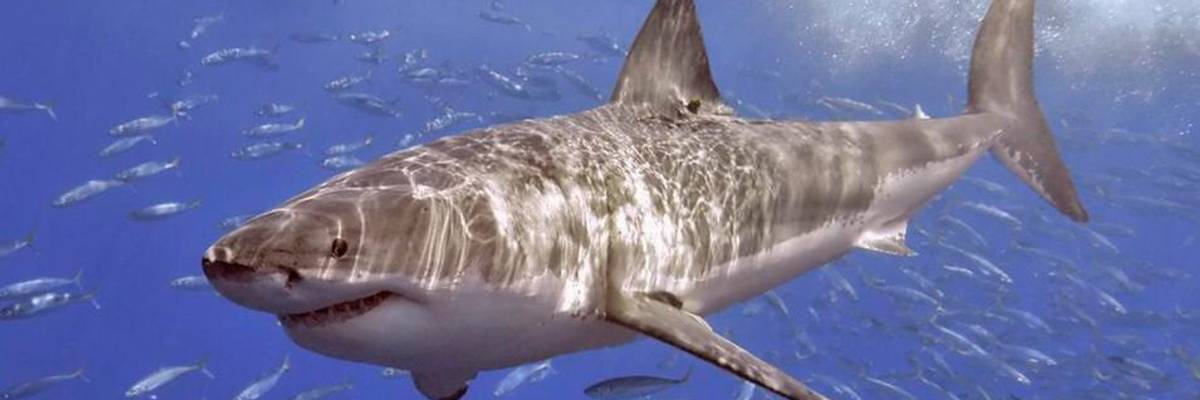
A great white shark swims among a school of fish in the Pacific Ocean near Isla Guadalupe, Baja California del Norte, Mexico. (Photo: pterantula/Flickr/cc)
Warming oceans--a key measure of the climate crisis--are forcing great white sharks into colder waters, where they are causing a devastating decrease in wildlife populations, according to new research reported Tuesday by The Guardian.
"The sharks are not the problem--climate change is the problem."
--Kyle Van Houtan
Monterey Bay Aquarium
The study, led by researchers at the Monterey Bay Aquarium in California and published in Scientific Reports, found that unprecedented sightings of juvenile great white sharks in the northern part of Monterey Bay prove a lack of suitable thermal habitat is driving the predatory fish into waters that were previously too cold for them.
Record ocean heating, including a 2014-2016 Pacific heatwave, has pushed young sharks to move more than 370 miles northward along the California coast since 2014. Between 1982 and 2013, the northernmost limit of juvenile great whites' range was near Santa Barbara, over 200 miles south of Montery Bay. After the heatwave, their range shifted as far north as Bodega Bay, about 330 miles north of Santa Barbara.
The study found that great white predation of sea otters in Monterey Bay has led to an alarming 86% drop in the mammals' population there, threatening decades of efforts to conserve the threatened species.
"White sharks aren't just another species--they're an apex predator and all eyes are on them in the ocean," Kyle Van Houtan of the Monterey Bay Aquarium told The Guardian. "The sharks are not the problem--climate change is the problem."
"The sharks are telling us that the ocean is changing," said Van Houtan, "and it's now time for us to do something about it."
Van Houtan said in a statement that "we need to act on climate change and reduce our reliance on fossil fuels."
Chris Lowe, a co-author of the study and director of the Shark Lab at California State University, Long Beach, said that the researchers' findings are "what many biologists have expected to see as the result of climate change and rising ocean temperatures."
"Frankly, I'll be surprised if we don't see this northerly shift across more species," he said.
Van Houtan concurred, noting that global heating is pushing many species toward the poles and that "what we've detected here is just a harbinger of much broader patterns."
Professor Malin Pinksy of Rutgers University in New Jersey called the study--in which he did not participate--"a particularly attention-grabbing example of the mass movement of marine life that's happening off our coasts right now, involving everything from mangroves to cod."
The presence of great white sharks in colder waters is also raising concerns about dangerous encounters with humans. Lasy May, a surfer was killed by one off the coast of Santa Cruz County in an area covered by the study, although researchers note that overall, California shark attacks have plummeted in recent decades.
"I've seen sharks right under surfers, just a few feet away," Chris Gularte, chief pilot with the Watsonville-based tour company Specialized Helicopters, told the Mercury News in San Jose. "When the water is warm and they come in the bay, you can see them swim near people all day long. Standup paddlers and kayakers will go right up to them and not realize they are there."
Indeed, Pinsky said that "climate change is scrambling our ocean ecosystems and sometimes it produces surprises with a whole lot of teeth."
Dear Common Dreams reader, It’s been nearly 30 years since I co-founded Common Dreams with my late wife, Lina Newhouser. We had the radical notion that journalism should serve the public good, not corporate profits. It was clear to us from the outset what it would take to build such a project. No paid advertisements. No corporate sponsors. No millionaire publisher telling us what to think or do. Many people said we wouldn't last a year, but we proved those doubters wrong. Together with a tremendous team of journalists and dedicated staff, we built an independent media outlet free from the constraints of profits and corporate control. Our mission has always been simple: To inform. To inspire. To ignite change for the common good. Building Common Dreams was not easy. Our survival was never guaranteed. When you take on the most powerful forces—Wall Street greed, fossil fuel industry destruction, Big Tech lobbyists, and uber-rich oligarchs who have spent billions upon billions rigging the economy and democracy in their favor—the only bulwark you have is supporters who believe in your work. But here’s the urgent message from me today. It's never been this bad out there. And it's never been this hard to keep us going. At the very moment Common Dreams is most needed, the threats we face are intensifying. We need your support now more than ever. We don't accept corporate advertising and never will. We don't have a paywall because we don't think people should be blocked from critical news based on their ability to pay. Everything we do is funded by the donations of readers like you. When everyone does the little they can afford, we are strong. But if that support retreats or dries up, so do we. Will you donate now to make sure Common Dreams not only survives but thrives? —Craig Brown, Co-founder |
Warming oceans--a key measure of the climate crisis--are forcing great white sharks into colder waters, where they are causing a devastating decrease in wildlife populations, according to new research reported Tuesday by The Guardian.
"The sharks are not the problem--climate change is the problem."
--Kyle Van Houtan
Monterey Bay Aquarium
The study, led by researchers at the Monterey Bay Aquarium in California and published in Scientific Reports, found that unprecedented sightings of juvenile great white sharks in the northern part of Monterey Bay prove a lack of suitable thermal habitat is driving the predatory fish into waters that were previously too cold for them.
Record ocean heating, including a 2014-2016 Pacific heatwave, has pushed young sharks to move more than 370 miles northward along the California coast since 2014. Between 1982 and 2013, the northernmost limit of juvenile great whites' range was near Santa Barbara, over 200 miles south of Montery Bay. After the heatwave, their range shifted as far north as Bodega Bay, about 330 miles north of Santa Barbara.
The study found that great white predation of sea otters in Monterey Bay has led to an alarming 86% drop in the mammals' population there, threatening decades of efforts to conserve the threatened species.
"White sharks aren't just another species--they're an apex predator and all eyes are on them in the ocean," Kyle Van Houtan of the Monterey Bay Aquarium told The Guardian. "The sharks are not the problem--climate change is the problem."
"The sharks are telling us that the ocean is changing," said Van Houtan, "and it's now time for us to do something about it."
Van Houtan said in a statement that "we need to act on climate change and reduce our reliance on fossil fuels."
Chris Lowe, a co-author of the study and director of the Shark Lab at California State University, Long Beach, said that the researchers' findings are "what many biologists have expected to see as the result of climate change and rising ocean temperatures."
"Frankly, I'll be surprised if we don't see this northerly shift across more species," he said.
Van Houtan concurred, noting that global heating is pushing many species toward the poles and that "what we've detected here is just a harbinger of much broader patterns."
Professor Malin Pinksy of Rutgers University in New Jersey called the study--in which he did not participate--"a particularly attention-grabbing example of the mass movement of marine life that's happening off our coasts right now, involving everything from mangroves to cod."
The presence of great white sharks in colder waters is also raising concerns about dangerous encounters with humans. Lasy May, a surfer was killed by one off the coast of Santa Cruz County in an area covered by the study, although researchers note that overall, California shark attacks have plummeted in recent decades.
"I've seen sharks right under surfers, just a few feet away," Chris Gularte, chief pilot with the Watsonville-based tour company Specialized Helicopters, told the Mercury News in San Jose. "When the water is warm and they come in the bay, you can see them swim near people all day long. Standup paddlers and kayakers will go right up to them and not realize they are there."
Indeed, Pinsky said that "climate change is scrambling our ocean ecosystems and sometimes it produces surprises with a whole lot of teeth."
Warming oceans--a key measure of the climate crisis--are forcing great white sharks into colder waters, where they are causing a devastating decrease in wildlife populations, according to new research reported Tuesday by The Guardian.
"The sharks are not the problem--climate change is the problem."
--Kyle Van Houtan
Monterey Bay Aquarium
The study, led by researchers at the Monterey Bay Aquarium in California and published in Scientific Reports, found that unprecedented sightings of juvenile great white sharks in the northern part of Monterey Bay prove a lack of suitable thermal habitat is driving the predatory fish into waters that were previously too cold for them.
Record ocean heating, including a 2014-2016 Pacific heatwave, has pushed young sharks to move more than 370 miles northward along the California coast since 2014. Between 1982 and 2013, the northernmost limit of juvenile great whites' range was near Santa Barbara, over 200 miles south of Montery Bay. After the heatwave, their range shifted as far north as Bodega Bay, about 330 miles north of Santa Barbara.
The study found that great white predation of sea otters in Monterey Bay has led to an alarming 86% drop in the mammals' population there, threatening decades of efforts to conserve the threatened species.
"White sharks aren't just another species--they're an apex predator and all eyes are on them in the ocean," Kyle Van Houtan of the Monterey Bay Aquarium told The Guardian. "The sharks are not the problem--climate change is the problem."
"The sharks are telling us that the ocean is changing," said Van Houtan, "and it's now time for us to do something about it."
Van Houtan said in a statement that "we need to act on climate change and reduce our reliance on fossil fuels."
Chris Lowe, a co-author of the study and director of the Shark Lab at California State University, Long Beach, said that the researchers' findings are "what many biologists have expected to see as the result of climate change and rising ocean temperatures."
"Frankly, I'll be surprised if we don't see this northerly shift across more species," he said.
Van Houtan concurred, noting that global heating is pushing many species toward the poles and that "what we've detected here is just a harbinger of much broader patterns."
Professor Malin Pinksy of Rutgers University in New Jersey called the study--in which he did not participate--"a particularly attention-grabbing example of the mass movement of marine life that's happening off our coasts right now, involving everything from mangroves to cod."
The presence of great white sharks in colder waters is also raising concerns about dangerous encounters with humans. Lasy May, a surfer was killed by one off the coast of Santa Cruz County in an area covered by the study, although researchers note that overall, California shark attacks have plummeted in recent decades.
"I've seen sharks right under surfers, just a few feet away," Chris Gularte, chief pilot with the Watsonville-based tour company Specialized Helicopters, told the Mercury News in San Jose. "When the water is warm and they come in the bay, you can see them swim near people all day long. Standup paddlers and kayakers will go right up to them and not realize they are there."
Indeed, Pinsky said that "climate change is scrambling our ocean ecosystems and sometimes it produces surprises with a whole lot of teeth."