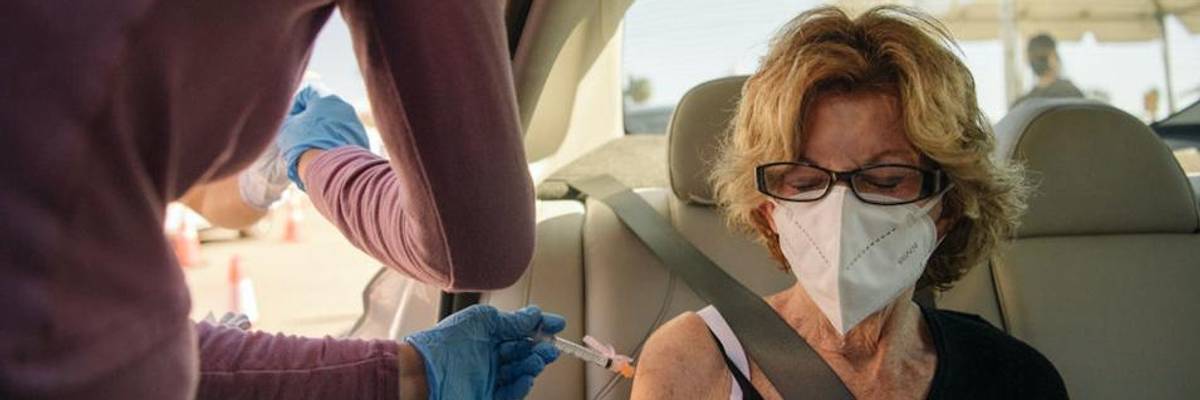
A woman receives a Covid-19 vaccination shot in a parking lot at Dodger Stadium in Los Angeles on January 30, 2021. (Photo: Morgan Lieberman/Getty Images)
'That Hurricane Is Coming': Leading Expert Says More Contagious UK Covid-19 Variant Could Portend Deadliest US Surge Yet
"We are going to see something like we have not seen yet in this country," warned Dr. Michael Osterholm, who advised President Joe Biden's transition team.
Imploring the Biden administration to accelerate efforts to vaccinate as many people as possible in the United States against Covid-19, a leading infectious disease expert on Sunday likened a possible impending surge of a newer coronavirus variant first found in the United Kingdom to a "Category 5 hurricane."
"We need to get as many one-doses in as many people over 65 as we possibly can, to reduce serious illness and deaths that are going to occur over the weeks ahead."
--Dr. Michael Osterholm
Appearing on NBC's "Meet the Press," Dr. Michael Osterholm, director of the Center for Infectious Disease Research and Policy at the University of Minnesota and one of President Joe Biden's Covid-19 advisers during the presidential transition, said the U.S. could soon experience record infections and deaths.
Osterholm predicted that infections from new variants of the virus--specifically the B.1.1.7 strain first found in Britain--will peak in the U.S. "in the next six to 14 weeks."
"If we see that happen, which my 45 years in the trenches tell us we will, we are going to see something like we have not seen yet in this country," he warned. "That hurricane is coming."
"We have to understand that because of this surge, we do have to call an audible," Osterholm added, an American football reference to changing a play at the last moment due to new circumstances.
That could involve a shift in vaccination strategy, one that focuses on getting the first dose injected into as many people as possible--especially the elderly and those with preexisting health conditions--rather than giving selected groups both doses. The Moderna and Pfizer vaccines currently approved in the U.S. require two shots for maximum efficacy.
"We still want to get two doses in everyone," said Osterholm, "but I think right now, in advance of this surge, we need to get as many one-doses in as many people over 65 as we possibly can, to reduce serious illness and deaths that are going to occur over the weeks ahead."
Osterholm noted that Moderna's vaccine is 80% effective after the first dose, while Johnson & Johnson's single-dose vaccine--which is expected to soon be approved by the U.S. Food and Drug Administration--has a 72% efficacy rate after the initial injection. Pfizer's vaccine, on the other hand, has proved just 52% effective after one shot.
The U.S. and the world are scrambling to control the virus in the face of the threat posed by the new variants. Late last month, the Netherlands' National Institute for Public Health and the Environment said that there are now "essentially two separate Covid-19 epidemics: one epidemic involving the 'old' variant, in which infections are decreasing, and another epidemic involving the [B.1.1.7] variant, in which infections are increasing."
Research suggests that the B.1.1.7 strain is more contagious than other forms of the virus, speading 30% to 70% faster. It may also be about 30% deadlier.
If there is any good news about B.1.1.7, it is that vaccines seem to be effective against it.
"Fortunately, [B.1.1.7] has not shown its ability to evade the protection from the vaccine. But its ability to cause many more infections and much more serious illness is there."
--Osterholm
"Fortunately, [B.1.1.7] has not shown its ability to evade the protection from the vaccine," Osterholm said. "But its ability to cause many more infections and much more serious illness is there."
According to Johns Hopkins University, the U.S. has now had over 26.2 million of the world's nearly 103.1 million documented Covid-19 infections, or 25% of all cases. As of early Monday afternoon the U.S. has suffered nearly 442,000 Covid-19 deaths, over 200,000 more than the country with the second-highest mortality, Brazil.
While U.S. hospitalizations are decreasing and the number of vaccinated people in the U.S. now exceeds 31 million, daily deaths are still at or near all-time highs, with a rolling seven-day average daily mortality of 3,153 on January 31, with severe racial disparities reported in both infections and deaths.
We are at a crossroads
This country and this world are at a monumental crossroads. In a few short weeks, US voters will have an opportunity to beat back the forces of fascism and confront the billionaires who are rigging the economy, our media system, and our democracy, making it increasingly impossible for ordinary people to get by. We’re not just talking about the election. We’re talking about what must be done once these fascist elements are vanquished from power. We need a bolder set of solutions than what either major party has so far been willing to offer and a working-class movement ready to fight like hell for it. Trump didn't emerge from nowhere. The conditions that fueled MAGA authoritarianism were created by decades of radical neoliberal economic policies and a corrupt political system dominated by corporate interests. They slashed taxes on the super-rich, promising that the benefits would trickle down. They said giveaways to the corporate titans would make life more affordable for the rest of us. It was all bullshit. And when a bitter, betrayed populace searches for someone to blame, right-wing demagogues have little trouble finding scapegoats. People know when they're being lied to, but you won't hear any of this from the corporate media. Only independent journalism—powered and funded by people who believe in building a better world—can deliver truly trustworthy daily news. Our Fall Campaign is underway, and we need your help. To power our newsroom through the rest of the year, we need to raise $125,000 by midnight on October 31. So if you share our vision, please contribute whatever you can to sustain our work. |
Imploring the Biden administration to accelerate efforts to vaccinate as many people as possible in the United States against Covid-19, a leading infectious disease expert on Sunday likened a possible impending surge of a newer coronavirus variant first found in the United Kingdom to a "Category 5 hurricane."
"We need to get as many one-doses in as many people over 65 as we possibly can, to reduce serious illness and deaths that are going to occur over the weeks ahead."
--Dr. Michael Osterholm
Appearing on NBC's "Meet the Press," Dr. Michael Osterholm, director of the Center for Infectious Disease Research and Policy at the University of Minnesota and one of President Joe Biden's Covid-19 advisers during the presidential transition, said the U.S. could soon experience record infections and deaths.
Osterholm predicted that infections from new variants of the virus--specifically the B.1.1.7 strain first found in Britain--will peak in the U.S. "in the next six to 14 weeks."
"If we see that happen, which my 45 years in the trenches tell us we will, we are going to see something like we have not seen yet in this country," he warned. "That hurricane is coming."
"We have to understand that because of this surge, we do have to call an audible," Osterholm added, an American football reference to changing a play at the last moment due to new circumstances.
That could involve a shift in vaccination strategy, one that focuses on getting the first dose injected into as many people as possible--especially the elderly and those with preexisting health conditions--rather than giving selected groups both doses. The Moderna and Pfizer vaccines currently approved in the U.S. require two shots for maximum efficacy.
"We still want to get two doses in everyone," said Osterholm, "but I think right now, in advance of this surge, we need to get as many one-doses in as many people over 65 as we possibly can, to reduce serious illness and deaths that are going to occur over the weeks ahead."
Osterholm noted that Moderna's vaccine is 80% effective after the first dose, while Johnson & Johnson's single-dose vaccine--which is expected to soon be approved by the U.S. Food and Drug Administration--has a 72% efficacy rate after the initial injection. Pfizer's vaccine, on the other hand, has proved just 52% effective after one shot.
The U.S. and the world are scrambling to control the virus in the face of the threat posed by the new variants. Late last month, the Netherlands' National Institute for Public Health and the Environment said that there are now "essentially two separate Covid-19 epidemics: one epidemic involving the 'old' variant, in which infections are decreasing, and another epidemic involving the [B.1.1.7] variant, in which infections are increasing."
Research suggests that the B.1.1.7 strain is more contagious than other forms of the virus, speading 30% to 70% faster. It may also be about 30% deadlier.
If there is any good news about B.1.1.7, it is that vaccines seem to be effective against it.
"Fortunately, [B.1.1.7] has not shown its ability to evade the protection from the vaccine. But its ability to cause many more infections and much more serious illness is there."
--Osterholm
"Fortunately, [B.1.1.7] has not shown its ability to evade the protection from the vaccine," Osterholm said. "But its ability to cause many more infections and much more serious illness is there."
According to Johns Hopkins University, the U.S. has now had over 26.2 million of the world's nearly 103.1 million documented Covid-19 infections, or 25% of all cases. As of early Monday afternoon the U.S. has suffered nearly 442,000 Covid-19 deaths, over 200,000 more than the country with the second-highest mortality, Brazil.
While U.S. hospitalizations are decreasing and the number of vaccinated people in the U.S. now exceeds 31 million, daily deaths are still at or near all-time highs, with a rolling seven-day average daily mortality of 3,153 on January 31, with severe racial disparities reported in both infections and deaths.
Imploring the Biden administration to accelerate efforts to vaccinate as many people as possible in the United States against Covid-19, a leading infectious disease expert on Sunday likened a possible impending surge of a newer coronavirus variant first found in the United Kingdom to a "Category 5 hurricane."
"We need to get as many one-doses in as many people over 65 as we possibly can, to reduce serious illness and deaths that are going to occur over the weeks ahead."
--Dr. Michael Osterholm
Appearing on NBC's "Meet the Press," Dr. Michael Osterholm, director of the Center for Infectious Disease Research and Policy at the University of Minnesota and one of President Joe Biden's Covid-19 advisers during the presidential transition, said the U.S. could soon experience record infections and deaths.
Osterholm predicted that infections from new variants of the virus--specifically the B.1.1.7 strain first found in Britain--will peak in the U.S. "in the next six to 14 weeks."
"If we see that happen, which my 45 years in the trenches tell us we will, we are going to see something like we have not seen yet in this country," he warned. "That hurricane is coming."
"We have to understand that because of this surge, we do have to call an audible," Osterholm added, an American football reference to changing a play at the last moment due to new circumstances.
That could involve a shift in vaccination strategy, one that focuses on getting the first dose injected into as many people as possible--especially the elderly and those with preexisting health conditions--rather than giving selected groups both doses. The Moderna and Pfizer vaccines currently approved in the U.S. require two shots for maximum efficacy.
"We still want to get two doses in everyone," said Osterholm, "but I think right now, in advance of this surge, we need to get as many one-doses in as many people over 65 as we possibly can, to reduce serious illness and deaths that are going to occur over the weeks ahead."
Osterholm noted that Moderna's vaccine is 80% effective after the first dose, while Johnson & Johnson's single-dose vaccine--which is expected to soon be approved by the U.S. Food and Drug Administration--has a 72% efficacy rate after the initial injection. Pfizer's vaccine, on the other hand, has proved just 52% effective after one shot.
The U.S. and the world are scrambling to control the virus in the face of the threat posed by the new variants. Late last month, the Netherlands' National Institute for Public Health and the Environment said that there are now "essentially two separate Covid-19 epidemics: one epidemic involving the 'old' variant, in which infections are decreasing, and another epidemic involving the [B.1.1.7] variant, in which infections are increasing."
Research suggests that the B.1.1.7 strain is more contagious than other forms of the virus, speading 30% to 70% faster. It may also be about 30% deadlier.
If there is any good news about B.1.1.7, it is that vaccines seem to be effective against it.
"Fortunately, [B.1.1.7] has not shown its ability to evade the protection from the vaccine. But its ability to cause many more infections and much more serious illness is there."
--Osterholm
"Fortunately, [B.1.1.7] has not shown its ability to evade the protection from the vaccine," Osterholm said. "But its ability to cause many more infections and much more serious illness is there."
According to Johns Hopkins University, the U.S. has now had over 26.2 million of the world's nearly 103.1 million documented Covid-19 infections, or 25% of all cases. As of early Monday afternoon the U.S. has suffered nearly 442,000 Covid-19 deaths, over 200,000 more than the country with the second-highest mortality, Brazil.
While U.S. hospitalizations are decreasing and the number of vaccinated people in the U.S. now exceeds 31 million, daily deaths are still at or near all-time highs, with a rolling seven-day average daily mortality of 3,153 on January 31, with severe racial disparities reported in both infections and deaths.