SUBSCRIBE TO OUR FREE NEWSLETTER
Daily news & progressive opinion—funded by the people, not the corporations—delivered straight to your inbox.
5
#000000
#FFFFFF
To donate by check, phone, or other method, see our More Ways to Give page.
Daily news & progressive opinion—funded by the people, not the corporations—delivered straight to your inbox.
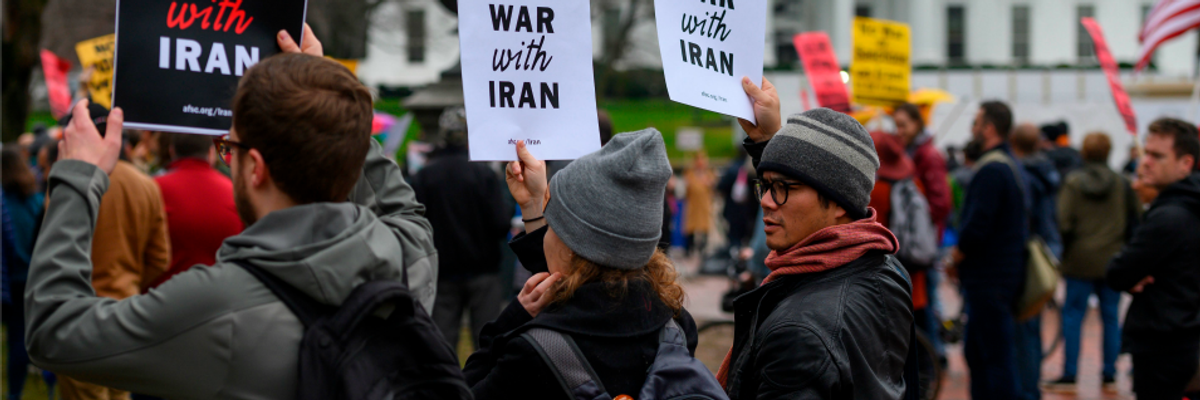
Anti-war activists protest in front of the White House in Washington, D.C. on January 4, 2020. (Photo: Andrew Caballero-Reynolds/AFP via Getty Images)
Sen. Bernie Sanders warned over the weekend that the assassination of top Iranian nuclear scientist Mohsen Fakhrizadeh--widely believed to have been the work of Israel--was carried out with the intention of undermining any prospect of diplomacy between the United States and Iran just weeks before President-elect Joe Biden is set to take office.
"The assassination of Mohsen Fakhrizadeh was reckless, provocative, and illegal," Sanders tweeted Saturday. "As a new administration takes power, it was clearly intended to undermine U.S.-Iran diplomacy. We must not allow that to happen. Diplomacy, not murder, is the best path forward."
Sanders' tweet came days after Fakhrizadeh was fatally wounded Friday in what was described as an ambush as the scientist traveled by car near Tehran. While specific details surrounding the assassination continue to emerge, Iranian and U.S. officials have both said Israel, led by right-wing Prime Minister Benjamin Netanyahu, was responsible.
It remains unclear what, if any, role the Trump administration played in the killing, which took place less than a week after Netanyahu, U.S. Secretary of State Mike Pompeo, and Saudi Crown Prince Mohammed bin Salman reportedly discussed Iran during a secret meeting that prompted fears of a coordinated attack.
The Vermont senator's view that the assassination of Fakhrizadeh was aimed at forestalling the possibility of diplomacy between the U.S. and Iran was echoed by other lawmakers, activists, and analysts, who pointed to Biden's vow to return the U.S. to the Iran nuclear accord that President Donald Trump violated in 2018. Netanyahu has publicly urged Biden against reviving the 2015 agreement.
"The assassination of Mohsen Fakhrizadeh was reckless and will severely undermine the Biden administration's ability to rebuild President Obama's historic diplomatic achievement with Iran: the JCPOA," said Rep.-elect Jamaal Bowman (D-N.Y.). "We believe in peace and diplomacy--not murder and assassination."
As of this writing, Biden has not commented on the targeted killing of Fakhrizadeh.
Trita Parsi, executive vice president at the Quincy Institute for Responsible Statecraft, argued Friday that "the assassination (and other likely future attacks) will likely harden Iran's position and complicate--if not ultimately cripple--the Biden team's attempts to revive diplomacy."
"If Israel was behind the assassination of Fakhrizadeh--which seems highly likely though not yet proven--it demonstrates the degree to which Netanyahu feels emboldened to undermine Democratic U.S. presidents with impunity and drag the United States into war," wrote Parsi. "This will not change unless and until Washington decides to end its drive for military hegemony in the Middle East."
Dear Common Dreams reader, It’s been nearly 30 years since I co-founded Common Dreams with my late wife, Lina Newhouser. We had the radical notion that journalism should serve the public good, not corporate profits. It was clear to us from the outset what it would take to build such a project. No paid advertisements. No corporate sponsors. No millionaire publisher telling us what to think or do. Many people said we wouldn't last a year, but we proved those doubters wrong. Together with a tremendous team of journalists and dedicated staff, we built an independent media outlet free from the constraints of profits and corporate control. Our mission has always been simple: To inform. To inspire. To ignite change for the common good. Building Common Dreams was not easy. Our survival was never guaranteed. When you take on the most powerful forces—Wall Street greed, fossil fuel industry destruction, Big Tech lobbyists, and uber-rich oligarchs who have spent billions upon billions rigging the economy and democracy in their favor—the only bulwark you have is supporters who believe in your work. But here’s the urgent message from me today. It's never been this bad out there. And it's never been this hard to keep us going. At the very moment Common Dreams is most needed, the threats we face are intensifying. We need your support now more than ever. We don't accept corporate advertising and never will. We don't have a paywall because we don't think people should be blocked from critical news based on their ability to pay. Everything we do is funded by the donations of readers like you. When everyone does the little they can afford, we are strong. But if that support retreats or dries up, so do we. Will you donate now to make sure Common Dreams not only survives but thrives? —Craig Brown, Co-founder |
Sen. Bernie Sanders warned over the weekend that the assassination of top Iranian nuclear scientist Mohsen Fakhrizadeh--widely believed to have been the work of Israel--was carried out with the intention of undermining any prospect of diplomacy between the United States and Iran just weeks before President-elect Joe Biden is set to take office.
"The assassination of Mohsen Fakhrizadeh was reckless, provocative, and illegal," Sanders tweeted Saturday. "As a new administration takes power, it was clearly intended to undermine U.S.-Iran diplomacy. We must not allow that to happen. Diplomacy, not murder, is the best path forward."
Sanders' tweet came days after Fakhrizadeh was fatally wounded Friday in what was described as an ambush as the scientist traveled by car near Tehran. While specific details surrounding the assassination continue to emerge, Iranian and U.S. officials have both said Israel, led by right-wing Prime Minister Benjamin Netanyahu, was responsible.
It remains unclear what, if any, role the Trump administration played in the killing, which took place less than a week after Netanyahu, U.S. Secretary of State Mike Pompeo, and Saudi Crown Prince Mohammed bin Salman reportedly discussed Iran during a secret meeting that prompted fears of a coordinated attack.
The Vermont senator's view that the assassination of Fakhrizadeh was aimed at forestalling the possibility of diplomacy between the U.S. and Iran was echoed by other lawmakers, activists, and analysts, who pointed to Biden's vow to return the U.S. to the Iran nuclear accord that President Donald Trump violated in 2018. Netanyahu has publicly urged Biden against reviving the 2015 agreement.
"The assassination of Mohsen Fakhrizadeh was reckless and will severely undermine the Biden administration's ability to rebuild President Obama's historic diplomatic achievement with Iran: the JCPOA," said Rep.-elect Jamaal Bowman (D-N.Y.). "We believe in peace and diplomacy--not murder and assassination."
As of this writing, Biden has not commented on the targeted killing of Fakhrizadeh.
Trita Parsi, executive vice president at the Quincy Institute for Responsible Statecraft, argued Friday that "the assassination (and other likely future attacks) will likely harden Iran's position and complicate--if not ultimately cripple--the Biden team's attempts to revive diplomacy."
"If Israel was behind the assassination of Fakhrizadeh--which seems highly likely though not yet proven--it demonstrates the degree to which Netanyahu feels emboldened to undermine Democratic U.S. presidents with impunity and drag the United States into war," wrote Parsi. "This will not change unless and until Washington decides to end its drive for military hegemony in the Middle East."
Sen. Bernie Sanders warned over the weekend that the assassination of top Iranian nuclear scientist Mohsen Fakhrizadeh--widely believed to have been the work of Israel--was carried out with the intention of undermining any prospect of diplomacy between the United States and Iran just weeks before President-elect Joe Biden is set to take office.
"The assassination of Mohsen Fakhrizadeh was reckless, provocative, and illegal," Sanders tweeted Saturday. "As a new administration takes power, it was clearly intended to undermine U.S.-Iran diplomacy. We must not allow that to happen. Diplomacy, not murder, is the best path forward."
Sanders' tweet came days after Fakhrizadeh was fatally wounded Friday in what was described as an ambush as the scientist traveled by car near Tehran. While specific details surrounding the assassination continue to emerge, Iranian and U.S. officials have both said Israel, led by right-wing Prime Minister Benjamin Netanyahu, was responsible.
It remains unclear what, if any, role the Trump administration played in the killing, which took place less than a week after Netanyahu, U.S. Secretary of State Mike Pompeo, and Saudi Crown Prince Mohammed bin Salman reportedly discussed Iran during a secret meeting that prompted fears of a coordinated attack.
The Vermont senator's view that the assassination of Fakhrizadeh was aimed at forestalling the possibility of diplomacy between the U.S. and Iran was echoed by other lawmakers, activists, and analysts, who pointed to Biden's vow to return the U.S. to the Iran nuclear accord that President Donald Trump violated in 2018. Netanyahu has publicly urged Biden against reviving the 2015 agreement.
"The assassination of Mohsen Fakhrizadeh was reckless and will severely undermine the Biden administration's ability to rebuild President Obama's historic diplomatic achievement with Iran: the JCPOA," said Rep.-elect Jamaal Bowman (D-N.Y.). "We believe in peace and diplomacy--not murder and assassination."
As of this writing, Biden has not commented on the targeted killing of Fakhrizadeh.
Trita Parsi, executive vice president at the Quincy Institute for Responsible Statecraft, argued Friday that "the assassination (and other likely future attacks) will likely harden Iran's position and complicate--if not ultimately cripple--the Biden team's attempts to revive diplomacy."
"If Israel was behind the assassination of Fakhrizadeh--which seems highly likely though not yet proven--it demonstrates the degree to which Netanyahu feels emboldened to undermine Democratic U.S. presidents with impunity and drag the United States into war," wrote Parsi. "This will not change unless and until Washington decides to end its drive for military hegemony in the Middle East."