SUBSCRIBE TO OUR FREE NEWSLETTER
Daily news & progressive opinion—funded by the people, not the corporations—delivered straight to your inbox.
5
#000000
#FFFFFF
To donate by check, phone, or other method, see our More Ways to Give page.
Daily news & progressive opinion—funded by the people, not the corporations—delivered straight to your inbox.
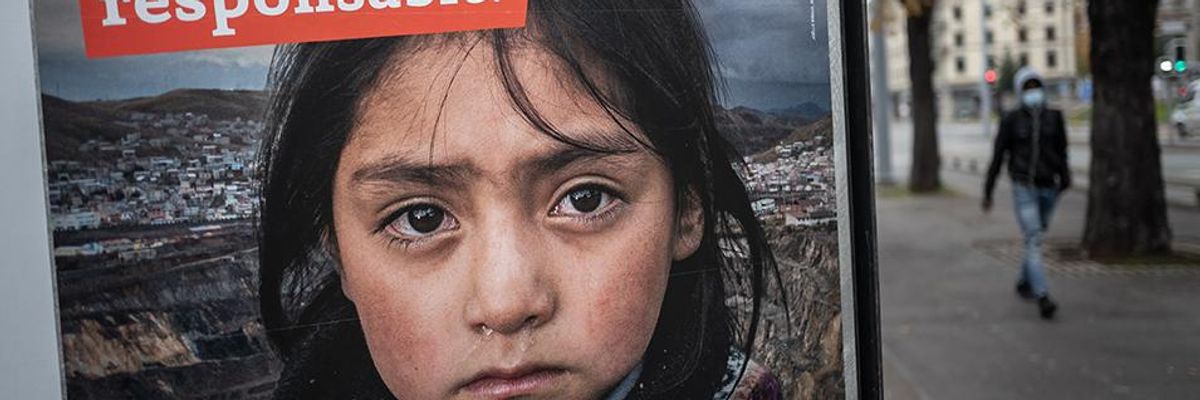
A man walks past a campaign banner reading in French "Contaminated drinking water, poisoned child, Multinational held responsible" displayed in the streets of Geneva on November 29, 2020. - Swiss voters rejected on November 29, 2020 a plan to impose the world's strictest corporate responsibility rules, which would have made multinationals headquartered in the country liable for abusive business practices worldwide. (Photo by FABRICE COFFRINI/AFP via Getty Images)
Sunday's vote in Switzerland to make multinational companies headquartered in the country--like Nestle, minerals giant Glencore, agribusiness company Syngenta-- liable for human rights violations and environmental abuses abroad failed in a country-wide referendum on Sunday.
The initiative titled "Responsible Companies -- to protect people and the environment'' won a narrow majority of votes on Sunday, with 50.7% percent backing it, but failed because a majority of the country's states (or cantons), came out against it. Under the Swiss system, because the initiative proposed a constitutional amendment, it needed the backing of both a popular majority and a majority of cantons to pass.
Organizations like Amnesty International, Greenpeace and the Swiss watchdog group Public Eye backed the proposal. Andreas Missbach, director of Public Eye, said it was a shame that the tougher proposals did not pass, considering that a majority of Swiss voters were in favor. He added that the government-backed legislation was insufficient. "The counterproposal doesn't really bring us anything other than more glossy corporate sustainability reports," he said. "The problems are still here; they are not going away."
The initiative, promoted by a coalition of over 130 civil society organizations, had faced strong opposition from the business sector and the government, which claimed the rules would hurt Swiss companies.
The proposal
The initiative requires Swiss companies to examine whether they can comply with internationally recognized human rights and environmental standards when carrying out their business operations. They will not only have to consider their own activities, but also the activities of their subsidiaries, suppliers and business partners. If need be, they will have to take action and submit reports. In addition, Swiss companies will also be liable for damage caused by companies that they control. However, they will not be held liable if they can prove that they complied with their due diligence obligations. Parliament has approved an indirect counter-proposal to the initiative, which also introduces new reporting and due diligence obligations. Any failures to comply would lead to fines being imposed. The counter-proposal will come into effect if the initiative is rejected, unless the counter-proposal itself is rejected in a referendum.
The vote on Sunday had been the source of much debate in Switzerland, and was the most expensive campaign in the country's history, according to the Swiss newspaper Tages-Anzeiger.
Separately on Sunday, an initiative on the financing of weapon manufacturers also failed. The proposal would have prevented Swiss institutions, including the central bank, from investing in companies generating more than 5 percent of their revenue from the production of war materials.
Dear Common Dreams reader, It’s been nearly 30 years since I co-founded Common Dreams with my late wife, Lina Newhouser. We had the radical notion that journalism should serve the public good, not corporate profits. It was clear to us from the outset what it would take to build such a project. No paid advertisements. No corporate sponsors. No millionaire publisher telling us what to think or do. Many people said we wouldn't last a year, but we proved those doubters wrong. Together with a tremendous team of journalists and dedicated staff, we built an independent media outlet free from the constraints of profits and corporate control. Our mission has always been simple: To inform. To inspire. To ignite change for the common good. Building Common Dreams was not easy. Our survival was never guaranteed. When you take on the most powerful forces—Wall Street greed, fossil fuel industry destruction, Big Tech lobbyists, and uber-rich oligarchs who have spent billions upon billions rigging the economy and democracy in their favor—the only bulwark you have is supporters who believe in your work. But here’s the urgent message from me today. It's never been this bad out there. And it's never been this hard to keep us going. At the very moment Common Dreams is most needed, the threats we face are intensifying. We need your support now more than ever. We don't accept corporate advertising and never will. We don't have a paywall because we don't think people should be blocked from critical news based on their ability to pay. Everything we do is funded by the donations of readers like you. When everyone does the little they can afford, we are strong. But if that support retreats or dries up, so do we. Will you donate now to make sure Common Dreams not only survives but thrives? —Craig Brown, Co-founder |
Sunday's vote in Switzerland to make multinational companies headquartered in the country--like Nestle, minerals giant Glencore, agribusiness company Syngenta-- liable for human rights violations and environmental abuses abroad failed in a country-wide referendum on Sunday.
The initiative titled "Responsible Companies -- to protect people and the environment'' won a narrow majority of votes on Sunday, with 50.7% percent backing it, but failed because a majority of the country's states (or cantons), came out against it. Under the Swiss system, because the initiative proposed a constitutional amendment, it needed the backing of both a popular majority and a majority of cantons to pass.
Organizations like Amnesty International, Greenpeace and the Swiss watchdog group Public Eye backed the proposal. Andreas Missbach, director of Public Eye, said it was a shame that the tougher proposals did not pass, considering that a majority of Swiss voters were in favor. He added that the government-backed legislation was insufficient. "The counterproposal doesn't really bring us anything other than more glossy corporate sustainability reports," he said. "The problems are still here; they are not going away."
The initiative, promoted by a coalition of over 130 civil society organizations, had faced strong opposition from the business sector and the government, which claimed the rules would hurt Swiss companies.
The proposal
The initiative requires Swiss companies to examine whether they can comply with internationally recognized human rights and environmental standards when carrying out their business operations. They will not only have to consider their own activities, but also the activities of their subsidiaries, suppliers and business partners. If need be, they will have to take action and submit reports. In addition, Swiss companies will also be liable for damage caused by companies that they control. However, they will not be held liable if they can prove that they complied with their due diligence obligations. Parliament has approved an indirect counter-proposal to the initiative, which also introduces new reporting and due diligence obligations. Any failures to comply would lead to fines being imposed. The counter-proposal will come into effect if the initiative is rejected, unless the counter-proposal itself is rejected in a referendum.
The vote on Sunday had been the source of much debate in Switzerland, and was the most expensive campaign in the country's history, according to the Swiss newspaper Tages-Anzeiger.
Separately on Sunday, an initiative on the financing of weapon manufacturers also failed. The proposal would have prevented Swiss institutions, including the central bank, from investing in companies generating more than 5 percent of their revenue from the production of war materials.
Sunday's vote in Switzerland to make multinational companies headquartered in the country--like Nestle, minerals giant Glencore, agribusiness company Syngenta-- liable for human rights violations and environmental abuses abroad failed in a country-wide referendum on Sunday.
The initiative titled "Responsible Companies -- to protect people and the environment'' won a narrow majority of votes on Sunday, with 50.7% percent backing it, but failed because a majority of the country's states (or cantons), came out against it. Under the Swiss system, because the initiative proposed a constitutional amendment, it needed the backing of both a popular majority and a majority of cantons to pass.
Organizations like Amnesty International, Greenpeace and the Swiss watchdog group Public Eye backed the proposal. Andreas Missbach, director of Public Eye, said it was a shame that the tougher proposals did not pass, considering that a majority of Swiss voters were in favor. He added that the government-backed legislation was insufficient. "The counterproposal doesn't really bring us anything other than more glossy corporate sustainability reports," he said. "The problems are still here; they are not going away."
The initiative, promoted by a coalition of over 130 civil society organizations, had faced strong opposition from the business sector and the government, which claimed the rules would hurt Swiss companies.
The proposal
The initiative requires Swiss companies to examine whether they can comply with internationally recognized human rights and environmental standards when carrying out their business operations. They will not only have to consider their own activities, but also the activities of their subsidiaries, suppliers and business partners. If need be, they will have to take action and submit reports. In addition, Swiss companies will also be liable for damage caused by companies that they control. However, they will not be held liable if they can prove that they complied with their due diligence obligations. Parliament has approved an indirect counter-proposal to the initiative, which also introduces new reporting and due diligence obligations. Any failures to comply would lead to fines being imposed. The counter-proposal will come into effect if the initiative is rejected, unless the counter-proposal itself is rejected in a referendum.
The vote on Sunday had been the source of much debate in Switzerland, and was the most expensive campaign in the country's history, according to the Swiss newspaper Tages-Anzeiger.
Separately on Sunday, an initiative on the financing of weapon manufacturers also failed. The proposal would have prevented Swiss institutions, including the central bank, from investing in companies generating more than 5 percent of their revenue from the production of war materials.