SUBSCRIBE TO OUR FREE NEWSLETTER
Daily news & progressive opinion—funded by the people, not the corporations—delivered straight to your inbox.
5
#000000
#FFFFFF
To donate by check, phone, or other method, see our More Ways to Give page.
Daily news & progressive opinion—funded by the people, not the corporations—delivered straight to your inbox.
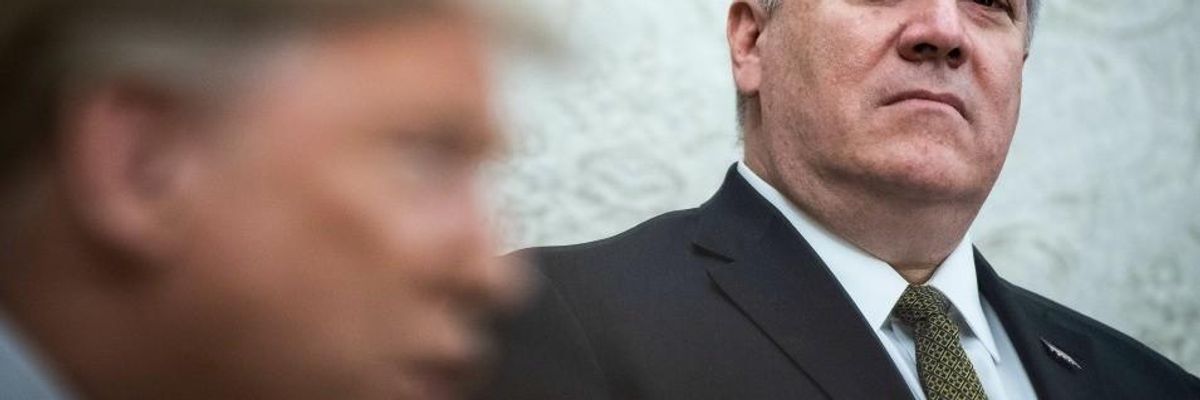
Secretary of State Mike Pompeo has said the Trump administration plans to impose several new sanctions on Iran in the coming weeks, while President Donald Trump expressed a desire to strike the country's uranium enrichment plant earlier this month. (Photo: Jabin Botsford/Washington Post via Getty Images)
A day after the Trump administration slapped Iran's government with new sanctions and amid reporting that President Donald Trump has considered military strikes against the country since losing the 2020 election earlier this month, a top adviser to Supreme Leader Ali Khamenei warned that the U.S. would risk "full-fledged war" in the Middle East should it attack Iran.
Hossein Dehghan, who is a possible presidential candidate in Iran's upcoming June 2021 election, told the Associated Press that the country does not seek a violent conflict with the U.S. but that the government would not welcome "a situation in which [the other party] buys time to weaken our nation."
"We don't welcome a crisis. We don't welcome war. We are not after starting a war," Dehghan told the outlet. "But we are not after negotiations for the sake of negotiations either."
Earlier this week the New York Times reported that Trump considered a military strike against Iran's Natanz uranium enrichment plant after the Nov. 3 election, following reports from international inspectors that there was a "significant increase" in the country's uranium stockpile. The International Atomic Energy Agency reported the supply is 12 times larger than the threshold imposed by the nuclear deal that Trump withdrew from in 2018 permitted.
The president also reportedly considered strikes against Iran's other assets and allies, including militias in Iraq.
"A limited, tactical conflict can turn into a full-fledged war," Dehghan told the AP. "Definitely, the United States, the region, and the world cannot stand such a comprehensive crisis."
Iran has maintained that its nuclear program is peaceful and not aimed at developing weapons, but the Trump administration has persisted in imposing sanctions on the Iranian government--most recently on Wednesday, with Secretary of State Mike Pompeo saying that any move by the incoming administration of President-elect Joe Biden to reverse Trump's actions against Iran would be "a dangerous choice, bound to weaken new partnerships for peace in the region and strengthen only the Islamic Republic."
Pompeo added that the administration plans to impose more sanctions in the coming weeks leading up to Inauguration Day.
Biden has signaled that he would be willing to rejoin the 2015 nuclear accord with Iran.
In his interview with the AP, Dehghan warned against other U.S. activities in the Middle East, including its support for the normalization of relations between Israel and the United Arab Emirates as well as Bahrain, agreements which Dehghan called "strategic" mistakes.
"It is opening an extensive front," he told the AP. "Just imagine every Israeli in any military base can be a target for groups who are opposed to Israel."
Dear Common Dreams reader, It’s been nearly 30 years since I co-founded Common Dreams with my late wife, Lina Newhouser. We had the radical notion that journalism should serve the public good, not corporate profits. It was clear to us from the outset what it would take to build such a project. No paid advertisements. No corporate sponsors. No millionaire publisher telling us what to think or do. Many people said we wouldn't last a year, but we proved those doubters wrong. Together with a tremendous team of journalists and dedicated staff, we built an independent media outlet free from the constraints of profits and corporate control. Our mission has always been simple: To inform. To inspire. To ignite change for the common good. Building Common Dreams was not easy. Our survival was never guaranteed. When you take on the most powerful forces—Wall Street greed, fossil fuel industry destruction, Big Tech lobbyists, and uber-rich oligarchs who have spent billions upon billions rigging the economy and democracy in their favor—the only bulwark you have is supporters who believe in your work. But here’s the urgent message from me today. It's never been this bad out there. And it's never been this hard to keep us going. At the very moment Common Dreams is most needed, the threats we face are intensifying. We need your support now more than ever. We don't accept corporate advertising and never will. We don't have a paywall because we don't think people should be blocked from critical news based on their ability to pay. Everything we do is funded by the donations of readers like you. When everyone does the little they can afford, we are strong. But if that support retreats or dries up, so do we. Will you donate now to make sure Common Dreams not only survives but thrives? —Craig Brown, Co-founder |
A day after the Trump administration slapped Iran's government with new sanctions and amid reporting that President Donald Trump has considered military strikes against the country since losing the 2020 election earlier this month, a top adviser to Supreme Leader Ali Khamenei warned that the U.S. would risk "full-fledged war" in the Middle East should it attack Iran.
Hossein Dehghan, who is a possible presidential candidate in Iran's upcoming June 2021 election, told the Associated Press that the country does not seek a violent conflict with the U.S. but that the government would not welcome "a situation in which [the other party] buys time to weaken our nation."
"We don't welcome a crisis. We don't welcome war. We are not after starting a war," Dehghan told the outlet. "But we are not after negotiations for the sake of negotiations either."
Earlier this week the New York Times reported that Trump considered a military strike against Iran's Natanz uranium enrichment plant after the Nov. 3 election, following reports from international inspectors that there was a "significant increase" in the country's uranium stockpile. The International Atomic Energy Agency reported the supply is 12 times larger than the threshold imposed by the nuclear deal that Trump withdrew from in 2018 permitted.
The president also reportedly considered strikes against Iran's other assets and allies, including militias in Iraq.
"A limited, tactical conflict can turn into a full-fledged war," Dehghan told the AP. "Definitely, the United States, the region, and the world cannot stand such a comprehensive crisis."
Iran has maintained that its nuclear program is peaceful and not aimed at developing weapons, but the Trump administration has persisted in imposing sanctions on the Iranian government--most recently on Wednesday, with Secretary of State Mike Pompeo saying that any move by the incoming administration of President-elect Joe Biden to reverse Trump's actions against Iran would be "a dangerous choice, bound to weaken new partnerships for peace in the region and strengthen only the Islamic Republic."
Pompeo added that the administration plans to impose more sanctions in the coming weeks leading up to Inauguration Day.
Biden has signaled that he would be willing to rejoin the 2015 nuclear accord with Iran.
In his interview with the AP, Dehghan warned against other U.S. activities in the Middle East, including its support for the normalization of relations between Israel and the United Arab Emirates as well as Bahrain, agreements which Dehghan called "strategic" mistakes.
"It is opening an extensive front," he told the AP. "Just imagine every Israeli in any military base can be a target for groups who are opposed to Israel."
A day after the Trump administration slapped Iran's government with new sanctions and amid reporting that President Donald Trump has considered military strikes against the country since losing the 2020 election earlier this month, a top adviser to Supreme Leader Ali Khamenei warned that the U.S. would risk "full-fledged war" in the Middle East should it attack Iran.
Hossein Dehghan, who is a possible presidential candidate in Iran's upcoming June 2021 election, told the Associated Press that the country does not seek a violent conflict with the U.S. but that the government would not welcome "a situation in which [the other party] buys time to weaken our nation."
"We don't welcome a crisis. We don't welcome war. We are not after starting a war," Dehghan told the outlet. "But we are not after negotiations for the sake of negotiations either."
Earlier this week the New York Times reported that Trump considered a military strike against Iran's Natanz uranium enrichment plant after the Nov. 3 election, following reports from international inspectors that there was a "significant increase" in the country's uranium stockpile. The International Atomic Energy Agency reported the supply is 12 times larger than the threshold imposed by the nuclear deal that Trump withdrew from in 2018 permitted.
The president also reportedly considered strikes against Iran's other assets and allies, including militias in Iraq.
"A limited, tactical conflict can turn into a full-fledged war," Dehghan told the AP. "Definitely, the United States, the region, and the world cannot stand such a comprehensive crisis."
Iran has maintained that its nuclear program is peaceful and not aimed at developing weapons, but the Trump administration has persisted in imposing sanctions on the Iranian government--most recently on Wednesday, with Secretary of State Mike Pompeo saying that any move by the incoming administration of President-elect Joe Biden to reverse Trump's actions against Iran would be "a dangerous choice, bound to weaken new partnerships for peace in the region and strengthen only the Islamic Republic."
Pompeo added that the administration plans to impose more sanctions in the coming weeks leading up to Inauguration Day.
Biden has signaled that he would be willing to rejoin the 2015 nuclear accord with Iran.
In his interview with the AP, Dehghan warned against other U.S. activities in the Middle East, including its support for the normalization of relations between Israel and the United Arab Emirates as well as Bahrain, agreements which Dehghan called "strategic" mistakes.
"It is opening an extensive front," he told the AP. "Just imagine every Israeli in any military base can be a target for groups who are opposed to Israel."