SUBSCRIBE TO OUR FREE NEWSLETTER
Daily news & progressive opinion—funded by the people, not the corporations—delivered straight to your inbox.
5
#000000
#FFFFFF
To donate by check, phone, or other method, see our More Ways to Give page.
Daily news & progressive opinion—funded by the people, not the corporations—delivered straight to your inbox.
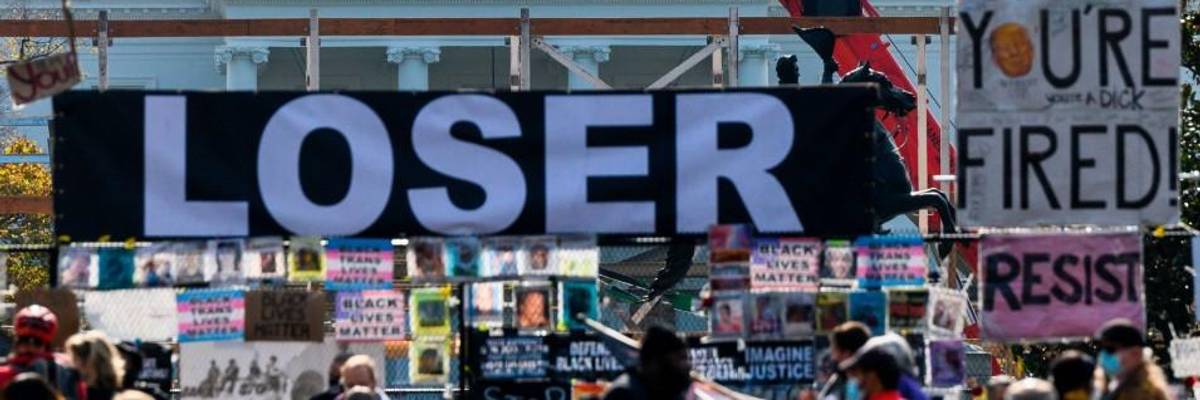
Demonstrators outside the White House in Washington, D.C. on November 13, 2020 have a resounding message for soon-to-be ex-President Donald Trump: "You're fired, loser!" (Photo: Andrew Caballero-Reynolds/AFP/Getty Images)
The Pennsylvania Supreme Court on Tuesday rejected a claim by President Donald Trump's campaign alleging Republican election observers were barred from adequately monitoring ballot counting in Philadelphia during the 2020 general election.
In a 5-2 ruling (pdf), the state high court found that the GOP observers could sufficiently watch ballots being counted in the nation's sixth-largest city, and that the Trump campaign's claim that the Philadelphia Board of Elections denied it "meaningful access" to the process was without merit. The campaign claimed it was kept so far back behind a waist-high fence that its observers could not make out key details on ballot envelopes or see if proper vote-counting procedures were followed.
"We conclude the board did not act contrary to law in fashioning its regulations governing the positioning of candidate representatives during the precanvassing and canvassing process," the court wrote in its majority opinion. "Critically, we find the board's regulations as applied herein were reasonable in that they allowed candidate representatives to observe the board conducting its activities as prescribed under the Election Code."
The only reason why two justices--including Chief Justice Thomas G. Saylor--voted against the majority is because they believe the case is moot given Trump's resounding 306-232 Electoral College thrashing.
The ruling noted that while state law requires observers be allowed "in the room" as votes are tallied, it is up to county election officials to determine how far from the counting tables they must stand.
The justices' decision overturns a lower state court's ruling in Trump's favor that permitted campaign observers to stand within six feet of the tables where ballots were being counted.
Tuesday's decision marks the latest failed attempt by the losing Trump campaign to find some way, any way, to challenge the results of an election process that the Department of Homeland Security's Cybersecurity and Infrastructure Security Agency--created by Trump in 2018--called "the most secure in American history." Tuesday evening, Trump fired the head of that agency, Christopher Krebs, for what the president called his "highly inaccurate" statement regarding the election.
Nevertheless, Trump attorney Rudy Guiliani argued Tuesday in a separate case in a Williamsport, Pennsylvania federal court that GOP observers in Philadelphia were prevented from doing their job by "the Democratic machine." The former New York City mayor also repeated the baseless claim that what happened in Philadelphia was part of "widespread nationwide voter fraud."
Dear Common Dreams reader, It’s been nearly 30 years since I co-founded Common Dreams with my late wife, Lina Newhouser. We had the radical notion that journalism should serve the public good, not corporate profits. It was clear to us from the outset what it would take to build such a project. No paid advertisements. No corporate sponsors. No millionaire publisher telling us what to think or do. Many people said we wouldn't last a year, but we proved those doubters wrong. Together with a tremendous team of journalists and dedicated staff, we built an independent media outlet free from the constraints of profits and corporate control. Our mission has always been simple: To inform. To inspire. To ignite change for the common good. Building Common Dreams was not easy. Our survival was never guaranteed. When you take on the most powerful forces—Wall Street greed, fossil fuel industry destruction, Big Tech lobbyists, and uber-rich oligarchs who have spent billions upon billions rigging the economy and democracy in their favor—the only bulwark you have is supporters who believe in your work. But here’s the urgent message from me today. It's never been this bad out there. And it's never been this hard to keep us going. At the very moment Common Dreams is most needed, the threats we face are intensifying. We need your support now more than ever. We don't accept corporate advertising and never will. We don't have a paywall because we don't think people should be blocked from critical news based on their ability to pay. Everything we do is funded by the donations of readers like you. When everyone does the little they can afford, we are strong. But if that support retreats or dries up, so do we. Will you donate now to make sure Common Dreams not only survives but thrives? —Craig Brown, Co-founder |
The Pennsylvania Supreme Court on Tuesday rejected a claim by President Donald Trump's campaign alleging Republican election observers were barred from adequately monitoring ballot counting in Philadelphia during the 2020 general election.
In a 5-2 ruling (pdf), the state high court found that the GOP observers could sufficiently watch ballots being counted in the nation's sixth-largest city, and that the Trump campaign's claim that the Philadelphia Board of Elections denied it "meaningful access" to the process was without merit. The campaign claimed it was kept so far back behind a waist-high fence that its observers could not make out key details on ballot envelopes or see if proper vote-counting procedures were followed.
"We conclude the board did not act contrary to law in fashioning its regulations governing the positioning of candidate representatives during the precanvassing and canvassing process," the court wrote in its majority opinion. "Critically, we find the board's regulations as applied herein were reasonable in that they allowed candidate representatives to observe the board conducting its activities as prescribed under the Election Code."
The only reason why two justices--including Chief Justice Thomas G. Saylor--voted against the majority is because they believe the case is moot given Trump's resounding 306-232 Electoral College thrashing.
The ruling noted that while state law requires observers be allowed "in the room" as votes are tallied, it is up to county election officials to determine how far from the counting tables they must stand.
The justices' decision overturns a lower state court's ruling in Trump's favor that permitted campaign observers to stand within six feet of the tables where ballots were being counted.
Tuesday's decision marks the latest failed attempt by the losing Trump campaign to find some way, any way, to challenge the results of an election process that the Department of Homeland Security's Cybersecurity and Infrastructure Security Agency--created by Trump in 2018--called "the most secure in American history." Tuesday evening, Trump fired the head of that agency, Christopher Krebs, for what the president called his "highly inaccurate" statement regarding the election.
Nevertheless, Trump attorney Rudy Guiliani argued Tuesday in a separate case in a Williamsport, Pennsylvania federal court that GOP observers in Philadelphia were prevented from doing their job by "the Democratic machine." The former New York City mayor also repeated the baseless claim that what happened in Philadelphia was part of "widespread nationwide voter fraud."
The Pennsylvania Supreme Court on Tuesday rejected a claim by President Donald Trump's campaign alleging Republican election observers were barred from adequately monitoring ballot counting in Philadelphia during the 2020 general election.
In a 5-2 ruling (pdf), the state high court found that the GOP observers could sufficiently watch ballots being counted in the nation's sixth-largest city, and that the Trump campaign's claim that the Philadelphia Board of Elections denied it "meaningful access" to the process was without merit. The campaign claimed it was kept so far back behind a waist-high fence that its observers could not make out key details on ballot envelopes or see if proper vote-counting procedures were followed.
"We conclude the board did not act contrary to law in fashioning its regulations governing the positioning of candidate representatives during the precanvassing and canvassing process," the court wrote in its majority opinion. "Critically, we find the board's regulations as applied herein were reasonable in that they allowed candidate representatives to observe the board conducting its activities as prescribed under the Election Code."
The only reason why two justices--including Chief Justice Thomas G. Saylor--voted against the majority is because they believe the case is moot given Trump's resounding 306-232 Electoral College thrashing.
The ruling noted that while state law requires observers be allowed "in the room" as votes are tallied, it is up to county election officials to determine how far from the counting tables they must stand.
The justices' decision overturns a lower state court's ruling in Trump's favor that permitted campaign observers to stand within six feet of the tables where ballots were being counted.
Tuesday's decision marks the latest failed attempt by the losing Trump campaign to find some way, any way, to challenge the results of an election process that the Department of Homeland Security's Cybersecurity and Infrastructure Security Agency--created by Trump in 2018--called "the most secure in American history." Tuesday evening, Trump fired the head of that agency, Christopher Krebs, for what the president called his "highly inaccurate" statement regarding the election.
Nevertheless, Trump attorney Rudy Guiliani argued Tuesday in a separate case in a Williamsport, Pennsylvania federal court that GOP observers in Philadelphia were prevented from doing their job by "the Democratic machine." The former New York City mayor also repeated the baseless claim that what happened in Philadelphia was part of "widespread nationwide voter fraud."