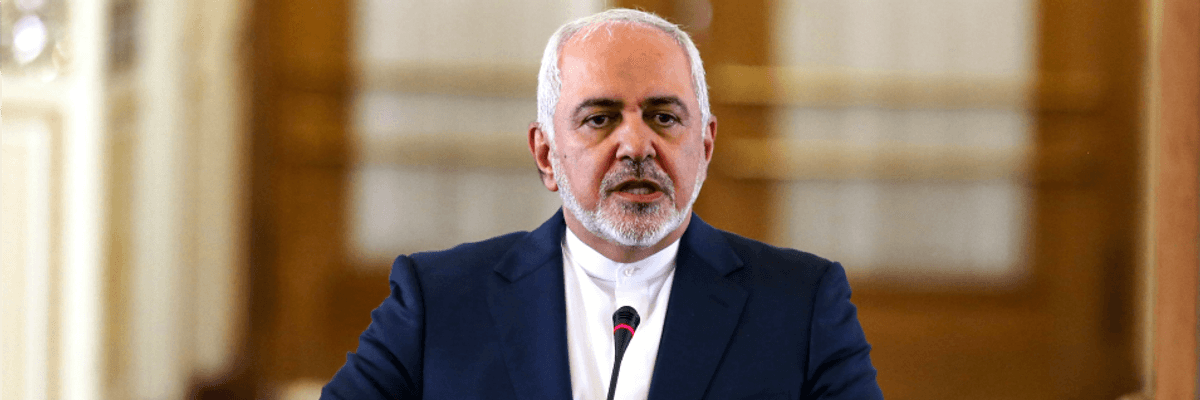
Iran's Foreign Minister Mohammad Javad Zarif speaks during a press conference in Tehran on June 10, 2019. (Photo: Atta Kenare/AFP/Getty Images)
At UN, Iranian Foreign Minister Blames US War on Terror for 'Countless Broken Societies'
The Iranian foreign minister took at at the "eight violent wars that the United States initiated or joined since 2001."
Iran's Foreign Minister Javad Zarif on Monday took aim at the United States' ongoing "war on terror," which he blamed for "countless broken societies."
The Iranian official's comments came in a video address to a high level meeting of the General Assembly marking the U.N's 75th anniversary.
"The eight violent wars that the United States initiated or joined since 2001, under the rubric of war on terror, have resulted in the loss of hundreds of thousands of innocent lives, countless broken societies and families... and unprecedented extremism," Zarif, a frequent critic of U.S. foreign policy, said in his remarks, according to Agence France-Presse.
"It's time to change that," he said, "saving American blood and treasure, and sparing the world from further misery."
The U.N., added Zarif, must "recommit itself to stand up united against unilateralism and war."
Zarif's comments came as Iran faces the Trump administration, which is stacked with Iran hardliners including Secretary of State Mike Pompeo, and punishing new sanctions imposed by the U.S. in the midst of the coronavirus pandemic.
President Donald Trump has just this year threatened to bomb Iranian cultural sites and allegedly had Iranian General Qasem Soleimani assassinated. And just this month Trump told s right-wing radio personality Rush Limbaugh that "if you do something bad to us, we are going to do things to you that have never been done before," referring to Iran.
Zarif's far from alone in his assessment of the so-called war on terror. U.S.-based researchers have put the death toll of post-9/11 wars at 800,000 or even as high as one million. The war on terror--which has cost some $6.4 trillion--has also been roundly blamed for effects including helping to militarize U.S. police forces and fomenting extremism.
U.N. Secretary-General Antonio Guterres, for his part, marked the body's 75th anniversary by renewing his demand for a global ceasefire and pointed to the coronavirus as humanity's "one common enemy."
"Now is the time for a stepped-up push for peace to achieve a global ceasefire," said Guterres. "The clock is ticking."
We are at a crossroads
This country and this world are at a monumental crossroads. US voters have an opportunity to beat back the forces of fascism and confront the billionaires who are rigging the economy, our media system, and our democracy, making it increasingly impossible for ordinary people to get by. We’re not just talking about the election. We’re talking about what must be done once these fascist elements are vanquished from power. We need a bolder set of solutions than what either major party has so far been willing to offer and a working-class movement ready to fight like hell for it. Trump didn't emerge from nowhere. The conditions that fueled MAGA authoritarianism were created by decades of radical neoliberal economic policies and a corrupt political system dominated by corporate interests. They slashed taxes on the super-rich, promising that the benefits would trickle down. They said giveaways to the corporate titans would make life more affordable for the rest of us. It was all bullshit. And when a bitter, betrayed populace searches for someone to blame, right-wing demagogues have little trouble finding scapegoats. People know when they're being lied to, but you won't hear any of this from the corporate media. Only independent journalism—powered and funded by people who believe in building a better world—can deliver truly trustworthy daily news. Our Fall Campaign is underway, and we need your help. To power our newsroom through the rest of the year, we need to raise $125,000 by midnight on October 31. So if you share our vision, please contribute whatever you can to sustain our work. |
Iran's Foreign Minister Javad Zarif on Monday took aim at the United States' ongoing "war on terror," which he blamed for "countless broken societies."
The Iranian official's comments came in a video address to a high level meeting of the General Assembly marking the U.N's 75th anniversary.
"The eight violent wars that the United States initiated or joined since 2001, under the rubric of war on terror, have resulted in the loss of hundreds of thousands of innocent lives, countless broken societies and families... and unprecedented extremism," Zarif, a frequent critic of U.S. foreign policy, said in his remarks, according to Agence France-Presse.
"It's time to change that," he said, "saving American blood and treasure, and sparing the world from further misery."
The U.N., added Zarif, must "recommit itself to stand up united against unilateralism and war."
Zarif's comments came as Iran faces the Trump administration, which is stacked with Iran hardliners including Secretary of State Mike Pompeo, and punishing new sanctions imposed by the U.S. in the midst of the coronavirus pandemic.
President Donald Trump has just this year threatened to bomb Iranian cultural sites and allegedly had Iranian General Qasem Soleimani assassinated. And just this month Trump told s right-wing radio personality Rush Limbaugh that "if you do something bad to us, we are going to do things to you that have never been done before," referring to Iran.
Zarif's far from alone in his assessment of the so-called war on terror. U.S.-based researchers have put the death toll of post-9/11 wars at 800,000 or even as high as one million. The war on terror--which has cost some $6.4 trillion--has also been roundly blamed for effects including helping to militarize U.S. police forces and fomenting extremism.
U.N. Secretary-General Antonio Guterres, for his part, marked the body's 75th anniversary by renewing his demand for a global ceasefire and pointed to the coronavirus as humanity's "one common enemy."
"Now is the time for a stepped-up push for peace to achieve a global ceasefire," said Guterres. "The clock is ticking."