

SUBSCRIBE TO OUR FREE NEWSLETTER
Daily news & progressive opinion—funded by the people, not the corporations—delivered straight to your inbox.
5
#000000
#FFFFFF
To donate by check, phone, or other method, see our More Ways to Give page.
Daily news & progressive opinion—funded by the people, not the corporations—delivered straight to your inbox.
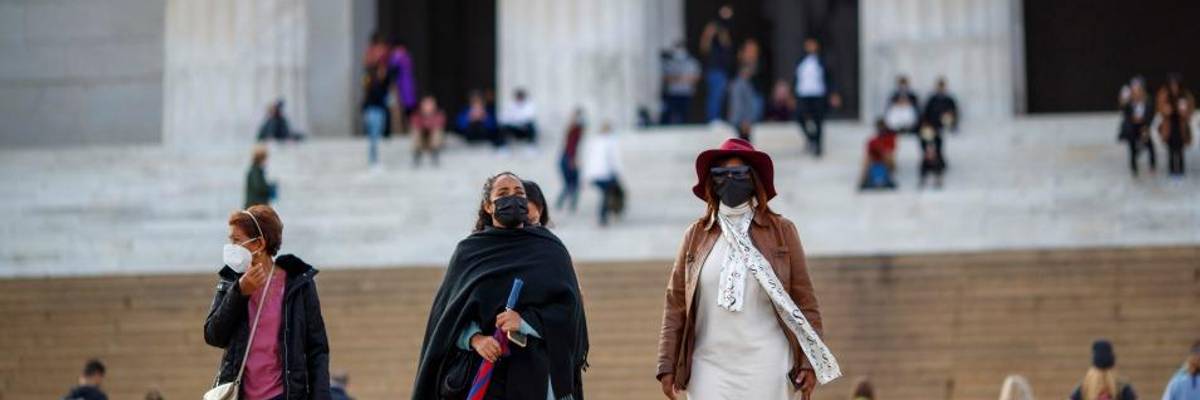
People wearing face masks visit the Lincoln Memorial in Washington, D.C. on Oct. 16, 2020. According to a recent study by Carnegie Mellon University, D.C. has the highest rate of mask-wearing and the lowest percentage of people who know someone with Covid-19 symptoms in the country. (Photo: Xinhua/Ting Shen via Getty Images)
As Covid-19 cases surged in the U.S.--with eight states setting single-day records on Thursday and hospitals in Utah and Wisconsin reporting that they're overwhelmed with sick patients--two new studies released Friday reaffirmed public health guidance that the more mask-wearing is observed in a community, the less likely it is to face coronavirus outbreaks and deaths.
The Institute for Health Metrics and Evaluation (IHME) at the University of Washington released a model showing that nearly 130,000 people's lives would be saved from now until early spring 2021 if the U.S. adopted universal mask-wearing.
"I'd like for people to see this study as a call to action, sort of a wake-up call, especially for those individuals who are unconvinced by the devastation that this pandemic is causing."
--Shweta Bansal, Georgetown University
Publishing the study in the journal Nature Medicine, the IHME analyzed the number of cases, testing rates, mask use, and cellphone data to estimate people's movements from the date of the first recorded case in each state through September 21. Using this data, the researchers estimated what the death toll until March 2021 would be for each state if mask-wearing and social distancing mandates are put in place, versus if they are not.
If 95% of the U.S. population spent the remainder of the fall and the winter months following public health guidance to wear face coverings when using public transportation, running errands, working, and doing other activities in public, 129,574 lives would be saved, the IHME estimated. Even compliance by 85% of the public would have a major impact, preventing 95,814 deaths from Covid-19.
"Increasing mask use is one of the best strategies that we have right now to delay the imposition of social distancing mandates and all the economic effects of that, and save lives," Christopher Murray, director of the institute, told the New York Times.
Public health officials are up against the Trump administration as they attempt to convince the public to use face masks. Earlier this month, President Donald Trump openly mocked Democratic presidential candidate Joe Biden for wearing a mask at public events--days before Trump himself was diagnosed with Covid-19. Last week, Dr. Scott Atlas, who is one of the president's top coronavirus advisers despite his lack of public health experience, tweeted, "Masks work? No." The tweet was removed by Twitter for spreading misinformation.
Shweta Bansal, an infectious disease researcher at Georgetown University who was not involved in the IHME's study, told the Times that the key finding by the institute is that "we can will this number [of deaths] out of existence."
"I'd like for people to see this study as a call to action, sort of a wake-up call, especially for those individuals who are unconvinced by the devastation that this pandemic is causing," Bansal told the Times.
A separate study out of Carnegie Mellon University's CovidCast project, also released Friday, showed how state-by-state, mask-wearing is helping to keep infection rates down--and how low levels of compliance with the public health guidance are having the opposite effect.
Researchers partnered with Facebook to survey users about their mask-wearing habits and whether they know people in their communities who have had Covid-19 symptoms.
Washington, D.C. residents reported the highest level of mask-wearing in the country, with 97% of respondents saying they wear face coverings whenever they are out in public. Just 11% of those surveyed said they knew someone who had had Covid-19. In Rhode Island and Massachusetts, where 93% of respondents said they always wear masks, 16% and 13%, respectively, said they knew someone who had had the illness.
In South Dakota, just 65% of respondents said they regularly use a face mask, and 45% said they knew someone who had developed symptoms of the disease. Sixty-three percent of Wyoming residents said they wear masks, and 36% reported someone in their community had had symptoms.
Dr. Linsey Marr, an expert at Virginia Tech in the field of airborne virus transmission, called the study "a powerful argument for wearing a mask, in visual form."
Alex Reinhart, a professor at Carnegie Mellon, noted that "there could be other explanations for the correlation" between mask-wearing and Covid-19 cases within communities in the study--but suggested the study does show adherence to public health guidance is helping to stop outbreaks from starting.
"If people say they're not wearing masks, they may not be taking other protective measures either," Reinhart told the Washington Post. "So perhaps what we see is a combination of mask usage, other social distancing behaviors, and perhaps other factors we haven't measured."
Dear Common Dreams reader, It’s been nearly 30 years since I co-founded Common Dreams with my late wife, Lina Newhouser. We had the radical notion that journalism should serve the public good, not corporate profits. It was clear to us from the outset what it would take to build such a project. No paid advertisements. No corporate sponsors. No millionaire publisher telling us what to think or do. Many people said we wouldn't last a year, but we proved those doubters wrong. Together with a tremendous team of journalists and dedicated staff, we built an independent media outlet free from the constraints of profits and corporate control. Our mission has always been simple: To inform. To inspire. To ignite change for the common good. Building Common Dreams was not easy. Our survival was never guaranteed. When you take on the most powerful forces—Wall Street greed, fossil fuel industry destruction, Big Tech lobbyists, and uber-rich oligarchs who have spent billions upon billions rigging the economy and democracy in their favor—the only bulwark you have is supporters who believe in your work. But here’s the urgent message from me today. It's never been this bad out there. And it's never been this hard to keep us going. At the very moment Common Dreams is most needed, the threats we face are intensifying. We need your support now more than ever. We don't accept corporate advertising and never will. We don't have a paywall because we don't think people should be blocked from critical news based on their ability to pay. Everything we do is funded by the donations of readers like you. When everyone does the little they can afford, we are strong. But if that support retreats or dries up, so do we. Will you donate now to make sure Common Dreams not only survives but thrives? —Craig Brown, Co-founder |
As Covid-19 cases surged in the U.S.--with eight states setting single-day records on Thursday and hospitals in Utah and Wisconsin reporting that they're overwhelmed with sick patients--two new studies released Friday reaffirmed public health guidance that the more mask-wearing is observed in a community, the less likely it is to face coronavirus outbreaks and deaths.
The Institute for Health Metrics and Evaluation (IHME) at the University of Washington released a model showing that nearly 130,000 people's lives would be saved from now until early spring 2021 if the U.S. adopted universal mask-wearing.
"I'd like for people to see this study as a call to action, sort of a wake-up call, especially for those individuals who are unconvinced by the devastation that this pandemic is causing."
--Shweta Bansal, Georgetown University
Publishing the study in the journal Nature Medicine, the IHME analyzed the number of cases, testing rates, mask use, and cellphone data to estimate people's movements from the date of the first recorded case in each state through September 21. Using this data, the researchers estimated what the death toll until March 2021 would be for each state if mask-wearing and social distancing mandates are put in place, versus if they are not.
If 95% of the U.S. population spent the remainder of the fall and the winter months following public health guidance to wear face coverings when using public transportation, running errands, working, and doing other activities in public, 129,574 lives would be saved, the IHME estimated. Even compliance by 85% of the public would have a major impact, preventing 95,814 deaths from Covid-19.
"Increasing mask use is one of the best strategies that we have right now to delay the imposition of social distancing mandates and all the economic effects of that, and save lives," Christopher Murray, director of the institute, told the New York Times.
Public health officials are up against the Trump administration as they attempt to convince the public to use face masks. Earlier this month, President Donald Trump openly mocked Democratic presidential candidate Joe Biden for wearing a mask at public events--days before Trump himself was diagnosed with Covid-19. Last week, Dr. Scott Atlas, who is one of the president's top coronavirus advisers despite his lack of public health experience, tweeted, "Masks work? No." The tweet was removed by Twitter for spreading misinformation.
Shweta Bansal, an infectious disease researcher at Georgetown University who was not involved in the IHME's study, told the Times that the key finding by the institute is that "we can will this number [of deaths] out of existence."
"I'd like for people to see this study as a call to action, sort of a wake-up call, especially for those individuals who are unconvinced by the devastation that this pandemic is causing," Bansal told the Times.
A separate study out of Carnegie Mellon University's CovidCast project, also released Friday, showed how state-by-state, mask-wearing is helping to keep infection rates down--and how low levels of compliance with the public health guidance are having the opposite effect.
Researchers partnered with Facebook to survey users about their mask-wearing habits and whether they know people in their communities who have had Covid-19 symptoms.
Washington, D.C. residents reported the highest level of mask-wearing in the country, with 97% of respondents saying they wear face coverings whenever they are out in public. Just 11% of those surveyed said they knew someone who had had Covid-19. In Rhode Island and Massachusetts, where 93% of respondents said they always wear masks, 16% and 13%, respectively, said they knew someone who had had the illness.
In South Dakota, just 65% of respondents said they regularly use a face mask, and 45% said they knew someone who had developed symptoms of the disease. Sixty-three percent of Wyoming residents said they wear masks, and 36% reported someone in their community had had symptoms.
Dr. Linsey Marr, an expert at Virginia Tech in the field of airborne virus transmission, called the study "a powerful argument for wearing a mask, in visual form."
Alex Reinhart, a professor at Carnegie Mellon, noted that "there could be other explanations for the correlation" between mask-wearing and Covid-19 cases within communities in the study--but suggested the study does show adherence to public health guidance is helping to stop outbreaks from starting.
"If people say they're not wearing masks, they may not be taking other protective measures either," Reinhart told the Washington Post. "So perhaps what we see is a combination of mask usage, other social distancing behaviors, and perhaps other factors we haven't measured."
As Covid-19 cases surged in the U.S.--with eight states setting single-day records on Thursday and hospitals in Utah and Wisconsin reporting that they're overwhelmed with sick patients--two new studies released Friday reaffirmed public health guidance that the more mask-wearing is observed in a community, the less likely it is to face coronavirus outbreaks and deaths.
The Institute for Health Metrics and Evaluation (IHME) at the University of Washington released a model showing that nearly 130,000 people's lives would be saved from now until early spring 2021 if the U.S. adopted universal mask-wearing.
"I'd like for people to see this study as a call to action, sort of a wake-up call, especially for those individuals who are unconvinced by the devastation that this pandemic is causing."
--Shweta Bansal, Georgetown University
Publishing the study in the journal Nature Medicine, the IHME analyzed the number of cases, testing rates, mask use, and cellphone data to estimate people's movements from the date of the first recorded case in each state through September 21. Using this data, the researchers estimated what the death toll until March 2021 would be for each state if mask-wearing and social distancing mandates are put in place, versus if they are not.
If 95% of the U.S. population spent the remainder of the fall and the winter months following public health guidance to wear face coverings when using public transportation, running errands, working, and doing other activities in public, 129,574 lives would be saved, the IHME estimated. Even compliance by 85% of the public would have a major impact, preventing 95,814 deaths from Covid-19.
"Increasing mask use is one of the best strategies that we have right now to delay the imposition of social distancing mandates and all the economic effects of that, and save lives," Christopher Murray, director of the institute, told the New York Times.
Public health officials are up against the Trump administration as they attempt to convince the public to use face masks. Earlier this month, President Donald Trump openly mocked Democratic presidential candidate Joe Biden for wearing a mask at public events--days before Trump himself was diagnosed with Covid-19. Last week, Dr. Scott Atlas, who is one of the president's top coronavirus advisers despite his lack of public health experience, tweeted, "Masks work? No." The tweet was removed by Twitter for spreading misinformation.
Shweta Bansal, an infectious disease researcher at Georgetown University who was not involved in the IHME's study, told the Times that the key finding by the institute is that "we can will this number [of deaths] out of existence."
"I'd like for people to see this study as a call to action, sort of a wake-up call, especially for those individuals who are unconvinced by the devastation that this pandemic is causing," Bansal told the Times.
A separate study out of Carnegie Mellon University's CovidCast project, also released Friday, showed how state-by-state, mask-wearing is helping to keep infection rates down--and how low levels of compliance with the public health guidance are having the opposite effect.
Researchers partnered with Facebook to survey users about their mask-wearing habits and whether they know people in their communities who have had Covid-19 symptoms.
Washington, D.C. residents reported the highest level of mask-wearing in the country, with 97% of respondents saying they wear face coverings whenever they are out in public. Just 11% of those surveyed said they knew someone who had had Covid-19. In Rhode Island and Massachusetts, where 93% of respondents said they always wear masks, 16% and 13%, respectively, said they knew someone who had had the illness.
In South Dakota, just 65% of respondents said they regularly use a face mask, and 45% said they knew someone who had developed symptoms of the disease. Sixty-three percent of Wyoming residents said they wear masks, and 36% reported someone in their community had had symptoms.
Dr. Linsey Marr, an expert at Virginia Tech in the field of airborne virus transmission, called the study "a powerful argument for wearing a mask, in visual form."
Alex Reinhart, a professor at Carnegie Mellon, noted that "there could be other explanations for the correlation" between mask-wearing and Covid-19 cases within communities in the study--but suggested the study does show adherence to public health guidance is helping to stop outbreaks from starting.
"If people say they're not wearing masks, they may not be taking other protective measures either," Reinhart told the Washington Post. "So perhaps what we see is a combination of mask usage, other social distancing behaviors, and perhaps other factors we haven't measured."

