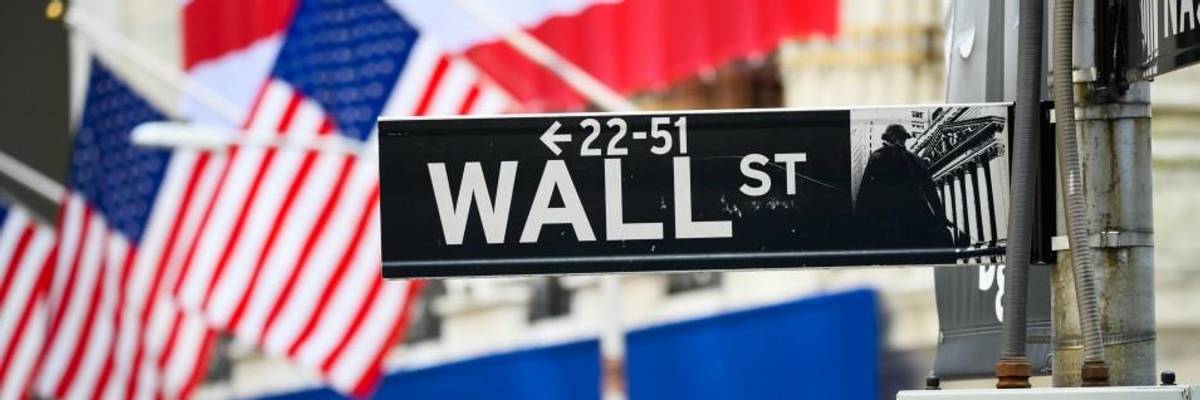
A view of the Wall St street sign and the New York Stock Exchange during the coronavirus pandemic on May 25, 2020 in New York City. (Photo: Noam Galai/Getty Images)
Fed Program Meant to Help Workers Amid Pandemic Prioritized Wall Street Investors Instead: Analysis
"The primary beneficiaries of the program have been corporate executives and investors, not workers."
A new analysis out Wednesday reveals that the Federal Reserve bond purchasing program meant to prevent workers from losing their jobs amid the Covid-19 pandemic instead bolstered companies who laid off more than one million workers while paying massive dividends to shareholders--a finding escalating concerns that the central bank's behavior is "contributing to an economic recovery that benefits wealthy executives and investors but leaves behind American workers."
The report put forth by the Select Subcommittee on the Coronavirus Crisis --titled "Prioritizing Wall Street" (pdf)--examines individual corporate bonds purchased through the Fed's Secondary Market Corporate Credit Facility (SMCCF), a lending system supported by funds from the CARES Act but which lacks taxpayer and worker protections included in other programs backed by the legislation passed earlier this year.
For corporations hoping to become eligible to issue bonds purchased by the Fed, the SMCCF "imposes no conditions requiring companies to save jobs or limit payments to executives or shareholders," the report notes.
The central bank has purchased corporate bonds issued by approximately 500 large companies since June. Subcommittee staff compared those transactions to public data on layoffs, dividend payouts, and illegal conduct.
"Fed Chair Jerome Powell testified in June that 'the intended beneficiaries of all of our programs are workers,'" the report states. "In May, he justified purchasing corporate bonds that had been downgraded to junk status since the start of the coronavirus crisis by stating that, because of the Fed's intervention, 'those companies have been able to go out and finance themselves. They've been able to avoid big layoffs. That is the point of all this.'"
However, the analysis shows that several of the companies whose bonds were purchased by the Fed conducted substantial layoffs, "suggesting that the primary beneficiaries of the program have been corporate executives and investors, not workers."
According to the report, nearly 140 of the companies that issued bonds purchased by the Fed have carried out furloughs or layoffs since March, affecting over one million workers.
The analysis notes several key instances of corporate opportunism. For example:
Boeing turned down a CARES Act loan, which would have imposed job retention requirements, limitations on executive pay, and restrictions on payouts to shareholders. Instead, it issued a massive corporate bond offering following the Fed's announcement of its corporate credit facilities, thanking the Fed for its intervention in the market. Boeing then laid off more than ten percent of its workforce, totaling about 16,000 employees.
The report also reveals that 383 of the roughly 500 companies whose bonds were purchased by the Fed have paid out dividends to their shareholders since April.
Ninety-five of these companies paid dividends and simultaneously laid off employees, "prioritizing their shareholders over their workers in the midst of the pandemic."
In addition, Subcommittee staff found that the Fed purchased bonds issued by 227 companies accused of lawbreaking since 2017, "including violations of workplace safety and environmental standards, as well as allegations of defrauding the government."
Tyson Foods is a beneficiary of the Fed's bond purchasing program even though the "multinational food processing company has been cited by the Department of Labor for at least 35 workplace safety or health violations since 2017 and at least five environmental violations from the EPA." Furthermore, the company "also failed to take adequate precautions to protect workers from the spread of the coronavirus," and "outbreaks in its facilities have led to the deaths of more than 24 employees and over 7,000 infections."
Finally, the report shows that oil, gas, and coal companies have benefited disproportionately from the Fed's actions. While fossil fuel companies employ only 2% of workers at large companies, they accounted for more than 10% of bond purchases.
Subcommittee staff wrote that "BlackRock--which executes the bond purchases on behalf of the Fed--has recognized that 'climate risk is investment risk'." Nevertheless, despite the exacerbation of the climate crisis and the declining status of the dirty energy sector, "the Fed, acting on behalf of U.S. taxpayers," has invested heavily in the fossil fuel industry.
On Wednesday, Chairman Powell testified before the Select Subcommittee on the Fed's response to Covid-19. Watch below:
We are at a crossroads
This country and this world are at a monumental crossroads. In a few short weeks, US voters will have an opportunity to beat back the forces of fascism and confront the billionaires who are rigging the economy, our media system, and our democracy, making it increasingly impossible for ordinary people to get by. We’re not just talking about the election. We’re talking about what must be done once these fascist elements are vanquished from power. We need a bolder set of solutions than what either major party has so far been willing to offer and a working-class movement ready to fight like hell for it. Trump didn't emerge from nowhere. The conditions that fueled MAGA authoritarianism were created by decades of radical neoliberal economic policies and a corrupt political system dominated by corporate interests. They slashed taxes on the super-rich, promising that the benefits would trickle down. They said giveaways to the corporate titans would make life more affordable for the rest of us. It was all bullshit. And when a bitter, betrayed populace searches for someone to blame, right-wing demagogues have little trouble finding scapegoats. People know when they're being lied to, but you won't hear any of this from the corporate media. Only independent journalism—powered and funded by people who believe in building a better world—can deliver truly trustworthy daily news. Our Fall Campaign is underway, and we need your help. To power our newsroom through the rest of the year, we need to raise $125,000 by midnight on October 31. So if you share our vision, please contribute whatever you can to sustain our work. |
A new analysis out Wednesday reveals that the Federal Reserve bond purchasing program meant to prevent workers from losing their jobs amid the Covid-19 pandemic instead bolstered companies who laid off more than one million workers while paying massive dividends to shareholders--a finding escalating concerns that the central bank's behavior is "contributing to an economic recovery that benefits wealthy executives and investors but leaves behind American workers."
The report put forth by the Select Subcommittee on the Coronavirus Crisis --titled "Prioritizing Wall Street" (pdf)--examines individual corporate bonds purchased through the Fed's Secondary Market Corporate Credit Facility (SMCCF), a lending system supported by funds from the CARES Act but which lacks taxpayer and worker protections included in other programs backed by the legislation passed earlier this year.
For corporations hoping to become eligible to issue bonds purchased by the Fed, the SMCCF "imposes no conditions requiring companies to save jobs or limit payments to executives or shareholders," the report notes.
The central bank has purchased corporate bonds issued by approximately 500 large companies since June. Subcommittee staff compared those transactions to public data on layoffs, dividend payouts, and illegal conduct.
"Fed Chair Jerome Powell testified in June that 'the intended beneficiaries of all of our programs are workers,'" the report states. "In May, he justified purchasing corporate bonds that had been downgraded to junk status since the start of the coronavirus crisis by stating that, because of the Fed's intervention, 'those companies have been able to go out and finance themselves. They've been able to avoid big layoffs. That is the point of all this.'"
However, the analysis shows that several of the companies whose bonds were purchased by the Fed conducted substantial layoffs, "suggesting that the primary beneficiaries of the program have been corporate executives and investors, not workers."
According to the report, nearly 140 of the companies that issued bonds purchased by the Fed have carried out furloughs or layoffs since March, affecting over one million workers.
The analysis notes several key instances of corporate opportunism. For example:
Boeing turned down a CARES Act loan, which would have imposed job retention requirements, limitations on executive pay, and restrictions on payouts to shareholders. Instead, it issued a massive corporate bond offering following the Fed's announcement of its corporate credit facilities, thanking the Fed for its intervention in the market. Boeing then laid off more than ten percent of its workforce, totaling about 16,000 employees.
The report also reveals that 383 of the roughly 500 companies whose bonds were purchased by the Fed have paid out dividends to their shareholders since April.
Ninety-five of these companies paid dividends and simultaneously laid off employees, "prioritizing their shareholders over their workers in the midst of the pandemic."
In addition, Subcommittee staff found that the Fed purchased bonds issued by 227 companies accused of lawbreaking since 2017, "including violations of workplace safety and environmental standards, as well as allegations of defrauding the government."
Tyson Foods is a beneficiary of the Fed's bond purchasing program even though the "multinational food processing company has been cited by the Department of Labor for at least 35 workplace safety or health violations since 2017 and at least five environmental violations from the EPA." Furthermore, the company "also failed to take adequate precautions to protect workers from the spread of the coronavirus," and "outbreaks in its facilities have led to the deaths of more than 24 employees and over 7,000 infections."
Finally, the report shows that oil, gas, and coal companies have benefited disproportionately from the Fed's actions. While fossil fuel companies employ only 2% of workers at large companies, they accounted for more than 10% of bond purchases.
Subcommittee staff wrote that "BlackRock--which executes the bond purchases on behalf of the Fed--has recognized that 'climate risk is investment risk'." Nevertheless, despite the exacerbation of the climate crisis and the declining status of the dirty energy sector, "the Fed, acting on behalf of U.S. taxpayers," has invested heavily in the fossil fuel industry.
On Wednesday, Chairman Powell testified before the Select Subcommittee on the Fed's response to Covid-19. Watch below:
A new analysis out Wednesday reveals that the Federal Reserve bond purchasing program meant to prevent workers from losing their jobs amid the Covid-19 pandemic instead bolstered companies who laid off more than one million workers while paying massive dividends to shareholders--a finding escalating concerns that the central bank's behavior is "contributing to an economic recovery that benefits wealthy executives and investors but leaves behind American workers."
The report put forth by the Select Subcommittee on the Coronavirus Crisis --titled "Prioritizing Wall Street" (pdf)--examines individual corporate bonds purchased through the Fed's Secondary Market Corporate Credit Facility (SMCCF), a lending system supported by funds from the CARES Act but which lacks taxpayer and worker protections included in other programs backed by the legislation passed earlier this year.
For corporations hoping to become eligible to issue bonds purchased by the Fed, the SMCCF "imposes no conditions requiring companies to save jobs or limit payments to executives or shareholders," the report notes.
The central bank has purchased corporate bonds issued by approximately 500 large companies since June. Subcommittee staff compared those transactions to public data on layoffs, dividend payouts, and illegal conduct.
"Fed Chair Jerome Powell testified in June that 'the intended beneficiaries of all of our programs are workers,'" the report states. "In May, he justified purchasing corporate bonds that had been downgraded to junk status since the start of the coronavirus crisis by stating that, because of the Fed's intervention, 'those companies have been able to go out and finance themselves. They've been able to avoid big layoffs. That is the point of all this.'"
However, the analysis shows that several of the companies whose bonds were purchased by the Fed conducted substantial layoffs, "suggesting that the primary beneficiaries of the program have been corporate executives and investors, not workers."
According to the report, nearly 140 of the companies that issued bonds purchased by the Fed have carried out furloughs or layoffs since March, affecting over one million workers.
The analysis notes several key instances of corporate opportunism. For example:
Boeing turned down a CARES Act loan, which would have imposed job retention requirements, limitations on executive pay, and restrictions on payouts to shareholders. Instead, it issued a massive corporate bond offering following the Fed's announcement of its corporate credit facilities, thanking the Fed for its intervention in the market. Boeing then laid off more than ten percent of its workforce, totaling about 16,000 employees.
The report also reveals that 383 of the roughly 500 companies whose bonds were purchased by the Fed have paid out dividends to their shareholders since April.
Ninety-five of these companies paid dividends and simultaneously laid off employees, "prioritizing their shareholders over their workers in the midst of the pandemic."
In addition, Subcommittee staff found that the Fed purchased bonds issued by 227 companies accused of lawbreaking since 2017, "including violations of workplace safety and environmental standards, as well as allegations of defrauding the government."
Tyson Foods is a beneficiary of the Fed's bond purchasing program even though the "multinational food processing company has been cited by the Department of Labor for at least 35 workplace safety or health violations since 2017 and at least five environmental violations from the EPA." Furthermore, the company "also failed to take adequate precautions to protect workers from the spread of the coronavirus," and "outbreaks in its facilities have led to the deaths of more than 24 employees and over 7,000 infections."
Finally, the report shows that oil, gas, and coal companies have benefited disproportionately from the Fed's actions. While fossil fuel companies employ only 2% of workers at large companies, they accounted for more than 10% of bond purchases.
Subcommittee staff wrote that "BlackRock--which executes the bond purchases on behalf of the Fed--has recognized that 'climate risk is investment risk'." Nevertheless, despite the exacerbation of the climate crisis and the declining status of the dirty energy sector, "the Fed, acting on behalf of U.S. taxpayers," has invested heavily in the fossil fuel industry.
On Wednesday, Chairman Powell testified before the Select Subcommittee on the Fed's response to Covid-19. Watch below: