

SUBSCRIBE TO OUR FREE NEWSLETTER
Daily news & progressive opinion—funded by the people, not the corporations—delivered straight to your inbox.
5
#000000
#FFFFFF
To donate by check, phone, or other method, see our More Ways to Give page.
Daily news & progressive opinion—funded by the people, not the corporations—delivered straight to your inbox.
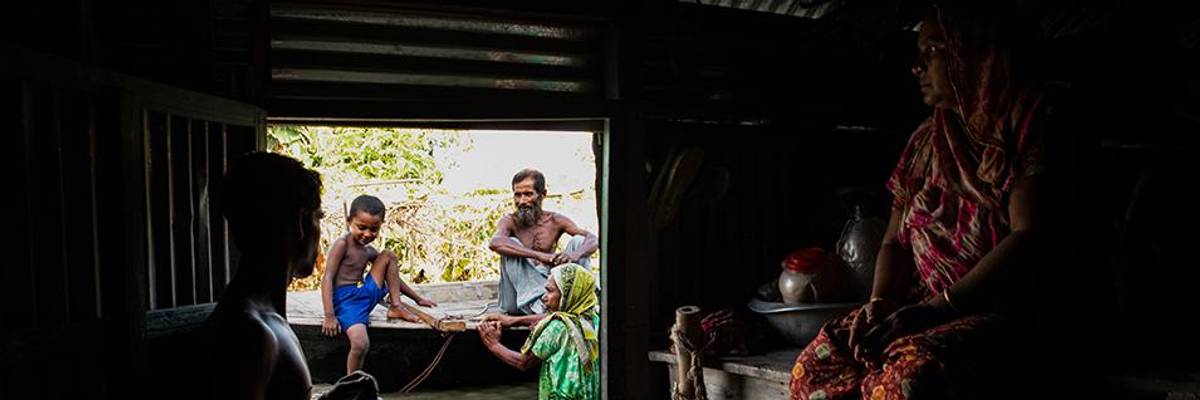
Flood-affected family are seen on a boat after their houses got flooded, in Bogura, Bangladesh, on July 20, 2020. (Photo: Mushfiqul Alam/NurPhoto via Getty Images)
Concern about the climate crisis has increased worldwide, but opinions vary regarding how urgently aggressive action is needed, according to a new study out Monday.
"This is a year of vulnerability and exacerbation of inequality and those most susceptible to disruption feel the greatest level of seriousness," Eric Whan, director of GlobeScan, which conducted the study, told the BBC.
Released for the kickoff of Climate Week NYC, an event that runs through September 27 and is hosted by the United Nations and the City of New York, the GlobeScan study found that nearly 90% of respondents in 27 countries said climate change is a very serious or somewhat serious threat, with respondents in Mexico and Turkey expressing "almost universal concern."
Respondents in Russia, the United States, Australia, and Sweden were the least worried, but around eight in 10 still said the issue is at least somewhat concerning.
"I think back to Hurricane Katrina," Whan told the BBC, "which was a watershed moment in more than two decades of tracking public opinion on climate change. There was a real shock to the system and the poll numbers changed quite a bit, as people more and more came to realize that this is a serious problem, that it's anthropogenic, and that we are actually vulnerable and not particularly protected."
According to the report, concern about climate change is particularly strong among women and younger generations, as well as among those with higher levels of education. In the U.S., respondents of Generation Z--those born between 1996 and 2015--are particularly concerned, as well as those living in urban areas. This data is consistent with rising youth protests in the United States and around the globe as a younger generation of climate advocates pressures lawmakers, the news media, and corporations to tackle the crisis with a sense of urgency.
But, globally, concern over how aggressively to act to curtail the crisis, as well as how personally affected individuals feel, depends on location. According to the report:
Those who live in countries where people express more concern about climate change also tend to feel more personally impacted by climate change; people in Mexico and Turkey are the most worried and also feel the strongest personal impact. In contrast, those in countries like Sweden, Australia, Germany, and the United States say they have experienced significantly less personal impact of climate change and tend to express much lower levels of concern.
In Japan, Sweden, Australia, the U.S., and the United Kingdom, less than 45% of respondents strongly agreed that urgent action by their respective governments is needed. This contrasts with 70% of those surveyed in Kenya, Mexico, Argentina, Turkey, and Nigeria.
In addition, 60% of respondents in Brazil, Kenya, Turkey, Nigeria, and South Africa strongly agreed that poor people would bear the brunt of the climate crisis, while just 40% of respondents in Japan, Australia, the U.S., and the United Kingdom felt the same.
As the U.S. National Hurricane Center begins using letters from the Greek alphabet to label hurricanes because it has already reached the end of its annual list of 21 male and female names, and ahead of a global climate strike planned for Friday, youth activist Greta Thunberg tweeted Monday about another study conducted by Oxfam that the world's richest 1% cause twice as much CO2 emission as poorest 50% of people.
"The climate crisis isn't something 'we' have created," Thunberg wrote. "'We' are not equally responsible for stealing the future."
Dear Common Dreams reader, It’s been nearly 30 years since I co-founded Common Dreams with my late wife, Lina Newhouser. We had the radical notion that journalism should serve the public good, not corporate profits. It was clear to us from the outset what it would take to build such a project. No paid advertisements. No corporate sponsors. No millionaire publisher telling us what to think or do. Many people said we wouldn't last a year, but we proved those doubters wrong. Together with a tremendous team of journalists and dedicated staff, we built an independent media outlet free from the constraints of profits and corporate control. Our mission has always been simple: To inform. To inspire. To ignite change for the common good. Building Common Dreams was not easy. Our survival was never guaranteed. When you take on the most powerful forces—Wall Street greed, fossil fuel industry destruction, Big Tech lobbyists, and uber-rich oligarchs who have spent billions upon billions rigging the economy and democracy in their favor—the only bulwark you have is supporters who believe in your work. But here’s the urgent message from me today. It's never been this bad out there. And it's never been this hard to keep us going. At the very moment Common Dreams is most needed, the threats we face are intensifying. We need your support now more than ever. We don't accept corporate advertising and never will. We don't have a paywall because we don't think people should be blocked from critical news based on their ability to pay. Everything we do is funded by the donations of readers like you. When everyone does the little they can afford, we are strong. But if that support retreats or dries up, so do we. Will you donate now to make sure Common Dreams not only survives but thrives? —Craig Brown, Co-founder |
Concern about the climate crisis has increased worldwide, but opinions vary regarding how urgently aggressive action is needed, according to a new study out Monday.
"This is a year of vulnerability and exacerbation of inequality and those most susceptible to disruption feel the greatest level of seriousness," Eric Whan, director of GlobeScan, which conducted the study, told the BBC.
Released for the kickoff of Climate Week NYC, an event that runs through September 27 and is hosted by the United Nations and the City of New York, the GlobeScan study found that nearly 90% of respondents in 27 countries said climate change is a very serious or somewhat serious threat, with respondents in Mexico and Turkey expressing "almost universal concern."
Respondents in Russia, the United States, Australia, and Sweden were the least worried, but around eight in 10 still said the issue is at least somewhat concerning.
"I think back to Hurricane Katrina," Whan told the BBC, "which was a watershed moment in more than two decades of tracking public opinion on climate change. There was a real shock to the system and the poll numbers changed quite a bit, as people more and more came to realize that this is a serious problem, that it's anthropogenic, and that we are actually vulnerable and not particularly protected."
According to the report, concern about climate change is particularly strong among women and younger generations, as well as among those with higher levels of education. In the U.S., respondents of Generation Z--those born between 1996 and 2015--are particularly concerned, as well as those living in urban areas. This data is consistent with rising youth protests in the United States and around the globe as a younger generation of climate advocates pressures lawmakers, the news media, and corporations to tackle the crisis with a sense of urgency.
But, globally, concern over how aggressively to act to curtail the crisis, as well as how personally affected individuals feel, depends on location. According to the report:
Those who live in countries where people express more concern about climate change also tend to feel more personally impacted by climate change; people in Mexico and Turkey are the most worried and also feel the strongest personal impact. In contrast, those in countries like Sweden, Australia, Germany, and the United States say they have experienced significantly less personal impact of climate change and tend to express much lower levels of concern.
In Japan, Sweden, Australia, the U.S., and the United Kingdom, less than 45% of respondents strongly agreed that urgent action by their respective governments is needed. This contrasts with 70% of those surveyed in Kenya, Mexico, Argentina, Turkey, and Nigeria.
In addition, 60% of respondents in Brazil, Kenya, Turkey, Nigeria, and South Africa strongly agreed that poor people would bear the brunt of the climate crisis, while just 40% of respondents in Japan, Australia, the U.S., and the United Kingdom felt the same.
As the U.S. National Hurricane Center begins using letters from the Greek alphabet to label hurricanes because it has already reached the end of its annual list of 21 male and female names, and ahead of a global climate strike planned for Friday, youth activist Greta Thunberg tweeted Monday about another study conducted by Oxfam that the world's richest 1% cause twice as much CO2 emission as poorest 50% of people.
"The climate crisis isn't something 'we' have created," Thunberg wrote. "'We' are not equally responsible for stealing the future."
Concern about the climate crisis has increased worldwide, but opinions vary regarding how urgently aggressive action is needed, according to a new study out Monday.
"This is a year of vulnerability and exacerbation of inequality and those most susceptible to disruption feel the greatest level of seriousness," Eric Whan, director of GlobeScan, which conducted the study, told the BBC.
Released for the kickoff of Climate Week NYC, an event that runs through September 27 and is hosted by the United Nations and the City of New York, the GlobeScan study found that nearly 90% of respondents in 27 countries said climate change is a very serious or somewhat serious threat, with respondents in Mexico and Turkey expressing "almost universal concern."
Respondents in Russia, the United States, Australia, and Sweden were the least worried, but around eight in 10 still said the issue is at least somewhat concerning.
"I think back to Hurricane Katrina," Whan told the BBC, "which was a watershed moment in more than two decades of tracking public opinion on climate change. There was a real shock to the system and the poll numbers changed quite a bit, as people more and more came to realize that this is a serious problem, that it's anthropogenic, and that we are actually vulnerable and not particularly protected."
According to the report, concern about climate change is particularly strong among women and younger generations, as well as among those with higher levels of education. In the U.S., respondents of Generation Z--those born between 1996 and 2015--are particularly concerned, as well as those living in urban areas. This data is consistent with rising youth protests in the United States and around the globe as a younger generation of climate advocates pressures lawmakers, the news media, and corporations to tackle the crisis with a sense of urgency.
But, globally, concern over how aggressively to act to curtail the crisis, as well as how personally affected individuals feel, depends on location. According to the report:
Those who live in countries where people express more concern about climate change also tend to feel more personally impacted by climate change; people in Mexico and Turkey are the most worried and also feel the strongest personal impact. In contrast, those in countries like Sweden, Australia, Germany, and the United States say they have experienced significantly less personal impact of climate change and tend to express much lower levels of concern.
In Japan, Sweden, Australia, the U.S., and the United Kingdom, less than 45% of respondents strongly agreed that urgent action by their respective governments is needed. This contrasts with 70% of those surveyed in Kenya, Mexico, Argentina, Turkey, and Nigeria.
In addition, 60% of respondents in Brazil, Kenya, Turkey, Nigeria, and South Africa strongly agreed that poor people would bear the brunt of the climate crisis, while just 40% of respondents in Japan, Australia, the U.S., and the United Kingdom felt the same.
As the U.S. National Hurricane Center begins using letters from the Greek alphabet to label hurricanes because it has already reached the end of its annual list of 21 male and female names, and ahead of a global climate strike planned for Friday, youth activist Greta Thunberg tweeted Monday about another study conducted by Oxfam that the world's richest 1% cause twice as much CO2 emission as poorest 50% of people.
"The climate crisis isn't something 'we' have created," Thunberg wrote. "'We' are not equally responsible for stealing the future."

