SUBSCRIBE TO OUR FREE NEWSLETTER
Daily news & progressive opinion—funded by the people, not the corporations—delivered straight to your inbox.
5
#000000
#FFFFFF
To donate by check, phone, or other method, see our More Ways to Give page.


Daily news & progressive opinion—funded by the people, not the corporations—delivered straight to your inbox.

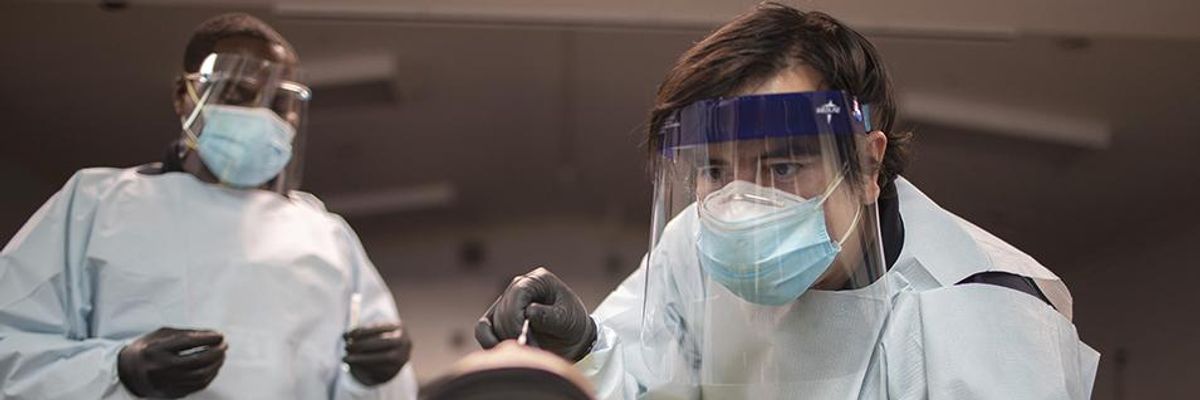
Health care workers use a nasal swab to test a person for COVID-19 at a pop up testing site at the Koinonia Worship Center and Village on July 22, 2020 in Pembroke Park, Florida. (Photo: Joe Raedle/Getty Images)
A research team at the University of Florida has confirmed Covid-19 does live in aerosol droplets, and that the standard 6-foot social distancing protocols used around the world as safety precautions may not be sufficient.
"It's unambiguous evidence that there is infectious virus in aerosols," Linsey Marr, an expert in airborne spread of viruses who was not involved in the work told the New York Times.
For this study, researchers collected air samples from a room in a hospital ward dedicated to Covid-19 patients who were not subject to procedures that are known to produce aerosols, the Times reported.
The research team collected two sets of samples, one at approximately 7 feet from the patients and another at about 16 feet, and found that Covid-19 virus contained in samples at both distances could infect cells in a lab dish.
Although not peer reviewed, scientists are pointing to this study as a potential 'smoking gun,' regarding the issue of aeorsol transmission.
News of the study comes as Covid-19 cases in the United States continue to climb, and as many states continue reopening plans. As of Tuesday, the Centers for Disease Control reported more than 5 million confimed cases in the U.S. and more than 162,000 deaths. Texas Governor Greg Abbot, a Republican, urged vigilance among his constituents Tuesday, as the Lone Star State attempts to reopen after becoming a Covid-19 hotspot in July.
"The numbers are moving in the right direction," Abbot told The Teaxs Tribune, "but it is fair to say that hospital capacity for those with COVID-19 remains too high."
Top U.S. Infectious Disease expert Dr. Anthony Fauci, who has held his post as director of National Institute of Allergy and Infectious Diseases since 1984, has previously cautioned about the possibility and probability of Covid-19 transmission via aerosol droplets. If confirmed, the initial findings of the University of Florida study would bolster his concerns, and indicate the virus can survive greater distances than once thought.
"We know that indoors, those distance rules don't matter anymore," Dr. Robyn Schofield, an atmospheric chemist at Melbourne University in Australia, who measures aerosols over the ocean told the the Times. "It takes about five minutes for small aerosols to traverse the room even in still air."
As Americans grapple with potential school reopenings and the majority of voters continue to favor remote-learning alternatives to in-person schooling, health experts continue to advocate wearing masks to limit Covid-19 transmission. A group of 12,000 infectious disease experts last week sent a letter to Vice President Mike Pence, who heads up the U.S.' Coronoavirus Task Force, urging him to push for a federal mask mandate which, they wrote, "is needed to save lives."
"Specifically, we urge you to publicly issue a strong federal directive calling for mask requirements in all states," the letter, signed by top leaders of the Infectious Diseases Society of America and the HIV Medicine Association read, "to launch a public education campaign about the importance of wearing masks or face coverings, and to require all individuals in the White House complex to wear a mask at all times when they are in the company of others, both for their own protection and to serve as role models for our country."
Pence has refused to issue such a mandate, arguing he doesn't think there is a need for it.
Still, the new study ought to be enough to give people pause, Dr. John Lednicky, the team's lead virologist at the University of Florida, told the Times.
"We can grow the virus from air--I think that should be the important take-home lesson," he said.

Dear Common Dreams reader, It’s been nearly 30 years since I co-founded Common Dreams with my late wife, Lina Newhouser. We had the radical notion that journalism should serve the public good, not corporate profits. It was clear to us from the outset what it would take to build such a project. No paid advertisements. No corporate sponsors. No millionaire publisher telling us what to think or do. Many people said we wouldn't last a year, but we proved those doubters wrong. Together with a tremendous team of journalists and dedicated staff, we built an independent media outlet free from the constraints of profits and corporate control. Our mission has always been simple: To inform. To inspire. To ignite change for the common good. Building Common Dreams was not easy. Our survival was never guaranteed. When you take on the most powerful forces—Wall Street greed, fossil fuel industry destruction, Big Tech lobbyists, and uber-rich oligarchs who have spent billions upon billions rigging the economy and democracy in their favor—the only bulwark you have is supporters who believe in your work. But here’s the urgent message from me today. It's never been this bad out there. And it's never been this hard to keep us going. At the very moment Common Dreams is most needed, the threats we face are intensifying. We need your support now more than ever. We don't accept corporate advertising and never will. We don't have a paywall because we don't think people should be blocked from critical news based on their ability to pay. Everything we do is funded by the donations of readers like you. When everyone does the little they can afford, we are strong. But if that support retreats or dries up, so do we. Will you donate now to make sure Common Dreams not only survives but thrives? —Craig Brown, Co-founder |
A research team at the University of Florida has confirmed Covid-19 does live in aerosol droplets, and that the standard 6-foot social distancing protocols used around the world as safety precautions may not be sufficient.
"It's unambiguous evidence that there is infectious virus in aerosols," Linsey Marr, an expert in airborne spread of viruses who was not involved in the work told the New York Times.
For this study, researchers collected air samples from a room in a hospital ward dedicated to Covid-19 patients who were not subject to procedures that are known to produce aerosols, the Times reported.
The research team collected two sets of samples, one at approximately 7 feet from the patients and another at about 16 feet, and found that Covid-19 virus contained in samples at both distances could infect cells in a lab dish.
Although not peer reviewed, scientists are pointing to this study as a potential 'smoking gun,' regarding the issue of aeorsol transmission.
News of the study comes as Covid-19 cases in the United States continue to climb, and as many states continue reopening plans. As of Tuesday, the Centers for Disease Control reported more than 5 million confimed cases in the U.S. and more than 162,000 deaths. Texas Governor Greg Abbot, a Republican, urged vigilance among his constituents Tuesday, as the Lone Star State attempts to reopen after becoming a Covid-19 hotspot in July.
"The numbers are moving in the right direction," Abbot told The Teaxs Tribune, "but it is fair to say that hospital capacity for those with COVID-19 remains too high."
Top U.S. Infectious Disease expert Dr. Anthony Fauci, who has held his post as director of National Institute of Allergy and Infectious Diseases since 1984, has previously cautioned about the possibility and probability of Covid-19 transmission via aerosol droplets. If confirmed, the initial findings of the University of Florida study would bolster his concerns, and indicate the virus can survive greater distances than once thought.
"We know that indoors, those distance rules don't matter anymore," Dr. Robyn Schofield, an atmospheric chemist at Melbourne University in Australia, who measures aerosols over the ocean told the the Times. "It takes about five minutes for small aerosols to traverse the room even in still air."
As Americans grapple with potential school reopenings and the majority of voters continue to favor remote-learning alternatives to in-person schooling, health experts continue to advocate wearing masks to limit Covid-19 transmission. A group of 12,000 infectious disease experts last week sent a letter to Vice President Mike Pence, who heads up the U.S.' Coronoavirus Task Force, urging him to push for a federal mask mandate which, they wrote, "is needed to save lives."
"Specifically, we urge you to publicly issue a strong federal directive calling for mask requirements in all states," the letter, signed by top leaders of the Infectious Diseases Society of America and the HIV Medicine Association read, "to launch a public education campaign about the importance of wearing masks or face coverings, and to require all individuals in the White House complex to wear a mask at all times when they are in the company of others, both for their own protection and to serve as role models for our country."
Pence has refused to issue such a mandate, arguing he doesn't think there is a need for it.
Still, the new study ought to be enough to give people pause, Dr. John Lednicky, the team's lead virologist at the University of Florida, told the Times.
"We can grow the virus from air--I think that should be the important take-home lesson," he said.
A research team at the University of Florida has confirmed Covid-19 does live in aerosol droplets, and that the standard 6-foot social distancing protocols used around the world as safety precautions may not be sufficient.
"It's unambiguous evidence that there is infectious virus in aerosols," Linsey Marr, an expert in airborne spread of viruses who was not involved in the work told the New York Times.
For this study, researchers collected air samples from a room in a hospital ward dedicated to Covid-19 patients who were not subject to procedures that are known to produce aerosols, the Times reported.
The research team collected two sets of samples, one at approximately 7 feet from the patients and another at about 16 feet, and found that Covid-19 virus contained in samples at both distances could infect cells in a lab dish.
Although not peer reviewed, scientists are pointing to this study as a potential 'smoking gun,' regarding the issue of aeorsol transmission.
News of the study comes as Covid-19 cases in the United States continue to climb, and as many states continue reopening plans. As of Tuesday, the Centers for Disease Control reported more than 5 million confimed cases in the U.S. and more than 162,000 deaths. Texas Governor Greg Abbot, a Republican, urged vigilance among his constituents Tuesday, as the Lone Star State attempts to reopen after becoming a Covid-19 hotspot in July.
"The numbers are moving in the right direction," Abbot told The Teaxs Tribune, "but it is fair to say that hospital capacity for those with COVID-19 remains too high."
Top U.S. Infectious Disease expert Dr. Anthony Fauci, who has held his post as director of National Institute of Allergy and Infectious Diseases since 1984, has previously cautioned about the possibility and probability of Covid-19 transmission via aerosol droplets. If confirmed, the initial findings of the University of Florida study would bolster his concerns, and indicate the virus can survive greater distances than once thought.
"We know that indoors, those distance rules don't matter anymore," Dr. Robyn Schofield, an atmospheric chemist at Melbourne University in Australia, who measures aerosols over the ocean told the the Times. "It takes about five minutes for small aerosols to traverse the room even in still air."
As Americans grapple with potential school reopenings and the majority of voters continue to favor remote-learning alternatives to in-person schooling, health experts continue to advocate wearing masks to limit Covid-19 transmission. A group of 12,000 infectious disease experts last week sent a letter to Vice President Mike Pence, who heads up the U.S.' Coronoavirus Task Force, urging him to push for a federal mask mandate which, they wrote, "is needed to save lives."
"Specifically, we urge you to publicly issue a strong federal directive calling for mask requirements in all states," the letter, signed by top leaders of the Infectious Diseases Society of America and the HIV Medicine Association read, "to launch a public education campaign about the importance of wearing masks or face coverings, and to require all individuals in the White House complex to wear a mask at all times when they are in the company of others, both for their own protection and to serve as role models for our country."
Pence has refused to issue such a mandate, arguing he doesn't think there is a need for it.
Still, the new study ought to be enough to give people pause, Dr. John Lednicky, the team's lead virologist at the University of Florida, told the Times.
"We can grow the virus from air--I think that should be the important take-home lesson," he said.