SUBSCRIBE TO OUR FREE NEWSLETTER
Daily news & progressive opinion—funded by the people, not the corporations—delivered straight to your inbox.
5
#000000
#FFFFFF
To donate by check, phone, or other method, see our More Ways to Give page.
Daily news & progressive opinion—funded by the people, not the corporations—delivered straight to your inbox.
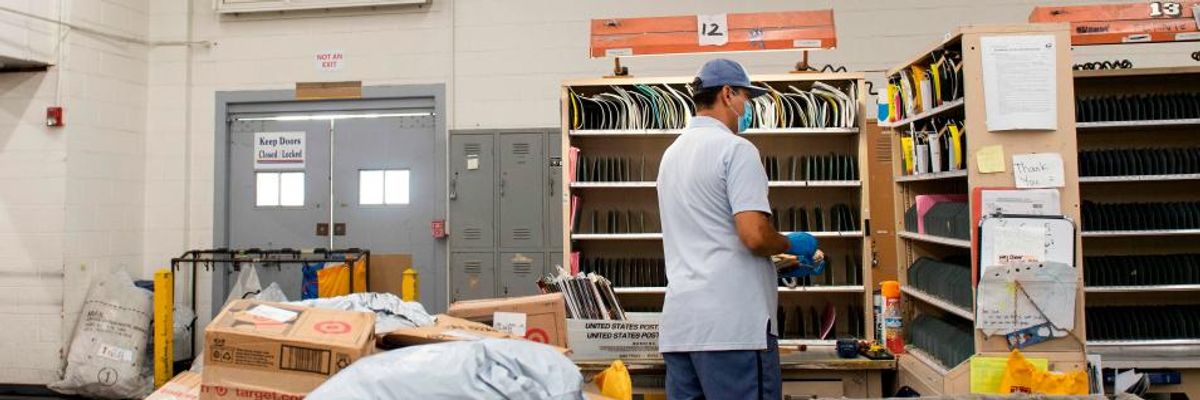
U.S. Postal Service mail carrier Oscar Osorio sorts mail April 29, 2020, in Los Angeles. (Photo: Valerie Macon/AFP via Getty Images)
Letter carriers and voting rights advocates are warning that sabotage of the U.S. Postal Service by the Trump administration and new Postmaster General Louis DeJoy--a major Republican donor to the president--could imperil the agency's ability to deliver mail-in ballots on time, potentially impacting the results of the November elections.
"Slowing down our Postal Service could interfere with this year's election. Voting by mail has become more popular than ever--and 34 states require ballots to be received--not just postmarked--by Election Day."
--Wendy Fields, Democracy Initiative
"I'm actually terrified to see election season under the new procedure," Lori Cash, president of the American Postal Workers Union (APWU) Local 183 in Western New York, told the Washington Post.
The Post reported Thursday that key battleground states like Michigan, Wisconsin, and Pennsylvania are already experiencing significant mail delays due to DeJoy's changes, which include overtime cuts and a new pilot program that bars postal workers from sorting mail in the morning.
"The cardinal rule is, 'don't delay the mail,' and we're in a 180-degree switch where we're delaying mail every day," said Cash. If DeJoy's system isn't fixed before election season, Cash warned, "it's going to be a catastrophe at the Post Office."
The Post noted that any delay in "delivering ballots to voters and then returning them to election officials could cause people to be disenfranchised--especially in states that require ballots to be returned by Election Day."
"Already, tens of thousands of ballots across the country have been disqualified in this year's primaries, many because they did not arrive in time," the Post reported. "In Wisconsin, 2,659 ballots that were returned after the April 13 deadline for the spring primary were not counted due to their late arrival."
Wendy Fields, executive director of the Democracy Initiative, a coalition of voting rights organizations, said in a statement earlier this month that "slower mail service is unfair--and dangerous--for the millions of Americans who rely on the mail for food, medicine, medical supplies, unemployment checks and other critical mail and packages."
"Slowing down our Postal Service also could interfere with this year's election," Fields said. "Voting by mail has become more popular than ever--and 34 states require ballots to be received--not just postmarked--by Election Day."
An anonymous postal worker from California told the Post that if major mail backlogs persist, "there's no telling how many days-worth of delays there could be" come election time.
"I mean, we'll be delivering political mail days after the election," the worker said.
Anticipating that mail delays are likely to continue, the USPS recommended in a statement this week that localities "immediately communicate and advise voters to request ballots at the earliest point allowable but no later than 15 days prior to election date."
"Trump's unprecedented politicization and gutting of USPS is a much greater threat to American democracy than his bogus call to delay the election."
--Ari Berman, Mother Jones
Warnings from postal workers come as President Donald Trump continues to peddle unfounded claims about the prevalence of vote-by-mail fraud. On Thursday, as Common Dreams reported, Trump floated the possibility of the delaying the November election, claiming without evidence that the surge in mail-in ballots will cause "the most inaccurate and fraudulent election in history."
While the president does not have the authority to delay elections, critics said Trump's comments represent yet another insidious attempt to undermine trust in the electoral process.
The New Yorker's Steve Coll wrote Wednesday that Trump's attacks on the legitimacy of the November election combined with his administration's undermining of the U.S. Postal Service "raise obvious questions about whether the management of voting by mail will be manipulated in service of Trump's reelection."
In a tweet Friday, Mother Jones reporter Ari Berman wrote that "Trump's unprecedented politicization and gutting of USPS is a much greater threat to American democracy than his bogus call to delay the election."
In April, Trump called the USPS "a joke" and demanded that the agency dramatically raise package prices during the Covid-19 pandemic.
With the USPS at risk of running out of cash by the end of September, Treasury Secretary Steve Mnuchin announced Thursday that he reached a deal with DeJoy to give the Postal Service access to $10 billion in funding approved by Congress in March.
Democratic lawmakers warned in a joint statement late Thursday that the terms of the agreement would "would inappropriately insert the Treasury into the internal operations of the Postal Service."
"Secretary Mnuchin and the leadership of the U.S. Postal Service appear to be exploiting this public health pandemic to hold the Postal Service to unreasonable loan terms without even consulting Congress," said Rep. Carolyn Maloney (D-N.Y.), Sen. Gary Peters (D-Mich.), Rep. Gerry Connolly (D-Va.), and Sen. Tom Carper (D-Del.). "We will not stop fighting to protect this critical service that communities depend on and to ensure that every American can safely participate in the November elections."
Dear Common Dreams reader, It’s been nearly 30 years since I co-founded Common Dreams with my late wife, Lina Newhouser. We had the radical notion that journalism should serve the public good, not corporate profits. It was clear to us from the outset what it would take to build such a project. No paid advertisements. No corporate sponsors. No millionaire publisher telling us what to think or do. Many people said we wouldn't last a year, but we proved those doubters wrong. Together with a tremendous team of journalists and dedicated staff, we built an independent media outlet free from the constraints of profits and corporate control. Our mission has always been simple: To inform. To inspire. To ignite change for the common good. Building Common Dreams was not easy. Our survival was never guaranteed. When you take on the most powerful forces—Wall Street greed, fossil fuel industry destruction, Big Tech lobbyists, and uber-rich oligarchs who have spent billions upon billions rigging the economy and democracy in their favor—the only bulwark you have is supporters who believe in your work. But here’s the urgent message from me today. It's never been this bad out there. And it's never been this hard to keep us going. At the very moment Common Dreams is most needed, the threats we face are intensifying. We need your support now more than ever. We don't accept corporate advertising and never will. We don't have a paywall because we don't think people should be blocked from critical news based on their ability to pay. Everything we do is funded by the donations of readers like you. When everyone does the little they can afford, we are strong. But if that support retreats or dries up, so do we. Will you donate now to make sure Common Dreams not only survives but thrives? —Craig Brown, Co-founder |
Letter carriers and voting rights advocates are warning that sabotage of the U.S. Postal Service by the Trump administration and new Postmaster General Louis DeJoy--a major Republican donor to the president--could imperil the agency's ability to deliver mail-in ballots on time, potentially impacting the results of the November elections.
"Slowing down our Postal Service could interfere with this year's election. Voting by mail has become more popular than ever--and 34 states require ballots to be received--not just postmarked--by Election Day."
--Wendy Fields, Democracy Initiative
"I'm actually terrified to see election season under the new procedure," Lori Cash, president of the American Postal Workers Union (APWU) Local 183 in Western New York, told the Washington Post.
The Post reported Thursday that key battleground states like Michigan, Wisconsin, and Pennsylvania are already experiencing significant mail delays due to DeJoy's changes, which include overtime cuts and a new pilot program that bars postal workers from sorting mail in the morning.
"The cardinal rule is, 'don't delay the mail,' and we're in a 180-degree switch where we're delaying mail every day," said Cash. If DeJoy's system isn't fixed before election season, Cash warned, "it's going to be a catastrophe at the Post Office."
The Post noted that any delay in "delivering ballots to voters and then returning them to election officials could cause people to be disenfranchised--especially in states that require ballots to be returned by Election Day."
"Already, tens of thousands of ballots across the country have been disqualified in this year's primaries, many because they did not arrive in time," the Post reported. "In Wisconsin, 2,659 ballots that were returned after the April 13 deadline for the spring primary were not counted due to their late arrival."
Wendy Fields, executive director of the Democracy Initiative, a coalition of voting rights organizations, said in a statement earlier this month that "slower mail service is unfair--and dangerous--for the millions of Americans who rely on the mail for food, medicine, medical supplies, unemployment checks and other critical mail and packages."
"Slowing down our Postal Service also could interfere with this year's election," Fields said. "Voting by mail has become more popular than ever--and 34 states require ballots to be received--not just postmarked--by Election Day."
An anonymous postal worker from California told the Post that if major mail backlogs persist, "there's no telling how many days-worth of delays there could be" come election time.
"I mean, we'll be delivering political mail days after the election," the worker said.
Anticipating that mail delays are likely to continue, the USPS recommended in a statement this week that localities "immediately communicate and advise voters to request ballots at the earliest point allowable but no later than 15 days prior to election date."
"Trump's unprecedented politicization and gutting of USPS is a much greater threat to American democracy than his bogus call to delay the election."
--Ari Berman, Mother Jones
Warnings from postal workers come as President Donald Trump continues to peddle unfounded claims about the prevalence of vote-by-mail fraud. On Thursday, as Common Dreams reported, Trump floated the possibility of the delaying the November election, claiming without evidence that the surge in mail-in ballots will cause "the most inaccurate and fraudulent election in history."
While the president does not have the authority to delay elections, critics said Trump's comments represent yet another insidious attempt to undermine trust in the electoral process.
The New Yorker's Steve Coll wrote Wednesday that Trump's attacks on the legitimacy of the November election combined with his administration's undermining of the U.S. Postal Service "raise obvious questions about whether the management of voting by mail will be manipulated in service of Trump's reelection."
In a tweet Friday, Mother Jones reporter Ari Berman wrote that "Trump's unprecedented politicization and gutting of USPS is a much greater threat to American democracy than his bogus call to delay the election."
In April, Trump called the USPS "a joke" and demanded that the agency dramatically raise package prices during the Covid-19 pandemic.
With the USPS at risk of running out of cash by the end of September, Treasury Secretary Steve Mnuchin announced Thursday that he reached a deal with DeJoy to give the Postal Service access to $10 billion in funding approved by Congress in March.
Democratic lawmakers warned in a joint statement late Thursday that the terms of the agreement would "would inappropriately insert the Treasury into the internal operations of the Postal Service."
"Secretary Mnuchin and the leadership of the U.S. Postal Service appear to be exploiting this public health pandemic to hold the Postal Service to unreasonable loan terms without even consulting Congress," said Rep. Carolyn Maloney (D-N.Y.), Sen. Gary Peters (D-Mich.), Rep. Gerry Connolly (D-Va.), and Sen. Tom Carper (D-Del.). "We will not stop fighting to protect this critical service that communities depend on and to ensure that every American can safely participate in the November elections."
Letter carriers and voting rights advocates are warning that sabotage of the U.S. Postal Service by the Trump administration and new Postmaster General Louis DeJoy--a major Republican donor to the president--could imperil the agency's ability to deliver mail-in ballots on time, potentially impacting the results of the November elections.
"Slowing down our Postal Service could interfere with this year's election. Voting by mail has become more popular than ever--and 34 states require ballots to be received--not just postmarked--by Election Day."
--Wendy Fields, Democracy Initiative
"I'm actually terrified to see election season under the new procedure," Lori Cash, president of the American Postal Workers Union (APWU) Local 183 in Western New York, told the Washington Post.
The Post reported Thursday that key battleground states like Michigan, Wisconsin, and Pennsylvania are already experiencing significant mail delays due to DeJoy's changes, which include overtime cuts and a new pilot program that bars postal workers from sorting mail in the morning.
"The cardinal rule is, 'don't delay the mail,' and we're in a 180-degree switch where we're delaying mail every day," said Cash. If DeJoy's system isn't fixed before election season, Cash warned, "it's going to be a catastrophe at the Post Office."
The Post noted that any delay in "delivering ballots to voters and then returning them to election officials could cause people to be disenfranchised--especially in states that require ballots to be returned by Election Day."
"Already, tens of thousands of ballots across the country have been disqualified in this year's primaries, many because they did not arrive in time," the Post reported. "In Wisconsin, 2,659 ballots that were returned after the April 13 deadline for the spring primary were not counted due to their late arrival."
Wendy Fields, executive director of the Democracy Initiative, a coalition of voting rights organizations, said in a statement earlier this month that "slower mail service is unfair--and dangerous--for the millions of Americans who rely on the mail for food, medicine, medical supplies, unemployment checks and other critical mail and packages."
"Slowing down our Postal Service also could interfere with this year's election," Fields said. "Voting by mail has become more popular than ever--and 34 states require ballots to be received--not just postmarked--by Election Day."
An anonymous postal worker from California told the Post that if major mail backlogs persist, "there's no telling how many days-worth of delays there could be" come election time.
"I mean, we'll be delivering political mail days after the election," the worker said.
Anticipating that mail delays are likely to continue, the USPS recommended in a statement this week that localities "immediately communicate and advise voters to request ballots at the earliest point allowable but no later than 15 days prior to election date."
"Trump's unprecedented politicization and gutting of USPS is a much greater threat to American democracy than his bogus call to delay the election."
--Ari Berman, Mother Jones
Warnings from postal workers come as President Donald Trump continues to peddle unfounded claims about the prevalence of vote-by-mail fraud. On Thursday, as Common Dreams reported, Trump floated the possibility of the delaying the November election, claiming without evidence that the surge in mail-in ballots will cause "the most inaccurate and fraudulent election in history."
While the president does not have the authority to delay elections, critics said Trump's comments represent yet another insidious attempt to undermine trust in the electoral process.
The New Yorker's Steve Coll wrote Wednesday that Trump's attacks on the legitimacy of the November election combined with his administration's undermining of the U.S. Postal Service "raise obvious questions about whether the management of voting by mail will be manipulated in service of Trump's reelection."
In a tweet Friday, Mother Jones reporter Ari Berman wrote that "Trump's unprecedented politicization and gutting of USPS is a much greater threat to American democracy than his bogus call to delay the election."
In April, Trump called the USPS "a joke" and demanded that the agency dramatically raise package prices during the Covid-19 pandemic.
With the USPS at risk of running out of cash by the end of September, Treasury Secretary Steve Mnuchin announced Thursday that he reached a deal with DeJoy to give the Postal Service access to $10 billion in funding approved by Congress in March.
Democratic lawmakers warned in a joint statement late Thursday that the terms of the agreement would "would inappropriately insert the Treasury into the internal operations of the Postal Service."
"Secretary Mnuchin and the leadership of the U.S. Postal Service appear to be exploiting this public health pandemic to hold the Postal Service to unreasonable loan terms without even consulting Congress," said Rep. Carolyn Maloney (D-N.Y.), Sen. Gary Peters (D-Mich.), Rep. Gerry Connolly (D-Va.), and Sen. Tom Carper (D-Del.). "We will not stop fighting to protect this critical service that communities depend on and to ensure that every American can safely participate in the November elections."