SUBSCRIBE TO OUR FREE NEWSLETTER
Daily news & progressive opinion—funded by the people, not the corporations—delivered straight to your inbox.
5
#000000
#FFFFFF
To donate by check, phone, or other method, see our More Ways to Give page.
Daily news & progressive opinion—funded by the people, not the corporations—delivered straight to your inbox.
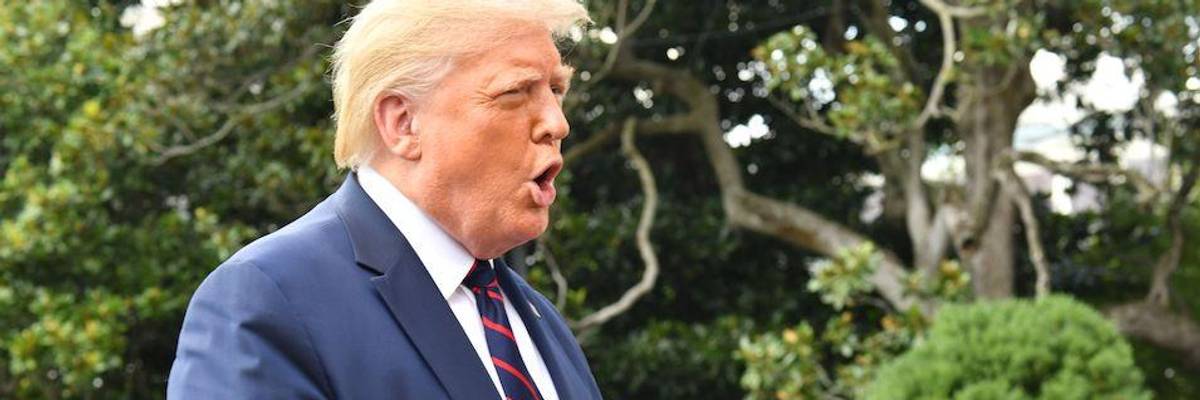
President Donald Trump speaks to the press at the White House on July 27, 2020. (Photo: Nicholas Kamm/AFP via Getty Images)
The U.S. response to the coronavirus pandemic has harmed the country's standing in the world, with observers calling the policy choices of President Donald Trump to handle the disease "ridiculous" and "shocking" as the crisis exposes the deep flaws in the American system.
"People are stunned about the effect of incapable leadership," German Marshall Fund vice president Thomas Kleine-Brockhoff told the Washington Post.
As the Post reported, the complete collapse of U.S. institutions in the face of the pandemic has led to a corresponding drop in American worldwide leadership that Kleine-Brockhoff termed the "collapse of soft power of America."
As journalist Grant Stern noted, the current catastrophe and ineffectiveness of U.S. leadership are both part of a longstanding push by the Republican Party to withdraw from the world.
"Totally avoidable," tweeted Stern. "Entirely foreseeable."
London think tank Chatham House director Robin Niblett termed the crisis and the ongoing protests around the country against the American system as the U.S. "being involved in its own internal reckoning."
"It's America trying to battle with historical and contemporary demons that as much as anything are a result of its own internal contradictions and tensions and strengths and weaknesses," Niblett told the Post. "And it's not all bad. I'm just saying it is like really seeing somebody's psychological flaws exposed at a moment of stress."
According to the Post:
Trump's handling of the pandemic has created division and confusion rather than an effective national strategy. The rest of the world sees the United States not as a leader in dealing with the coronavirus but as the country with the highest number of coronavirus infections and Covid-19 deaths, and with the disease far from under control. European nations have responded with the unprecedented step of blocking Americans from entering their countries.
From abroad, the United States is seen as having lost confidence in itself as it grapples not only with the pandemic but also with long-standing political divisions and a racial reckoning over the treatment of black Americans. The perceived loss of confidence among Americans in turn has led others to question the United States' appetite or capacity for a collaborative leadership role at a time when the health and economic crises call out for committed global cooperation.
International youth surveyed on the U.S. response to the pandemic by the New York Times in a video essay echoed the concerns of the experts in the Post story.
"Are they mass graves?" one young woman from New Zealand asks as the video shows mass graves being dug in New York from April. "I'm sorry, America has mass graves?"
Trump's misleadership comes in for particular criticism, with one young man in Singapore noting that while the president is a figure of ridicule around the world, his actions are having a real human cost to the people of the U.S.
"We see the shit that he says. We see the decisions he makes," the young man says. "And it's funny, but when it comes to something as serious as this, it's just--it's not funny anymore."
Dear Common Dreams reader, It’s been nearly 30 years since I co-founded Common Dreams with my late wife, Lina Newhouser. We had the radical notion that journalism should serve the public good, not corporate profits. It was clear to us from the outset what it would take to build such a project. No paid advertisements. No corporate sponsors. No millionaire publisher telling us what to think or do. Many people said we wouldn't last a year, but we proved those doubters wrong. Together with a tremendous team of journalists and dedicated staff, we built an independent media outlet free from the constraints of profits and corporate control. Our mission has always been simple: To inform. To inspire. To ignite change for the common good. Building Common Dreams was not easy. Our survival was never guaranteed. When you take on the most powerful forces—Wall Street greed, fossil fuel industry destruction, Big Tech lobbyists, and uber-rich oligarchs who have spent billions upon billions rigging the economy and democracy in their favor—the only bulwark you have is supporters who believe in your work. But here’s the urgent message from me today. It's never been this bad out there. And it's never been this hard to keep us going. At the very moment Common Dreams is most needed, the threats we face are intensifying. We need your support now more than ever. We don't accept corporate advertising and never will. We don't have a paywall because we don't think people should be blocked from critical news based on their ability to pay. Everything we do is funded by the donations of readers like you. When everyone does the little they can afford, we are strong. But if that support retreats or dries up, so do we. Will you donate now to make sure Common Dreams not only survives but thrives? —Craig Brown, Co-founder |
The U.S. response to the coronavirus pandemic has harmed the country's standing in the world, with observers calling the policy choices of President Donald Trump to handle the disease "ridiculous" and "shocking" as the crisis exposes the deep flaws in the American system.
"People are stunned about the effect of incapable leadership," German Marshall Fund vice president Thomas Kleine-Brockhoff told the Washington Post.
As the Post reported, the complete collapse of U.S. institutions in the face of the pandemic has led to a corresponding drop in American worldwide leadership that Kleine-Brockhoff termed the "collapse of soft power of America."
As journalist Grant Stern noted, the current catastrophe and ineffectiveness of U.S. leadership are both part of a longstanding push by the Republican Party to withdraw from the world.
"Totally avoidable," tweeted Stern. "Entirely foreseeable."
London think tank Chatham House director Robin Niblett termed the crisis and the ongoing protests around the country against the American system as the U.S. "being involved in its own internal reckoning."
"It's America trying to battle with historical and contemporary demons that as much as anything are a result of its own internal contradictions and tensions and strengths and weaknesses," Niblett told the Post. "And it's not all bad. I'm just saying it is like really seeing somebody's psychological flaws exposed at a moment of stress."
According to the Post:
Trump's handling of the pandemic has created division and confusion rather than an effective national strategy. The rest of the world sees the United States not as a leader in dealing with the coronavirus but as the country with the highest number of coronavirus infections and Covid-19 deaths, and with the disease far from under control. European nations have responded with the unprecedented step of blocking Americans from entering their countries.
From abroad, the United States is seen as having lost confidence in itself as it grapples not only with the pandemic but also with long-standing political divisions and a racial reckoning over the treatment of black Americans. The perceived loss of confidence among Americans in turn has led others to question the United States' appetite or capacity for a collaborative leadership role at a time when the health and economic crises call out for committed global cooperation.
International youth surveyed on the U.S. response to the pandemic by the New York Times in a video essay echoed the concerns of the experts in the Post story.
"Are they mass graves?" one young woman from New Zealand asks as the video shows mass graves being dug in New York from April. "I'm sorry, America has mass graves?"
Trump's misleadership comes in for particular criticism, with one young man in Singapore noting that while the president is a figure of ridicule around the world, his actions are having a real human cost to the people of the U.S.
"We see the shit that he says. We see the decisions he makes," the young man says. "And it's funny, but when it comes to something as serious as this, it's just--it's not funny anymore."
The U.S. response to the coronavirus pandemic has harmed the country's standing in the world, with observers calling the policy choices of President Donald Trump to handle the disease "ridiculous" and "shocking" as the crisis exposes the deep flaws in the American system.
"People are stunned about the effect of incapable leadership," German Marshall Fund vice president Thomas Kleine-Brockhoff told the Washington Post.
As the Post reported, the complete collapse of U.S. institutions in the face of the pandemic has led to a corresponding drop in American worldwide leadership that Kleine-Brockhoff termed the "collapse of soft power of America."
As journalist Grant Stern noted, the current catastrophe and ineffectiveness of U.S. leadership are both part of a longstanding push by the Republican Party to withdraw from the world.
"Totally avoidable," tweeted Stern. "Entirely foreseeable."
London think tank Chatham House director Robin Niblett termed the crisis and the ongoing protests around the country against the American system as the U.S. "being involved in its own internal reckoning."
"It's America trying to battle with historical and contemporary demons that as much as anything are a result of its own internal contradictions and tensions and strengths and weaknesses," Niblett told the Post. "And it's not all bad. I'm just saying it is like really seeing somebody's psychological flaws exposed at a moment of stress."
According to the Post:
Trump's handling of the pandemic has created division and confusion rather than an effective national strategy. The rest of the world sees the United States not as a leader in dealing with the coronavirus but as the country with the highest number of coronavirus infections and Covid-19 deaths, and with the disease far from under control. European nations have responded with the unprecedented step of blocking Americans from entering their countries.
From abroad, the United States is seen as having lost confidence in itself as it grapples not only with the pandemic but also with long-standing political divisions and a racial reckoning over the treatment of black Americans. The perceived loss of confidence among Americans in turn has led others to question the United States' appetite or capacity for a collaborative leadership role at a time when the health and economic crises call out for committed global cooperation.
International youth surveyed on the U.S. response to the pandemic by the New York Times in a video essay echoed the concerns of the experts in the Post story.
"Are they mass graves?" one young woman from New Zealand asks as the video shows mass graves being dug in New York from April. "I'm sorry, America has mass graves?"
Trump's misleadership comes in for particular criticism, with one young man in Singapore noting that while the president is a figure of ridicule around the world, his actions are having a real human cost to the people of the U.S.
"We see the shit that he says. We see the decisions he makes," the young man says. "And it's funny, but when it comes to something as serious as this, it's just--it's not funny anymore."