SUBSCRIBE TO OUR FREE NEWSLETTER
Daily news & progressive opinion—funded by the people, not the corporations—delivered straight to your inbox.
5
#000000
#FFFFFF
To donate by check, phone, or other method, see our More Ways to Give page.
Daily news & progressive opinion—funded by the people, not the corporations—delivered straight to your inbox.
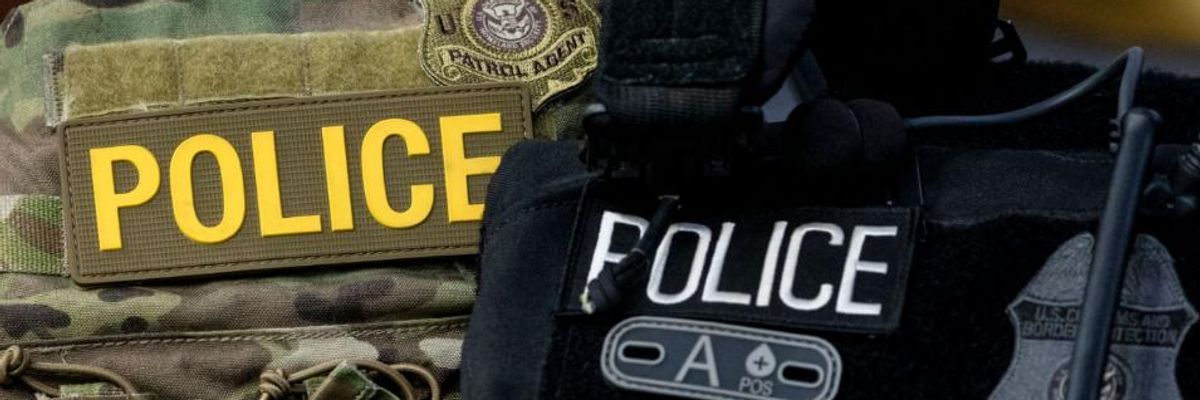
Two examples of the protective vests with identifying markings worn by Border Patrol and Homeland Security agents during a press conference with Secretary of Homeland Security Chad Wolf on the recent events involving the agents during continued protests in Portland at the US Customs and Border Patrol headquarters on July 21, 2020 in Washington, DC. (Photo: Samuel Corum/Getty Images)
Escalating his authoritarian threat to send even more federal agents into U.S. cities in what critics have denounced as a cynical and dangerous election year ploy to sow division and chaos, President Donald Trump on Thursday night said his administration is ready to deploy up to 75,000 such officers nationwide in the weeks ahead.
In an interview with Fox News' Sean Hannity that aired Thursday night Trump said he would send 50,000 or 60,000 federal agents into U.S. cities under the auspices of combating violent crime and then later upped the figure to 75,000.
While Trump initially acknowledged that federal agents would "have to be invited in" by local or state authorities, he subsequently added, "At some point we'll have to do something much stronger than being invited in."
"We'll go into all of the cities, any of the cities," Trump said. "We're ready."
According to CNN:
Deploying 75,000 officers would mark a significant portion of all federal officers in the country. According to a 2019 report from the Bureau of Justice Statistics, there were approximately 100,000 federal law enforcement officers in the entire United States in 2016, the last year for which data was available.
Critics of the president's behavior and threats of further federal agents in more cities have repeatedly warned that this is part of a broader project for Trump to distract from his mismanagement of the Covid-19 pandemic and to energize his right-wing base ahead of the November election. Others say the maneuvers go beyond that and should be seen as a telltale sign of Trump's underlying fascist ambitions.
John Feffer, director of Foreign Policy In Focus at the Institute for Policy Studies, wrote this week of Trump's compounding threats that the president "is doubling down, not backing down. He says that the paramilitaries are there to restore order. The Feds are preparing to descend on Chicago, and Trump is also warning Philadelphia and New York that they're next."
In Feffer's assessment, the threats from Trump should not be confused as an isolated tactic to look strong but should instead be recognized by the American public as a broader authoritarian project that mirrors other historic chapters in which fascists consolidated power by exploiting racial tensions and partisan divisions. Accordin to Feffer:
Trump is claiming that areas of the country under Democratic Party control are in fact swamps of anti-Americanism. He is deploying the classic vocabulary associated with dehumanizing America's putative enemies prior to attack. This is no longer a conflict between red and blue. Trump is transforming America's political divide into an existential battle between grey and blue, where the Feds are supporting a Confederate-friendly president and the rebellious states long for the return of a more perfect Union.
Trump's use of federal paramilitaries is a classic tactic of autocrats to test how far they can push their authority and what forces they can count on in an emergency. The Black Lives Matter protests inadvertently provided Trump with that opportunity. Come election time, he'll know which guns are on his side if he chooses to question the election results and stay in office.
While New York Times reporting earlier this week detailed how the Trump campaign has already folded images of federal agents in Portland, Oregon attacking protesters into recent 2020 presidential ads--"a tactic that reinforces his 'law and order' campaign message," the newspaper noted--critics of the president like Dr. Rosanna Guadagno, a social psychologist and director of the Information Warfare Working Group at Stanford University's Center for International Security and Cooperation, warned that such an approach could backfire politically.
"Watching moms, reporters, medics, and peaceful protesters get tear gassed and beaten by federal agents on a regular basis," tweeted Guadagno on her personal account, "isn't the imagery I'd choose as a cornerstone of my campaign."
Dear Common Dreams reader, It’s been nearly 30 years since I co-founded Common Dreams with my late wife, Lina Newhouser. We had the radical notion that journalism should serve the public good, not corporate profits. It was clear to us from the outset what it would take to build such a project. No paid advertisements. No corporate sponsors. No millionaire publisher telling us what to think or do. Many people said we wouldn't last a year, but we proved those doubters wrong. Together with a tremendous team of journalists and dedicated staff, we built an independent media outlet free from the constraints of profits and corporate control. Our mission has always been simple: To inform. To inspire. To ignite change for the common good. Building Common Dreams was not easy. Our survival was never guaranteed. When you take on the most powerful forces—Wall Street greed, fossil fuel industry destruction, Big Tech lobbyists, and uber-rich oligarchs who have spent billions upon billions rigging the economy and democracy in their favor—the only bulwark you have is supporters who believe in your work. But here’s the urgent message from me today. It's never been this bad out there. And it's never been this hard to keep us going. At the very moment Common Dreams is most needed, the threats we face are intensifying. We need your support now more than ever. We don't accept corporate advertising and never will. We don't have a paywall because we don't think people should be blocked from critical news based on their ability to pay. Everything we do is funded by the donations of readers like you. When everyone does the little they can afford, we are strong. But if that support retreats or dries up, so do we. Will you donate now to make sure Common Dreams not only survives but thrives? —Craig Brown, Co-founder |
Escalating his authoritarian threat to send even more federal agents into U.S. cities in what critics have denounced as a cynical and dangerous election year ploy to sow division and chaos, President Donald Trump on Thursday night said his administration is ready to deploy up to 75,000 such officers nationwide in the weeks ahead.
In an interview with Fox News' Sean Hannity that aired Thursday night Trump said he would send 50,000 or 60,000 federal agents into U.S. cities under the auspices of combating violent crime and then later upped the figure to 75,000.
While Trump initially acknowledged that federal agents would "have to be invited in" by local or state authorities, he subsequently added, "At some point we'll have to do something much stronger than being invited in."
"We'll go into all of the cities, any of the cities," Trump said. "We're ready."
According to CNN:
Deploying 75,000 officers would mark a significant portion of all federal officers in the country. According to a 2019 report from the Bureau of Justice Statistics, there were approximately 100,000 federal law enforcement officers in the entire United States in 2016, the last year for which data was available.
Critics of the president's behavior and threats of further federal agents in more cities have repeatedly warned that this is part of a broader project for Trump to distract from his mismanagement of the Covid-19 pandemic and to energize his right-wing base ahead of the November election. Others say the maneuvers go beyond that and should be seen as a telltale sign of Trump's underlying fascist ambitions.
John Feffer, director of Foreign Policy In Focus at the Institute for Policy Studies, wrote this week of Trump's compounding threats that the president "is doubling down, not backing down. He says that the paramilitaries are there to restore order. The Feds are preparing to descend on Chicago, and Trump is also warning Philadelphia and New York that they're next."
In Feffer's assessment, the threats from Trump should not be confused as an isolated tactic to look strong but should instead be recognized by the American public as a broader authoritarian project that mirrors other historic chapters in which fascists consolidated power by exploiting racial tensions and partisan divisions. Accordin to Feffer:
Trump is claiming that areas of the country under Democratic Party control are in fact swamps of anti-Americanism. He is deploying the classic vocabulary associated with dehumanizing America's putative enemies prior to attack. This is no longer a conflict between red and blue. Trump is transforming America's political divide into an existential battle between grey and blue, where the Feds are supporting a Confederate-friendly president and the rebellious states long for the return of a more perfect Union.
Trump's use of federal paramilitaries is a classic tactic of autocrats to test how far they can push their authority and what forces they can count on in an emergency. The Black Lives Matter protests inadvertently provided Trump with that opportunity. Come election time, he'll know which guns are on his side if he chooses to question the election results and stay in office.
While New York Times reporting earlier this week detailed how the Trump campaign has already folded images of federal agents in Portland, Oregon attacking protesters into recent 2020 presidential ads--"a tactic that reinforces his 'law and order' campaign message," the newspaper noted--critics of the president like Dr. Rosanna Guadagno, a social psychologist and director of the Information Warfare Working Group at Stanford University's Center for International Security and Cooperation, warned that such an approach could backfire politically.
"Watching moms, reporters, medics, and peaceful protesters get tear gassed and beaten by federal agents on a regular basis," tweeted Guadagno on her personal account, "isn't the imagery I'd choose as a cornerstone of my campaign."
Escalating his authoritarian threat to send even more federal agents into U.S. cities in what critics have denounced as a cynical and dangerous election year ploy to sow division and chaos, President Donald Trump on Thursday night said his administration is ready to deploy up to 75,000 such officers nationwide in the weeks ahead.
In an interview with Fox News' Sean Hannity that aired Thursday night Trump said he would send 50,000 or 60,000 federal agents into U.S. cities under the auspices of combating violent crime and then later upped the figure to 75,000.
While Trump initially acknowledged that federal agents would "have to be invited in" by local or state authorities, he subsequently added, "At some point we'll have to do something much stronger than being invited in."
"We'll go into all of the cities, any of the cities," Trump said. "We're ready."
According to CNN:
Deploying 75,000 officers would mark a significant portion of all federal officers in the country. According to a 2019 report from the Bureau of Justice Statistics, there were approximately 100,000 federal law enforcement officers in the entire United States in 2016, the last year for which data was available.
Critics of the president's behavior and threats of further federal agents in more cities have repeatedly warned that this is part of a broader project for Trump to distract from his mismanagement of the Covid-19 pandemic and to energize his right-wing base ahead of the November election. Others say the maneuvers go beyond that and should be seen as a telltale sign of Trump's underlying fascist ambitions.
John Feffer, director of Foreign Policy In Focus at the Institute for Policy Studies, wrote this week of Trump's compounding threats that the president "is doubling down, not backing down. He says that the paramilitaries are there to restore order. The Feds are preparing to descend on Chicago, and Trump is also warning Philadelphia and New York that they're next."
In Feffer's assessment, the threats from Trump should not be confused as an isolated tactic to look strong but should instead be recognized by the American public as a broader authoritarian project that mirrors other historic chapters in which fascists consolidated power by exploiting racial tensions and partisan divisions. Accordin to Feffer:
Trump is claiming that areas of the country under Democratic Party control are in fact swamps of anti-Americanism. He is deploying the classic vocabulary associated with dehumanizing America's putative enemies prior to attack. This is no longer a conflict between red and blue. Trump is transforming America's political divide into an existential battle between grey and blue, where the Feds are supporting a Confederate-friendly president and the rebellious states long for the return of a more perfect Union.
Trump's use of federal paramilitaries is a classic tactic of autocrats to test how far they can push their authority and what forces they can count on in an emergency. The Black Lives Matter protests inadvertently provided Trump with that opportunity. Come election time, he'll know which guns are on his side if he chooses to question the election results and stay in office.
While New York Times reporting earlier this week detailed how the Trump campaign has already folded images of federal agents in Portland, Oregon attacking protesters into recent 2020 presidential ads--"a tactic that reinforces his 'law and order' campaign message," the newspaper noted--critics of the president like Dr. Rosanna Guadagno, a social psychologist and director of the Information Warfare Working Group at Stanford University's Center for International Security and Cooperation, warned that such an approach could backfire politically.
"Watching moms, reporters, medics, and peaceful protesters get tear gassed and beaten by federal agents on a regular basis," tweeted Guadagno on her personal account, "isn't the imagery I'd choose as a cornerstone of my campaign."