SUBSCRIBE TO OUR FREE NEWSLETTER
Daily news & progressive opinion—funded by the people, not the corporations—delivered straight to your inbox.
5
#000000
#FFFFFF
To donate by check, phone, or other method, see our More Ways to Give page.
Daily news & progressive opinion—funded by the people, not the corporations—delivered straight to your inbox.
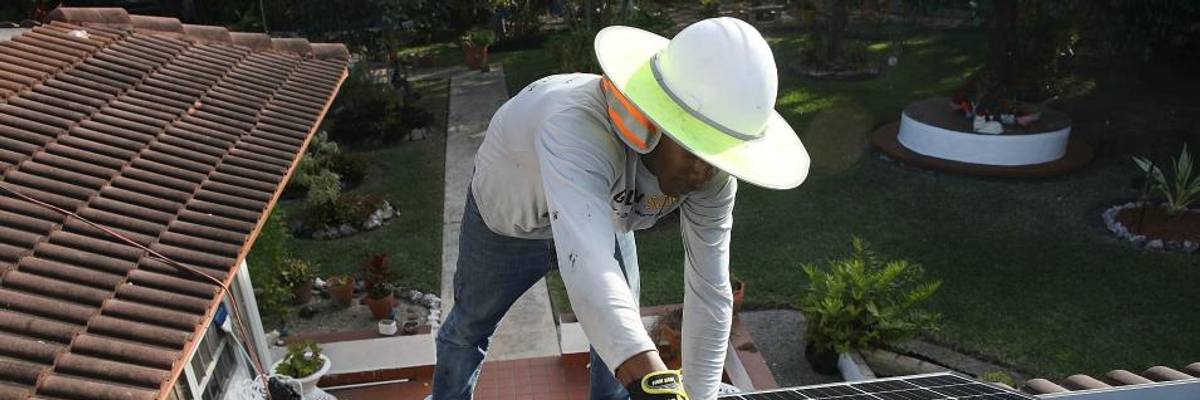
Roger Garbey, from the Goldin Solar company, installs a solar panel system on the roof of a home a day after the Trump administration announced it will impose duties of as much as 30% on solar equipment made abroad on January 23, 2018 in Palmetto Bay, Florida. (Photo: Joe Raedle/Getty Images)
Federal regulators on Thursday released a pair of decisions expected to impact the expansion of renewable power nationwide--one that was celebrated by environmentalists and clean energy advocates as a crucial win and another that critics warned "could lead to more pollution by propping up fossil fuel power plants."
The Federal Energy Regulatory Commission (FERC) delivered a victory to supporters of renewables by rejecting an April petition from the New England Ratepayers Association (NERA) calling for federal rather than local jurisdiction over solar net-metering policies, which had provoked strong condemnation from a bipartisan group of congressional lawmakers, solar investors, and hundreds of advocacy groups.
As Public Citizen explained last month:
Net-metering is a billing mechanism that credits solar power generators for the electricity they add to the grid. It is a crucial component of rooftop solar project financing because it makes solar energy systems affordable for small businesses and families through energy credits for the solar power they generate. The NERA petition would grant FERC sole jurisdiction to govern such programs through the Public Utility Regulatory Policy Act [PURPA] or Federal Power Act.
Public Citizen, the Center for Biological Diversity, and over 450 other environmental, faith, and consumer groups sent a letter to FERC in June arguing that "state net-metering policies and distributed solar systems are foundational to achieving the nation's urgently needed clean and just energy transition--to address historical environmental injustices, fight the climate emergency, and ensure long-term resilience."
Howard Crystal, an attorney with the Center for Biological Diversity's energy justice program, authored a legal intervention filed with FERC regarding the petition. In a statement Thursday, he welcomed the Republican-led commission's rejection of the NERA proposal.
"This is a big win for our climate and for communities embracing clean solar power," Crystal said. "FERC's unanimous ruling ensures that states can keep appropriately compensating people who install rooftop solar. That allows community solar and other distributed renewables to continue playing a critical role in the urgent transition to clean energy."
Abigail Ross Hopper, president and CEO of the Solar Energy Industries Association, applauded the panel's dismissal of the "flawed petition" in a statement that highlighted the solar industry's record on job creation and contributions to the U.S. economy.
"Our industry holds great promise to help create jobs and revive local economies," she said. "We are grateful to the state utility commissions and many other partners who strongly opposed this petition. We will continue working in the states to strengthen net metering policies to generate more jobs and investment and we will advocate for fair treatment of solar at FERC where it has jurisdiction."
Tom Rutigliano, an advocate in the Sustainable FERC Project, which is housed at the Natural Resources Defense Council (NRDC), similarly welcomed the decision, saying that "FERC did one thing right today in rejecting the outrageous petition that would have upended the ability of rooftop solar owners to get a fair price for the excess electricity they generate."
However, Rutigliano expressed concern about the panel's vote to overhaul PURPA, which is more than 40 years old and has been key to renewable energy growth across the country. As he put it: "Instead of promoting small, clean generation, FERC is undercutting the ability of solar and wind power to get a fair chance to compete."
Noting that "utilities have long sought changes to the law" over cost concerns while solar and wind developers say it "is critical to giving renewables a leg up in states that aren't green-leaning," Bloomberg reported Thursday that the panel
reduced the mandatory purchase obligation for utilities to five megawatts from 20 megawatts in some markets, and gave states more authority to set the price at which small generators sell their power. The "one-mile rule," which determines whether generation facilities should be considered to be part of a single facility, was also changed. The agency will now require that qualifying facilities demonstrate commercial viability.
...
Commissioner Richard Glick, the lone Democrat on the panel, dissented in part but said that the changes would benefit consumers. "Under the old regime, customers were overpaying for power they were receiving" to the tune of $2.2 billion to $3.9 billion, he said.
Rutigliano warned that "homeowners putting solar panels on their roof, farmers leasing their land to wind turbines, and industrial facilities with efficient on-site power all lose under FERC's rule today."
"FERC is pushing the nation to use more fossil fuels," he said, "just when it should be doing everything it can to support clean power."
Dear Common Dreams reader, It’s been nearly 30 years since I co-founded Common Dreams with my late wife, Lina Newhouser. We had the radical notion that journalism should serve the public good, not corporate profits. It was clear to us from the outset what it would take to build such a project. No paid advertisements. No corporate sponsors. No millionaire publisher telling us what to think or do. Many people said we wouldn't last a year, but we proved those doubters wrong. Together with a tremendous team of journalists and dedicated staff, we built an independent media outlet free from the constraints of profits and corporate control. Our mission has always been simple: To inform. To inspire. To ignite change for the common good. Building Common Dreams was not easy. Our survival was never guaranteed. When you take on the most powerful forces—Wall Street greed, fossil fuel industry destruction, Big Tech lobbyists, and uber-rich oligarchs who have spent billions upon billions rigging the economy and democracy in their favor—the only bulwark you have is supporters who believe in your work. But here’s the urgent message from me today. It's never been this bad out there. And it's never been this hard to keep us going. At the very moment Common Dreams is most needed, the threats we face are intensifying. We need your support now more than ever. We don't accept corporate advertising and never will. We don't have a paywall because we don't think people should be blocked from critical news based on their ability to pay. Everything we do is funded by the donations of readers like you. When everyone does the little they can afford, we are strong. But if that support retreats or dries up, so do we. Will you donate now to make sure Common Dreams not only survives but thrives? —Craig Brown, Co-founder |
Federal regulators on Thursday released a pair of decisions expected to impact the expansion of renewable power nationwide--one that was celebrated by environmentalists and clean energy advocates as a crucial win and another that critics warned "could lead to more pollution by propping up fossil fuel power plants."
The Federal Energy Regulatory Commission (FERC) delivered a victory to supporters of renewables by rejecting an April petition from the New England Ratepayers Association (NERA) calling for federal rather than local jurisdiction over solar net-metering policies, which had provoked strong condemnation from a bipartisan group of congressional lawmakers, solar investors, and hundreds of advocacy groups.
As Public Citizen explained last month:
Net-metering is a billing mechanism that credits solar power generators for the electricity they add to the grid. It is a crucial component of rooftop solar project financing because it makes solar energy systems affordable for small businesses and families through energy credits for the solar power they generate. The NERA petition would grant FERC sole jurisdiction to govern such programs through the Public Utility Regulatory Policy Act [PURPA] or Federal Power Act.
Public Citizen, the Center for Biological Diversity, and over 450 other environmental, faith, and consumer groups sent a letter to FERC in June arguing that "state net-metering policies and distributed solar systems are foundational to achieving the nation's urgently needed clean and just energy transition--to address historical environmental injustices, fight the climate emergency, and ensure long-term resilience."
Howard Crystal, an attorney with the Center for Biological Diversity's energy justice program, authored a legal intervention filed with FERC regarding the petition. In a statement Thursday, he welcomed the Republican-led commission's rejection of the NERA proposal.
"This is a big win for our climate and for communities embracing clean solar power," Crystal said. "FERC's unanimous ruling ensures that states can keep appropriately compensating people who install rooftop solar. That allows community solar and other distributed renewables to continue playing a critical role in the urgent transition to clean energy."
Abigail Ross Hopper, president and CEO of the Solar Energy Industries Association, applauded the panel's dismissal of the "flawed petition" in a statement that highlighted the solar industry's record on job creation and contributions to the U.S. economy.
"Our industry holds great promise to help create jobs and revive local economies," she said. "We are grateful to the state utility commissions and many other partners who strongly opposed this petition. We will continue working in the states to strengthen net metering policies to generate more jobs and investment and we will advocate for fair treatment of solar at FERC where it has jurisdiction."
Tom Rutigliano, an advocate in the Sustainable FERC Project, which is housed at the Natural Resources Defense Council (NRDC), similarly welcomed the decision, saying that "FERC did one thing right today in rejecting the outrageous petition that would have upended the ability of rooftop solar owners to get a fair price for the excess electricity they generate."
However, Rutigliano expressed concern about the panel's vote to overhaul PURPA, which is more than 40 years old and has been key to renewable energy growth across the country. As he put it: "Instead of promoting small, clean generation, FERC is undercutting the ability of solar and wind power to get a fair chance to compete."
Noting that "utilities have long sought changes to the law" over cost concerns while solar and wind developers say it "is critical to giving renewables a leg up in states that aren't green-leaning," Bloomberg reported Thursday that the panel
reduced the mandatory purchase obligation for utilities to five megawatts from 20 megawatts in some markets, and gave states more authority to set the price at which small generators sell their power. The "one-mile rule," which determines whether generation facilities should be considered to be part of a single facility, was also changed. The agency will now require that qualifying facilities demonstrate commercial viability.
...
Commissioner Richard Glick, the lone Democrat on the panel, dissented in part but said that the changes would benefit consumers. "Under the old regime, customers were overpaying for power they were receiving" to the tune of $2.2 billion to $3.9 billion, he said.
Rutigliano warned that "homeowners putting solar panels on their roof, farmers leasing their land to wind turbines, and industrial facilities with efficient on-site power all lose under FERC's rule today."
"FERC is pushing the nation to use more fossil fuels," he said, "just when it should be doing everything it can to support clean power."
Federal regulators on Thursday released a pair of decisions expected to impact the expansion of renewable power nationwide--one that was celebrated by environmentalists and clean energy advocates as a crucial win and another that critics warned "could lead to more pollution by propping up fossil fuel power plants."
The Federal Energy Regulatory Commission (FERC) delivered a victory to supporters of renewables by rejecting an April petition from the New England Ratepayers Association (NERA) calling for federal rather than local jurisdiction over solar net-metering policies, which had provoked strong condemnation from a bipartisan group of congressional lawmakers, solar investors, and hundreds of advocacy groups.
As Public Citizen explained last month:
Net-metering is a billing mechanism that credits solar power generators for the electricity they add to the grid. It is a crucial component of rooftop solar project financing because it makes solar energy systems affordable for small businesses and families through energy credits for the solar power they generate. The NERA petition would grant FERC sole jurisdiction to govern such programs through the Public Utility Regulatory Policy Act [PURPA] or Federal Power Act.
Public Citizen, the Center for Biological Diversity, and over 450 other environmental, faith, and consumer groups sent a letter to FERC in June arguing that "state net-metering policies and distributed solar systems are foundational to achieving the nation's urgently needed clean and just energy transition--to address historical environmental injustices, fight the climate emergency, and ensure long-term resilience."
Howard Crystal, an attorney with the Center for Biological Diversity's energy justice program, authored a legal intervention filed with FERC regarding the petition. In a statement Thursday, he welcomed the Republican-led commission's rejection of the NERA proposal.
"This is a big win for our climate and for communities embracing clean solar power," Crystal said. "FERC's unanimous ruling ensures that states can keep appropriately compensating people who install rooftop solar. That allows community solar and other distributed renewables to continue playing a critical role in the urgent transition to clean energy."
Abigail Ross Hopper, president and CEO of the Solar Energy Industries Association, applauded the panel's dismissal of the "flawed petition" in a statement that highlighted the solar industry's record on job creation and contributions to the U.S. economy.
"Our industry holds great promise to help create jobs and revive local economies," she said. "We are grateful to the state utility commissions and many other partners who strongly opposed this petition. We will continue working in the states to strengthen net metering policies to generate more jobs and investment and we will advocate for fair treatment of solar at FERC where it has jurisdiction."
Tom Rutigliano, an advocate in the Sustainable FERC Project, which is housed at the Natural Resources Defense Council (NRDC), similarly welcomed the decision, saying that "FERC did one thing right today in rejecting the outrageous petition that would have upended the ability of rooftop solar owners to get a fair price for the excess electricity they generate."
However, Rutigliano expressed concern about the panel's vote to overhaul PURPA, which is more than 40 years old and has been key to renewable energy growth across the country. As he put it: "Instead of promoting small, clean generation, FERC is undercutting the ability of solar and wind power to get a fair chance to compete."
Noting that "utilities have long sought changes to the law" over cost concerns while solar and wind developers say it "is critical to giving renewables a leg up in states that aren't green-leaning," Bloomberg reported Thursday that the panel
reduced the mandatory purchase obligation for utilities to five megawatts from 20 megawatts in some markets, and gave states more authority to set the price at which small generators sell their power. The "one-mile rule," which determines whether generation facilities should be considered to be part of a single facility, was also changed. The agency will now require that qualifying facilities demonstrate commercial viability.
...
Commissioner Richard Glick, the lone Democrat on the panel, dissented in part but said that the changes would benefit consumers. "Under the old regime, customers were overpaying for power they were receiving" to the tune of $2.2 billion to $3.9 billion, he said.
Rutigliano warned that "homeowners putting solar panels on their roof, farmers leasing their land to wind turbines, and industrial facilities with efficient on-site power all lose under FERC's rule today."
"FERC is pushing the nation to use more fossil fuels," he said, "just when it should be doing everything it can to support clean power."