SUBSCRIBE TO OUR FREE NEWSLETTER
Daily news & progressive opinion—funded by the people, not the corporations—delivered straight to your inbox.
5
#000000
#FFFFFF
To donate by check, phone, or other method, see our More Ways to Give page.
Daily news & progressive opinion—funded by the people, not the corporations—delivered straight to your inbox.
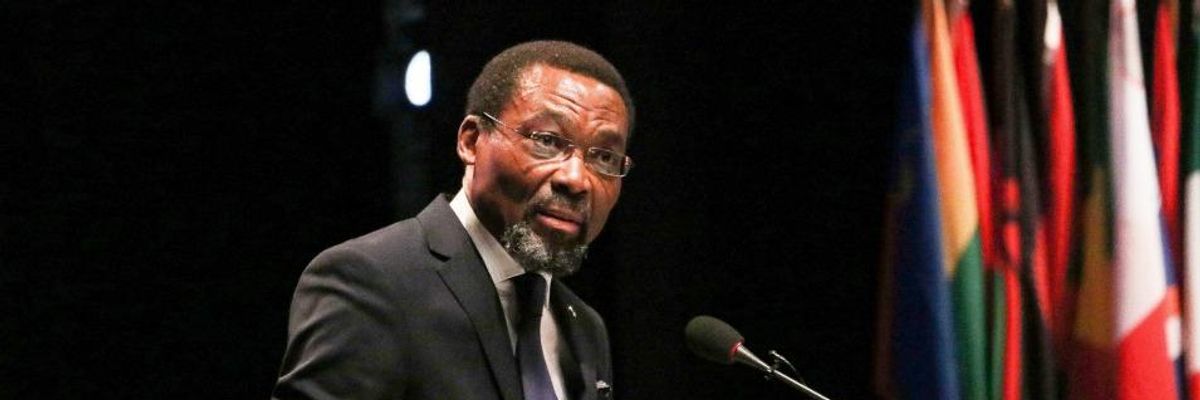
Judge Chile Eboe-Osuji, President of International Criminal Court, makes a speech during the 18th session of the ICCs Assembly of States Parties, held in The Hague, Netherlands on December 2, 2019. (Photo: Abdullah Asiran/Anadolu Agency via Getty Images)
The head of the International Criminal Court expressed shock late Tuesday at the Trump administration's continued threats to the institution and accused the U.S. of unlawful conduct.
Chile Eboe-Osuji, president of the body, accused the Trump administration of attempting to coerce the court "in order to have justice the way [it wants] it."
The U.S. said this month it would restrict visas for ICC officials taking part in an investigation into war crimes in Afghanistan, which was authorized in March, as well as their families' visas. The administration also threatened to open its own probe into corruption at the ICC.
Last week, Attorney General William Barr said that by investigating war crimes in Afghanistan--including those perpetrated by the CIA and U.S. troops as well as the Taliban and government forces--the ICC is "exceeding its mandate and violating the sovereignty of the United States."
"This is unlawful... In any liberal democracy, or even not so liberal democracies, you pick up a statute book and it will tell you that it is against the law to coerce a court of law," Eboe-Osuji told The Guardian on Wednesday. "Even in the U.S. itself, the law forbids that form of conduct."
An ICC investigation would likely uncover information about CIA "black sites" that were set up around the world, where U.S. authorities tortured detainees. Earlier this year, the U.N. said at least 100,000 civilians have been injured or killed in the last decade. The U.N. began tracking civilian casualties almost a decade after the U.S. invasion of Afghanistan.
The ICC's chief prosecutor, Fatou Bensouda, confirmed in April that her visa had been revoked shortly after the investigation was announced.
Eboe-Osuji told The Guardian on Wednesday that he was confident that the 123 member states of the ICC "will understand this as an attack against them too."
On Tuesday, nearly 70 of the member states expressed support for the ICC. The Costa Rican and Swiss delegations drafted a statement affirming "unwavering support for the court as an independent and impartial judicial institution."
"We remain committed to an international rules-based order," reads the statement. "The ICC is an integral part of this order and a central institution in the fight against impunity and the pursuit of justice, which are essential components or sustainable peace, security, and reconciliation."
"We call on all states to ensure full cooperation with the court for it to carry out its most important mandate of ensuring justice for the victims of the most serious crimes of international concern," continued the member states.
The statement was signed by U.S. allies including the delegations from the U.K., France, and Germany.
Separately, France--which also sent troops to Afghanistan and which could potentially be implicated in the war crimes investigation--called the Trump administration's threats "a grave attack on the court and a further undermining of multilateralism."
Human Rights Watch applauded the show of solidarity by the 67 member states.
"Multilateral support for the ICC is key to deterring the chilling effect of the Trump administration's outrageous effort to undermine justice for victims," said international justice director Richard Dicker. "Member countries will need sustained vigilance and to be ready to take further steps to push back against U.S. bullying of the court."
Dear Common Dreams reader, It’s been nearly 30 years since I co-founded Common Dreams with my late wife, Lina Newhouser. We had the radical notion that journalism should serve the public good, not corporate profits. It was clear to us from the outset what it would take to build such a project. No paid advertisements. No corporate sponsors. No millionaire publisher telling us what to think or do. Many people said we wouldn't last a year, but we proved those doubters wrong. Together with a tremendous team of journalists and dedicated staff, we built an independent media outlet free from the constraints of profits and corporate control. Our mission has always been simple: To inform. To inspire. To ignite change for the common good. Building Common Dreams was not easy. Our survival was never guaranteed. When you take on the most powerful forces—Wall Street greed, fossil fuel industry destruction, Big Tech lobbyists, and uber-rich oligarchs who have spent billions upon billions rigging the economy and democracy in their favor—the only bulwark you have is supporters who believe in your work. But here’s the urgent message from me today. It's never been this bad out there. And it's never been this hard to keep us going. At the very moment Common Dreams is most needed, the threats we face are intensifying. We need your support now more than ever. We don't accept corporate advertising and never will. We don't have a paywall because we don't think people should be blocked from critical news based on their ability to pay. Everything we do is funded by the donations of readers like you. When everyone does the little they can afford, we are strong. But if that support retreats or dries up, so do we. Will you donate now to make sure Common Dreams not only survives but thrives? —Craig Brown, Co-founder |
The head of the International Criminal Court expressed shock late Tuesday at the Trump administration's continued threats to the institution and accused the U.S. of unlawful conduct.
Chile Eboe-Osuji, president of the body, accused the Trump administration of attempting to coerce the court "in order to have justice the way [it wants] it."
The U.S. said this month it would restrict visas for ICC officials taking part in an investigation into war crimes in Afghanistan, which was authorized in March, as well as their families' visas. The administration also threatened to open its own probe into corruption at the ICC.
Last week, Attorney General William Barr said that by investigating war crimes in Afghanistan--including those perpetrated by the CIA and U.S. troops as well as the Taliban and government forces--the ICC is "exceeding its mandate and violating the sovereignty of the United States."
"This is unlawful... In any liberal democracy, or even not so liberal democracies, you pick up a statute book and it will tell you that it is against the law to coerce a court of law," Eboe-Osuji told The Guardian on Wednesday. "Even in the U.S. itself, the law forbids that form of conduct."
An ICC investigation would likely uncover information about CIA "black sites" that were set up around the world, where U.S. authorities tortured detainees. Earlier this year, the U.N. said at least 100,000 civilians have been injured or killed in the last decade. The U.N. began tracking civilian casualties almost a decade after the U.S. invasion of Afghanistan.
The ICC's chief prosecutor, Fatou Bensouda, confirmed in April that her visa had been revoked shortly after the investigation was announced.
Eboe-Osuji told The Guardian on Wednesday that he was confident that the 123 member states of the ICC "will understand this as an attack against them too."
On Tuesday, nearly 70 of the member states expressed support for the ICC. The Costa Rican and Swiss delegations drafted a statement affirming "unwavering support for the court as an independent and impartial judicial institution."
"We remain committed to an international rules-based order," reads the statement. "The ICC is an integral part of this order and a central institution in the fight against impunity and the pursuit of justice, which are essential components or sustainable peace, security, and reconciliation."
"We call on all states to ensure full cooperation with the court for it to carry out its most important mandate of ensuring justice for the victims of the most serious crimes of international concern," continued the member states.
The statement was signed by U.S. allies including the delegations from the U.K., France, and Germany.
Separately, France--which also sent troops to Afghanistan and which could potentially be implicated in the war crimes investigation--called the Trump administration's threats "a grave attack on the court and a further undermining of multilateralism."
Human Rights Watch applauded the show of solidarity by the 67 member states.
"Multilateral support for the ICC is key to deterring the chilling effect of the Trump administration's outrageous effort to undermine justice for victims," said international justice director Richard Dicker. "Member countries will need sustained vigilance and to be ready to take further steps to push back against U.S. bullying of the court."
The head of the International Criminal Court expressed shock late Tuesday at the Trump administration's continued threats to the institution and accused the U.S. of unlawful conduct.
Chile Eboe-Osuji, president of the body, accused the Trump administration of attempting to coerce the court "in order to have justice the way [it wants] it."
The U.S. said this month it would restrict visas for ICC officials taking part in an investigation into war crimes in Afghanistan, which was authorized in March, as well as their families' visas. The administration also threatened to open its own probe into corruption at the ICC.
Last week, Attorney General William Barr said that by investigating war crimes in Afghanistan--including those perpetrated by the CIA and U.S. troops as well as the Taliban and government forces--the ICC is "exceeding its mandate and violating the sovereignty of the United States."
"This is unlawful... In any liberal democracy, or even not so liberal democracies, you pick up a statute book and it will tell you that it is against the law to coerce a court of law," Eboe-Osuji told The Guardian on Wednesday. "Even in the U.S. itself, the law forbids that form of conduct."
An ICC investigation would likely uncover information about CIA "black sites" that were set up around the world, where U.S. authorities tortured detainees. Earlier this year, the U.N. said at least 100,000 civilians have been injured or killed in the last decade. The U.N. began tracking civilian casualties almost a decade after the U.S. invasion of Afghanistan.
The ICC's chief prosecutor, Fatou Bensouda, confirmed in April that her visa had been revoked shortly after the investigation was announced.
Eboe-Osuji told The Guardian on Wednesday that he was confident that the 123 member states of the ICC "will understand this as an attack against them too."
On Tuesday, nearly 70 of the member states expressed support for the ICC. The Costa Rican and Swiss delegations drafted a statement affirming "unwavering support for the court as an independent and impartial judicial institution."
"We remain committed to an international rules-based order," reads the statement. "The ICC is an integral part of this order and a central institution in the fight against impunity and the pursuit of justice, which are essential components or sustainable peace, security, and reconciliation."
"We call on all states to ensure full cooperation with the court for it to carry out its most important mandate of ensuring justice for the victims of the most serious crimes of international concern," continued the member states.
The statement was signed by U.S. allies including the delegations from the U.K., France, and Germany.
Separately, France--which also sent troops to Afghanistan and which could potentially be implicated in the war crimes investigation--called the Trump administration's threats "a grave attack on the court and a further undermining of multilateralism."
Human Rights Watch applauded the show of solidarity by the 67 member states.
"Multilateral support for the ICC is key to deterring the chilling effect of the Trump administration's outrageous effort to undermine justice for victims," said international justice director Richard Dicker. "Member countries will need sustained vigilance and to be ready to take further steps to push back against U.S. bullying of the court."