SUBSCRIBE TO OUR FREE NEWSLETTER
Daily news & progressive opinion—funded by the people, not the corporations—delivered straight to your inbox.
5
#000000
#FFFFFF
To donate by check, phone, or other method, see our More Ways to Give page.
Daily news & progressive opinion—funded by the people, not the corporations—delivered straight to your inbox.
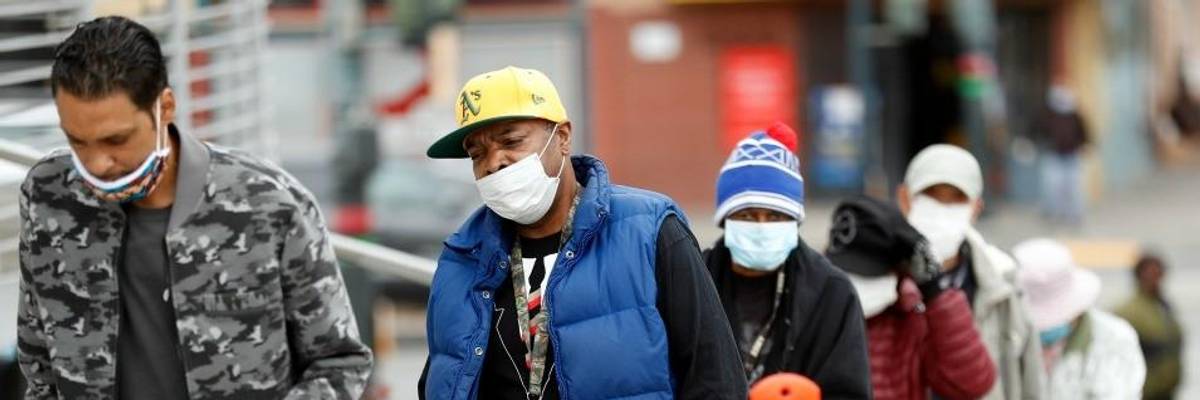
People wait in line as SF-Marin Food Bank hands out 1,600 food bags at a pop-up pantry at Bayview Opera House in San Francisco, Calif., on Monday, April 20, 2020. Work furloughs and layoffs created by coronavirus shelter-in-place orders are driving thousands to seek food assistance. (Scott Strazzante/The San Francisco Chronicle via Getty Images)
Three months into the coronavirus pandemic, which has now killed more than 116,000 Americans, people across the United States are reporting lower levels of happiness than at any point since the 1970s--nearly 50 years ago.
According to the Covid Response Tracking Survey, conducted late last month by NORC at the University of Chicago, just 14% of Americans report that they are "very happy."
The researchers compared their findings to those of the General Social Survey, taken every other year since 1972, and found that at least 29% of respondents to that poll have always reported feeling "very happy" with their lives.
Just two years ago, when the last General Social Survey was taken, 31% of Americans said they were "very happy."
As many Americans avoid large gatherings, cancel planned vacations, suffer job loss, and stay at home as much as possible even while state economies are reopening, 50% of respondents told the Covid Response Tracking Survey that they feel isolated, up from 23% in 2018.
The survey was taken between May 21 and May 29, with 2,279 Americans polled. While the research was being conducted, a nationwide uprising over police brutality and racial injustice exploded after George Floyd became the latest black American killed by police officers during an arrest.
The protests gave way to new incidents of police officers using excessive force, with Washington, D.C. officers tear-gassing protesters, reportedly at the direction of the White House; NYPD officers driving an SUV into a crowd of demonstrators, and hundreds of other cases.
The survey was also taken as the country faced its worst unemployment crisis since the Great Depression. More than 33 million Americans were out of work in early May. Long lines at food banks across the country and reports of a third of Americans being unable to pay their rent or mortgage payments in May have illustrated the precarious financial circumstances in which many lived before the pandemic.
Meanwhile, the government has been reticent to offer more financial assistance to Americans than a one time $1,200 direct payment and an extra $600 per week on top of regular unemployment benefits, which are set to expire in July. Democratic and Republican leaders alike have scoffed at more robust proposals that would allow workers to socially distance for the duration of the pandemic without losing their incomes--similar to measures which were adopted by other wealthy countries at the beginning of the pandemic.
"It's been one thing after another," Lexi Walker, a respondent who experienced several personal losses just before the pandemic, reported to the survey. "This is very hard. The worst thing about this for me, after so much, I don't know what's going to happen."
The survey also found that Americans currently feel little optimism about the future. Only 42% believe their children will have a better quality of life, compared with 57% who said so in 2018.
Dear Common Dreams reader, It’s been nearly 30 years since I co-founded Common Dreams with my late wife, Lina Newhouser. We had the radical notion that journalism should serve the public good, not corporate profits. It was clear to us from the outset what it would take to build such a project. No paid advertisements. No corporate sponsors. No millionaire publisher telling us what to think or do. Many people said we wouldn't last a year, but we proved those doubters wrong. Together with a tremendous team of journalists and dedicated staff, we built an independent media outlet free from the constraints of profits and corporate control. Our mission has always been simple: To inform. To inspire. To ignite change for the common good. Building Common Dreams was not easy. Our survival was never guaranteed. When you take on the most powerful forces—Wall Street greed, fossil fuel industry destruction, Big Tech lobbyists, and uber-rich oligarchs who have spent billions upon billions rigging the economy and democracy in their favor—the only bulwark you have is supporters who believe in your work. But here’s the urgent message from me today. It's never been this bad out there. And it's never been this hard to keep us going. At the very moment Common Dreams is most needed, the threats we face are intensifying. We need your support now more than ever. We don't accept corporate advertising and never will. We don't have a paywall because we don't think people should be blocked from critical news based on their ability to pay. Everything we do is funded by the donations of readers like you. When everyone does the little they can afford, we are strong. But if that support retreats or dries up, so do we. Will you donate now to make sure Common Dreams not only survives but thrives? —Craig Brown, Co-founder |
Three months into the coronavirus pandemic, which has now killed more than 116,000 Americans, people across the United States are reporting lower levels of happiness than at any point since the 1970s--nearly 50 years ago.
According to the Covid Response Tracking Survey, conducted late last month by NORC at the University of Chicago, just 14% of Americans report that they are "very happy."
The researchers compared their findings to those of the General Social Survey, taken every other year since 1972, and found that at least 29% of respondents to that poll have always reported feeling "very happy" with their lives.
Just two years ago, when the last General Social Survey was taken, 31% of Americans said they were "very happy."
As many Americans avoid large gatherings, cancel planned vacations, suffer job loss, and stay at home as much as possible even while state economies are reopening, 50% of respondents told the Covid Response Tracking Survey that they feel isolated, up from 23% in 2018.
The survey was taken between May 21 and May 29, with 2,279 Americans polled. While the research was being conducted, a nationwide uprising over police brutality and racial injustice exploded after George Floyd became the latest black American killed by police officers during an arrest.
The protests gave way to new incidents of police officers using excessive force, with Washington, D.C. officers tear-gassing protesters, reportedly at the direction of the White House; NYPD officers driving an SUV into a crowd of demonstrators, and hundreds of other cases.
The survey was also taken as the country faced its worst unemployment crisis since the Great Depression. More than 33 million Americans were out of work in early May. Long lines at food banks across the country and reports of a third of Americans being unable to pay their rent or mortgage payments in May have illustrated the precarious financial circumstances in which many lived before the pandemic.
Meanwhile, the government has been reticent to offer more financial assistance to Americans than a one time $1,200 direct payment and an extra $600 per week on top of regular unemployment benefits, which are set to expire in July. Democratic and Republican leaders alike have scoffed at more robust proposals that would allow workers to socially distance for the duration of the pandemic without losing their incomes--similar to measures which were adopted by other wealthy countries at the beginning of the pandemic.
"It's been one thing after another," Lexi Walker, a respondent who experienced several personal losses just before the pandemic, reported to the survey. "This is very hard. The worst thing about this for me, after so much, I don't know what's going to happen."
The survey also found that Americans currently feel little optimism about the future. Only 42% believe their children will have a better quality of life, compared with 57% who said so in 2018.
Three months into the coronavirus pandemic, which has now killed more than 116,000 Americans, people across the United States are reporting lower levels of happiness than at any point since the 1970s--nearly 50 years ago.
According to the Covid Response Tracking Survey, conducted late last month by NORC at the University of Chicago, just 14% of Americans report that they are "very happy."
The researchers compared their findings to those of the General Social Survey, taken every other year since 1972, and found that at least 29% of respondents to that poll have always reported feeling "very happy" with their lives.
Just two years ago, when the last General Social Survey was taken, 31% of Americans said they were "very happy."
As many Americans avoid large gatherings, cancel planned vacations, suffer job loss, and stay at home as much as possible even while state economies are reopening, 50% of respondents told the Covid Response Tracking Survey that they feel isolated, up from 23% in 2018.
The survey was taken between May 21 and May 29, with 2,279 Americans polled. While the research was being conducted, a nationwide uprising over police brutality and racial injustice exploded after George Floyd became the latest black American killed by police officers during an arrest.
The protests gave way to new incidents of police officers using excessive force, with Washington, D.C. officers tear-gassing protesters, reportedly at the direction of the White House; NYPD officers driving an SUV into a crowd of demonstrators, and hundreds of other cases.
The survey was also taken as the country faced its worst unemployment crisis since the Great Depression. More than 33 million Americans were out of work in early May. Long lines at food banks across the country and reports of a third of Americans being unable to pay their rent or mortgage payments in May have illustrated the precarious financial circumstances in which many lived before the pandemic.
Meanwhile, the government has been reticent to offer more financial assistance to Americans than a one time $1,200 direct payment and an extra $600 per week on top of regular unemployment benefits, which are set to expire in July. Democratic and Republican leaders alike have scoffed at more robust proposals that would allow workers to socially distance for the duration of the pandemic without losing their incomes--similar to measures which were adopted by other wealthy countries at the beginning of the pandemic.
"It's been one thing after another," Lexi Walker, a respondent who experienced several personal losses just before the pandemic, reported to the survey. "This is very hard. The worst thing about this for me, after so much, I don't know what's going to happen."
The survey also found that Americans currently feel little optimism about the future. Only 42% believe their children will have a better quality of life, compared with 57% who said so in 2018.