SUBSCRIBE TO OUR FREE NEWSLETTER
Daily news & progressive opinion—funded by the people, not the corporations—delivered straight to your inbox.
5
#000000
#FFFFFF
To donate by check, phone, or other method, see our More Ways to Give page.
Daily news & progressive opinion—funded by the people, not the corporations—delivered straight to your inbox.
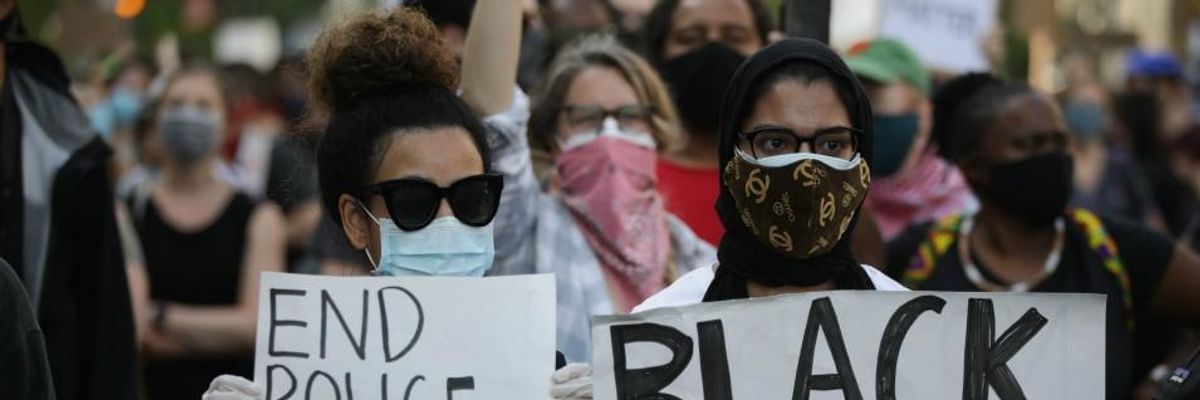
People hold banners during a protest over the death killing of George Floyd on June 2, 2020 in Washington, D.C. (Photo: Yasin Ozturk/Anadolu Agency via Getty Images)
Cities across the U.S. are cutting and reallocating funds from police budgets as calls from an ongoing nationwide uprising over police violence for reimagining the country's approach to law enforcement continue.
"Instead of protecting us, we're terrified of the military-like forces that patrol and harass our neighborhoods. Yet we keep supporting a system that is clearly broken."
--Mercedes Fulbright, Texas Working Families Party
"I hope that we don't miss this moment," Austin Mayor pro tem Delia Garza said after a meeting Thursday on reforming the city's police department's use of force and where the city council directed the city manager to cut the department's budget. "Our community is at a boiling point."
Austin is not alone in Texas--a few hundred miles away, the Dallas city government is also looking at cutting its police department's budget as approval for an increase has stalled amid calls to defund.
Mercedes Fulbright, an organizing director for Texas Working Families Party, said in a statement that she and other members of the Dallas Movement for Black Lives coalition were happy the council heard their demands that the city not, at minimum, increase funding for the department.
"Policing doesn't work," said Fulbright. "It never worked in the interest of our marginalized communities. Instead of protecting us, we're terrified of the military-like forces that patrol and harass our neighborhoods."
"Yet we keep supporting a system that is clearly broken," she said.
Fordham law professor John Pfaff pointed to the insufficient results from spending huge amounts on policing in city after city, noting that investing funds in drug treatment and healthcare rather than law enforcement have more positive effects than policing--raising the question of why cities around the country continue to pour money into departments.
"You don't have to go full abolition to see that maybe sinking 1/3 of a city's general budget into police is a problematic investment," tweeted Pfaff.
City governments appear to be listening. Dallas and Austin are part of a growing number of municipalities around the country taking such action after demands from the protest movement sparked by the killing of George Floyd by four Minneapolis police officers last month.
The size of New York City police budgets, Rep. Alexandria Ocasio-Cortez (D-N.Y.) told Good Morning America's George Stephanopoulos on Wednesday, dwarfs social services spending in her city.
"The New York City Police department has a $6 billion dollar a year budget," said Ocasio-Cortez. "That is more than we spend on youth, housing, healthcare, and homelessness combined."
Boston Mayor Walsh announced Friday he will seek to transfer 20% of the city's police overtime budget to social services while nearby Hartford, Connecticut will slash $1 million from its department.
Activist Jonathan Cohn was skeptical of Walsh's move.
Hartford will redistribute the money to city departments for health and other public services, Mayor Luke Bronin told the Hartford Courant Thursday, and look to take police out of responding to situations where their presence can escalate things such as calls for mental health and drug abuse.
"Building a system for responding to those needs in real time, with trained, effective professionals outside of law enforcement won't happen overnight, but it's a goal that I embrace," said Cronin. "That's one part of the systemic change that I hope we can work on together, with non-profit partners and with the state, in the months ahead."
The $1 million was less than the $9.6 million in cuts asked for by Working Families Party council members Wildaliz Bermudez and Joshua Michtom.
In Portland, Oregon and San Francisco, city governments are sending officials back to the drawing board, charging that cuts of $15 million and $23 million respectively are insufficient.
Portland commissioner Chloe Eudaly's "no" vote helped send the budget back for further consideration.
According to Oregon Live:
Eudaly said the vote reminded her of regrets over voting yes to the city budget in 2018, which called for increased police funding. She said while she agreed with the changes to police spending her fellow commissioners made Thursday, she didn't believe they went far enough and that members of the public "deserve better."
"I can't swallow another bitter budget pill in good conscience," Eudaly said. "I vote no."
San Francisco Public Defender Mano Raju celebrated his city's decision to ask for more cuts.
"The public call for transformative change is urgent," said Raju. "The rejection of what amounts to an invisible budget cut is the very least we must do to answer this call."
"A much smaller, much altered police department and policing model is what San Franciscans are calling for," Raju added, "and the current moment demands nothing less."
While many activists around the country like Raju find the level of cuts suggested thus far in the cities to be insufficient, the move to reallocate funding from departments at represents a shift in the way Americans are thinking about policing in the midst of the ongoing protest movement.
Despite the fact that two-thirds of Americans still oppose "defunding the police," public support for the idea has spiked considerably in a number of recent polls. Part of that may be how the question is asked--HuffPost polling found a plurality, 44%, backing budgeting less money for the police and more for social services while only 27% supported defunding.
The fight needs to be about more than just police departments, Eric Levitz wrote at New York magazine Friday:
The activists and community organizers who've rallied behind "defund the police" are engaged in discrete struggles over fiscal priorities across a wide range of cities. As such, their focus on contesting police departments' outsize share of municipal budgets is appropriate. But the fight must not end there. We cannot provide disadvantaged communities with the social resources they deserve--nor, in all likelihood, the social resources necessary for guaranteeing their safety in the absence of conventional policing--merely by reallocating existing public funds. Rather, doing so will require massively increasing overall public spending on these communities.
Seattle-based activist Nikkita Oliver told Vanity Fair Thursday that she hoped the movement would keep pushing city leaders around the country to do the right thing.
"Those structures were not made to be transformed from the inside out," said Oliver. "They have to be transformed by the pressure that we're creating."
Dear Common Dreams reader, It’s been nearly 30 years since I co-founded Common Dreams with my late wife, Lina Newhouser. We had the radical notion that journalism should serve the public good, not corporate profits. It was clear to us from the outset what it would take to build such a project. No paid advertisements. No corporate sponsors. No millionaire publisher telling us what to think or do. Many people said we wouldn't last a year, but we proved those doubters wrong. Together with a tremendous team of journalists and dedicated staff, we built an independent media outlet free from the constraints of profits and corporate control. Our mission has always been simple: To inform. To inspire. To ignite change for the common good. Building Common Dreams was not easy. Our survival was never guaranteed. When you take on the most powerful forces—Wall Street greed, fossil fuel industry destruction, Big Tech lobbyists, and uber-rich oligarchs who have spent billions upon billions rigging the economy and democracy in their favor—the only bulwark you have is supporters who believe in your work. But here’s the urgent message from me today. It's never been this bad out there. And it's never been this hard to keep us going. At the very moment Common Dreams is most needed, the threats we face are intensifying. We need your support now more than ever. We don't accept corporate advertising and never will. We don't have a paywall because we don't think people should be blocked from critical news based on their ability to pay. Everything we do is funded by the donations of readers like you. When everyone does the little they can afford, we are strong. But if that support retreats or dries up, so do we. Will you donate now to make sure Common Dreams not only survives but thrives? —Craig Brown, Co-founder |
Cities across the U.S. are cutting and reallocating funds from police budgets as calls from an ongoing nationwide uprising over police violence for reimagining the country's approach to law enforcement continue.
"Instead of protecting us, we're terrified of the military-like forces that patrol and harass our neighborhoods. Yet we keep supporting a system that is clearly broken."
--Mercedes Fulbright, Texas Working Families Party
"I hope that we don't miss this moment," Austin Mayor pro tem Delia Garza said after a meeting Thursday on reforming the city's police department's use of force and where the city council directed the city manager to cut the department's budget. "Our community is at a boiling point."
Austin is not alone in Texas--a few hundred miles away, the Dallas city government is also looking at cutting its police department's budget as approval for an increase has stalled amid calls to defund.
Mercedes Fulbright, an organizing director for Texas Working Families Party, said in a statement that she and other members of the Dallas Movement for Black Lives coalition were happy the council heard their demands that the city not, at minimum, increase funding for the department.
"Policing doesn't work," said Fulbright. "It never worked in the interest of our marginalized communities. Instead of protecting us, we're terrified of the military-like forces that patrol and harass our neighborhoods."
"Yet we keep supporting a system that is clearly broken," she said.
Fordham law professor John Pfaff pointed to the insufficient results from spending huge amounts on policing in city after city, noting that investing funds in drug treatment and healthcare rather than law enforcement have more positive effects than policing--raising the question of why cities around the country continue to pour money into departments.
"You don't have to go full abolition to see that maybe sinking 1/3 of a city's general budget into police is a problematic investment," tweeted Pfaff.
City governments appear to be listening. Dallas and Austin are part of a growing number of municipalities around the country taking such action after demands from the protest movement sparked by the killing of George Floyd by four Minneapolis police officers last month.
The size of New York City police budgets, Rep. Alexandria Ocasio-Cortez (D-N.Y.) told Good Morning America's George Stephanopoulos on Wednesday, dwarfs social services spending in her city.
"The New York City Police department has a $6 billion dollar a year budget," said Ocasio-Cortez. "That is more than we spend on youth, housing, healthcare, and homelessness combined."
Boston Mayor Walsh announced Friday he will seek to transfer 20% of the city's police overtime budget to social services while nearby Hartford, Connecticut will slash $1 million from its department.
Activist Jonathan Cohn was skeptical of Walsh's move.
Hartford will redistribute the money to city departments for health and other public services, Mayor Luke Bronin told the Hartford Courant Thursday, and look to take police out of responding to situations where their presence can escalate things such as calls for mental health and drug abuse.
"Building a system for responding to those needs in real time, with trained, effective professionals outside of law enforcement won't happen overnight, but it's a goal that I embrace," said Cronin. "That's one part of the systemic change that I hope we can work on together, with non-profit partners and with the state, in the months ahead."
The $1 million was less than the $9.6 million in cuts asked for by Working Families Party council members Wildaliz Bermudez and Joshua Michtom.
In Portland, Oregon and San Francisco, city governments are sending officials back to the drawing board, charging that cuts of $15 million and $23 million respectively are insufficient.
Portland commissioner Chloe Eudaly's "no" vote helped send the budget back for further consideration.
According to Oregon Live:
Eudaly said the vote reminded her of regrets over voting yes to the city budget in 2018, which called for increased police funding. She said while she agreed with the changes to police spending her fellow commissioners made Thursday, she didn't believe they went far enough and that members of the public "deserve better."
"I can't swallow another bitter budget pill in good conscience," Eudaly said. "I vote no."
San Francisco Public Defender Mano Raju celebrated his city's decision to ask for more cuts.
"The public call for transformative change is urgent," said Raju. "The rejection of what amounts to an invisible budget cut is the very least we must do to answer this call."
"A much smaller, much altered police department and policing model is what San Franciscans are calling for," Raju added, "and the current moment demands nothing less."
While many activists around the country like Raju find the level of cuts suggested thus far in the cities to be insufficient, the move to reallocate funding from departments at represents a shift in the way Americans are thinking about policing in the midst of the ongoing protest movement.
Despite the fact that two-thirds of Americans still oppose "defunding the police," public support for the idea has spiked considerably in a number of recent polls. Part of that may be how the question is asked--HuffPost polling found a plurality, 44%, backing budgeting less money for the police and more for social services while only 27% supported defunding.
The fight needs to be about more than just police departments, Eric Levitz wrote at New York magazine Friday:
The activists and community organizers who've rallied behind "defund the police" are engaged in discrete struggles over fiscal priorities across a wide range of cities. As such, their focus on contesting police departments' outsize share of municipal budgets is appropriate. But the fight must not end there. We cannot provide disadvantaged communities with the social resources they deserve--nor, in all likelihood, the social resources necessary for guaranteeing their safety in the absence of conventional policing--merely by reallocating existing public funds. Rather, doing so will require massively increasing overall public spending on these communities.
Seattle-based activist Nikkita Oliver told Vanity Fair Thursday that she hoped the movement would keep pushing city leaders around the country to do the right thing.
"Those structures were not made to be transformed from the inside out," said Oliver. "They have to be transformed by the pressure that we're creating."
Cities across the U.S. are cutting and reallocating funds from police budgets as calls from an ongoing nationwide uprising over police violence for reimagining the country's approach to law enforcement continue.
"Instead of protecting us, we're terrified of the military-like forces that patrol and harass our neighborhoods. Yet we keep supporting a system that is clearly broken."
--Mercedes Fulbright, Texas Working Families Party
"I hope that we don't miss this moment," Austin Mayor pro tem Delia Garza said after a meeting Thursday on reforming the city's police department's use of force and where the city council directed the city manager to cut the department's budget. "Our community is at a boiling point."
Austin is not alone in Texas--a few hundred miles away, the Dallas city government is also looking at cutting its police department's budget as approval for an increase has stalled amid calls to defund.
Mercedes Fulbright, an organizing director for Texas Working Families Party, said in a statement that she and other members of the Dallas Movement for Black Lives coalition were happy the council heard their demands that the city not, at minimum, increase funding for the department.
"Policing doesn't work," said Fulbright. "It never worked in the interest of our marginalized communities. Instead of protecting us, we're terrified of the military-like forces that patrol and harass our neighborhoods."
"Yet we keep supporting a system that is clearly broken," she said.
Fordham law professor John Pfaff pointed to the insufficient results from spending huge amounts on policing in city after city, noting that investing funds in drug treatment and healthcare rather than law enforcement have more positive effects than policing--raising the question of why cities around the country continue to pour money into departments.
"You don't have to go full abolition to see that maybe sinking 1/3 of a city's general budget into police is a problematic investment," tweeted Pfaff.
City governments appear to be listening. Dallas and Austin are part of a growing number of municipalities around the country taking such action after demands from the protest movement sparked by the killing of George Floyd by four Minneapolis police officers last month.
The size of New York City police budgets, Rep. Alexandria Ocasio-Cortez (D-N.Y.) told Good Morning America's George Stephanopoulos on Wednesday, dwarfs social services spending in her city.
"The New York City Police department has a $6 billion dollar a year budget," said Ocasio-Cortez. "That is more than we spend on youth, housing, healthcare, and homelessness combined."
Boston Mayor Walsh announced Friday he will seek to transfer 20% of the city's police overtime budget to social services while nearby Hartford, Connecticut will slash $1 million from its department.
Activist Jonathan Cohn was skeptical of Walsh's move.
Hartford will redistribute the money to city departments for health and other public services, Mayor Luke Bronin told the Hartford Courant Thursday, and look to take police out of responding to situations where their presence can escalate things such as calls for mental health and drug abuse.
"Building a system for responding to those needs in real time, with trained, effective professionals outside of law enforcement won't happen overnight, but it's a goal that I embrace," said Cronin. "That's one part of the systemic change that I hope we can work on together, with non-profit partners and with the state, in the months ahead."
The $1 million was less than the $9.6 million in cuts asked for by Working Families Party council members Wildaliz Bermudez and Joshua Michtom.
In Portland, Oregon and San Francisco, city governments are sending officials back to the drawing board, charging that cuts of $15 million and $23 million respectively are insufficient.
Portland commissioner Chloe Eudaly's "no" vote helped send the budget back for further consideration.
According to Oregon Live:
Eudaly said the vote reminded her of regrets over voting yes to the city budget in 2018, which called for increased police funding. She said while she agreed with the changes to police spending her fellow commissioners made Thursday, she didn't believe they went far enough and that members of the public "deserve better."
"I can't swallow another bitter budget pill in good conscience," Eudaly said. "I vote no."
San Francisco Public Defender Mano Raju celebrated his city's decision to ask for more cuts.
"The public call for transformative change is urgent," said Raju. "The rejection of what amounts to an invisible budget cut is the very least we must do to answer this call."
"A much smaller, much altered police department and policing model is what San Franciscans are calling for," Raju added, "and the current moment demands nothing less."
While many activists around the country like Raju find the level of cuts suggested thus far in the cities to be insufficient, the move to reallocate funding from departments at represents a shift in the way Americans are thinking about policing in the midst of the ongoing protest movement.
Despite the fact that two-thirds of Americans still oppose "defunding the police," public support for the idea has spiked considerably in a number of recent polls. Part of that may be how the question is asked--HuffPost polling found a plurality, 44%, backing budgeting less money for the police and more for social services while only 27% supported defunding.
The fight needs to be about more than just police departments, Eric Levitz wrote at New York magazine Friday:
The activists and community organizers who've rallied behind "defund the police" are engaged in discrete struggles over fiscal priorities across a wide range of cities. As such, their focus on contesting police departments' outsize share of municipal budgets is appropriate. But the fight must not end there. We cannot provide disadvantaged communities with the social resources they deserve--nor, in all likelihood, the social resources necessary for guaranteeing their safety in the absence of conventional policing--merely by reallocating existing public funds. Rather, doing so will require massively increasing overall public spending on these communities.
Seattle-based activist Nikkita Oliver told Vanity Fair Thursday that she hoped the movement would keep pushing city leaders around the country to do the right thing.
"Those structures were not made to be transformed from the inside out," said Oliver. "They have to be transformed by the pressure that we're creating."