SUBSCRIBE TO OUR FREE NEWSLETTER
Daily news & progressive opinion—funded by the people, not the corporations—delivered straight to your inbox.
5
#000000
#FFFFFF
To donate by check, phone, or other method, see our More Ways to Give page.
Daily news & progressive opinion—funded by the people, not the corporations—delivered straight to your inbox.
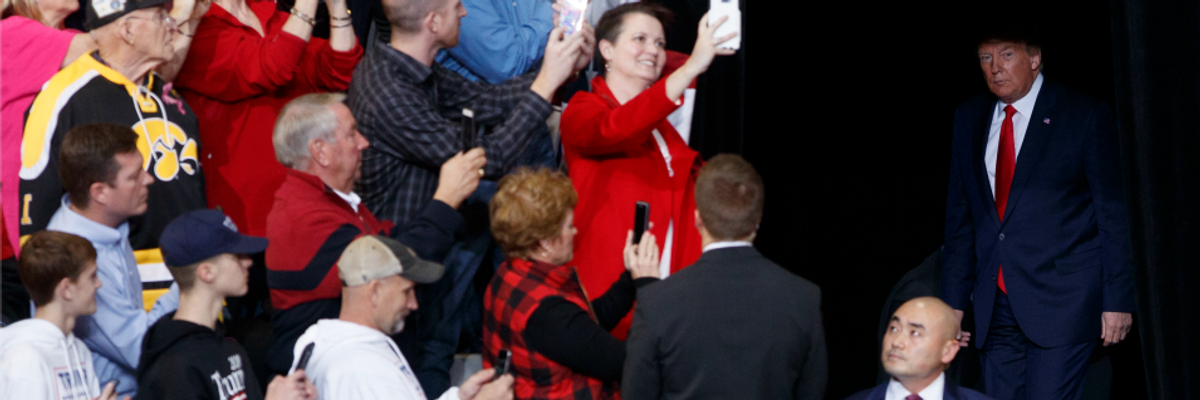
President Donald Trump walks to the podium before speaking at a campaign rally inside of the Knapp Center arena at Drake University on January 30, 2020 in Des Moines, Iowa. (Photo: Tom Brenner/Getty Images)
To register for a spot at President Donald Trump's first campaign rally since the Covid-19 pandemic shuttered much of the United States in March, prospective attendees must first agree not to sue either the Trump campaign or the venue if they contract coronavirus during the event--a requirement critics say is an attempt by the president's team to evade responsibility for moving ahead with a hazardous indoor gathering.
"By clicking register below, you are acknowledging that an inherent risk of exposure to Covid-19 exists in any public place where people are present," reads a paragraph at the bottom of the registration form for Trump's planned rally in Tulsa, Oklahoma on Juneteenth. "By attending the Rally, you and any guests voluntarily assume all risks related to exposure to Covid-19 and agree not to hold Donald J. Trump for President, Inc.; BOK Center; ASM Global; or any of their affiliates, directors, officers, employees, agents, contractors, or volunteers liable for any illness or injury."
"The Trump campaign may have shied away from such a move if it could be held accountable for the resulting illness and potential deaths that are likely to follow."
--Robert Weissman, Public Citizen
Oklahoma, which began reopening its economy last month, has recorded more than 7,600 coronavirus cases and at least 357 deaths. The president's Tulsa rally is slated to take place inside the BOK Center, which boasts a seat capacity of nearly 19,200.
As the Associated Press reported, "arena marketing director Meghan Blood said Thursday that she didn't know yet about any plans for social distancing or other coronavirus precautions for Trump's rally, which would be one of the larger public gatherings in the U.S. at this stage of the outbreak."
The Trump campaign said the president will also soon hold rallies in Florida, North Carolina, and Arizona--three states that are currently seeing a surge in new Covid-19 infections.
Catherine Sharkey, a professor at New York University School of Law, told CNN Thursday that liability waivers are likely to become commonplace in the U.S. as states continue the process reopening their economies.
"They only give limited protections, so they never would protect against, for example, gross negligence or recklessness," said Sharkey. "One could argue that holding a large public gathering that will draw people together in a context in which they're not able to do social distancing or follow the directive of the CDC, et cetera. One could argue that is grossly negligent."
Robert Weissman, president of consumer advocacy group Public Citizen, warned in a statement late Thursday that indoor campaign rallies "are extremely likely to spread the coronavirus, particularly if Trump discourages attendees from wearing masks either explicitly or by example."
"The Trump campaign may have shied away from such a move if it could be held accountable for the resulting illness and potential deaths that are likely to follow," said Weissman. "Instead, it aims to escape liability and any measure of accountability by forcing attendees to waive their rights through contract terms that they are unlikely even to notice."
"Immunity from lawsuits encourages irresponsible and reckless behavior, and undermines public health, as the Trump campaign is now shamefully making clear," Weissman added. "Congress must learn from the bad Trump campaign example and protect the rights of workers, patients, and consumers. That means no immunity for businesses and entities that engage in unreasonable conduct that endangers people by exposing them to the coronavirus."
Political scientist Miranda Yaver tweeted that the president knows "his campaign rallies have significant potential to be super-spreader events, especially as many states see increases in coronavirus cases and hospitalizations."
"He doesn't care, so long as he's not liable," Yaver wrote. "Classic Trump."
Dear Common Dreams reader, It’s been nearly 30 years since I co-founded Common Dreams with my late wife, Lina Newhouser. We had the radical notion that journalism should serve the public good, not corporate profits. It was clear to us from the outset what it would take to build such a project. No paid advertisements. No corporate sponsors. No millionaire publisher telling us what to think or do. Many people said we wouldn't last a year, but we proved those doubters wrong. Together with a tremendous team of journalists and dedicated staff, we built an independent media outlet free from the constraints of profits and corporate control. Our mission has always been simple: To inform. To inspire. To ignite change for the common good. Building Common Dreams was not easy. Our survival was never guaranteed. When you take on the most powerful forces—Wall Street greed, fossil fuel industry destruction, Big Tech lobbyists, and uber-rich oligarchs who have spent billions upon billions rigging the economy and democracy in their favor—the only bulwark you have is supporters who believe in your work. But here’s the urgent message from me today. It's never been this bad out there. And it's never been this hard to keep us going. At the very moment Common Dreams is most needed, the threats we face are intensifying. We need your support now more than ever. We don't accept corporate advertising and never will. We don't have a paywall because we don't think people should be blocked from critical news based on their ability to pay. Everything we do is funded by the donations of readers like you. When everyone does the little they can afford, we are strong. But if that support retreats or dries up, so do we. Will you donate now to make sure Common Dreams not only survives but thrives? —Craig Brown, Co-founder |
To register for a spot at President Donald Trump's first campaign rally since the Covid-19 pandemic shuttered much of the United States in March, prospective attendees must first agree not to sue either the Trump campaign or the venue if they contract coronavirus during the event--a requirement critics say is an attempt by the president's team to evade responsibility for moving ahead with a hazardous indoor gathering.
"By clicking register below, you are acknowledging that an inherent risk of exposure to Covid-19 exists in any public place where people are present," reads a paragraph at the bottom of the registration form for Trump's planned rally in Tulsa, Oklahoma on Juneteenth. "By attending the Rally, you and any guests voluntarily assume all risks related to exposure to Covid-19 and agree not to hold Donald J. Trump for President, Inc.; BOK Center; ASM Global; or any of their affiliates, directors, officers, employees, agents, contractors, or volunteers liable for any illness or injury."
"The Trump campaign may have shied away from such a move if it could be held accountable for the resulting illness and potential deaths that are likely to follow."
--Robert Weissman, Public Citizen
Oklahoma, which began reopening its economy last month, has recorded more than 7,600 coronavirus cases and at least 357 deaths. The president's Tulsa rally is slated to take place inside the BOK Center, which boasts a seat capacity of nearly 19,200.
As the Associated Press reported, "arena marketing director Meghan Blood said Thursday that she didn't know yet about any plans for social distancing or other coronavirus precautions for Trump's rally, which would be one of the larger public gatherings in the U.S. at this stage of the outbreak."
The Trump campaign said the president will also soon hold rallies in Florida, North Carolina, and Arizona--three states that are currently seeing a surge in new Covid-19 infections.
Catherine Sharkey, a professor at New York University School of Law, told CNN Thursday that liability waivers are likely to become commonplace in the U.S. as states continue the process reopening their economies.
"They only give limited protections, so they never would protect against, for example, gross negligence or recklessness," said Sharkey. "One could argue that holding a large public gathering that will draw people together in a context in which they're not able to do social distancing or follow the directive of the CDC, et cetera. One could argue that is grossly negligent."
Robert Weissman, president of consumer advocacy group Public Citizen, warned in a statement late Thursday that indoor campaign rallies "are extremely likely to spread the coronavirus, particularly if Trump discourages attendees from wearing masks either explicitly or by example."
"The Trump campaign may have shied away from such a move if it could be held accountable for the resulting illness and potential deaths that are likely to follow," said Weissman. "Instead, it aims to escape liability and any measure of accountability by forcing attendees to waive their rights through contract terms that they are unlikely even to notice."
"Immunity from lawsuits encourages irresponsible and reckless behavior, and undermines public health, as the Trump campaign is now shamefully making clear," Weissman added. "Congress must learn from the bad Trump campaign example and protect the rights of workers, patients, and consumers. That means no immunity for businesses and entities that engage in unreasonable conduct that endangers people by exposing them to the coronavirus."
Political scientist Miranda Yaver tweeted that the president knows "his campaign rallies have significant potential to be super-spreader events, especially as many states see increases in coronavirus cases and hospitalizations."
"He doesn't care, so long as he's not liable," Yaver wrote. "Classic Trump."
To register for a spot at President Donald Trump's first campaign rally since the Covid-19 pandemic shuttered much of the United States in March, prospective attendees must first agree not to sue either the Trump campaign or the venue if they contract coronavirus during the event--a requirement critics say is an attempt by the president's team to evade responsibility for moving ahead with a hazardous indoor gathering.
"By clicking register below, you are acknowledging that an inherent risk of exposure to Covid-19 exists in any public place where people are present," reads a paragraph at the bottom of the registration form for Trump's planned rally in Tulsa, Oklahoma on Juneteenth. "By attending the Rally, you and any guests voluntarily assume all risks related to exposure to Covid-19 and agree not to hold Donald J. Trump for President, Inc.; BOK Center; ASM Global; or any of their affiliates, directors, officers, employees, agents, contractors, or volunteers liable for any illness or injury."
"The Trump campaign may have shied away from such a move if it could be held accountable for the resulting illness and potential deaths that are likely to follow."
--Robert Weissman, Public Citizen
Oklahoma, which began reopening its economy last month, has recorded more than 7,600 coronavirus cases and at least 357 deaths. The president's Tulsa rally is slated to take place inside the BOK Center, which boasts a seat capacity of nearly 19,200.
As the Associated Press reported, "arena marketing director Meghan Blood said Thursday that she didn't know yet about any plans for social distancing or other coronavirus precautions for Trump's rally, which would be one of the larger public gatherings in the U.S. at this stage of the outbreak."
The Trump campaign said the president will also soon hold rallies in Florida, North Carolina, and Arizona--three states that are currently seeing a surge in new Covid-19 infections.
Catherine Sharkey, a professor at New York University School of Law, told CNN Thursday that liability waivers are likely to become commonplace in the U.S. as states continue the process reopening their economies.
"They only give limited protections, so they never would protect against, for example, gross negligence or recklessness," said Sharkey. "One could argue that holding a large public gathering that will draw people together in a context in which they're not able to do social distancing or follow the directive of the CDC, et cetera. One could argue that is grossly negligent."
Robert Weissman, president of consumer advocacy group Public Citizen, warned in a statement late Thursday that indoor campaign rallies "are extremely likely to spread the coronavirus, particularly if Trump discourages attendees from wearing masks either explicitly or by example."
"The Trump campaign may have shied away from such a move if it could be held accountable for the resulting illness and potential deaths that are likely to follow," said Weissman. "Instead, it aims to escape liability and any measure of accountability by forcing attendees to waive their rights through contract terms that they are unlikely even to notice."
"Immunity from lawsuits encourages irresponsible and reckless behavior, and undermines public health, as the Trump campaign is now shamefully making clear," Weissman added. "Congress must learn from the bad Trump campaign example and protect the rights of workers, patients, and consumers. That means no immunity for businesses and entities that engage in unreasonable conduct that endangers people by exposing them to the coronavirus."
Political scientist Miranda Yaver tweeted that the president knows "his campaign rallies have significant potential to be super-spreader events, especially as many states see increases in coronavirus cases and hospitalizations."
"He doesn't care, so long as he's not liable," Yaver wrote. "Classic Trump."