SUBSCRIBE TO OUR FREE NEWSLETTER
Daily news & progressive opinion—funded by the people, not the corporations—delivered straight to your inbox.
5
#000000
#FFFFFF
To donate by check, phone, or other method, see our More Ways to Give page.
Daily news & progressive opinion—funded by the people, not the corporations—delivered straight to your inbox.
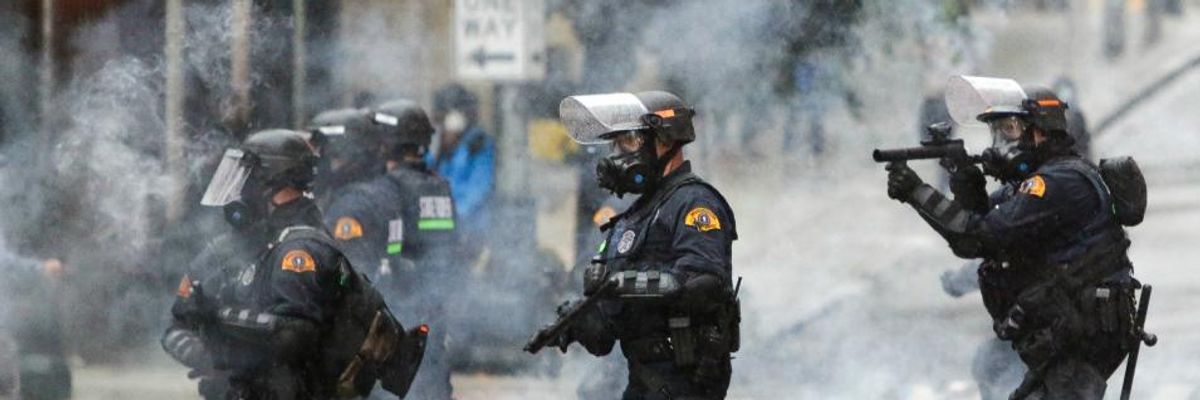
Police use tear gas during protests against the killing of George Floyd in Seattle, Washington on May 30, 2020. (Photo: Jason Redmond/AFP via Getty Images)
President Donald Trump on Monday applauded U.S. police officers as "great, great people" who "have been letting us live in peace," praise that is starkly odds with the direct experience of protesters and journalists on the ground who in recent days have witnessed--and, in many cases, captured on video--cops beating and tear-gassing peaceful demonstrators in the streets demanding justice for the killing of George Floyd.
"They've done a fantastic job," Trump, who has repeatedly encouraged police to use excessive force, said during a roundtable with law enforcement officials at the White House. "There won't be defunding. There won't be dismantling of our police. And there's not going to be any disbanding of our police. Our police have been letting us live in peace."
Trump's description of police officers as peacekeepers comes as activists are in the process of compiling an online spreadsheet of videos and images documenting law enforcement brutality against demonstrators across the nation, violence that has galvanized efforts to fundamentally change policing in the U.S.--including by disbanding entire police departments.
Attorney T. Greg Doucette and mathematician Jason Miller teamed up to create the Google spreadsheet--which, as of this writing, has nearly 600 entries--after efforts to compile the footage of police violence on Twitter proved difficult, given the sheer volume of videos that have circulated across social media during the nationwide uprising over Floyd's killing.
The Freedom of the Press Foundation has also documented nearly 300 incidents of police violence against members of the press covering the demonstrations.
"This kind of documentation serves as a counter-narrative to repeated denials of responsibility from the police, who are routinely claiming protesters were the ones to grow violent first, or that a man who they pushed to the ground, cracking his head open, simply tripped," wrote VICE's Katie Way. "It also combats media coverage that downplays police violence or even goes to the lengths of using passive voice to obfuscate what the police have done."
On Monday, the Washington Post published a video timeline of the violent police crackdown on peaceful demonstrators in Lafayette Square on June 1, an assault that cleared the way for Trump's photo-op at St. John's Episcopal Church.
Asked about police conduct during a briefing on Monday, White House press secretary Kayleigh McEnany said the administration has "no regrets" and is "not sorry" for the attack on demonstrators.
Dear Common Dreams reader, It’s been nearly 30 years since I co-founded Common Dreams with my late wife, Lina Newhouser. We had the radical notion that journalism should serve the public good, not corporate profits. It was clear to us from the outset what it would take to build such a project. No paid advertisements. No corporate sponsors. No millionaire publisher telling us what to think or do. Many people said we wouldn't last a year, but we proved those doubters wrong. Together with a tremendous team of journalists and dedicated staff, we built an independent media outlet free from the constraints of profits and corporate control. Our mission has always been simple: To inform. To inspire. To ignite change for the common good. Building Common Dreams was not easy. Our survival was never guaranteed. When you take on the most powerful forces—Wall Street greed, fossil fuel industry destruction, Big Tech lobbyists, and uber-rich oligarchs who have spent billions upon billions rigging the economy and democracy in their favor—the only bulwark you have is supporters who believe in your work. But here’s the urgent message from me today. It's never been this bad out there. And it's never been this hard to keep us going. At the very moment Common Dreams is most needed, the threats we face are intensifying. We need your support now more than ever. We don't accept corporate advertising and never will. We don't have a paywall because we don't think people should be blocked from critical news based on their ability to pay. Everything we do is funded by the donations of readers like you. When everyone does the little they can afford, we are strong. But if that support retreats or dries up, so do we. Will you donate now to make sure Common Dreams not only survives but thrives? —Craig Brown, Co-founder |
President Donald Trump on Monday applauded U.S. police officers as "great, great people" who "have been letting us live in peace," praise that is starkly odds with the direct experience of protesters and journalists on the ground who in recent days have witnessed--and, in many cases, captured on video--cops beating and tear-gassing peaceful demonstrators in the streets demanding justice for the killing of George Floyd.
"They've done a fantastic job," Trump, who has repeatedly encouraged police to use excessive force, said during a roundtable with law enforcement officials at the White House. "There won't be defunding. There won't be dismantling of our police. And there's not going to be any disbanding of our police. Our police have been letting us live in peace."
Trump's description of police officers as peacekeepers comes as activists are in the process of compiling an online spreadsheet of videos and images documenting law enforcement brutality against demonstrators across the nation, violence that has galvanized efforts to fundamentally change policing in the U.S.--including by disbanding entire police departments.
Attorney T. Greg Doucette and mathematician Jason Miller teamed up to create the Google spreadsheet--which, as of this writing, has nearly 600 entries--after efforts to compile the footage of police violence on Twitter proved difficult, given the sheer volume of videos that have circulated across social media during the nationwide uprising over Floyd's killing.
The Freedom of the Press Foundation has also documented nearly 300 incidents of police violence against members of the press covering the demonstrations.
"This kind of documentation serves as a counter-narrative to repeated denials of responsibility from the police, who are routinely claiming protesters were the ones to grow violent first, or that a man who they pushed to the ground, cracking his head open, simply tripped," wrote VICE's Katie Way. "It also combats media coverage that downplays police violence or even goes to the lengths of using passive voice to obfuscate what the police have done."
On Monday, the Washington Post published a video timeline of the violent police crackdown on peaceful demonstrators in Lafayette Square on June 1, an assault that cleared the way for Trump's photo-op at St. John's Episcopal Church.
Asked about police conduct during a briefing on Monday, White House press secretary Kayleigh McEnany said the administration has "no regrets" and is "not sorry" for the attack on demonstrators.
President Donald Trump on Monday applauded U.S. police officers as "great, great people" who "have been letting us live in peace," praise that is starkly odds with the direct experience of protesters and journalists on the ground who in recent days have witnessed--and, in many cases, captured on video--cops beating and tear-gassing peaceful demonstrators in the streets demanding justice for the killing of George Floyd.
"They've done a fantastic job," Trump, who has repeatedly encouraged police to use excessive force, said during a roundtable with law enforcement officials at the White House. "There won't be defunding. There won't be dismantling of our police. And there's not going to be any disbanding of our police. Our police have been letting us live in peace."
Trump's description of police officers as peacekeepers comes as activists are in the process of compiling an online spreadsheet of videos and images documenting law enforcement brutality against demonstrators across the nation, violence that has galvanized efforts to fundamentally change policing in the U.S.--including by disbanding entire police departments.
Attorney T. Greg Doucette and mathematician Jason Miller teamed up to create the Google spreadsheet--which, as of this writing, has nearly 600 entries--after efforts to compile the footage of police violence on Twitter proved difficult, given the sheer volume of videos that have circulated across social media during the nationwide uprising over Floyd's killing.
The Freedom of the Press Foundation has also documented nearly 300 incidents of police violence against members of the press covering the demonstrations.
"This kind of documentation serves as a counter-narrative to repeated denials of responsibility from the police, who are routinely claiming protesters were the ones to grow violent first, or that a man who they pushed to the ground, cracking his head open, simply tripped," wrote VICE's Katie Way. "It also combats media coverage that downplays police violence or even goes to the lengths of using passive voice to obfuscate what the police have done."
On Monday, the Washington Post published a video timeline of the violent police crackdown on peaceful demonstrators in Lafayette Square on June 1, an assault that cleared the way for Trump's photo-op at St. John's Episcopal Church.
Asked about police conduct during a briefing on Monday, White House press secretary Kayleigh McEnany said the administration has "no regrets" and is "not sorry" for the attack on demonstrators.