

SUBSCRIBE TO OUR FREE NEWSLETTER
Daily news & progressive opinion—funded by the people, not the corporations—delivered straight to your inbox.
5
#000000
#FFFFFF
To donate by check, phone, or other method, see our More Ways to Give page.
Daily news & progressive opinion—funded by the people, not the corporations—delivered straight to your inbox.
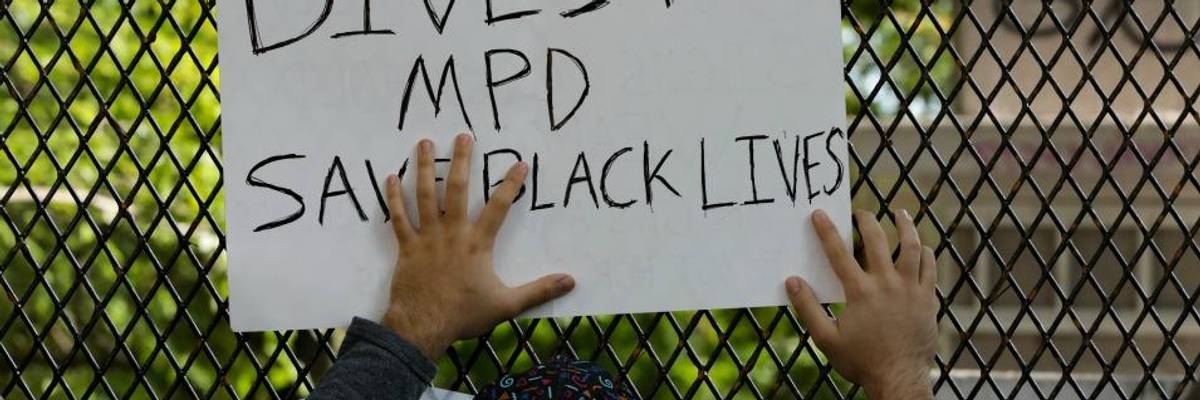
A person holds a banner during a protest on June 2, 2020 over the death of George Floyd, an unarmed black man who died after being pinned down by a white police officer in Minneapolis. (Photo by Yasin Ozturk/Anadolu Agency via Getty Images)
The Minneapolis school board unanimously voted Tuesday evening to terminate the district's $1.1 million yearly contract with the city's police department, the decision coming a week and a half after the police killing of George Floyd.
The resolution, which will end the use of armed "school resource officers" in the district's schools, had the support of 90% of Minneapolis's 35,000 public school students, according to a recent online survey.
The district is now required under the resolution to develop a plan to keep students safe that does not involved contracting with the Minneapolis Police Department, which has a long history of police killings and discrimination against black residents.
"I value people and education and life," school board chairwoman Kim Ellison told the Star Tribune. "Now I'm convinced, based on the actions of the Minneapolis Police Department, that we don't have the same values."
According to Buzzfeed News, there is "little precedent for a school district ending its contract with police entirely as Minneapolis has."
The resolution was passed on the seventh day of nationwide protests over Floyd's death. Derek Chauvin, the officer who was filmed pressing his knee into Floyd's neck while he was handcuffed, was charged with third-degree murder and second-degree manslaughter last week. Three other officers who helped to restrain Floyd and did not end the assault as he said he was unable to breathe have not yet been arrested.
"We cannot continue to be in partnership with an organization that has the culture of violence and racism that the Minneapolis police department has historically demonstrated," Nelson Inz, one of the school board members, said at Tuesday's meeting. "We have to stand in solidarity with our black students."
School districts in recent decades have poured resources into contracts with police departments in response to increasingly frequent school shootings. While those shootings are primarily carried out by white males, black students are more likely than their white counterparts to face violence from police officers in their schools.
"It's a very specific group of people who feel safe with police, but most black and brown children do not feel safe with police in schools," Jackie Byers of the Black Organizing Project, told The Guardian.
On social media, Minneapolis schools' firm stance against working with the police department was applauded as a major step away from the use of school resource officers and other armed disciplinarians in American schools.
School districts in New York, Arizona, Oregon, and other states have reportedly reached out to the Minneapolis school board in recent days to discuss crafting their own resolutions to end police contracts.
Dear Common Dreams reader, It’s been nearly 30 years since I co-founded Common Dreams with my late wife, Lina Newhouser. We had the radical notion that journalism should serve the public good, not corporate profits. It was clear to us from the outset what it would take to build such a project. No paid advertisements. No corporate sponsors. No millionaire publisher telling us what to think or do. Many people said we wouldn't last a year, but we proved those doubters wrong. Together with a tremendous team of journalists and dedicated staff, we built an independent media outlet free from the constraints of profits and corporate control. Our mission has always been simple: To inform. To inspire. To ignite change for the common good. Building Common Dreams was not easy. Our survival was never guaranteed. When you take on the most powerful forces—Wall Street greed, fossil fuel industry destruction, Big Tech lobbyists, and uber-rich oligarchs who have spent billions upon billions rigging the economy and democracy in their favor—the only bulwark you have is supporters who believe in your work. But here’s the urgent message from me today. It's never been this bad out there. And it's never been this hard to keep us going. At the very moment Common Dreams is most needed, the threats we face are intensifying. We need your support now more than ever. We don't accept corporate advertising and never will. We don't have a paywall because we don't think people should be blocked from critical news based on their ability to pay. Everything we do is funded by the donations of readers like you. When everyone does the little they can afford, we are strong. But if that support retreats or dries up, so do we. Will you donate now to make sure Common Dreams not only survives but thrives? —Craig Brown, Co-founder |
The Minneapolis school board unanimously voted Tuesday evening to terminate the district's $1.1 million yearly contract with the city's police department, the decision coming a week and a half after the police killing of George Floyd.
The resolution, which will end the use of armed "school resource officers" in the district's schools, had the support of 90% of Minneapolis's 35,000 public school students, according to a recent online survey.
The district is now required under the resolution to develop a plan to keep students safe that does not involved contracting with the Minneapolis Police Department, which has a long history of police killings and discrimination against black residents.
"I value people and education and life," school board chairwoman Kim Ellison told the Star Tribune. "Now I'm convinced, based on the actions of the Minneapolis Police Department, that we don't have the same values."
According to Buzzfeed News, there is "little precedent for a school district ending its contract with police entirely as Minneapolis has."
The resolution was passed on the seventh day of nationwide protests over Floyd's death. Derek Chauvin, the officer who was filmed pressing his knee into Floyd's neck while he was handcuffed, was charged with third-degree murder and second-degree manslaughter last week. Three other officers who helped to restrain Floyd and did not end the assault as he said he was unable to breathe have not yet been arrested.
"We cannot continue to be in partnership with an organization that has the culture of violence and racism that the Minneapolis police department has historically demonstrated," Nelson Inz, one of the school board members, said at Tuesday's meeting. "We have to stand in solidarity with our black students."
School districts in recent decades have poured resources into contracts with police departments in response to increasingly frequent school shootings. While those shootings are primarily carried out by white males, black students are more likely than their white counterparts to face violence from police officers in their schools.
"It's a very specific group of people who feel safe with police, but most black and brown children do not feel safe with police in schools," Jackie Byers of the Black Organizing Project, told The Guardian.
On social media, Minneapolis schools' firm stance against working with the police department was applauded as a major step away from the use of school resource officers and other armed disciplinarians in American schools.
School districts in New York, Arizona, Oregon, and other states have reportedly reached out to the Minneapolis school board in recent days to discuss crafting their own resolutions to end police contracts.
The Minneapolis school board unanimously voted Tuesday evening to terminate the district's $1.1 million yearly contract with the city's police department, the decision coming a week and a half after the police killing of George Floyd.
The resolution, which will end the use of armed "school resource officers" in the district's schools, had the support of 90% of Minneapolis's 35,000 public school students, according to a recent online survey.
The district is now required under the resolution to develop a plan to keep students safe that does not involved contracting with the Minneapolis Police Department, which has a long history of police killings and discrimination against black residents.
"I value people and education and life," school board chairwoman Kim Ellison told the Star Tribune. "Now I'm convinced, based on the actions of the Minneapolis Police Department, that we don't have the same values."
According to Buzzfeed News, there is "little precedent for a school district ending its contract with police entirely as Minneapolis has."
The resolution was passed on the seventh day of nationwide protests over Floyd's death. Derek Chauvin, the officer who was filmed pressing his knee into Floyd's neck while he was handcuffed, was charged with third-degree murder and second-degree manslaughter last week. Three other officers who helped to restrain Floyd and did not end the assault as he said he was unable to breathe have not yet been arrested.
"We cannot continue to be in partnership with an organization that has the culture of violence and racism that the Minneapolis police department has historically demonstrated," Nelson Inz, one of the school board members, said at Tuesday's meeting. "We have to stand in solidarity with our black students."
School districts in recent decades have poured resources into contracts with police departments in response to increasingly frequent school shootings. While those shootings are primarily carried out by white males, black students are more likely than their white counterparts to face violence from police officers in their schools.
"It's a very specific group of people who feel safe with police, but most black and brown children do not feel safe with police in schools," Jackie Byers of the Black Organizing Project, told The Guardian.
On social media, Minneapolis schools' firm stance against working with the police department was applauded as a major step away from the use of school resource officers and other armed disciplinarians in American schools.
School districts in New York, Arizona, Oregon, and other states have reportedly reached out to the Minneapolis school board in recent days to discuss crafting their own resolutions to end police contracts.

