SUBSCRIBE TO OUR FREE NEWSLETTER
Daily news & progressive opinion—funded by the people, not the corporations—delivered straight to your inbox.
5
#000000
#FFFFFF
To donate by check, phone, or other method, see our More Ways to Give page.
Daily news & progressive opinion—funded by the people, not the corporations—delivered straight to your inbox.
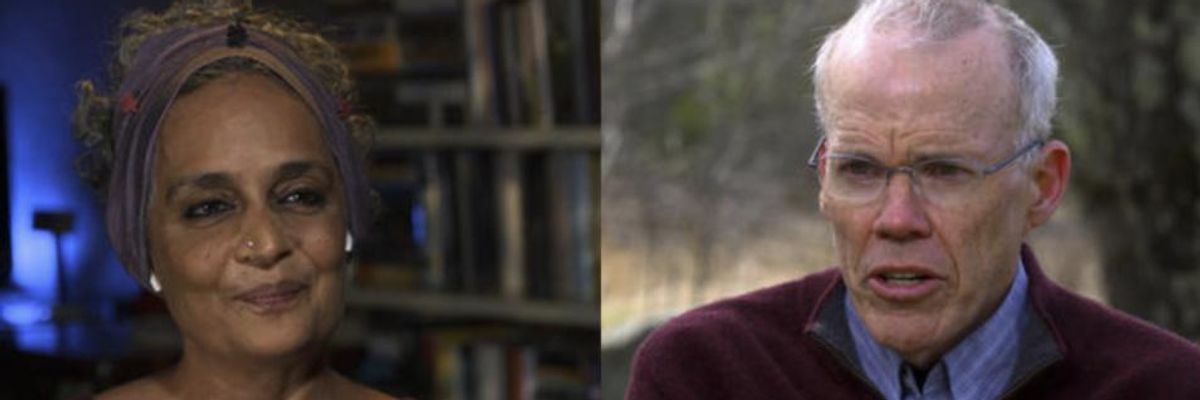
Novelist and activist Arundhati Roy and 350.org co-founder and author Bill McKibben were both featured in a "60 Minutes" segment that aired Sunday night. (Photo: CBS News/60 Minutes)
Interviewed by CBS's "60 Minutes" for a segment that aired Sunday night, writer-activists Arundhati Roy and Bill McKibben argue that the Covid-19 virus now sweeping the globe has exposed the limits of humanity's ability to negotiate with or control nature's awesome powers--especially now that the geophysical and biological systems of the planet have been so pushed to their limits by human activity and pollution.
"We tend to forget that the physical world still is in charge," said McKibben, author of numerous books on the climate crisis and the co-founder of the global advocacy group 350.org. "I've spent, you know, 30 years trying to get people to understand that physics and chemistry matter. That you can't spin them. They don't negotiate. They're not gonna compromise with you. You have to do what they say."
As noted in the segment--titled "What will be the new normal after the coronavirus pandemic?"--world history is rife with examples of great social upheaval, whether wars or natural disasters or pandemics, leading to surges in human and social advancement. But as Roy points out, so much of what the United States, for example, has been spending its vast resources on turned out to be useless in the face of the Covid-19 outbreak.
"If [the coronavirus] were a war, then nobody would be better prepared than the United States," laments Roy, award-winning novelist and longtime human rights activist, in her interview. "If it were that you needed nuclear missiles or depleted uranium or bunker busters or tanks or submarines or whatever it is, there would be plenty. But there aren't swabs. There aren't gloves. There aren't masks. There isn't medicine."
Both McKibben and Roy argue that there is no reason that life should go back to what it was like before the virus struck.
Asked if the crisis should be seen as an opportunity to do things differently going forward, "what choice does one have," McKibben responded. "I mean, the dumbest thing to do would just be to set up all the pins in the bowling alley one more time exactly the same way," he said.
Instead of returning to the frequent "dystopian" reality of a hyper-polluted world, Roy acknowledges that it is time for humanity to reflect on some of the silver linings the pandemic has provided and ready the battle for a more sustainable and just future.
As Roy wrote in an essay in the Financial Times last month:
Whatever it is, coronavirus has made the mighty kneel and brought the world to a halt like nothing else could. Our minds are still racing back and forth, longing for a return to "normality," trying to stitch our future to our past and refusing to acknowledge the rupture. But the rupture exists. And in the midst of this terrible despair, it offers us a chance to rethink the doomsday machine we have built for ourselves. Nothing could be worse than a return to normality.
Historically, pandemics have forced humans to break with the past and imagine their world anew. This one is no different. It is a portal, a gateway between one world and the next.
We can choose to walk through it, dragging the carcasses of our prejudice and hatred, our avarice, our data banks and dead ideas, our dead rivers and smoky skies behind us. Or we can walk through lightly, with little luggage, ready to imagine another world. And ready to fight for it.
In his comments, McKibben said that maybe humanity does "still have a window to take a step back" from its addiction to endless economic growth and fossil fuel-driven society. "And if we do, maybe the Earth will meet us halfway," he says.
If the world is able to "flatten the carbon curve" in the same way it is now desperately trying to flatten the curve of the infection rate, he concluded, "then people might look back in 50 years at this time and thank us, you know, instead of curse us. 'Cause those are the two possibilities."
Watch the full segment:
Dear Common Dreams reader, It’s been nearly 30 years since I co-founded Common Dreams with my late wife, Lina Newhouser. We had the radical notion that journalism should serve the public good, not corporate profits. It was clear to us from the outset what it would take to build such a project. No paid advertisements. No corporate sponsors. No millionaire publisher telling us what to think or do. Many people said we wouldn't last a year, but we proved those doubters wrong. Together with a tremendous team of journalists and dedicated staff, we built an independent media outlet free from the constraints of profits and corporate control. Our mission has always been simple: To inform. To inspire. To ignite change for the common good. Building Common Dreams was not easy. Our survival was never guaranteed. When you take on the most powerful forces—Wall Street greed, fossil fuel industry destruction, Big Tech lobbyists, and uber-rich oligarchs who have spent billions upon billions rigging the economy and democracy in their favor—the only bulwark you have is supporters who believe in your work. But here’s the urgent message from me today. It's never been this bad out there. And it's never been this hard to keep us going. At the very moment Common Dreams is most needed, the threats we face are intensifying. We need your support now more than ever. We don't accept corporate advertising and never will. We don't have a paywall because we don't think people should be blocked from critical news based on their ability to pay. Everything we do is funded by the donations of readers like you. When everyone does the little they can afford, we are strong. But if that support retreats or dries up, so do we. Will you donate now to make sure Common Dreams not only survives but thrives? —Craig Brown, Co-founder |
Interviewed by CBS's "60 Minutes" for a segment that aired Sunday night, writer-activists Arundhati Roy and Bill McKibben argue that the Covid-19 virus now sweeping the globe has exposed the limits of humanity's ability to negotiate with or control nature's awesome powers--especially now that the geophysical and biological systems of the planet have been so pushed to their limits by human activity and pollution.
"We tend to forget that the physical world still is in charge," said McKibben, author of numerous books on the climate crisis and the co-founder of the global advocacy group 350.org. "I've spent, you know, 30 years trying to get people to understand that physics and chemistry matter. That you can't spin them. They don't negotiate. They're not gonna compromise with you. You have to do what they say."
As noted in the segment--titled "What will be the new normal after the coronavirus pandemic?"--world history is rife with examples of great social upheaval, whether wars or natural disasters or pandemics, leading to surges in human and social advancement. But as Roy points out, so much of what the United States, for example, has been spending its vast resources on turned out to be useless in the face of the Covid-19 outbreak.
"If [the coronavirus] were a war, then nobody would be better prepared than the United States," laments Roy, award-winning novelist and longtime human rights activist, in her interview. "If it were that you needed nuclear missiles or depleted uranium or bunker busters or tanks or submarines or whatever it is, there would be plenty. But there aren't swabs. There aren't gloves. There aren't masks. There isn't medicine."
Both McKibben and Roy argue that there is no reason that life should go back to what it was like before the virus struck.
Asked if the crisis should be seen as an opportunity to do things differently going forward, "what choice does one have," McKibben responded. "I mean, the dumbest thing to do would just be to set up all the pins in the bowling alley one more time exactly the same way," he said.
Instead of returning to the frequent "dystopian" reality of a hyper-polluted world, Roy acknowledges that it is time for humanity to reflect on some of the silver linings the pandemic has provided and ready the battle for a more sustainable and just future.
As Roy wrote in an essay in the Financial Times last month:
Whatever it is, coronavirus has made the mighty kneel and brought the world to a halt like nothing else could. Our minds are still racing back and forth, longing for a return to "normality," trying to stitch our future to our past and refusing to acknowledge the rupture. But the rupture exists. And in the midst of this terrible despair, it offers us a chance to rethink the doomsday machine we have built for ourselves. Nothing could be worse than a return to normality.
Historically, pandemics have forced humans to break with the past and imagine their world anew. This one is no different. It is a portal, a gateway between one world and the next.
We can choose to walk through it, dragging the carcasses of our prejudice and hatred, our avarice, our data banks and dead ideas, our dead rivers and smoky skies behind us. Or we can walk through lightly, with little luggage, ready to imagine another world. And ready to fight for it.
In his comments, McKibben said that maybe humanity does "still have a window to take a step back" from its addiction to endless economic growth and fossil fuel-driven society. "And if we do, maybe the Earth will meet us halfway," he says.
If the world is able to "flatten the carbon curve" in the same way it is now desperately trying to flatten the curve of the infection rate, he concluded, "then people might look back in 50 years at this time and thank us, you know, instead of curse us. 'Cause those are the two possibilities."
Watch the full segment:
Interviewed by CBS's "60 Minutes" for a segment that aired Sunday night, writer-activists Arundhati Roy and Bill McKibben argue that the Covid-19 virus now sweeping the globe has exposed the limits of humanity's ability to negotiate with or control nature's awesome powers--especially now that the geophysical and biological systems of the planet have been so pushed to their limits by human activity and pollution.
"We tend to forget that the physical world still is in charge," said McKibben, author of numerous books on the climate crisis and the co-founder of the global advocacy group 350.org. "I've spent, you know, 30 years trying to get people to understand that physics and chemistry matter. That you can't spin them. They don't negotiate. They're not gonna compromise with you. You have to do what they say."
As noted in the segment--titled "What will be the new normal after the coronavirus pandemic?"--world history is rife with examples of great social upheaval, whether wars or natural disasters or pandemics, leading to surges in human and social advancement. But as Roy points out, so much of what the United States, for example, has been spending its vast resources on turned out to be useless in the face of the Covid-19 outbreak.
"If [the coronavirus] were a war, then nobody would be better prepared than the United States," laments Roy, award-winning novelist and longtime human rights activist, in her interview. "If it were that you needed nuclear missiles or depleted uranium or bunker busters or tanks or submarines or whatever it is, there would be plenty. But there aren't swabs. There aren't gloves. There aren't masks. There isn't medicine."
Both McKibben and Roy argue that there is no reason that life should go back to what it was like before the virus struck.
Asked if the crisis should be seen as an opportunity to do things differently going forward, "what choice does one have," McKibben responded. "I mean, the dumbest thing to do would just be to set up all the pins in the bowling alley one more time exactly the same way," he said.
Instead of returning to the frequent "dystopian" reality of a hyper-polluted world, Roy acknowledges that it is time for humanity to reflect on some of the silver linings the pandemic has provided and ready the battle for a more sustainable and just future.
As Roy wrote in an essay in the Financial Times last month:
Whatever it is, coronavirus has made the mighty kneel and brought the world to a halt like nothing else could. Our minds are still racing back and forth, longing for a return to "normality," trying to stitch our future to our past and refusing to acknowledge the rupture. But the rupture exists. And in the midst of this terrible despair, it offers us a chance to rethink the doomsday machine we have built for ourselves. Nothing could be worse than a return to normality.
Historically, pandemics have forced humans to break with the past and imagine their world anew. This one is no different. It is a portal, a gateway between one world and the next.
We can choose to walk through it, dragging the carcasses of our prejudice and hatred, our avarice, our data banks and dead ideas, our dead rivers and smoky skies behind us. Or we can walk through lightly, with little luggage, ready to imagine another world. And ready to fight for it.
In his comments, McKibben said that maybe humanity does "still have a window to take a step back" from its addiction to endless economic growth and fossil fuel-driven society. "And if we do, maybe the Earth will meet us halfway," he says.
If the world is able to "flatten the carbon curve" in the same way it is now desperately trying to flatten the curve of the infection rate, he concluded, "then people might look back in 50 years at this time and thank us, you know, instead of curse us. 'Cause those are the two possibilities."
Watch the full segment: