

SUBSCRIBE TO OUR FREE NEWSLETTER
Daily news & progressive opinion—funded by the people, not the corporations—delivered straight to your inbox.
5
#000000
#FFFFFF
To donate by check, phone, or other method, see our More Ways to Give page.
Daily news & progressive opinion—funded by the people, not the corporations—delivered straight to your inbox.
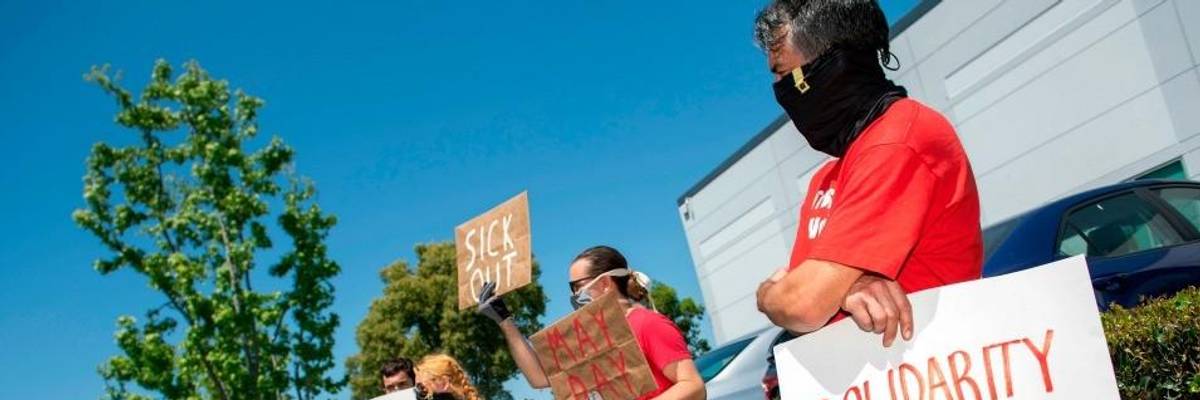
Workers protest against the failure from their employers to provide adequate protections in the workplace of the Amazon delivery hub on National May Day Walkout/Sickout by workers at Amazon, Whole Foods, Innstacart and Shipt amid the Covid-19 pandemic on May 1, 2020, in Hawthorne, California. (Photo: Valerie Macon/AFP via Getty Images)
New reporting Thursday reveals that Amazon is jeopardizing the safety of its southern California warehouse workers with policies that essentially force them to choose between losing their jobs and risking their safety as another employee of the e-commerce giant died of Covid-19.
"I'm afraid to come to work, but I don't have a choice," a 48-year-old San Bernardino worker who was identified as Eddie told the Guardian. "We're risking our safety for the company."
According to a Thursday report from the Guardian, workers at an Amazon warehouse in the Inland Empire region have been hit by the company's May 1 ending of a policy allowing workers unlimited unpaid time off and its flouting of a state order, issued by Gov. Gavin Newsom last month, granting food sector employees--including "workers at warehouses where food is stored"--two weeks of supplemental paid sick leave.
As Sam Levin explained:
Employees also shared emails showing that Amazon has dismissed some paid sick leave requests by claiming a California law intended to provide supplemental sick leave during the pandemic does not apply to the warehouses.
[...]
[E]mployees say that when they have asked about Newsom's order in recent weeks, the human resources department has ignored their questions or responded that the facilities are not considered part of the food sector.
A spokesperson for the state labor department confirmed to the Guardian that the executive order does, in fact, apply to Amazon warehouse workers. An Amazon spokesperson told the Guardian the company has complied with state requirements.
While an employee may still apply for unpaid leave, because Amazon said it can review such requests on a case-by-case basis, "it can take weeks for Amazon to respond to these requests, and multiple employees who asked for this said their requests were 'pending' and that they were worried they would soon lose their jobs," Levin wrote.
The Guardian added:
Amazon has experienced a boom in sales during the pandemic, with revenues of $75.4bn in the first three months of 2020, over $33m an hour. The fortune of CEO Jeff Bezos has grown by $24bn during the crisis.
The new reporting comes days after Amazon and other workers continue to demand better workplace safeguards from the highly infectious virus. The personal risk the company's workers are exposed to was punctuated Tuesday after labor advocates said a worker at Amazon's Staten Island warehouse, dubbed JFK8, died of COVID-19.
"For a long time now, workers at JFK8 and other Amazon facilities around the world have been demanding safer working conditions--especially during this pandemic," said Stuart Appelbaum, president of the Retail, Wholesale and Department Store Union. "Yesterday's death unfortunately has shown the true cost of Amazon's failure to provide a safe work environment."
Those who've spoken up about that failure have faced retalation. "Amazon has fired at least four employees who called for greater safety protections for warehouse workers during the pandemic," CNBC noted Thursday
ABC News adds:
It is unclear how many of the hundreds of thousands of workers employed by Amazon have gotten sick or died during the pandemic. According to the New York Times, there have been cases in more than 50 facilities and the first warehouse worker died at the end of March in California.
Dissent over worker conditions has also come from the higher ranks--earlier this week, as Common Dreams reported, an Amazon vice president, Tim Bray, resigned in protest.
"I quit in dismay at Amazon firing whistleblowers who were making noise about warehouse employees frightened of Covid-19," Bray wrote on his personal blog. "It's a matter of fact that workers are saying they're at risk in the warehouses."
According to Bray, "at the end of the day, the big problem isn't the specifics of Covid-19 response. It's that Amazon treats the humans in the warehouses as fungible units of pick-and-pack potential. Only that's not just Amazon, it's how 21st-century capitalism is done."
Dear Common Dreams reader, It’s been nearly 30 years since I co-founded Common Dreams with my late wife, Lina Newhouser. We had the radical notion that journalism should serve the public good, not corporate profits. It was clear to us from the outset what it would take to build such a project. No paid advertisements. No corporate sponsors. No millionaire publisher telling us what to think or do. Many people said we wouldn't last a year, but we proved those doubters wrong. Together with a tremendous team of journalists and dedicated staff, we built an independent media outlet free from the constraints of profits and corporate control. Our mission has always been simple: To inform. To inspire. To ignite change for the common good. Building Common Dreams was not easy. Our survival was never guaranteed. When you take on the most powerful forces—Wall Street greed, fossil fuel industry destruction, Big Tech lobbyists, and uber-rich oligarchs who have spent billions upon billions rigging the economy and democracy in their favor—the only bulwark you have is supporters who believe in your work. But here’s the urgent message from me today. It's never been this bad out there. And it's never been this hard to keep us going. At the very moment Common Dreams is most needed, the threats we face are intensifying. We need your support now more than ever. We don't accept corporate advertising and never will. We don't have a paywall because we don't think people should be blocked from critical news based on their ability to pay. Everything we do is funded by the donations of readers like you. When everyone does the little they can afford, we are strong. But if that support retreats or dries up, so do we. Will you donate now to make sure Common Dreams not only survives but thrives? —Craig Brown, Co-founder |
New reporting Thursday reveals that Amazon is jeopardizing the safety of its southern California warehouse workers with policies that essentially force them to choose between losing their jobs and risking their safety as another employee of the e-commerce giant died of Covid-19.
"I'm afraid to come to work, but I don't have a choice," a 48-year-old San Bernardino worker who was identified as Eddie told the Guardian. "We're risking our safety for the company."
According to a Thursday report from the Guardian, workers at an Amazon warehouse in the Inland Empire region have been hit by the company's May 1 ending of a policy allowing workers unlimited unpaid time off and its flouting of a state order, issued by Gov. Gavin Newsom last month, granting food sector employees--including "workers at warehouses where food is stored"--two weeks of supplemental paid sick leave.
As Sam Levin explained:
Employees also shared emails showing that Amazon has dismissed some paid sick leave requests by claiming a California law intended to provide supplemental sick leave during the pandemic does not apply to the warehouses.
[...]
[E]mployees say that when they have asked about Newsom's order in recent weeks, the human resources department has ignored their questions or responded that the facilities are not considered part of the food sector.
A spokesperson for the state labor department confirmed to the Guardian that the executive order does, in fact, apply to Amazon warehouse workers. An Amazon spokesperson told the Guardian the company has complied with state requirements.
While an employee may still apply for unpaid leave, because Amazon said it can review such requests on a case-by-case basis, "it can take weeks for Amazon to respond to these requests, and multiple employees who asked for this said their requests were 'pending' and that they were worried they would soon lose their jobs," Levin wrote.
The Guardian added:
Amazon has experienced a boom in sales during the pandemic, with revenues of $75.4bn in the first three months of 2020, over $33m an hour. The fortune of CEO Jeff Bezos has grown by $24bn during the crisis.
The new reporting comes days after Amazon and other workers continue to demand better workplace safeguards from the highly infectious virus. The personal risk the company's workers are exposed to was punctuated Tuesday after labor advocates said a worker at Amazon's Staten Island warehouse, dubbed JFK8, died of COVID-19.
"For a long time now, workers at JFK8 and other Amazon facilities around the world have been demanding safer working conditions--especially during this pandemic," said Stuart Appelbaum, president of the Retail, Wholesale and Department Store Union. "Yesterday's death unfortunately has shown the true cost of Amazon's failure to provide a safe work environment."
Those who've spoken up about that failure have faced retalation. "Amazon has fired at least four employees who called for greater safety protections for warehouse workers during the pandemic," CNBC noted Thursday
ABC News adds:
It is unclear how many of the hundreds of thousands of workers employed by Amazon have gotten sick or died during the pandemic. According to the New York Times, there have been cases in more than 50 facilities and the first warehouse worker died at the end of March in California.
Dissent over worker conditions has also come from the higher ranks--earlier this week, as Common Dreams reported, an Amazon vice president, Tim Bray, resigned in protest.
"I quit in dismay at Amazon firing whistleblowers who were making noise about warehouse employees frightened of Covid-19," Bray wrote on his personal blog. "It's a matter of fact that workers are saying they're at risk in the warehouses."
According to Bray, "at the end of the day, the big problem isn't the specifics of Covid-19 response. It's that Amazon treats the humans in the warehouses as fungible units of pick-and-pack potential. Only that's not just Amazon, it's how 21st-century capitalism is done."
New reporting Thursday reveals that Amazon is jeopardizing the safety of its southern California warehouse workers with policies that essentially force them to choose between losing their jobs and risking their safety as another employee of the e-commerce giant died of Covid-19.
"I'm afraid to come to work, but I don't have a choice," a 48-year-old San Bernardino worker who was identified as Eddie told the Guardian. "We're risking our safety for the company."
According to a Thursday report from the Guardian, workers at an Amazon warehouse in the Inland Empire region have been hit by the company's May 1 ending of a policy allowing workers unlimited unpaid time off and its flouting of a state order, issued by Gov. Gavin Newsom last month, granting food sector employees--including "workers at warehouses where food is stored"--two weeks of supplemental paid sick leave.
As Sam Levin explained:
Employees also shared emails showing that Amazon has dismissed some paid sick leave requests by claiming a California law intended to provide supplemental sick leave during the pandemic does not apply to the warehouses.
[...]
[E]mployees say that when they have asked about Newsom's order in recent weeks, the human resources department has ignored their questions or responded that the facilities are not considered part of the food sector.
A spokesperson for the state labor department confirmed to the Guardian that the executive order does, in fact, apply to Amazon warehouse workers. An Amazon spokesperson told the Guardian the company has complied with state requirements.
While an employee may still apply for unpaid leave, because Amazon said it can review such requests on a case-by-case basis, "it can take weeks for Amazon to respond to these requests, and multiple employees who asked for this said their requests were 'pending' and that they were worried they would soon lose their jobs," Levin wrote.
The Guardian added:
Amazon has experienced a boom in sales during the pandemic, with revenues of $75.4bn in the first three months of 2020, over $33m an hour. The fortune of CEO Jeff Bezos has grown by $24bn during the crisis.
The new reporting comes days after Amazon and other workers continue to demand better workplace safeguards from the highly infectious virus. The personal risk the company's workers are exposed to was punctuated Tuesday after labor advocates said a worker at Amazon's Staten Island warehouse, dubbed JFK8, died of COVID-19.
"For a long time now, workers at JFK8 and other Amazon facilities around the world have been demanding safer working conditions--especially during this pandemic," said Stuart Appelbaum, president of the Retail, Wholesale and Department Store Union. "Yesterday's death unfortunately has shown the true cost of Amazon's failure to provide a safe work environment."
Those who've spoken up about that failure have faced retalation. "Amazon has fired at least four employees who called for greater safety protections for warehouse workers during the pandemic," CNBC noted Thursday
ABC News adds:
It is unclear how many of the hundreds of thousands of workers employed by Amazon have gotten sick or died during the pandemic. According to the New York Times, there have been cases in more than 50 facilities and the first warehouse worker died at the end of March in California.
Dissent over worker conditions has also come from the higher ranks--earlier this week, as Common Dreams reported, an Amazon vice president, Tim Bray, resigned in protest.
"I quit in dismay at Amazon firing whistleblowers who were making noise about warehouse employees frightened of Covid-19," Bray wrote on his personal blog. "It's a matter of fact that workers are saying they're at risk in the warehouses."
According to Bray, "at the end of the day, the big problem isn't the specifics of Covid-19 response. It's that Amazon treats the humans in the warehouses as fungible units of pick-and-pack potential. Only that's not just Amazon, it's how 21st-century capitalism is done."

