

SUBSCRIBE TO OUR FREE NEWSLETTER
Daily news & progressive opinion—funded by the people, not the corporations—delivered straight to your inbox.
5
#000000
#FFFFFF
To donate by check, phone, or other method, see our More Ways to Give page.
Daily news & progressive opinion—funded by the people, not the corporations—delivered straight to your inbox.
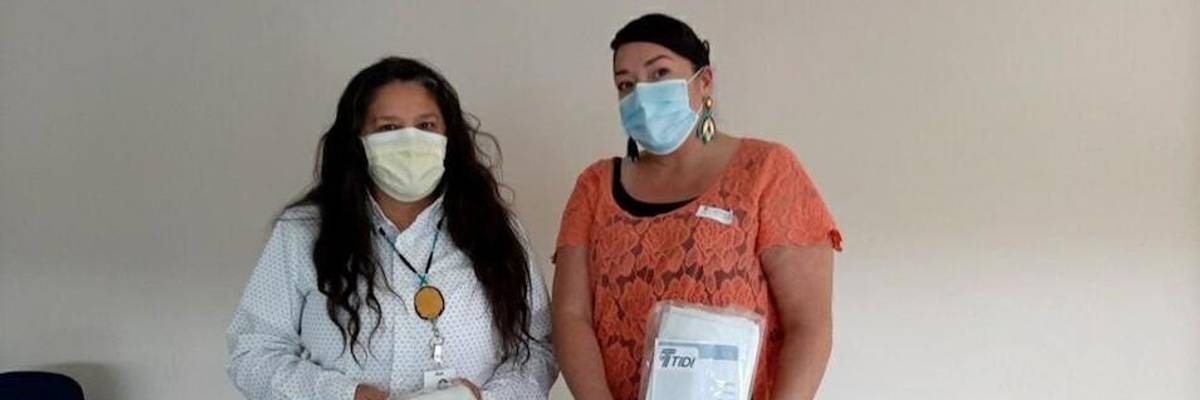
The Seattle Indian Health Board's Esther Lucero, left, and Abigail Echo-Hawk, right, with a box of body bags. (Photo: Seattle Indian Health Board)
A Seattle-area Native American health center in April received body bags instead of requested equipment to handle the coronavirus in what tribal officials described as a "metaphor" for how the Indigenous population is being treated by local, state, and federal governments around the country as the pandemic continues to rage.
"My question is: Are we going to keep getting body bags or are we going to get what we actually need?" Seattle Indian Health Board chief research officer Abigail Echo-Hawk told NBC News.
NBC News reported on Tuesday that the experience of the Seattle-area health center came after a request for testing equipment:
"My team turned ghost white," said Esther Lucero, chief executive officer of the Seattle Indian Health Board. "We asked for tests, and they sent us a box of body bags."
The health board's center--serving about 6,000 people a year in Seattle and King County--still has the package, which is filled with zippered white bags and beige tags that read "attach to toe."
According to Echo-Hawk, the delivery of the body bags--though a mistake by a King County's Public Health Department distributor--was indicative of the treatment of Native Americans in Seattle and around the country as the communities grapple with Covid-19 and a government that appears disinterested in helping.
"The Navajo Nation is in a crisis with cases, and there are tribes and other Indian organizations across the country that are in similar crises and can use medical supplies and help instead of watching people die," Echo-Hawk said. "This is a metaphor for what's happening."
Native American attorney Brett Chapman agreed, telling Common Dreams that the crisis is the result of years of inaction on the part of the government.
"Native vulnerability to coronavirus did not occur out of left field," said Chapman. "It came about due to decades of neglect by leaders of both parties to move Native nations forward."
"Native American health care providers have always been woefully underfunded and undersupplied," Chapman added. 'This is nothing new."
President Donald Trump's administration held up $8 billion in aid set aside in relief legislation for Native American communities until this week, as Indianz reported Tuesday.
According to Indianz:
Only $4.8 billion, or 60 percent of the fund, is going out at this time. It will be based on "population data used in the distribution of the Indian Housing Block Grant" funds. Notably, such data was not required of tribes when they submitted their certification forms to the Trump administration in April 2020.
"Indian Country is tired of waiting for the administration to follow the law by delivering pandemic aid to our communities and our people," Bay Mills Indian Community President Bryan Newland said.
"Quit telling us to wait," he added.
While the Trump administration's reaction to the crisis has been denounced as grossly inadequate, residents of Ireland have stepped up to help out, donating hundreds of thousands of dollars to a GoFundMe for the Navajo Nation and the Hopi Reservation that has raised a total of over $1.8 million so far. The Irish people have cited a $170 gift from over 170 years ago from the Choctaw tribe during the Irish Famine as a motivator for the donations.
Chapman told Common Dreams that U.S. lawmakers need to start prioritizing the country's first people.
"If 'America First' means anything, the billions allocated for needless projects like, say, the border wall, should be rerouted to immediately honoring America's commitment to Native Americans at a time when many Native nations and communities are suffering disproportionately from this scourge," said Chapman.
Dear Common Dreams reader, It’s been nearly 30 years since I co-founded Common Dreams with my late wife, Lina Newhouser. We had the radical notion that journalism should serve the public good, not corporate profits. It was clear to us from the outset what it would take to build such a project. No paid advertisements. No corporate sponsors. No millionaire publisher telling us what to think or do. Many people said we wouldn't last a year, but we proved those doubters wrong. Together with a tremendous team of journalists and dedicated staff, we built an independent media outlet free from the constraints of profits and corporate control. Our mission has always been simple: To inform. To inspire. To ignite change for the common good. Building Common Dreams was not easy. Our survival was never guaranteed. When you take on the most powerful forces—Wall Street greed, fossil fuel industry destruction, Big Tech lobbyists, and uber-rich oligarchs who have spent billions upon billions rigging the economy and democracy in their favor—the only bulwark you have is supporters who believe in your work. But here’s the urgent message from me today. It's never been this bad out there. And it's never been this hard to keep us going. At the very moment Common Dreams is most needed, the threats we face are intensifying. We need your support now more than ever. We don't accept corporate advertising and never will. We don't have a paywall because we don't think people should be blocked from critical news based on their ability to pay. Everything we do is funded by the donations of readers like you. When everyone does the little they can afford, we are strong. But if that support retreats or dries up, so do we. Will you donate now to make sure Common Dreams not only survives but thrives? —Craig Brown, Co-founder |
A Seattle-area Native American health center in April received body bags instead of requested equipment to handle the coronavirus in what tribal officials described as a "metaphor" for how the Indigenous population is being treated by local, state, and federal governments around the country as the pandemic continues to rage.
"My question is: Are we going to keep getting body bags or are we going to get what we actually need?" Seattle Indian Health Board chief research officer Abigail Echo-Hawk told NBC News.
NBC News reported on Tuesday that the experience of the Seattle-area health center came after a request for testing equipment:
"My team turned ghost white," said Esther Lucero, chief executive officer of the Seattle Indian Health Board. "We asked for tests, and they sent us a box of body bags."
The health board's center--serving about 6,000 people a year in Seattle and King County--still has the package, which is filled with zippered white bags and beige tags that read "attach to toe."
According to Echo-Hawk, the delivery of the body bags--though a mistake by a King County's Public Health Department distributor--was indicative of the treatment of Native Americans in Seattle and around the country as the communities grapple with Covid-19 and a government that appears disinterested in helping.
"The Navajo Nation is in a crisis with cases, and there are tribes and other Indian organizations across the country that are in similar crises and can use medical supplies and help instead of watching people die," Echo-Hawk said. "This is a metaphor for what's happening."
Native American attorney Brett Chapman agreed, telling Common Dreams that the crisis is the result of years of inaction on the part of the government.
"Native vulnerability to coronavirus did not occur out of left field," said Chapman. "It came about due to decades of neglect by leaders of both parties to move Native nations forward."
"Native American health care providers have always been woefully underfunded and undersupplied," Chapman added. 'This is nothing new."
President Donald Trump's administration held up $8 billion in aid set aside in relief legislation for Native American communities until this week, as Indianz reported Tuesday.
According to Indianz:
Only $4.8 billion, or 60 percent of the fund, is going out at this time. It will be based on "population data used in the distribution of the Indian Housing Block Grant" funds. Notably, such data was not required of tribes when they submitted their certification forms to the Trump administration in April 2020.
"Indian Country is tired of waiting for the administration to follow the law by delivering pandemic aid to our communities and our people," Bay Mills Indian Community President Bryan Newland said.
"Quit telling us to wait," he added.
While the Trump administration's reaction to the crisis has been denounced as grossly inadequate, residents of Ireland have stepped up to help out, donating hundreds of thousands of dollars to a GoFundMe for the Navajo Nation and the Hopi Reservation that has raised a total of over $1.8 million so far. The Irish people have cited a $170 gift from over 170 years ago from the Choctaw tribe during the Irish Famine as a motivator for the donations.
Chapman told Common Dreams that U.S. lawmakers need to start prioritizing the country's first people.
"If 'America First' means anything, the billions allocated for needless projects like, say, the border wall, should be rerouted to immediately honoring America's commitment to Native Americans at a time when many Native nations and communities are suffering disproportionately from this scourge," said Chapman.
A Seattle-area Native American health center in April received body bags instead of requested equipment to handle the coronavirus in what tribal officials described as a "metaphor" for how the Indigenous population is being treated by local, state, and federal governments around the country as the pandemic continues to rage.
"My question is: Are we going to keep getting body bags or are we going to get what we actually need?" Seattle Indian Health Board chief research officer Abigail Echo-Hawk told NBC News.
NBC News reported on Tuesday that the experience of the Seattle-area health center came after a request for testing equipment:
"My team turned ghost white," said Esther Lucero, chief executive officer of the Seattle Indian Health Board. "We asked for tests, and they sent us a box of body bags."
The health board's center--serving about 6,000 people a year in Seattle and King County--still has the package, which is filled with zippered white bags and beige tags that read "attach to toe."
According to Echo-Hawk, the delivery of the body bags--though a mistake by a King County's Public Health Department distributor--was indicative of the treatment of Native Americans in Seattle and around the country as the communities grapple with Covid-19 and a government that appears disinterested in helping.
"The Navajo Nation is in a crisis with cases, and there are tribes and other Indian organizations across the country that are in similar crises and can use medical supplies and help instead of watching people die," Echo-Hawk said. "This is a metaphor for what's happening."
Native American attorney Brett Chapman agreed, telling Common Dreams that the crisis is the result of years of inaction on the part of the government.
"Native vulnerability to coronavirus did not occur out of left field," said Chapman. "It came about due to decades of neglect by leaders of both parties to move Native nations forward."
"Native American health care providers have always been woefully underfunded and undersupplied," Chapman added. 'This is nothing new."
President Donald Trump's administration held up $8 billion in aid set aside in relief legislation for Native American communities until this week, as Indianz reported Tuesday.
According to Indianz:
Only $4.8 billion, or 60 percent of the fund, is going out at this time. It will be based on "population data used in the distribution of the Indian Housing Block Grant" funds. Notably, such data was not required of tribes when they submitted their certification forms to the Trump administration in April 2020.
"Indian Country is tired of waiting for the administration to follow the law by delivering pandemic aid to our communities and our people," Bay Mills Indian Community President Bryan Newland said.
"Quit telling us to wait," he added.
While the Trump administration's reaction to the crisis has been denounced as grossly inadequate, residents of Ireland have stepped up to help out, donating hundreds of thousands of dollars to a GoFundMe for the Navajo Nation and the Hopi Reservation that has raised a total of over $1.8 million so far. The Irish people have cited a $170 gift from over 170 years ago from the Choctaw tribe during the Irish Famine as a motivator for the donations.
Chapman told Common Dreams that U.S. lawmakers need to start prioritizing the country's first people.
"If 'America First' means anything, the billions allocated for needless projects like, say, the border wall, should be rerouted to immediately honoring America's commitment to Native Americans at a time when many Native nations and communities are suffering disproportionately from this scourge," said Chapman.

