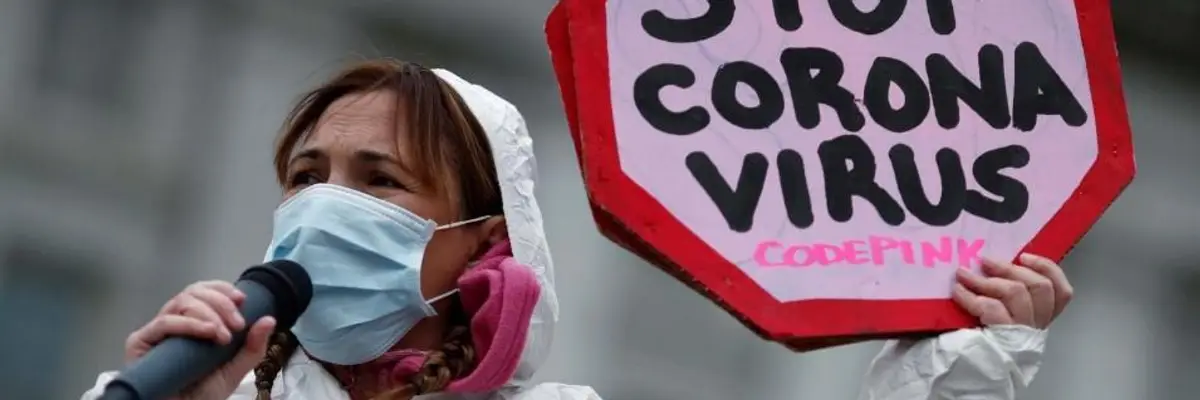
"Sanctions kill innocents indiscriminately just like bombs." (Photo: CodePink)
70+ Groups Demand Trump Immediately End US Sanctions Against Iran, Venezuela, Cuba, and Others During Covid-19 Crisis
"In a context of global pandemic, impeding medical efforts in one country heightens the risk for all of us."
Over 70 civil society groups representing more than 40 million people called on President Donald Trump Thursday to issue immediate sanctions relief for numerous countries--including Iran, Syria, Venezuela, Cuba, and North Korea--for at least the duration of the coronavirus crisis which threatens to kill thousands in the hard-hit countries.
The "urgent appeal" came in the form of an open letter sent by the groups to Trump, Secretary of State Mike Pompeo, and Secretary of the Treasury Steve Mnuchin calling for curtailing the sanctions regime for the duration of the pandemic. Entitled "Lift Sanctions, Save Lives," the initiative is aimed at ensuring the economic warfare by the U.S. claims as few lives as possible as the nations fight off the health crisis.
"Denying people access to lifesaving resources now represents a risk to the entire world," said Daniel Jasper of the American Friends Service Committee, a signatory to the letter. "The U.S. must rethink its approach to sanctions."
According to a press release accompanying the letter:
The letter puts forth a framework for universal safeguards that include six specific categories. These include aid that is directly related to containing and providing treatment for COVID-19 (such as testing kits, personal protective equipment, ventilators, etc.). The letter also calls for safeguarding aid needed to address simultaneous challenges exacerbated by the pandemic, such as providing adequate water supply, food security, and urgent health services for other infectious diseases.
"Sanctions kill innocents indiscriminately just like bombs," said Peace Action senior policy director Paul Kawika Martin. "Historically, this type of economic warfare fails to positively affect the behavior of governments. During this pandemic crisis, the U.S. needs to remove all barriers, like sanctions, so countries can counteract COVID-19."
The letter also emphasizes the risks of "over-compliance" on the part of companies and financial institutions overly cautious in the face of sanctions. That can lead to more pain and suffering, said CodePink Latin America Campaign coordinator Teri Mattson.
"Banks often block purchases for these items out of fear of running afoul of sanctions, in what is known as over-compliance," said Mattson. "Over-compliance is one of the many ways that innocent civilians end up being harmed by sanctions regimes."
On Thursday, The Nation's Ken Klippenstein revealed evidence of the unintended consequences for the U.S. of maintaining the sanctions regime.
Citing a leaked classified Pentagon intelligence briefing, Klippenstein showed that the American military is concerned that the Iranian government's inability to handle the disease--due in part to brutal and continuing U.S. sanctions--could result in U.S. soldiers getting sick.
As Klippenstein reported:
The document, dated April 3, says that Qatar--host to the largest US military base in the region--"has the highest number of COVID-19 cases, with over 800 confirmed."
[...]
The majority of these cases, the brief says, derive from Iran, which is located across the Persian Gulf from Qatar. The document warns that US sanctions have "left Iran bereft of financial resources to mount an effective public health response" to the pandemic and "unable to order ventilators from abroad, which are crucial for treatment."
The damage to Iran's people and economy from the ongoing sanctions is expected to continue to be catastrophic, leading Rep. Ilhan Omar (D-Minn.) to comment that the cruelty of the Trump administration has no excuse.
"Keeping sanctions in place on Iran during a global pandemic is unconscionable," Omar told The Nation. "These sanctions are only harming innocent civilians who bear the brunt of this crisis while having zero effect on the behavior of the Iranian government. Civilians are unable to receive lifesaving medicine and humanitarian supplies due to the U.S.-placed sanctions."
An Urgent Message From Our Co-Founder
Dear Common Dreams reader, It’s been nearly 30 years since I co-founded Common Dreams with my late wife, Lina Newhouser. We had the radical notion that journalism should serve the public good, not corporate profits. It was clear to us from the outset what it would take to build such a project. No paid advertisements. No corporate sponsors. No millionaire publisher telling us what to think or do. Many people said we wouldn't last a year, but we proved those doubters wrong. Together with a tremendous team of journalists and dedicated staff, we built an independent media outlet free from the constraints of profits and corporate control. Our mission has always been simple: To inform. To inspire. To ignite change for the common good. Building Common Dreams was not easy. Our survival was never guaranteed. When you take on the most powerful forces—Wall Street greed, fossil fuel industry destruction, Big Tech lobbyists, and uber-rich oligarchs who have spent billions upon billions rigging the economy and democracy in their favor—the only bulwark you have is supporters who believe in your work. But here’s the urgent message from me today. It's never been this bad out there. And it's never been this hard to keep us going. At the very moment Common Dreams is most needed, the threats we face are intensifying. We need your support now more than ever. We don't accept corporate advertising and never will. We don't have a paywall because we don't think people should be blocked from critical news based on their ability to pay. Everything we do is funded by the donations of readers like you. When everyone does the little they can afford, we are strong. But if that support retreats or dries up, so do we. Will you donate now to make sure Common Dreams not only survives but thrives? —Craig Brown, Co-founder |
Over 70 civil society groups representing more than 40 million people called on President Donald Trump Thursday to issue immediate sanctions relief for numerous countries--including Iran, Syria, Venezuela, Cuba, and North Korea--for at least the duration of the coronavirus crisis which threatens to kill thousands in the hard-hit countries.
The "urgent appeal" came in the form of an open letter sent by the groups to Trump, Secretary of State Mike Pompeo, and Secretary of the Treasury Steve Mnuchin calling for curtailing the sanctions regime for the duration of the pandemic. Entitled "Lift Sanctions, Save Lives," the initiative is aimed at ensuring the economic warfare by the U.S. claims as few lives as possible as the nations fight off the health crisis.
"Denying people access to lifesaving resources now represents a risk to the entire world," said Daniel Jasper of the American Friends Service Committee, a signatory to the letter. "The U.S. must rethink its approach to sanctions."
According to a press release accompanying the letter:
The letter puts forth a framework for universal safeguards that include six specific categories. These include aid that is directly related to containing and providing treatment for COVID-19 (such as testing kits, personal protective equipment, ventilators, etc.). The letter also calls for safeguarding aid needed to address simultaneous challenges exacerbated by the pandemic, such as providing adequate water supply, food security, and urgent health services for other infectious diseases.
"Sanctions kill innocents indiscriminately just like bombs," said Peace Action senior policy director Paul Kawika Martin. "Historically, this type of economic warfare fails to positively affect the behavior of governments. During this pandemic crisis, the U.S. needs to remove all barriers, like sanctions, so countries can counteract COVID-19."
The letter also emphasizes the risks of "over-compliance" on the part of companies and financial institutions overly cautious in the face of sanctions. That can lead to more pain and suffering, said CodePink Latin America Campaign coordinator Teri Mattson.
"Banks often block purchases for these items out of fear of running afoul of sanctions, in what is known as over-compliance," said Mattson. "Over-compliance is one of the many ways that innocent civilians end up being harmed by sanctions regimes."
On Thursday, The Nation's Ken Klippenstein revealed evidence of the unintended consequences for the U.S. of maintaining the sanctions regime.
Citing a leaked classified Pentagon intelligence briefing, Klippenstein showed that the American military is concerned that the Iranian government's inability to handle the disease--due in part to brutal and continuing U.S. sanctions--could result in U.S. soldiers getting sick.
As Klippenstein reported:
The document, dated April 3, says that Qatar--host to the largest US military base in the region--"has the highest number of COVID-19 cases, with over 800 confirmed."
[...]
The majority of these cases, the brief says, derive from Iran, which is located across the Persian Gulf from Qatar. The document warns that US sanctions have "left Iran bereft of financial resources to mount an effective public health response" to the pandemic and "unable to order ventilators from abroad, which are crucial for treatment."
The damage to Iran's people and economy from the ongoing sanctions is expected to continue to be catastrophic, leading Rep. Ilhan Omar (D-Minn.) to comment that the cruelty of the Trump administration has no excuse.
"Keeping sanctions in place on Iran during a global pandemic is unconscionable," Omar told The Nation. "These sanctions are only harming innocent civilians who bear the brunt of this crisis while having zero effect on the behavior of the Iranian government. Civilians are unable to receive lifesaving medicine and humanitarian supplies due to the U.S.-placed sanctions."
Over 70 civil society groups representing more than 40 million people called on President Donald Trump Thursday to issue immediate sanctions relief for numerous countries--including Iran, Syria, Venezuela, Cuba, and North Korea--for at least the duration of the coronavirus crisis which threatens to kill thousands in the hard-hit countries.
The "urgent appeal" came in the form of an open letter sent by the groups to Trump, Secretary of State Mike Pompeo, and Secretary of the Treasury Steve Mnuchin calling for curtailing the sanctions regime for the duration of the pandemic. Entitled "Lift Sanctions, Save Lives," the initiative is aimed at ensuring the economic warfare by the U.S. claims as few lives as possible as the nations fight off the health crisis.
"Denying people access to lifesaving resources now represents a risk to the entire world," said Daniel Jasper of the American Friends Service Committee, a signatory to the letter. "The U.S. must rethink its approach to sanctions."
According to a press release accompanying the letter:
The letter puts forth a framework for universal safeguards that include six specific categories. These include aid that is directly related to containing and providing treatment for COVID-19 (such as testing kits, personal protective equipment, ventilators, etc.). The letter also calls for safeguarding aid needed to address simultaneous challenges exacerbated by the pandemic, such as providing adequate water supply, food security, and urgent health services for other infectious diseases.
"Sanctions kill innocents indiscriminately just like bombs," said Peace Action senior policy director Paul Kawika Martin. "Historically, this type of economic warfare fails to positively affect the behavior of governments. During this pandemic crisis, the U.S. needs to remove all barriers, like sanctions, so countries can counteract COVID-19."
The letter also emphasizes the risks of "over-compliance" on the part of companies and financial institutions overly cautious in the face of sanctions. That can lead to more pain and suffering, said CodePink Latin America Campaign coordinator Teri Mattson.
"Banks often block purchases for these items out of fear of running afoul of sanctions, in what is known as over-compliance," said Mattson. "Over-compliance is one of the many ways that innocent civilians end up being harmed by sanctions regimes."
On Thursday, The Nation's Ken Klippenstein revealed evidence of the unintended consequences for the U.S. of maintaining the sanctions regime.
Citing a leaked classified Pentagon intelligence briefing, Klippenstein showed that the American military is concerned that the Iranian government's inability to handle the disease--due in part to brutal and continuing U.S. sanctions--could result in U.S. soldiers getting sick.
As Klippenstein reported:
The document, dated April 3, says that Qatar--host to the largest US military base in the region--"has the highest number of COVID-19 cases, with over 800 confirmed."
[...]
The majority of these cases, the brief says, derive from Iran, which is located across the Persian Gulf from Qatar. The document warns that US sanctions have "left Iran bereft of financial resources to mount an effective public health response" to the pandemic and "unable to order ventilators from abroad, which are crucial for treatment."
The damage to Iran's people and economy from the ongoing sanctions is expected to continue to be catastrophic, leading Rep. Ilhan Omar (D-Minn.) to comment that the cruelty of the Trump administration has no excuse.
"Keeping sanctions in place on Iran during a global pandemic is unconscionable," Omar told The Nation. "These sanctions are only harming innocent civilians who bear the brunt of this crisis while having zero effect on the behavior of the Iranian government. Civilians are unable to receive lifesaving medicine and humanitarian supplies due to the U.S.-placed sanctions."