SUBSCRIBE TO OUR FREE NEWSLETTER
Daily news & progressive opinion—funded by the people, not the corporations—delivered straight to your inbox.
5
#000000
#FFFFFF
To donate by check, phone, or other method, see our More Ways to Give page.
Daily news & progressive opinion—funded by the people, not the corporations—delivered straight to your inbox.
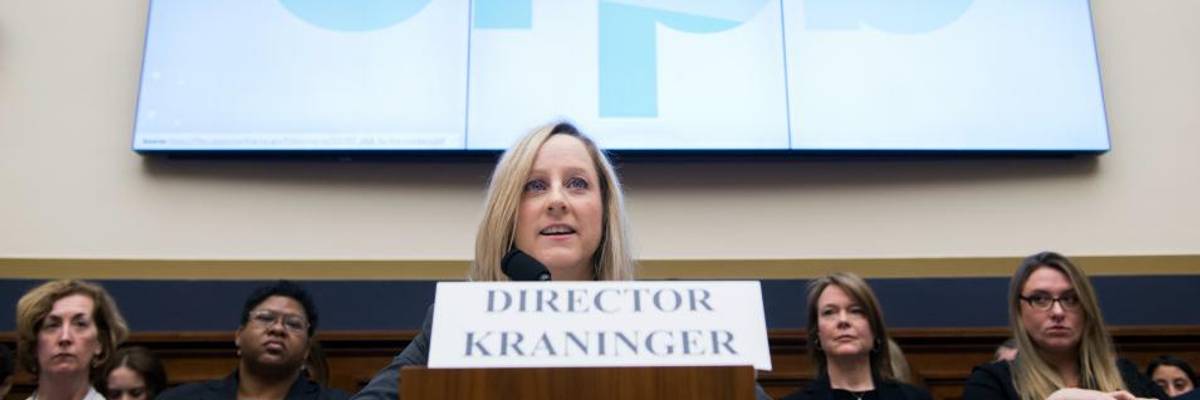
Kathy Kraninger, director of the Consumer Financial Protection Bureau, testifies at a House Financial Services Committee hearing on Thursday, March 7, 2019. (Photo: Tom Williams/CQ Roll Call)
Amid an unprecedented economic crisis driven by the novel coronavirus pandemic, the Consumer Financial Protection Bureau is reportedly pushing ahead with a series of rule changes that watchdog groups say would reward predatory lenders and leave vulnerable people more susceptible to industry abuses at the worst possible time.
The American Banker reported this week that the CFPB--headed by Kathy Kraninger, an appointee of President Donald Trump--is "moving forward with its payday lending and 'qualified mortgage' rules despite logistical issues and the industry's focus on economic effects from the coronavirus pandemic."
"The director should be using every resource at her disposal to shut down financial fraudsters that thrive in economic downturns like this. Instead, she's busy crossing off wish list items for greedy industries."
--Jeremy Funk, Allied Progress
"Since the outbreak began, the financial regulators have paused some efforts but persisted with others," The American Banker noted. "Yet the CFPB is moving quickly to finalize some rules to make it harder--should the Democrats win the presidency in November--for a new agency director to reverse them, according to sources familiar with the agency's thinking."
The payday lending proposal, which has been under consideration for more than a year, would gut an Obama-era rule requiring payday lenders to verify that borrowers have the ability to repay before approving a loan.
The rule--which Kraninger delayed by 15 months last August--was intended to serve as a safeguard against debt traps set by payday lenders, which charge exorbitant interest rates for small short-term loans. The Payday Loan Debt Trap Tracker estimates that the delay in implementing the Obama-era rule has cost consumers over $4 billion in fees.
According to The American Banker, the CFPB is also "expected to issue a separate rulemaking at the same time to reconsider the payment provision of the original rule limiting how often a lender can access a consumer's checking account."
Jeremy Funk, spokesman for consumer watchdog group Allied Progress, said in a statement Thursday that "not even a pandemic and looming recession can keep Director Kraninger from empowering predatory lenders to rip off vulnerable consumers."
"The director should be using every resource at her disposal to shut down financial fraudsters that thrive in economic downturns like this," said Funk. "Instead, she's busy crossing off wish list items for greedy industries that have given her boss millions of dollars, just like she's done any other day on the job."
Last October, as Common Dreams reported, Allied Progress obtained audio of payday lending executives bragging about how they have used campaign donations to Trump to obtain access to the White House and exert influence over policymaking.
Diane Thompson, a former regulator at the CFPB, tweeted that it is "disappointing" but "not surprising that CFPB is continuing a deregulatory, anti-transparency, anti-accountability, anti-consumer protection rulemaking agenda, even in the face of Covid-19."
Last month, as the coronavirus-induced economic downturn accelerated, the CFPB joined four other federal financial regulators in urging banks to increase small-dollar lending to assist people with short-term financial struggles.
Consumer advocacy groups and civil rights organizations raised alarm at the recommendation, calling it an invitation for banks to prey on vulnerable consumers.
"This is the worst possible time for banks to make predatory payday loans," a coalition of groups including the Center for Responsible Lending and NAACP said in a joint statement. "Government regulators have opened the door for banks to exploit people, rather than to help them."
Dear Common Dreams reader, It’s been nearly 30 years since I co-founded Common Dreams with my late wife, Lina Newhouser. We had the radical notion that journalism should serve the public good, not corporate profits. It was clear to us from the outset what it would take to build such a project. No paid advertisements. No corporate sponsors. No millionaire publisher telling us what to think or do. Many people said we wouldn't last a year, but we proved those doubters wrong. Together with a tremendous team of journalists and dedicated staff, we built an independent media outlet free from the constraints of profits and corporate control. Our mission has always been simple: To inform. To inspire. To ignite change for the common good. Building Common Dreams was not easy. Our survival was never guaranteed. When you take on the most powerful forces—Wall Street greed, fossil fuel industry destruction, Big Tech lobbyists, and uber-rich oligarchs who have spent billions upon billions rigging the economy and democracy in their favor—the only bulwark you have is supporters who believe in your work. But here’s the urgent message from me today. It's never been this bad out there. And it's never been this hard to keep us going. At the very moment Common Dreams is most needed, the threats we face are intensifying. We need your support now more than ever. We don't accept corporate advertising and never will. We don't have a paywall because we don't think people should be blocked from critical news based on their ability to pay. Everything we do is funded by the donations of readers like you. When everyone does the little they can afford, we are strong. But if that support retreats or dries up, so do we. Will you donate now to make sure Common Dreams not only survives but thrives? —Craig Brown, Co-founder |
Amid an unprecedented economic crisis driven by the novel coronavirus pandemic, the Consumer Financial Protection Bureau is reportedly pushing ahead with a series of rule changes that watchdog groups say would reward predatory lenders and leave vulnerable people more susceptible to industry abuses at the worst possible time.
The American Banker reported this week that the CFPB--headed by Kathy Kraninger, an appointee of President Donald Trump--is "moving forward with its payday lending and 'qualified mortgage' rules despite logistical issues and the industry's focus on economic effects from the coronavirus pandemic."
"The director should be using every resource at her disposal to shut down financial fraudsters that thrive in economic downturns like this. Instead, she's busy crossing off wish list items for greedy industries."
--Jeremy Funk, Allied Progress
"Since the outbreak began, the financial regulators have paused some efforts but persisted with others," The American Banker noted. "Yet the CFPB is moving quickly to finalize some rules to make it harder--should the Democrats win the presidency in November--for a new agency director to reverse them, according to sources familiar with the agency's thinking."
The payday lending proposal, which has been under consideration for more than a year, would gut an Obama-era rule requiring payday lenders to verify that borrowers have the ability to repay before approving a loan.
The rule--which Kraninger delayed by 15 months last August--was intended to serve as a safeguard against debt traps set by payday lenders, which charge exorbitant interest rates for small short-term loans. The Payday Loan Debt Trap Tracker estimates that the delay in implementing the Obama-era rule has cost consumers over $4 billion in fees.
According to The American Banker, the CFPB is also "expected to issue a separate rulemaking at the same time to reconsider the payment provision of the original rule limiting how often a lender can access a consumer's checking account."
Jeremy Funk, spokesman for consumer watchdog group Allied Progress, said in a statement Thursday that "not even a pandemic and looming recession can keep Director Kraninger from empowering predatory lenders to rip off vulnerable consumers."
"The director should be using every resource at her disposal to shut down financial fraudsters that thrive in economic downturns like this," said Funk. "Instead, she's busy crossing off wish list items for greedy industries that have given her boss millions of dollars, just like she's done any other day on the job."
Last October, as Common Dreams reported, Allied Progress obtained audio of payday lending executives bragging about how they have used campaign donations to Trump to obtain access to the White House and exert influence over policymaking.
Diane Thompson, a former regulator at the CFPB, tweeted that it is "disappointing" but "not surprising that CFPB is continuing a deregulatory, anti-transparency, anti-accountability, anti-consumer protection rulemaking agenda, even in the face of Covid-19."
Last month, as the coronavirus-induced economic downturn accelerated, the CFPB joined four other federal financial regulators in urging banks to increase small-dollar lending to assist people with short-term financial struggles.
Consumer advocacy groups and civil rights organizations raised alarm at the recommendation, calling it an invitation for banks to prey on vulnerable consumers.
"This is the worst possible time for banks to make predatory payday loans," a coalition of groups including the Center for Responsible Lending and NAACP said in a joint statement. "Government regulators have opened the door for banks to exploit people, rather than to help them."
Amid an unprecedented economic crisis driven by the novel coronavirus pandemic, the Consumer Financial Protection Bureau is reportedly pushing ahead with a series of rule changes that watchdog groups say would reward predatory lenders and leave vulnerable people more susceptible to industry abuses at the worst possible time.
The American Banker reported this week that the CFPB--headed by Kathy Kraninger, an appointee of President Donald Trump--is "moving forward with its payday lending and 'qualified mortgage' rules despite logistical issues and the industry's focus on economic effects from the coronavirus pandemic."
"The director should be using every resource at her disposal to shut down financial fraudsters that thrive in economic downturns like this. Instead, she's busy crossing off wish list items for greedy industries."
--Jeremy Funk, Allied Progress
"Since the outbreak began, the financial regulators have paused some efforts but persisted with others," The American Banker noted. "Yet the CFPB is moving quickly to finalize some rules to make it harder--should the Democrats win the presidency in November--for a new agency director to reverse them, according to sources familiar with the agency's thinking."
The payday lending proposal, which has been under consideration for more than a year, would gut an Obama-era rule requiring payday lenders to verify that borrowers have the ability to repay before approving a loan.
The rule--which Kraninger delayed by 15 months last August--was intended to serve as a safeguard against debt traps set by payday lenders, which charge exorbitant interest rates for small short-term loans. The Payday Loan Debt Trap Tracker estimates that the delay in implementing the Obama-era rule has cost consumers over $4 billion in fees.
According to The American Banker, the CFPB is also "expected to issue a separate rulemaking at the same time to reconsider the payment provision of the original rule limiting how often a lender can access a consumer's checking account."
Jeremy Funk, spokesman for consumer watchdog group Allied Progress, said in a statement Thursday that "not even a pandemic and looming recession can keep Director Kraninger from empowering predatory lenders to rip off vulnerable consumers."
"The director should be using every resource at her disposal to shut down financial fraudsters that thrive in economic downturns like this," said Funk. "Instead, she's busy crossing off wish list items for greedy industries that have given her boss millions of dollars, just like she's done any other day on the job."
Last October, as Common Dreams reported, Allied Progress obtained audio of payday lending executives bragging about how they have used campaign donations to Trump to obtain access to the White House and exert influence over policymaking.
Diane Thompson, a former regulator at the CFPB, tweeted that it is "disappointing" but "not surprising that CFPB is continuing a deregulatory, anti-transparency, anti-accountability, anti-consumer protection rulemaking agenda, even in the face of Covid-19."
Last month, as the coronavirus-induced economic downturn accelerated, the CFPB joined four other federal financial regulators in urging banks to increase small-dollar lending to assist people with short-term financial struggles.
Consumer advocacy groups and civil rights organizations raised alarm at the recommendation, calling it an invitation for banks to prey on vulnerable consumers.
"This is the worst possible time for banks to make predatory payday loans," a coalition of groups including the Center for Responsible Lending and NAACP said in a joint statement. "Government regulators have opened the door for banks to exploit people, rather than to help them."