

SUBSCRIBE TO OUR FREE NEWSLETTER
Daily news & progressive opinion—funded by the people, not the corporations—delivered straight to your inbox.
5
#000000
#FFFFFF
To donate by check, phone, or other method, see our More Ways to Give page.
Daily news & progressive opinion—funded by the people, not the corporations—delivered straight to your inbox.
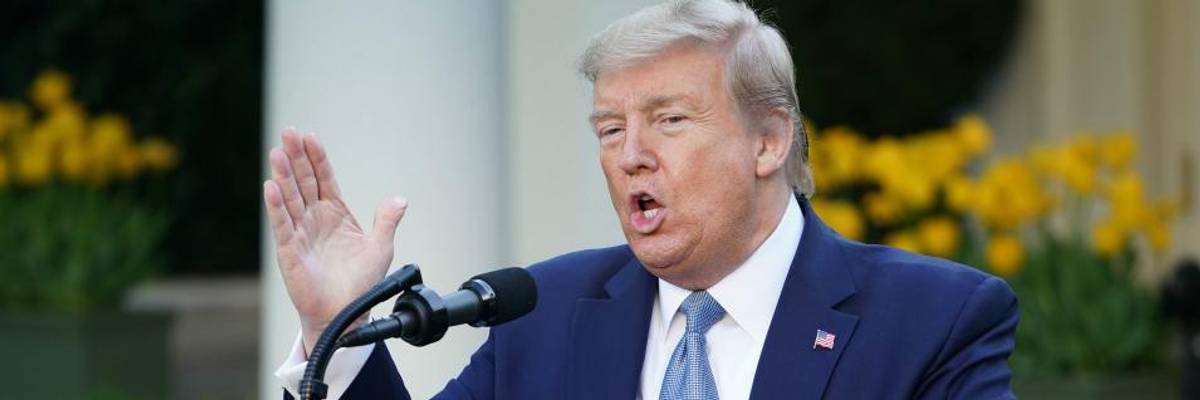
President Donald Trump speaks during the daily briefing on the novel coronavirus at the Rose Garden of the White House on April 15, 2020 in Washington, D.C. (Photo: Mandel Ngan/AFP via Getty Images)
President Donald Trump on Wednesday threatened to adjourn both chambers of Congress so he can unilaterally ram through judges and political appointees amid the coronavirus pandemic, a move Democratic lawmakers and legal experts said would be dictatorial and unconstitutional.
During a press conference in the Rose Garden of the White House Wednesday evening, Trump urged Congress to voluntarily vote to end the current legislative session so he can "recess appoint" nominees without Senate approval. Members of Congress are currently in their home districts and not expected to return to Washington, D.C. until next month at the earliest due to concerns about the spread of Covid-19.
" Donald Trump thinks he's above the law. Time and again, the Republican justices on the Supreme Court have told him he's right--enabling his worst impulses."
--Demand Justice
"If the House will not agree to that adjournment, I will exercise my constitutional authority to adjourn both chambers of Congress," Trump declared. "The current practice of leaving town while conducting phony pro forma sessions is a dereliction of duty that the American people cannot afford during this crisis. It is a scam what they do."
The Constitution does give the president the authority to unilaterally adjourn both chambers of Congress, but only "in Case of Disagreement between them, with Respect to the Time of Adjournment." As Steve Vladeck, a professor at the University of Texas School of Law, pointed out on Twitter, there is no such disagreement at present.
"Article II of the Constitution gives the president the power to adjourn Congress if--and only if--the House and Senate cannot agree on a date for ending the current session," wrote Vladeck. "But they have agreed--January 3, 2021. There's a reason why this power has never been exercised before."
Trump's threat was immediately condemned by Democratic members of Congress.
Rep. Jamie Raskin (D-Md.), a constitutional law expert and member of the House Judiciary Committee, told the Washington Post Wednesday that "dissolving an assembly comes out of a dictator's handbook."
"That's banana republic stuff," said Raskin.
Trump's warning to Congress came after the president had a conversation with Senate Majority Leader Mitch McConnell (R-Ky.) earlier Wednesday in which the two reportedly discussed Senate Democrats' supposedly "unprecedented obstruction of the president's well-qualified nominees."
As Common Dreams reported, Trump and McConnell have not allowed the coronavirus pandemic to hinder their effort to shift the U.S. judiciary further to the right by filling vacancies with disproportionately young and--contrary to the president's claims--unqualified nominees.
Earlier this month, Trump announced the nomination of U.S. District Judge Justin Walker to the U.S. Court of Appeals for the D.C. Circuit. In late March, the president nominated Mississippi Court of Appeals Judge Cory Wilson to the U.S. Court of Appeals for the Fifth Circuit.
As for nominees to vacant posts within his administration, Trump claimed Wednesday that the positions must be filled to help the White House with its coronavirus response. But as the Post reported, "most of the vacancies in the federal government are because Trump hasn't selected anyone to fill them."
Trump said that if Congress doesn't agree to voluntarily end the current session, he plans to attempt to unilaterally adjourn both chambers and fight it out in the courts.
"They know they've been warned and they've been warned right now," said Trump. "If they don't approve it, then we're going to go this route and we'll probably be challenged in court and we'll see who wins."
Advocacy group Demand Justice tweeted in response to the president's remarks that "Donald Trump thinks he's above the law."
"Time and again, the Republican justices on the Supreme Court have told him he's right," the group said, "enabling his worst impulses."
Dear Common Dreams reader, It’s been nearly 30 years since I co-founded Common Dreams with my late wife, Lina Newhouser. We had the radical notion that journalism should serve the public good, not corporate profits. It was clear to us from the outset what it would take to build such a project. No paid advertisements. No corporate sponsors. No millionaire publisher telling us what to think or do. Many people said we wouldn't last a year, but we proved those doubters wrong. Together with a tremendous team of journalists and dedicated staff, we built an independent media outlet free from the constraints of profits and corporate control. Our mission has always been simple: To inform. To inspire. To ignite change for the common good. Building Common Dreams was not easy. Our survival was never guaranteed. When you take on the most powerful forces—Wall Street greed, fossil fuel industry destruction, Big Tech lobbyists, and uber-rich oligarchs who have spent billions upon billions rigging the economy and democracy in their favor—the only bulwark you have is supporters who believe in your work. But here’s the urgent message from me today. It's never been this bad out there. And it's never been this hard to keep us going. At the very moment Common Dreams is most needed, the threats we face are intensifying. We need your support now more than ever. We don't accept corporate advertising and never will. We don't have a paywall because we don't think people should be blocked from critical news based on their ability to pay. Everything we do is funded by the donations of readers like you. When everyone does the little they can afford, we are strong. But if that support retreats or dries up, so do we. Will you donate now to make sure Common Dreams not only survives but thrives? —Craig Brown, Co-founder |
President Donald Trump on Wednesday threatened to adjourn both chambers of Congress so he can unilaterally ram through judges and political appointees amid the coronavirus pandemic, a move Democratic lawmakers and legal experts said would be dictatorial and unconstitutional.
During a press conference in the Rose Garden of the White House Wednesday evening, Trump urged Congress to voluntarily vote to end the current legislative session so he can "recess appoint" nominees without Senate approval. Members of Congress are currently in their home districts and not expected to return to Washington, D.C. until next month at the earliest due to concerns about the spread of Covid-19.
" Donald Trump thinks he's above the law. Time and again, the Republican justices on the Supreme Court have told him he's right--enabling his worst impulses."
--Demand Justice
"If the House will not agree to that adjournment, I will exercise my constitutional authority to adjourn both chambers of Congress," Trump declared. "The current practice of leaving town while conducting phony pro forma sessions is a dereliction of duty that the American people cannot afford during this crisis. It is a scam what they do."
The Constitution does give the president the authority to unilaterally adjourn both chambers of Congress, but only "in Case of Disagreement between them, with Respect to the Time of Adjournment." As Steve Vladeck, a professor at the University of Texas School of Law, pointed out on Twitter, there is no such disagreement at present.
"Article II of the Constitution gives the president the power to adjourn Congress if--and only if--the House and Senate cannot agree on a date for ending the current session," wrote Vladeck. "But they have agreed--January 3, 2021. There's a reason why this power has never been exercised before."
Trump's threat was immediately condemned by Democratic members of Congress.
Rep. Jamie Raskin (D-Md.), a constitutional law expert and member of the House Judiciary Committee, told the Washington Post Wednesday that "dissolving an assembly comes out of a dictator's handbook."
"That's banana republic stuff," said Raskin.
Trump's warning to Congress came after the president had a conversation with Senate Majority Leader Mitch McConnell (R-Ky.) earlier Wednesday in which the two reportedly discussed Senate Democrats' supposedly "unprecedented obstruction of the president's well-qualified nominees."
As Common Dreams reported, Trump and McConnell have not allowed the coronavirus pandemic to hinder their effort to shift the U.S. judiciary further to the right by filling vacancies with disproportionately young and--contrary to the president's claims--unqualified nominees.
Earlier this month, Trump announced the nomination of U.S. District Judge Justin Walker to the U.S. Court of Appeals for the D.C. Circuit. In late March, the president nominated Mississippi Court of Appeals Judge Cory Wilson to the U.S. Court of Appeals for the Fifth Circuit.
As for nominees to vacant posts within his administration, Trump claimed Wednesday that the positions must be filled to help the White House with its coronavirus response. But as the Post reported, "most of the vacancies in the federal government are because Trump hasn't selected anyone to fill them."
Trump said that if Congress doesn't agree to voluntarily end the current session, he plans to attempt to unilaterally adjourn both chambers and fight it out in the courts.
"They know they've been warned and they've been warned right now," said Trump. "If they don't approve it, then we're going to go this route and we'll probably be challenged in court and we'll see who wins."
Advocacy group Demand Justice tweeted in response to the president's remarks that "Donald Trump thinks he's above the law."
"Time and again, the Republican justices on the Supreme Court have told him he's right," the group said, "enabling his worst impulses."
President Donald Trump on Wednesday threatened to adjourn both chambers of Congress so he can unilaterally ram through judges and political appointees amid the coronavirus pandemic, a move Democratic lawmakers and legal experts said would be dictatorial and unconstitutional.
During a press conference in the Rose Garden of the White House Wednesday evening, Trump urged Congress to voluntarily vote to end the current legislative session so he can "recess appoint" nominees without Senate approval. Members of Congress are currently in their home districts and not expected to return to Washington, D.C. until next month at the earliest due to concerns about the spread of Covid-19.
" Donald Trump thinks he's above the law. Time and again, the Republican justices on the Supreme Court have told him he's right--enabling his worst impulses."
--Demand Justice
"If the House will not agree to that adjournment, I will exercise my constitutional authority to adjourn both chambers of Congress," Trump declared. "The current practice of leaving town while conducting phony pro forma sessions is a dereliction of duty that the American people cannot afford during this crisis. It is a scam what they do."
The Constitution does give the president the authority to unilaterally adjourn both chambers of Congress, but only "in Case of Disagreement between them, with Respect to the Time of Adjournment." As Steve Vladeck, a professor at the University of Texas School of Law, pointed out on Twitter, there is no such disagreement at present.
"Article II of the Constitution gives the president the power to adjourn Congress if--and only if--the House and Senate cannot agree on a date for ending the current session," wrote Vladeck. "But they have agreed--January 3, 2021. There's a reason why this power has never been exercised before."
Trump's threat was immediately condemned by Democratic members of Congress.
Rep. Jamie Raskin (D-Md.), a constitutional law expert and member of the House Judiciary Committee, told the Washington Post Wednesday that "dissolving an assembly comes out of a dictator's handbook."
"That's banana republic stuff," said Raskin.
Trump's warning to Congress came after the president had a conversation with Senate Majority Leader Mitch McConnell (R-Ky.) earlier Wednesday in which the two reportedly discussed Senate Democrats' supposedly "unprecedented obstruction of the president's well-qualified nominees."
As Common Dreams reported, Trump and McConnell have not allowed the coronavirus pandemic to hinder their effort to shift the U.S. judiciary further to the right by filling vacancies with disproportionately young and--contrary to the president's claims--unqualified nominees.
Earlier this month, Trump announced the nomination of U.S. District Judge Justin Walker to the U.S. Court of Appeals for the D.C. Circuit. In late March, the president nominated Mississippi Court of Appeals Judge Cory Wilson to the U.S. Court of Appeals for the Fifth Circuit.
As for nominees to vacant posts within his administration, Trump claimed Wednesday that the positions must be filled to help the White House with its coronavirus response. But as the Post reported, "most of the vacancies in the federal government are because Trump hasn't selected anyone to fill them."
Trump said that if Congress doesn't agree to voluntarily end the current session, he plans to attempt to unilaterally adjourn both chambers and fight it out in the courts.
"They know they've been warned and they've been warned right now," said Trump. "If they don't approve it, then we're going to go this route and we'll probably be challenged in court and we'll see who wins."
Advocacy group Demand Justice tweeted in response to the president's remarks that "Donald Trump thinks he's above the law."
"Time and again, the Republican justices on the Supreme Court have told him he's right," the group said, "enabling his worst impulses."

