SUBSCRIBE TO OUR FREE NEWSLETTER
Daily news & progressive opinion—funded by the people, not the corporations—delivered straight to your inbox.
5
#000000
#FFFFFF
To donate by check, phone, or other method, see our More Ways to Give page.
Daily news & progressive opinion—funded by the people, not the corporations—delivered straight to your inbox.
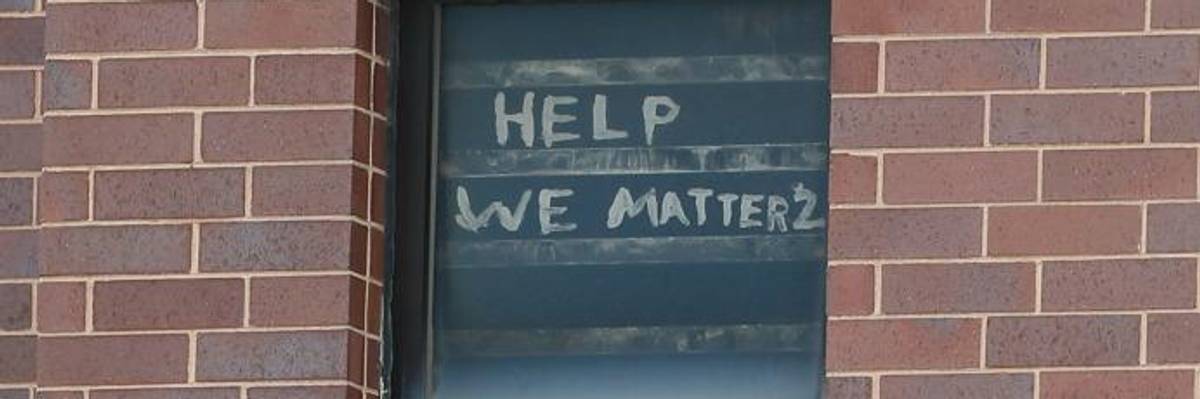
The words "help we matter 2" are seen written in a window at the Cook County Department of Corrections (CCDOC), housing one of the nation's largest jails, is seen in Chicago, on April 9, 2020. The Cook County Sheriff's Office reported that as of 5pm on April 9, 2020, 276 inmates and 172 Sheriff's Office staff had tested positive for the virus. (Photo: Kamil Krzaczynski/AFP via Getty Images)
The same day a second Cook County Jail inmate died after testing positive for the coronavirus, a federal judge denied detainees' request for emergency release from the disease hotspot.
The Chicago jail is largest-known source of COVID-19 infections in the nation, the New York Times reported Wednesday. As of Thursday, 276 inmates and 172 Sheriff's Office staff had tested positive for the disease.
The ruling from U.S. District Judge Matthew F. Kennell, said lawyers for the inmates, fell far short of the remedy they'd asked for, which included the release of inmates medically vulnerable to COVID-19.
"We are disappointed that there has been no order for further releases from Cook County Jail. Leaving people incarcerated in Cook County Jail during this public health crisis is effectively leaving them to die. If we the county does not decarcerate quickly, more people will die," said Sharlyn Grace, executive director of Chicago Community Bond Fund, one of the groups that helped file the class-action lawsuit against the Cook County Sheriff's Office.
Judge Kennell granted part of the lawyers' requests, ordering the sheriff to:
The inmates' advocates welcomed those orders to Sheriff Thomas Dart as "an important first step."
Sheriff Dart claimed the jail was already implementing those measures, save the requirement of face masks. "But if the judge is going to order us to do that then we'll to have to do that," he said. "We're just going to have to see where we can find the medical masks."
Sarah Grady, an attorney with the Chicago-based civil rights law firm Loevy and Loevy, said it's clear more must be done to protect the constitutional rights of the inmates.
"The court's order is a significant first step to protecting the rights and well being of people at the jail which is in the midst of a crisis. But this is only the first step and we will continue to work to protect those who are vulnerable in the jail as the lawsuit continues," she said.
Fifty-nine-year-old Jeffery Pendleton on Sunday became the first Cook County Jail inmate to die from COVID-19 complications. Fifty-one-year-old Leslie Pieroni on Thursday died after testing positive for COVID-19.
Civil rights advocates fear Pendleton and Pieroni's COVID-19-related deaths won't be the last at the jail as the pandemic continues to rage.
"Nearly 1,000 of these people are incarcerated only because they can't afford to pay their bond," added Chicago Community Bond Fund's Grace. "The size of someone's bank account shouldn't determine whether or not they survive this pandemic."
Dear Common Dreams reader, It’s been nearly 30 years since I co-founded Common Dreams with my late wife, Lina Newhouser. We had the radical notion that journalism should serve the public good, not corporate profits. It was clear to us from the outset what it would take to build such a project. No paid advertisements. No corporate sponsors. No millionaire publisher telling us what to think or do. Many people said we wouldn't last a year, but we proved those doubters wrong. Together with a tremendous team of journalists and dedicated staff, we built an independent media outlet free from the constraints of profits and corporate control. Our mission has always been simple: To inform. To inspire. To ignite change for the common good. Building Common Dreams was not easy. Our survival was never guaranteed. When you take on the most powerful forces—Wall Street greed, fossil fuel industry destruction, Big Tech lobbyists, and uber-rich oligarchs who have spent billions upon billions rigging the economy and democracy in their favor—the only bulwark you have is supporters who believe in your work. But here’s the urgent message from me today. It's never been this bad out there. And it's never been this hard to keep us going. At the very moment Common Dreams is most needed, the threats we face are intensifying. We need your support now more than ever. We don't accept corporate advertising and never will. We don't have a paywall because we don't think people should be blocked from critical news based on their ability to pay. Everything we do is funded by the donations of readers like you. When everyone does the little they can afford, we are strong. But if that support retreats or dries up, so do we. Will you donate now to make sure Common Dreams not only survives but thrives? —Craig Brown, Co-founder |
The same day a second Cook County Jail inmate died after testing positive for the coronavirus, a federal judge denied detainees' request for emergency release from the disease hotspot.
The Chicago jail is largest-known source of COVID-19 infections in the nation, the New York Times reported Wednesday. As of Thursday, 276 inmates and 172 Sheriff's Office staff had tested positive for the disease.
The ruling from U.S. District Judge Matthew F. Kennell, said lawyers for the inmates, fell far short of the remedy they'd asked for, which included the release of inmates medically vulnerable to COVID-19.
"We are disappointed that there has been no order for further releases from Cook County Jail. Leaving people incarcerated in Cook County Jail during this public health crisis is effectively leaving them to die. If we the county does not decarcerate quickly, more people will die," said Sharlyn Grace, executive director of Chicago Community Bond Fund, one of the groups that helped file the class-action lawsuit against the Cook County Sheriff's Office.
Judge Kennell granted part of the lawyers' requests, ordering the sheriff to:
The inmates' advocates welcomed those orders to Sheriff Thomas Dart as "an important first step."
Sheriff Dart claimed the jail was already implementing those measures, save the requirement of face masks. "But if the judge is going to order us to do that then we'll to have to do that," he said. "We're just going to have to see where we can find the medical masks."
Sarah Grady, an attorney with the Chicago-based civil rights law firm Loevy and Loevy, said it's clear more must be done to protect the constitutional rights of the inmates.
"The court's order is a significant first step to protecting the rights and well being of people at the jail which is in the midst of a crisis. But this is only the first step and we will continue to work to protect those who are vulnerable in the jail as the lawsuit continues," she said.
Fifty-nine-year-old Jeffery Pendleton on Sunday became the first Cook County Jail inmate to die from COVID-19 complications. Fifty-one-year-old Leslie Pieroni on Thursday died after testing positive for COVID-19.
Civil rights advocates fear Pendleton and Pieroni's COVID-19-related deaths won't be the last at the jail as the pandemic continues to rage.
"Nearly 1,000 of these people are incarcerated only because they can't afford to pay their bond," added Chicago Community Bond Fund's Grace. "The size of someone's bank account shouldn't determine whether or not they survive this pandemic."
The same day a second Cook County Jail inmate died after testing positive for the coronavirus, a federal judge denied detainees' request for emergency release from the disease hotspot.
The Chicago jail is largest-known source of COVID-19 infections in the nation, the New York Times reported Wednesday. As of Thursday, 276 inmates and 172 Sheriff's Office staff had tested positive for the disease.
The ruling from U.S. District Judge Matthew F. Kennell, said lawyers for the inmates, fell far short of the remedy they'd asked for, which included the release of inmates medically vulnerable to COVID-19.
"We are disappointed that there has been no order for further releases from Cook County Jail. Leaving people incarcerated in Cook County Jail during this public health crisis is effectively leaving them to die. If we the county does not decarcerate quickly, more people will die," said Sharlyn Grace, executive director of Chicago Community Bond Fund, one of the groups that helped file the class-action lawsuit against the Cook County Sheriff's Office.
Judge Kennell granted part of the lawyers' requests, ordering the sheriff to:
The inmates' advocates welcomed those orders to Sheriff Thomas Dart as "an important first step."
Sheriff Dart claimed the jail was already implementing those measures, save the requirement of face masks. "But if the judge is going to order us to do that then we'll to have to do that," he said. "We're just going to have to see where we can find the medical masks."
Sarah Grady, an attorney with the Chicago-based civil rights law firm Loevy and Loevy, said it's clear more must be done to protect the constitutional rights of the inmates.
"The court's order is a significant first step to protecting the rights and well being of people at the jail which is in the midst of a crisis. But this is only the first step and we will continue to work to protect those who are vulnerable in the jail as the lawsuit continues," she said.
Fifty-nine-year-old Jeffery Pendleton on Sunday became the first Cook County Jail inmate to die from COVID-19 complications. Fifty-one-year-old Leslie Pieroni on Thursday died after testing positive for COVID-19.
Civil rights advocates fear Pendleton and Pieroni's COVID-19-related deaths won't be the last at the jail as the pandemic continues to rage.
"Nearly 1,000 of these people are incarcerated only because they can't afford to pay their bond," added Chicago Community Bond Fund's Grace. "The size of someone's bank account shouldn't determine whether or not they survive this pandemic."