

SUBSCRIBE TO OUR FREE NEWSLETTER
Daily news & progressive opinion—funded by the people, not the corporations—delivered straight to your inbox.
5
#000000
#FFFFFF
To donate by check, phone, or other method, see our More Ways to Give page.
Daily news & progressive opinion—funded by the people, not the corporations—delivered straight to your inbox.
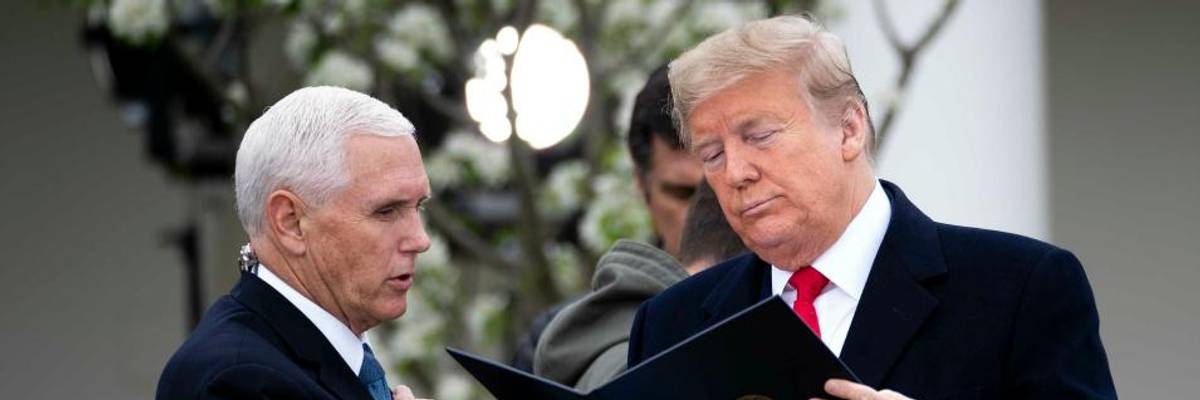
President Donald Trump and Vice President Mike Pence look over some notes as they participate in a Fox News Virtual Town Hall with Anchor Bill Hemmer in the Rose Garden of the White House on March 24, 2020 in Washington, D.C. (Photo: Doug Mills-Pool/Getty Images)
A massive coronavirus stimulus plan that the Senate and White House agreed to in the early hours of Wednesday morning would bar any companies owned or controlled by President Donald Trump, the president's children, Vice President Mike Pence, or members of Congress from receiving any taxpayer bailout money, according to a summary of the legislation circulated by Senate Minority Leader Chuck Schumer.
The sprawling $2 trillion bill, which has not yet been released in full, would "prohibit businesses controlled by the president, vice president, members of Congress, and heads of executive departments from receiving loans or investments from Treasury programs," Schumer's summary states.
"The children, spouses, and in-laws of the aforementioned principals are also included in this prohibition," the document adds.
Trump in recent days has voiced his desire for the hotel industry to be among the corporate beneficiaries of any congressional stimulus legislation and--after being pressed repeatedly by reporters--has refused to vow that his own companies would not receive money from any taxpayer bailout programs.
The president also asserted that he will personally oversee the corporate bailout funds. "We're going to make good deals," Trump said during a press briefing on Monday.
"Several Trump-branded properties have been affected by the virus-induced demand crash, as well as state and local restrictions on going out in public," Bloomberg reported Wednesday morning.
Senate Democrats earlier this week stopped the GOP's efforts to advance an earlier version of the stimulus bill in an effort to extract concessions from the White House and Senate Republicans, who Democrats accused of attempting to force through a corporate "slush fund" with little regard for workers.
In negotiations with Senate Republicans and Trump administration officials, Democrats reportedly won inclusion of a significant boost in unemployment benefits (which would also be extended to gig workers), more money for hospitals, and independent oversight of a $500 billion corporate loan fund that the legislation would establish.
As the heated talks over the stimulus bill progressed Tuesday, progressive lawmakers expressed concerns about the enormous legislative package, which could hit the Senate floor for a vote as soon as Wednesday afternoon.
"The developments of this Senate relief bill are concerning," Rep. Alexandria Ocasio-Cortez (D-N.Y.) tweeted Tuesday afternoon, before the Senate agreement was finalized. "We are hearing lots of vague statements, but not a single member of Congress has seen actual bill text. It seems to give a *HALF TRILLION DOLLARS* away to big corporations, with few worker protections. Half a trillion."
With the House out of session and lawmakers wary of returning to Capitol Hill amid the coronavirus outbreak, House Speaker Nancy Pelosi (D-Calif.) is expected to attempt to pass the Senate bill by unanimous consent, which requires the agreement of every member.
"If unanimous consent is not possible," the Washington Post reported, "aides of both parties said the most likely scenario would be a day-long vote where members would be encouraged to spread out their trips to the floor and not congregate as the vote is taken."
Dear Common Dreams reader, It’s been nearly 30 years since I co-founded Common Dreams with my late wife, Lina Newhouser. We had the radical notion that journalism should serve the public good, not corporate profits. It was clear to us from the outset what it would take to build such a project. No paid advertisements. No corporate sponsors. No millionaire publisher telling us what to think or do. Many people said we wouldn't last a year, but we proved those doubters wrong. Together with a tremendous team of journalists and dedicated staff, we built an independent media outlet free from the constraints of profits and corporate control. Our mission has always been simple: To inform. To inspire. To ignite change for the common good. Building Common Dreams was not easy. Our survival was never guaranteed. When you take on the most powerful forces—Wall Street greed, fossil fuel industry destruction, Big Tech lobbyists, and uber-rich oligarchs who have spent billions upon billions rigging the economy and democracy in their favor—the only bulwark you have is supporters who believe in your work. But here’s the urgent message from me today. It's never been this bad out there. And it's never been this hard to keep us going. At the very moment Common Dreams is most needed, the threats we face are intensifying. We need your support now more than ever. We don't accept corporate advertising and never will. We don't have a paywall because we don't think people should be blocked from critical news based on their ability to pay. Everything we do is funded by the donations of readers like you. When everyone does the little they can afford, we are strong. But if that support retreats or dries up, so do we. Will you donate now to make sure Common Dreams not only survives but thrives? —Craig Brown, Co-founder |
A massive coronavirus stimulus plan that the Senate and White House agreed to in the early hours of Wednesday morning would bar any companies owned or controlled by President Donald Trump, the president's children, Vice President Mike Pence, or members of Congress from receiving any taxpayer bailout money, according to a summary of the legislation circulated by Senate Minority Leader Chuck Schumer.
The sprawling $2 trillion bill, which has not yet been released in full, would "prohibit businesses controlled by the president, vice president, members of Congress, and heads of executive departments from receiving loans or investments from Treasury programs," Schumer's summary states.
"The children, spouses, and in-laws of the aforementioned principals are also included in this prohibition," the document adds.
Trump in recent days has voiced his desire for the hotel industry to be among the corporate beneficiaries of any congressional stimulus legislation and--after being pressed repeatedly by reporters--has refused to vow that his own companies would not receive money from any taxpayer bailout programs.
The president also asserted that he will personally oversee the corporate bailout funds. "We're going to make good deals," Trump said during a press briefing on Monday.
"Several Trump-branded properties have been affected by the virus-induced demand crash, as well as state and local restrictions on going out in public," Bloomberg reported Wednesday morning.
Senate Democrats earlier this week stopped the GOP's efforts to advance an earlier version of the stimulus bill in an effort to extract concessions from the White House and Senate Republicans, who Democrats accused of attempting to force through a corporate "slush fund" with little regard for workers.
In negotiations with Senate Republicans and Trump administration officials, Democrats reportedly won inclusion of a significant boost in unemployment benefits (which would also be extended to gig workers), more money for hospitals, and independent oversight of a $500 billion corporate loan fund that the legislation would establish.
As the heated talks over the stimulus bill progressed Tuesday, progressive lawmakers expressed concerns about the enormous legislative package, which could hit the Senate floor for a vote as soon as Wednesday afternoon.
"The developments of this Senate relief bill are concerning," Rep. Alexandria Ocasio-Cortez (D-N.Y.) tweeted Tuesday afternoon, before the Senate agreement was finalized. "We are hearing lots of vague statements, but not a single member of Congress has seen actual bill text. It seems to give a *HALF TRILLION DOLLARS* away to big corporations, with few worker protections. Half a trillion."
With the House out of session and lawmakers wary of returning to Capitol Hill amid the coronavirus outbreak, House Speaker Nancy Pelosi (D-Calif.) is expected to attempt to pass the Senate bill by unanimous consent, which requires the agreement of every member.
"If unanimous consent is not possible," the Washington Post reported, "aides of both parties said the most likely scenario would be a day-long vote where members would be encouraged to spread out their trips to the floor and not congregate as the vote is taken."
A massive coronavirus stimulus plan that the Senate and White House agreed to in the early hours of Wednesday morning would bar any companies owned or controlled by President Donald Trump, the president's children, Vice President Mike Pence, or members of Congress from receiving any taxpayer bailout money, according to a summary of the legislation circulated by Senate Minority Leader Chuck Schumer.
The sprawling $2 trillion bill, which has not yet been released in full, would "prohibit businesses controlled by the president, vice president, members of Congress, and heads of executive departments from receiving loans or investments from Treasury programs," Schumer's summary states.
"The children, spouses, and in-laws of the aforementioned principals are also included in this prohibition," the document adds.
Trump in recent days has voiced his desire for the hotel industry to be among the corporate beneficiaries of any congressional stimulus legislation and--after being pressed repeatedly by reporters--has refused to vow that his own companies would not receive money from any taxpayer bailout programs.
The president also asserted that he will personally oversee the corporate bailout funds. "We're going to make good deals," Trump said during a press briefing on Monday.
"Several Trump-branded properties have been affected by the virus-induced demand crash, as well as state and local restrictions on going out in public," Bloomberg reported Wednesday morning.
Senate Democrats earlier this week stopped the GOP's efforts to advance an earlier version of the stimulus bill in an effort to extract concessions from the White House and Senate Republicans, who Democrats accused of attempting to force through a corporate "slush fund" with little regard for workers.
In negotiations with Senate Republicans and Trump administration officials, Democrats reportedly won inclusion of a significant boost in unemployment benefits (which would also be extended to gig workers), more money for hospitals, and independent oversight of a $500 billion corporate loan fund that the legislation would establish.
As the heated talks over the stimulus bill progressed Tuesday, progressive lawmakers expressed concerns about the enormous legislative package, which could hit the Senate floor for a vote as soon as Wednesday afternoon.
"The developments of this Senate relief bill are concerning," Rep. Alexandria Ocasio-Cortez (D-N.Y.) tweeted Tuesday afternoon, before the Senate agreement was finalized. "We are hearing lots of vague statements, but not a single member of Congress has seen actual bill text. It seems to give a *HALF TRILLION DOLLARS* away to big corporations, with few worker protections. Half a trillion."
With the House out of session and lawmakers wary of returning to Capitol Hill amid the coronavirus outbreak, House Speaker Nancy Pelosi (D-Calif.) is expected to attempt to pass the Senate bill by unanimous consent, which requires the agreement of every member.
"If unanimous consent is not possible," the Washington Post reported, "aides of both parties said the most likely scenario would be a day-long vote where members would be encouraged to spread out their trips to the floor and not congregate as the vote is taken."

