SUBSCRIBE TO OUR FREE NEWSLETTER
Daily news & progressive opinion—funded by the people, not the corporations—delivered straight to your inbox.
5
#000000
#FFFFFF
To donate by check, phone, or other method, see our More Ways to Give page.
Daily news & progressive opinion—funded by the people, not the corporations—delivered straight to your inbox.
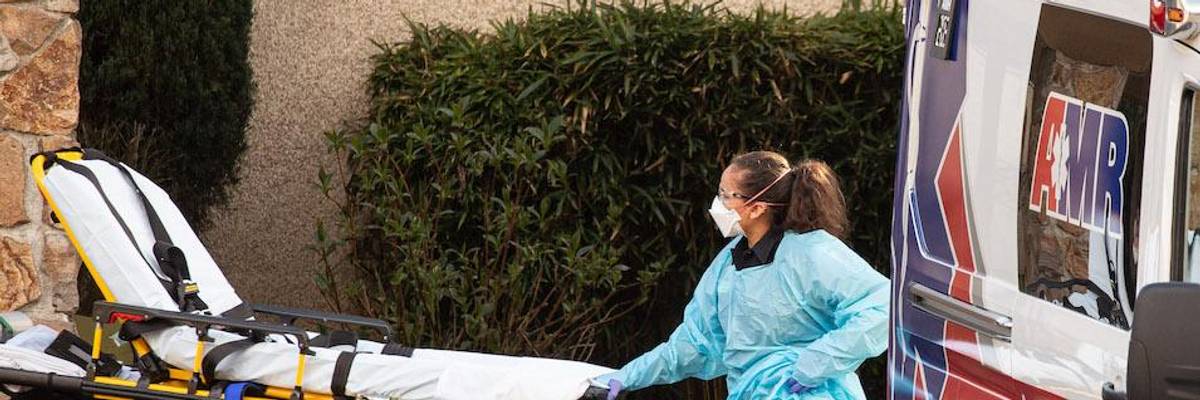
A healthcare worker prepares to transport a patient on a stretcher into an ambulance at Life Care Center of Kirkland on February 29, 2020 in Kirkland, Washington. (Photo: David Ryder/Getty Images)
Reporting from a number of outlets over the weekend indicates that the White House response to the global coronavirus outbreak was aimed more at President Donald Trump's political goals and less at public health, raising questions about what could have been done differently had the administration prioritized healthcare and safety over the president's ego and aims.
In an early morning tweet Monday, Trump claimed that the disease was being handled and blamed Democrats for trying to use the outbreak as a political attack.
"Dems were working the Impeachment Hoax," the president tweeted. "They didn't have a clue! Now they are fear mongering. Be calm & vigilant!"
As Politico reported Monday, the president's assurances are incompatible from the reality on the ground:
Aside from his criticism of Democrats, Trump also wrote online Monday morning that he would be "meeting with the major pharmaceutical companies today at the White House about progress on a vaccine and cure" to the coronavirus. "Progress being made!" he tweeted.
Despite the president's claims that a coronavirus vaccine could be forthcoming, health officials have consistently said that such a medicine is likely many months away from completion.
The Washington Post over the weekend detailed the administration's response to the disease and raised questions on how the White House is dealing with the coronavirus and managing the Centers for Disease Control (CDC) response.
On February 29, the Post detailed how Trump's main concern as the potential for a viral outbreak heightened in the U.S. was that he was being treated unfairly by the media, that health officials offering candid assessments of the threat posed by the disease were making him look bad, and that the panic was affecting the stock market. That led to the president downplaying the danger posed by the disease and encouraging conspiracy theories calling the outbreak a "hoax."
The Post also reported Trump knowingly lied about the disease spread in a press conference in an attempt to soothe markets.
The president has assigned managing the virus to a team of health industry-connected officials who have interests in profiting off of the disease, Sharon Lerner reported for the Intercept Saturday, and over the course of his presidency "shut down the National Security Council's global health security unit and cut $15 billion in national health spending, including funding for the management of infectious global diseases at the CDC, DHS, and HHS."
CNN, on March 1, described how the CDC has failed to share information about recovered patients to doctors around the country--a necessity in handling an outbreak of this magnitude:
The CDC is the federal agency that communicates with physicians about how to handle outbreaks. Whether it's SARS, Ebola or last year's measles outbreak, the agency uses information from cases around the world--and in particular the United States--to advise doctors on how to diagnose, evaluate and treat diseases.
The federal agency possesses such information about several US coronavirus patients, but has not released it. That means doctors who now unexpectedly find themselves treating new coronavirus patients aren't able to benefit from the findings of doctors who preceded them.
The CNN article came hours after an Axios report on the contamination of some coronavirus testing kits from Atlanta that could throw the department's response into doubt.
Citizens for Responsibility and Ethics in Washington (CREW) deputy director Dinald K. Sherman wrote in a Post opinion piece Monday that the president's behavior could have "deadly consequences" for Americans and urged accountability for the administration's response.
"It's no surprise that the president has viewed the emerging coronavirus pandemic through the lens of what would damage or benefit him politically," wrote Sherman.
As the New York Times explained Sunday, Trump's insistence on politicizing the outbreak could have detrimental effects on the public's ability to handle the virus. Vanderbilt University infectious disease specialist Dr. William Schaffner warned that the spread of misinformation about the reasons for health warnings and preventative actions--particularly at the highest levels of government--has the potential to make things worse.
"If the public perceives that issues regarding communicable diseases are influenced by political considerations, they will lose confidence in the information," said Schaffner. "That will be to the detriment of all of us."
Dear Common Dreams reader, It’s been nearly 30 years since I co-founded Common Dreams with my late wife, Lina Newhouser. We had the radical notion that journalism should serve the public good, not corporate profits. It was clear to us from the outset what it would take to build such a project. No paid advertisements. No corporate sponsors. No millionaire publisher telling us what to think or do. Many people said we wouldn't last a year, but we proved those doubters wrong. Together with a tremendous team of journalists and dedicated staff, we built an independent media outlet free from the constraints of profits and corporate control. Our mission has always been simple: To inform. To inspire. To ignite change for the common good. Building Common Dreams was not easy. Our survival was never guaranteed. When you take on the most powerful forces—Wall Street greed, fossil fuel industry destruction, Big Tech lobbyists, and uber-rich oligarchs who have spent billions upon billions rigging the economy and democracy in their favor—the only bulwark you have is supporters who believe in your work. But here’s the urgent message from me today. It's never been this bad out there. And it's never been this hard to keep us going. At the very moment Common Dreams is most needed, the threats we face are intensifying. We need your support now more than ever. We don't accept corporate advertising and never will. We don't have a paywall because we don't think people should be blocked from critical news based on their ability to pay. Everything we do is funded by the donations of readers like you. When everyone does the little they can afford, we are strong. But if that support retreats or dries up, so do we. Will you donate now to make sure Common Dreams not only survives but thrives? —Craig Brown, Co-founder |
Reporting from a number of outlets over the weekend indicates that the White House response to the global coronavirus outbreak was aimed more at President Donald Trump's political goals and less at public health, raising questions about what could have been done differently had the administration prioritized healthcare and safety over the president's ego and aims.
In an early morning tweet Monday, Trump claimed that the disease was being handled and blamed Democrats for trying to use the outbreak as a political attack.
"Dems were working the Impeachment Hoax," the president tweeted. "They didn't have a clue! Now they are fear mongering. Be calm & vigilant!"
As Politico reported Monday, the president's assurances are incompatible from the reality on the ground:
Aside from his criticism of Democrats, Trump also wrote online Monday morning that he would be "meeting with the major pharmaceutical companies today at the White House about progress on a vaccine and cure" to the coronavirus. "Progress being made!" he tweeted.
Despite the president's claims that a coronavirus vaccine could be forthcoming, health officials have consistently said that such a medicine is likely many months away from completion.
The Washington Post over the weekend detailed the administration's response to the disease and raised questions on how the White House is dealing with the coronavirus and managing the Centers for Disease Control (CDC) response.
On February 29, the Post detailed how Trump's main concern as the potential for a viral outbreak heightened in the U.S. was that he was being treated unfairly by the media, that health officials offering candid assessments of the threat posed by the disease were making him look bad, and that the panic was affecting the stock market. That led to the president downplaying the danger posed by the disease and encouraging conspiracy theories calling the outbreak a "hoax."
The Post also reported Trump knowingly lied about the disease spread in a press conference in an attempt to soothe markets.
The president has assigned managing the virus to a team of health industry-connected officials who have interests in profiting off of the disease, Sharon Lerner reported for the Intercept Saturday, and over the course of his presidency "shut down the National Security Council's global health security unit and cut $15 billion in national health spending, including funding for the management of infectious global diseases at the CDC, DHS, and HHS."
CNN, on March 1, described how the CDC has failed to share information about recovered patients to doctors around the country--a necessity in handling an outbreak of this magnitude:
The CDC is the federal agency that communicates with physicians about how to handle outbreaks. Whether it's SARS, Ebola or last year's measles outbreak, the agency uses information from cases around the world--and in particular the United States--to advise doctors on how to diagnose, evaluate and treat diseases.
The federal agency possesses such information about several US coronavirus patients, but has not released it. That means doctors who now unexpectedly find themselves treating new coronavirus patients aren't able to benefit from the findings of doctors who preceded them.
The CNN article came hours after an Axios report on the contamination of some coronavirus testing kits from Atlanta that could throw the department's response into doubt.
Citizens for Responsibility and Ethics in Washington (CREW) deputy director Dinald K. Sherman wrote in a Post opinion piece Monday that the president's behavior could have "deadly consequences" for Americans and urged accountability for the administration's response.
"It's no surprise that the president has viewed the emerging coronavirus pandemic through the lens of what would damage or benefit him politically," wrote Sherman.
As the New York Times explained Sunday, Trump's insistence on politicizing the outbreak could have detrimental effects on the public's ability to handle the virus. Vanderbilt University infectious disease specialist Dr. William Schaffner warned that the spread of misinformation about the reasons for health warnings and preventative actions--particularly at the highest levels of government--has the potential to make things worse.
"If the public perceives that issues regarding communicable diseases are influenced by political considerations, they will lose confidence in the information," said Schaffner. "That will be to the detriment of all of us."
Reporting from a number of outlets over the weekend indicates that the White House response to the global coronavirus outbreak was aimed more at President Donald Trump's political goals and less at public health, raising questions about what could have been done differently had the administration prioritized healthcare and safety over the president's ego and aims.
In an early morning tweet Monday, Trump claimed that the disease was being handled and blamed Democrats for trying to use the outbreak as a political attack.
"Dems were working the Impeachment Hoax," the president tweeted. "They didn't have a clue! Now they are fear mongering. Be calm & vigilant!"
As Politico reported Monday, the president's assurances are incompatible from the reality on the ground:
Aside from his criticism of Democrats, Trump also wrote online Monday morning that he would be "meeting with the major pharmaceutical companies today at the White House about progress on a vaccine and cure" to the coronavirus. "Progress being made!" he tweeted.
Despite the president's claims that a coronavirus vaccine could be forthcoming, health officials have consistently said that such a medicine is likely many months away from completion.
The Washington Post over the weekend detailed the administration's response to the disease and raised questions on how the White House is dealing with the coronavirus and managing the Centers for Disease Control (CDC) response.
On February 29, the Post detailed how Trump's main concern as the potential for a viral outbreak heightened in the U.S. was that he was being treated unfairly by the media, that health officials offering candid assessments of the threat posed by the disease were making him look bad, and that the panic was affecting the stock market. That led to the president downplaying the danger posed by the disease and encouraging conspiracy theories calling the outbreak a "hoax."
The Post also reported Trump knowingly lied about the disease spread in a press conference in an attempt to soothe markets.
The president has assigned managing the virus to a team of health industry-connected officials who have interests in profiting off of the disease, Sharon Lerner reported for the Intercept Saturday, and over the course of his presidency "shut down the National Security Council's global health security unit and cut $15 billion in national health spending, including funding for the management of infectious global diseases at the CDC, DHS, and HHS."
CNN, on March 1, described how the CDC has failed to share information about recovered patients to doctors around the country--a necessity in handling an outbreak of this magnitude:
The CDC is the federal agency that communicates with physicians about how to handle outbreaks. Whether it's SARS, Ebola or last year's measles outbreak, the agency uses information from cases around the world--and in particular the United States--to advise doctors on how to diagnose, evaluate and treat diseases.
The federal agency possesses such information about several US coronavirus patients, but has not released it. That means doctors who now unexpectedly find themselves treating new coronavirus patients aren't able to benefit from the findings of doctors who preceded them.
The CNN article came hours after an Axios report on the contamination of some coronavirus testing kits from Atlanta that could throw the department's response into doubt.
Citizens for Responsibility and Ethics in Washington (CREW) deputy director Dinald K. Sherman wrote in a Post opinion piece Monday that the president's behavior could have "deadly consequences" for Americans and urged accountability for the administration's response.
"It's no surprise that the president has viewed the emerging coronavirus pandemic through the lens of what would damage or benefit him politically," wrote Sherman.
As the New York Times explained Sunday, Trump's insistence on politicizing the outbreak could have detrimental effects on the public's ability to handle the virus. Vanderbilt University infectious disease specialist Dr. William Schaffner warned that the spread of misinformation about the reasons for health warnings and preventative actions--particularly at the highest levels of government--has the potential to make things worse.
"If the public perceives that issues regarding communicable diseases are influenced by political considerations, they will lose confidence in the information," said Schaffner. "That will be to the detriment of all of us."