SUBSCRIBE TO OUR FREE NEWSLETTER
Daily news & progressive opinion—funded by the people, not the corporations—delivered straight to your inbox.
5
#000000
#FFFFFF
To donate by check, phone, or other method, see our More Ways to Give page.
Daily news & progressive opinion—funded by the people, not the corporations—delivered straight to your inbox.
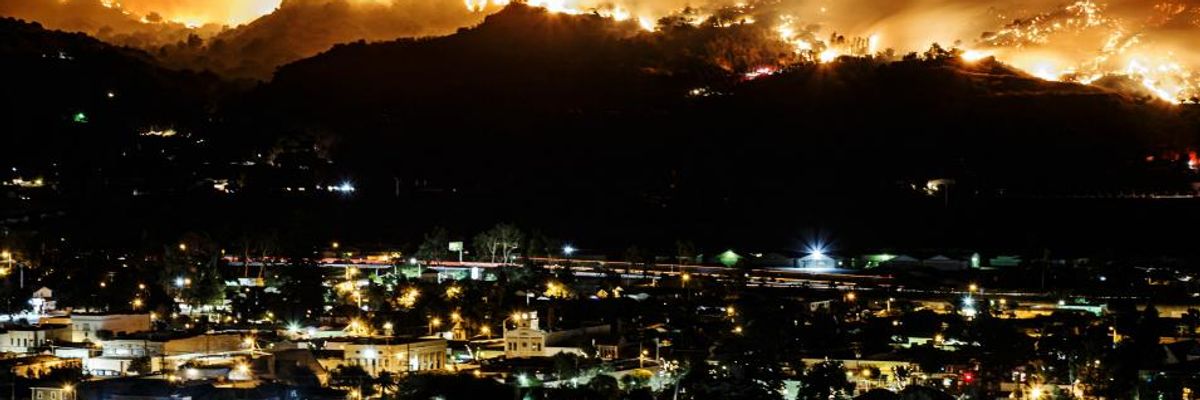
Smoke plume from the Maria Fire rises as seen from Santa Paula, California on Oct. 31, 2019. (Photo: Marcus Yam/Los Angeles Times via Getty Images)
New research published Monday warns that extreme weather driven by the climate crisis could bring about an economic recession "the likes of which we've never seen before" if markets don't do a better job assessing climate risks.
Paul Griffin, an accounting professor at the University of California, Davis Graduate School of Management, wrote in a paper for Nature Energy that financial markets have not sufficiently accounted for the major economic risks posed by the global climate crisis, even as extreme weather--from destructive hurricanes to prolonged drought--wreaks havoc across the globe.
"Unpriced risk was the main cause of the Great Recession in 2007-2008," Griffin wrote. "Right now, energy companies shoulder much of that risk. The market needs to better assess risk, and factor a risk of extreme weather into securities prices... Without better knowledge of this risk, the average energy investor can only hope that the next extreme event will not trigger a sudden correction to the market values of energy firms."
Griffin continued:
This past summer, the United States and Europe experienced record-breaking heat. Now linked reliably to climate change, excessive high temperature is among the deadliest of weather extremes. Not only can it disrupt agriculture, harm human health, and stunt economic growth, it can also overwhelm--and temporarily shut down--large parts of a state's or a nation's energy system, as in the case of the Pacific Gas and Electric Company (PG&E) in California.
Extreme heat events can create uncertain and longer duration power outages, threaten critical infrastructure, exacerbate energy supply and demand imbalances, and trigger significant legal liability for energy firms. Newer reports of an increase in the frequency and severity of extreme weather events, moreover, amplify those risks for energy firms.
Despite these obvious risks, investors and asset managers have been conspicuously slow to connect physical climate risk from extreme weather events to company market valuations.
Griffin is not the first financial expert to raise alarm about the potentially calamitous economic impacts of the climate crisis--which would come in addition to the emergency's incalculable effects on humans, animals, plants, insects, and the planet as a whole.
The Switzerland-based Bank for International Settlements warned in a 115-page report (pdf) last month that the "increase in the frequency and intensity of extreme weather events could trigger non-linear and irreversible financial losses."
"Climate change poses unprecedented challenges to human societies," the report stated, "and our community of central banks and supervisors cannot consider itself immune to the risks ahead of us."
Dear Common Dreams reader, It’s been nearly 30 years since I co-founded Common Dreams with my late wife, Lina Newhouser. We had the radical notion that journalism should serve the public good, not corporate profits. It was clear to us from the outset what it would take to build such a project. No paid advertisements. No corporate sponsors. No millionaire publisher telling us what to think or do. Many people said we wouldn't last a year, but we proved those doubters wrong. Together with a tremendous team of journalists and dedicated staff, we built an independent media outlet free from the constraints of profits and corporate control. Our mission has always been simple: To inform. To inspire. To ignite change for the common good. Building Common Dreams was not easy. Our survival was never guaranteed. When you take on the most powerful forces—Wall Street greed, fossil fuel industry destruction, Big Tech lobbyists, and uber-rich oligarchs who have spent billions upon billions rigging the economy and democracy in their favor—the only bulwark you have is supporters who believe in your work. But here’s the urgent message from me today. It's never been this bad out there. And it's never been this hard to keep us going. At the very moment Common Dreams is most needed, the threats we face are intensifying. We need your support now more than ever. We don't accept corporate advertising and never will. We don't have a paywall because we don't think people should be blocked from critical news based on their ability to pay. Everything we do is funded by the donations of readers like you. When everyone does the little they can afford, we are strong. But if that support retreats or dries up, so do we. Will you donate now to make sure Common Dreams not only survives but thrives? —Craig Brown, Co-founder |
New research published Monday warns that extreme weather driven by the climate crisis could bring about an economic recession "the likes of which we've never seen before" if markets don't do a better job assessing climate risks.
Paul Griffin, an accounting professor at the University of California, Davis Graduate School of Management, wrote in a paper for Nature Energy that financial markets have not sufficiently accounted for the major economic risks posed by the global climate crisis, even as extreme weather--from destructive hurricanes to prolonged drought--wreaks havoc across the globe.
"Unpriced risk was the main cause of the Great Recession in 2007-2008," Griffin wrote. "Right now, energy companies shoulder much of that risk. The market needs to better assess risk, and factor a risk of extreme weather into securities prices... Without better knowledge of this risk, the average energy investor can only hope that the next extreme event will not trigger a sudden correction to the market values of energy firms."
Griffin continued:
This past summer, the United States and Europe experienced record-breaking heat. Now linked reliably to climate change, excessive high temperature is among the deadliest of weather extremes. Not only can it disrupt agriculture, harm human health, and stunt economic growth, it can also overwhelm--and temporarily shut down--large parts of a state's or a nation's energy system, as in the case of the Pacific Gas and Electric Company (PG&E) in California.
Extreme heat events can create uncertain and longer duration power outages, threaten critical infrastructure, exacerbate energy supply and demand imbalances, and trigger significant legal liability for energy firms. Newer reports of an increase in the frequency and severity of extreme weather events, moreover, amplify those risks for energy firms.
Despite these obvious risks, investors and asset managers have been conspicuously slow to connect physical climate risk from extreme weather events to company market valuations.
Griffin is not the first financial expert to raise alarm about the potentially calamitous economic impacts of the climate crisis--which would come in addition to the emergency's incalculable effects on humans, animals, plants, insects, and the planet as a whole.
The Switzerland-based Bank for International Settlements warned in a 115-page report (pdf) last month that the "increase in the frequency and intensity of extreme weather events could trigger non-linear and irreversible financial losses."
"Climate change poses unprecedented challenges to human societies," the report stated, "and our community of central banks and supervisors cannot consider itself immune to the risks ahead of us."
New research published Monday warns that extreme weather driven by the climate crisis could bring about an economic recession "the likes of which we've never seen before" if markets don't do a better job assessing climate risks.
Paul Griffin, an accounting professor at the University of California, Davis Graduate School of Management, wrote in a paper for Nature Energy that financial markets have not sufficiently accounted for the major economic risks posed by the global climate crisis, even as extreme weather--from destructive hurricanes to prolonged drought--wreaks havoc across the globe.
"Unpriced risk was the main cause of the Great Recession in 2007-2008," Griffin wrote. "Right now, energy companies shoulder much of that risk. The market needs to better assess risk, and factor a risk of extreme weather into securities prices... Without better knowledge of this risk, the average energy investor can only hope that the next extreme event will not trigger a sudden correction to the market values of energy firms."
Griffin continued:
This past summer, the United States and Europe experienced record-breaking heat. Now linked reliably to climate change, excessive high temperature is among the deadliest of weather extremes. Not only can it disrupt agriculture, harm human health, and stunt economic growth, it can also overwhelm--and temporarily shut down--large parts of a state's or a nation's energy system, as in the case of the Pacific Gas and Electric Company (PG&E) in California.
Extreme heat events can create uncertain and longer duration power outages, threaten critical infrastructure, exacerbate energy supply and demand imbalances, and trigger significant legal liability for energy firms. Newer reports of an increase in the frequency and severity of extreme weather events, moreover, amplify those risks for energy firms.
Despite these obvious risks, investors and asset managers have been conspicuously slow to connect physical climate risk from extreme weather events to company market valuations.
Griffin is not the first financial expert to raise alarm about the potentially calamitous economic impacts of the climate crisis--which would come in addition to the emergency's incalculable effects on humans, animals, plants, insects, and the planet as a whole.
The Switzerland-based Bank for International Settlements warned in a 115-page report (pdf) last month that the "increase in the frequency and intensity of extreme weather events could trigger non-linear and irreversible financial losses."
"Climate change poses unprecedented challenges to human societies," the report stated, "and our community of central banks and supervisors cannot consider itself immune to the risks ahead of us."