SUBSCRIBE TO OUR FREE NEWSLETTER
Daily news & progressive opinion—funded by the people, not the corporations—delivered straight to your inbox.
5
#000000
#FFFFFF
To donate by check, phone, or other method, see our More Ways to Give page.
Daily news & progressive opinion—funded by the people, not the corporations—delivered straight to your inbox.
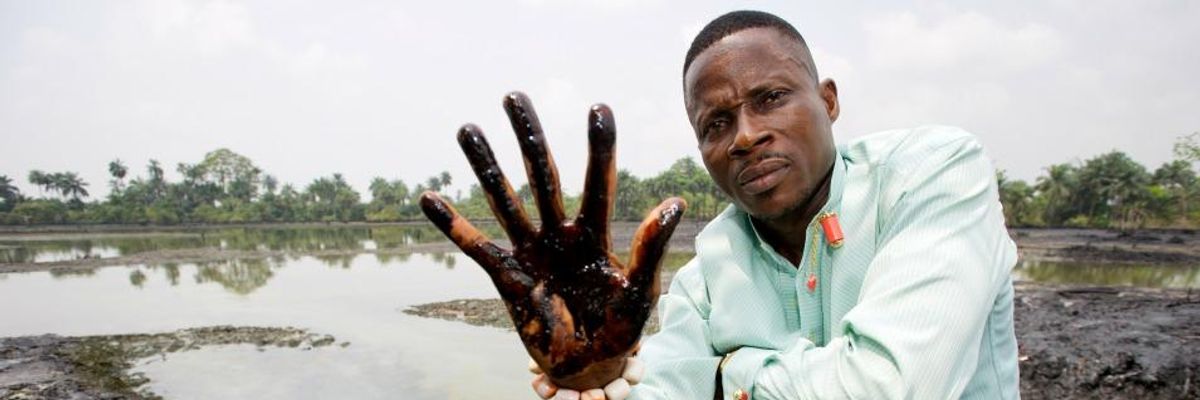
Claimant Eric Dooh shows the crude oil that has damaged the banks of the creek through his village of Goi (Ogoniland). Multiple leaks in a Shell pipeline have heavily contaminated the creek over many miles, eliminating fish, and other life from the tidal area. (Photo: Milieudefensie)
In addition to having a disproportionate impact on marginalized communities around the globe which have contributed the least to climate-warming fossil fuel emissions, the climate crisis has exacerbated the human rights violations already perpetrated by the fossil fuel industry, according to a new report.
The grassroots climate action group 350.org examined ten global communities which have suffered from heavy pollution, deforestation, displacement, and other violations as multinational corporations like Chevron and Shell--in addition to smaller fossil fuel entities and corrupt governments--have placed profits over human rights.
"The pollution and contamination often caused by fossil fuel industry activities mainly affect the poorest populations, as well as the climate crisis," said Aaron Packard, manager of the Climate Defenders program at 350.org, in a statement. "Vulnerable communities are being doubly exposed to losses or scarcity of land, fish stocks and water, for example."
350.org surveyed the region of Ogoniland in Nigeria, where Shell Oil has dumped an estimated nine to 13 million barrels of crude oil into the Niger Delta since 1958.
"Companies are actively disregarding the right of entire populations to a healthy environment, sufficient and quality food, and a political and social scenario of stability."
--Aaron Packard, 350.org
The company's activities in Ogoniland have led to polluted air and water as well as decimated natural habitats, violating the rights of the 832,000 people who live there.
The local government has also worked with Shell to suppress the right of people in Ogoniland to fight against the pollution.
" Protests against widespread and persistent oil pollution have been brutally repressed, with loss of life and a series of other egregious human rights violations," the report reads. "Victims of severe human rights abuses associated with oil extraction in the Niger Delta are still awaiting for remediation of the harm caused to their lands, water, and livelihood, in spite of multiple victories before courts and human rights bodies."
Shell's activities in the Niger Delta are just one example of how the fossil fuel industry has led to an estimated 45,000 premature deaths due to pollution, crop losses resulting from drought and other climate extremes, and other environmental results of the carbon emissions.
The report also points to coal power plants in the Mugla region of Turkey, where companies have done "severe environmental harm" since 1983. Emissions from the plants have been linked to premature deaths from heart disease, respiratory disease, and cancer, while the companies have forced communities to leave the area as they ramp up their operations.
The European Court of Human Rights recognized in 2005 that the communities had a right to bring legal action against the plants, but the companies have not ceased their extraction of coal and the resulting pollution. Governments, 350.org wrote, must pass legislation to rein in the fossil fuel industry.
The recognition by courts of human rights is "no replacement for effective legislation concerning environmental harm," the report states, "and human rights remedies are no replacement for effective preventive and remedial measures against environmental harm caused by fossil fuel companies."
Other cases detailed in the report include threats to water security in Australia and the contamination of rivers and fish stocks in indigenous territories in the Ecuadorian Amazon.
"Even in the face of the clearest scientific evidence that burning fossil fuels is literally setting the planet on fire, this sector continues to invest in the same old model and often misinforms society about the climate crisis and its causes," said Packard. "In doing so, companies are actively disregarding the right of entire populations to a healthy environment, sufficient and quality food, and a political and social scenario of stability."
Dear Common Dreams reader, It’s been nearly 30 years since I co-founded Common Dreams with my late wife, Lina Newhouser. We had the radical notion that journalism should serve the public good, not corporate profits. It was clear to us from the outset what it would take to build such a project. No paid advertisements. No corporate sponsors. No millionaire publisher telling us what to think or do. Many people said we wouldn't last a year, but we proved those doubters wrong. Together with a tremendous team of journalists and dedicated staff, we built an independent media outlet free from the constraints of profits and corporate control. Our mission has always been simple: To inform. To inspire. To ignite change for the common good. Building Common Dreams was not easy. Our survival was never guaranteed. When you take on the most powerful forces—Wall Street greed, fossil fuel industry destruction, Big Tech lobbyists, and uber-rich oligarchs who have spent billions upon billions rigging the economy and democracy in their favor—the only bulwark you have is supporters who believe in your work. But here’s the urgent message from me today. It's never been this bad out there. And it's never been this hard to keep us going. At the very moment Common Dreams is most needed, the threats we face are intensifying. We need your support now more than ever. We don't accept corporate advertising and never will. We don't have a paywall because we don't think people should be blocked from critical news based on their ability to pay. Everything we do is funded by the donations of readers like you. When everyone does the little they can afford, we are strong. But if that support retreats or dries up, so do we. Will you donate now to make sure Common Dreams not only survives but thrives? —Craig Brown, Co-founder |
In addition to having a disproportionate impact on marginalized communities around the globe which have contributed the least to climate-warming fossil fuel emissions, the climate crisis has exacerbated the human rights violations already perpetrated by the fossil fuel industry, according to a new report.
The grassroots climate action group 350.org examined ten global communities which have suffered from heavy pollution, deforestation, displacement, and other violations as multinational corporations like Chevron and Shell--in addition to smaller fossil fuel entities and corrupt governments--have placed profits over human rights.
"The pollution and contamination often caused by fossil fuel industry activities mainly affect the poorest populations, as well as the climate crisis," said Aaron Packard, manager of the Climate Defenders program at 350.org, in a statement. "Vulnerable communities are being doubly exposed to losses or scarcity of land, fish stocks and water, for example."
350.org surveyed the region of Ogoniland in Nigeria, where Shell Oil has dumped an estimated nine to 13 million barrels of crude oil into the Niger Delta since 1958.
"Companies are actively disregarding the right of entire populations to a healthy environment, sufficient and quality food, and a political and social scenario of stability."
--Aaron Packard, 350.org
The company's activities in Ogoniland have led to polluted air and water as well as decimated natural habitats, violating the rights of the 832,000 people who live there.
The local government has also worked with Shell to suppress the right of people in Ogoniland to fight against the pollution.
" Protests against widespread and persistent oil pollution have been brutally repressed, with loss of life and a series of other egregious human rights violations," the report reads. "Victims of severe human rights abuses associated with oil extraction in the Niger Delta are still awaiting for remediation of the harm caused to their lands, water, and livelihood, in spite of multiple victories before courts and human rights bodies."
Shell's activities in the Niger Delta are just one example of how the fossil fuel industry has led to an estimated 45,000 premature deaths due to pollution, crop losses resulting from drought and other climate extremes, and other environmental results of the carbon emissions.
The report also points to coal power plants in the Mugla region of Turkey, where companies have done "severe environmental harm" since 1983. Emissions from the plants have been linked to premature deaths from heart disease, respiratory disease, and cancer, while the companies have forced communities to leave the area as they ramp up their operations.
The European Court of Human Rights recognized in 2005 that the communities had a right to bring legal action against the plants, but the companies have not ceased their extraction of coal and the resulting pollution. Governments, 350.org wrote, must pass legislation to rein in the fossil fuel industry.
The recognition by courts of human rights is "no replacement for effective legislation concerning environmental harm," the report states, "and human rights remedies are no replacement for effective preventive and remedial measures against environmental harm caused by fossil fuel companies."
Other cases detailed in the report include threats to water security in Australia and the contamination of rivers and fish stocks in indigenous territories in the Ecuadorian Amazon.
"Even in the face of the clearest scientific evidence that burning fossil fuels is literally setting the planet on fire, this sector continues to invest in the same old model and often misinforms society about the climate crisis and its causes," said Packard. "In doing so, companies are actively disregarding the right of entire populations to a healthy environment, sufficient and quality food, and a political and social scenario of stability."
In addition to having a disproportionate impact on marginalized communities around the globe which have contributed the least to climate-warming fossil fuel emissions, the climate crisis has exacerbated the human rights violations already perpetrated by the fossil fuel industry, according to a new report.
The grassroots climate action group 350.org examined ten global communities which have suffered from heavy pollution, deforestation, displacement, and other violations as multinational corporations like Chevron and Shell--in addition to smaller fossil fuel entities and corrupt governments--have placed profits over human rights.
"The pollution and contamination often caused by fossil fuel industry activities mainly affect the poorest populations, as well as the climate crisis," said Aaron Packard, manager of the Climate Defenders program at 350.org, in a statement. "Vulnerable communities are being doubly exposed to losses or scarcity of land, fish stocks and water, for example."
350.org surveyed the region of Ogoniland in Nigeria, where Shell Oil has dumped an estimated nine to 13 million barrels of crude oil into the Niger Delta since 1958.
"Companies are actively disregarding the right of entire populations to a healthy environment, sufficient and quality food, and a political and social scenario of stability."
--Aaron Packard, 350.org
The company's activities in Ogoniland have led to polluted air and water as well as decimated natural habitats, violating the rights of the 832,000 people who live there.
The local government has also worked with Shell to suppress the right of people in Ogoniland to fight against the pollution.
" Protests against widespread and persistent oil pollution have been brutally repressed, with loss of life and a series of other egregious human rights violations," the report reads. "Victims of severe human rights abuses associated with oil extraction in the Niger Delta are still awaiting for remediation of the harm caused to their lands, water, and livelihood, in spite of multiple victories before courts and human rights bodies."
Shell's activities in the Niger Delta are just one example of how the fossil fuel industry has led to an estimated 45,000 premature deaths due to pollution, crop losses resulting from drought and other climate extremes, and other environmental results of the carbon emissions.
The report also points to coal power plants in the Mugla region of Turkey, where companies have done "severe environmental harm" since 1983. Emissions from the plants have been linked to premature deaths from heart disease, respiratory disease, and cancer, while the companies have forced communities to leave the area as they ramp up their operations.
The European Court of Human Rights recognized in 2005 that the communities had a right to bring legal action against the plants, but the companies have not ceased their extraction of coal and the resulting pollution. Governments, 350.org wrote, must pass legislation to rein in the fossil fuel industry.
The recognition by courts of human rights is "no replacement for effective legislation concerning environmental harm," the report states, "and human rights remedies are no replacement for effective preventive and remedial measures against environmental harm caused by fossil fuel companies."
Other cases detailed in the report include threats to water security in Australia and the contamination of rivers and fish stocks in indigenous territories in the Ecuadorian Amazon.
"Even in the face of the clearest scientific evidence that burning fossil fuels is literally setting the planet on fire, this sector continues to invest in the same old model and often misinforms society about the climate crisis and its causes," said Packard. "In doing so, companies are actively disregarding the right of entire populations to a healthy environment, sufficient and quality food, and a political and social scenario of stability."